We learned through confirmation from the tour operator Azemar (with whom we travelled) that the Dickwella, our hotel in the far south of Sri Lanka, was completely swept away by the tsunami and the seaquake that devastated Asia that late December 2004. It is currently being rebuilt, but the village suffered very serious damage and many people died. I therefore invite you to read the story with the utmost attention, to reflect and not forget the wonderful people who populate Sri Lanka and who were so harshly hit by the tsunami. I no longer even know whether those boys and those dear children I talk about and whom I met are still all alive... I have set up a forum on my site to deal specifically with Dickwella and its surroundings:
Day 121 Oct 2003
The trip
We are at Elmas, it is just past three in the afternoon. The new Cagliari airport, recently enlarged, is completely unrecognizable. Now at last it takes on a more international appearance! We have little to wait: a quick check-in and the flight is on time at 16:10 to Milan Malpensa. We arrive after a little over an hour. We calmly take care of the formalities and baggage claim; after all, we have a lot to wait for. The agency kindly called yesterday to inform us of a good hour and a half delay for the Milan Malpensa - Colombo flight. Instead of leaving at 23:00 we have to wait until past midnight. We take a good reconnaissance tour of the whole airport and choose a quiet little spot to wait. Stefania buys some newspapers, more or less cultural, and starts reading. Out of boredom, I shoot a few clips with the video camera to document this long wait.
At least there is the enthusiasm of the trip, we know it is worth it and that the return will be much worse, since we have to spend the entire night dumped somewhere in the airport! We repeatedly check the departures monitor: finally our flight appears. We reach the groups area looking for our tour operator Azemar. We are given all the travel documentation, the itinerary, the vouchers for the resorts and the airline tickets. They even give us a backpack, not exactly beautiful with those light-blue and brown colors and the Azemar logo, and a shoulder bag in the same style. We put all the documentation in the shoulder bag but we really don't know what to do with the backpack! It catches us unprepared, we already have ours, so we find a way to stuff it into Stefania's suitcase as best we can.
We go to check in, get rid of our baggage (two suitcases plus a duffel bag for the snorkeling gear), and wait impatiently for the last minutes before the flight. Takeoff comes at one in the morning, just in time to attempt a troubled sleep on the plane. The Eurofly flight is however all in all comfortable, certainly more than the small seats of China Airlines that we took to go to Thailand last year. Needless to say, nothing can be seen from the window, it is pitch dark, so there is nothing left but to console ourselves with the seat monitor to see if there is any interesting film and to scan the plane's position as it slowly starts tracing the white line of the route on the map and grinding out those over 4000 miles that separate us from Sri Lanka. Finally the lights are turned off and we can rest by reclining the seats.
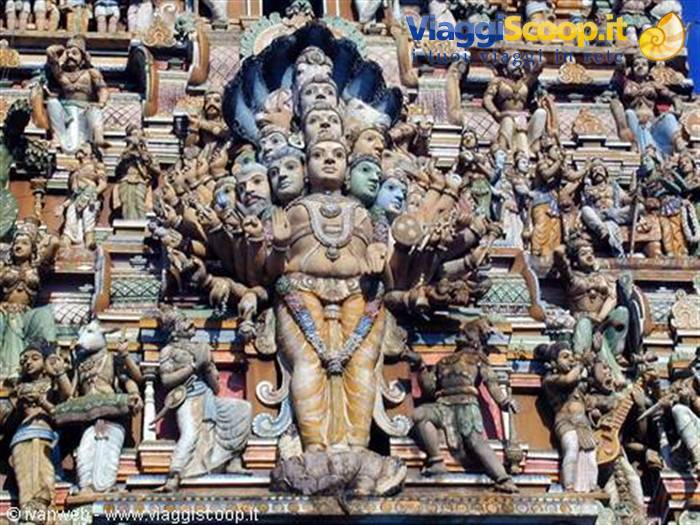
Hindu temple in Colombo
Day 222 Oct 2003
Colombo. City tour. Visit to Hindu and Buddhist temples. Stay at the "Trans Asia" Hotel
Hard to say what time it is, the airplane windows are still closed and we are in the middle of the Indian Ocean at the junction of some time zone. The staff serves us breakfast and I wait dozing for arrival in Colombo. We finally open the windows. Only sea can still be seen but the map shows that the plane is arriving at its destination. The descent toward the capital of Sri Lanka begins. The landing takes place at 14:30 local time, so, minus the five hours of time difference, that becomes almost nine hours of flight from Milan. The Colombo airport appears spartan and essential. We quickly collect our baggage and change 50 euros at the counter to cover initial expenses. The rate appears good at 107.59 for a total of 5379.5 rupees. Much higher than the one cited in the Lonely Planet, by now dating back a few years.
We thus find ourselves at the exit, where our group of Italians from Azemar gathers under the sole guidance of Gianfranco, a guy in his thirties. All together we now know who our travel companions are: a couple of young people like us, Luca and Marzia, a couple of older folks, Ambrogio and Gabriella, two girls, Doriana and Patrizia, and then another lady, Franca, and another guy, Mauro. Ten in all, from different parts of Italy and of different ages. We wait for Gianfranco as he takes care of some errands and formalities, to finally head to our bus. Two guys, among the many in line who are waiting for nothing else, as is the custom around here, carry the suitcases to our spot for a hundred meters and we immediately spend our first 50 rupees as a tip. It is quite hot and the sun is beating down.
We get on our bus, entirely similar to our Italian ones, which turns out to be practically empty since there are only ten of us! During the first stretch, Gianfranco takes the opportunity to introduce himself and explain some things about local uses, customs and traditions. First of all: don't be frightened by the terrible driving of the Sinhalese, who overtake and squeeze in from all sides without apparent reason, not sparing cutting across the road outright and honking their horns nonstop. We realize this immediately in the first kilometers...
At this point, since the flight is late, we find ourselves having to hazard no small choice: instead of going straight to the hotel as initially planned by the program, and then doing the city tour included in the package, Gianfranco proposes opting first for the tour, since it is already half past three in the afternoon and at six o'clock sharp it gets dark. After a whole day of traveling, especially for us who from Cagliari had to wait so many hours in Milan, it feels a bit grueling, but we nevertheless unanimously decide not to miss the chance to see Colombo. The dream of a nice shower, a hearty rest and a decent meal is only postponed: after all, we are on vacation and we must be super active! After an hour of travel we pass in front of our hotel.
Hard to say how many kilometers we have covered from the airport, but it is certainly accurate to state that the city of Colombo appears endless amid a continuous succession of houses, shops, vehicles of every kind (from carts to tuk-tuks, to ramshackle buses to compact cars, with luxury cars quite rare). I expected it to be much smaller and more contained, but it is probably very spread out due to the lack of tall buildings. For the rest, the panorama is the typical one of Eastern countries: many small markets, colorful stalls, frenzied traffic. Our first stop is a Hindu temple. As soon as we get off the bus the impact is really not the best, I must say much harsher and cruder than what you feel walking the streets of Bangkok.
Alongside the decaying hovels are corners of total garbage dump, where stray cats and dogs, almost all with evident signs of disease and in precarious conditions, look for something to eat. Fortunately there are no people too. All this in just a hundred meters of road separating us from the temple. Let's hope the rest of the city is not all like this! We observe stunned the facade of the temple, rich in statues and sculptures that protrude from all sides creating superb and colorful plays of depth. Immediately some beggars lying in wait begin to approach our group, in a clear begging attitude. A few cents of a euro for these people is money that has value. Gianfranco explained on the bus that their average monthly salary varies between twenty and fifty dollars for those who are luckier.
Giving a hundred rupees as a tip, which is more or less equal to one euro, means gifting an entire day of hard work to a Sinhalese. It is also true that begging is never nice, just as it is not nice to see these poor people with suffering and drawn faces, often bare-chested and barefoot, all around you waiting to receive something. We leave our shoes at the entrance and enter the temple. The visitable part is not very large, you just walk around a few large rooms. The frescoes and the interior in general are a bit neglected, but in better times it must truly have been beautiful and shining. An elderly man follows us and improvises a few words in English to act as a sort of guide. Needless to say, at the exit he asks for a tip, which Gianfranco informs us is in any case not obligatory at all.
While I pick up my shoes I leave twenty rupees to the man, who does not seem very happy or satisfied and keeps asking with an attitude that almost irritates me. We return to the bus and continue to another temple, this time Buddhist, that of Gangaramaya. The entrance is paid and costs 100 rupees per person. Well, at least this way things are made clear right away: you pay and no tip! The entrance is bizarre, with many trinkets, statuettes and gifts scattered everywhere. Inside it looks like a sort of museum, with objects and relics of every kind, some very colorful and quite bizarre. The ancient merges with the modern without middle ground. We go outside into an inner courtyard, in front of hundreds of statues arranged in an organized and equidistant way that create a beautiful visual effect.
To the side a perfectly preserved vintage car makes the idea of the bizarre museum even stronger. Another room of objects and we emerge into another courtyard with a gigantic Bodhi tree. After some explanations by Gianfranco in Italian and by the temple guide in English, we finally return to the bus. Our next destination is a big souvenir shop, where Gianfranco advises to look around to start getting a sense of the prices.
On the way, before arriving, we can quickly observe from the windows some typical monuments of Colombo, such as the temple on the lake, the Trade Center, even the original City Hall built as an identical copy of the White House! We thus arrive at our shop, divided into three floors, each full of numerous objects and souvenirs of every kind: wooden statuettes, typical masks, fabric and batik, clothes, sarongs, paintings, handicraft products, spices, postcards, truly everything. Although Ste and I had promised before entering not to spend anything, since this is only the first shop we visit, we cannot help but be struck by countless little things that would really be tempting to bring home. So our final choice falls on a very cute and truly original-for-us little elephant, carved from a coconut, complete with trunk and features painted in black.
Wonderful! Its cost is 360 rupees (3.5 euros).
due to space reasons the story continues on:
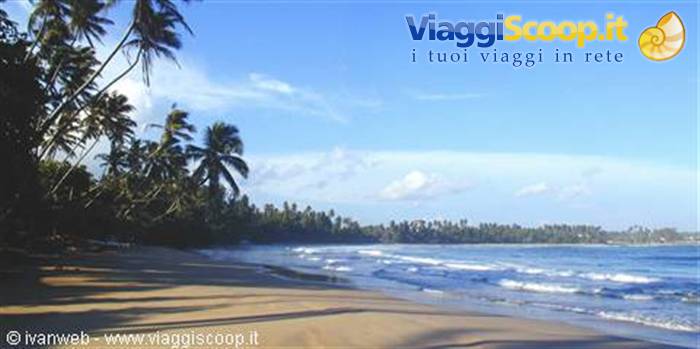
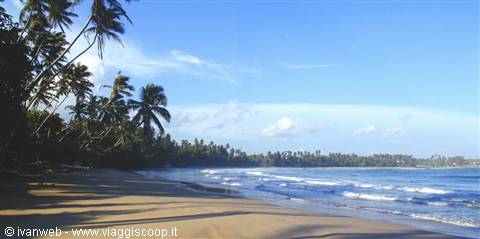
Beach at Dickwella
Day 323 Oct 2003
Visit to a sea turtle center. Arrival at Dickwella village.
At 7:30 we all meet at the entrance. The bus arrives and we leave. The first two and a half hours of travel are all in the built-up area, a continuous flow of low houses and stalls, people going to work, school groups, groups of people in who knows what local demonstrations that in our eyes appear, to say the least, folkloric. I no longer understand whether we are still in Colombo, in the outskirts, or who knows where. Finally the ocean can be seen, with increasingly frequent glimpses. We are following the coast exactly, through repetitive and flat landscapes, but in some points also very beautiful and evocative. The dwellings thin out leaving room for lush green vegetation of tall palms, while the overtakes, for us reckless and senseless, repeat constantly on a road with barely two lanes, narrow and certainly not in perfect condition.
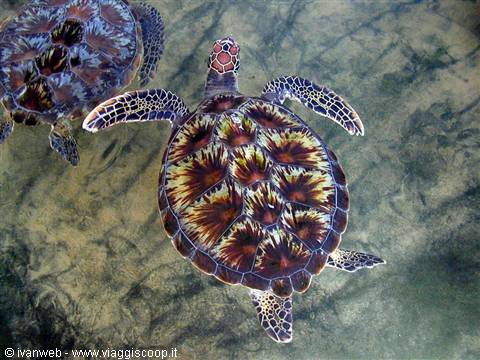
Done by a bus they then appear even more inappropriate, but that is how driving is in Sri Lanka! All in all, however, no high speed is reached, and you practically never stop due to the absence of traffic lights or jams. A constant speed of about 40-50 kilometers per hour is maintained: everything slower is overtaken, including vehicles, trucks, other buses, whether on a straight or a curve. Obviously the same applies to those going faster than us, who do not spare themselves from overtaking our bus amid continuous honking and sudden swerves to get back into lane. We stop along the way at a turtle center, to observe the growth and breeding of these wonderful century-old animals. The entrance ticket costs 100 rupees (1 euro). From a piece of land, protected by a fence, wooden sticks emerge: here the turtle eggs are laid, the guide explains to us.
Further on, instead, a tank contains hundreds of tiny newly hatched specimens taking their first swims. We pick one up to stroke it, it is beautiful! In other tanks there are the larger ones, which show a stunning shell that seems drawn by the hand of a great artist. They let themselves be stroked calmly without pulling back their heads, they are used to human presence. We are right in front of a beautiful, very long ocean beach, with golden sand and patches of beautiful bright green lawn topped by tall coconut palms. We will soon discover that this is the typical Sinhalese coastal landscape. Having left the center, we continue the journey stopping only once more for the so-called "toilet" break, which is after all obligatory after hours and hours on the bus... It is a sort of market selling snacks and drinks of various kinds.
While waiting I look around at the road: we are truly in another world, which does not resemble the Western one at all! We pass Galle, an important coastal city in the South from a commercial point of view for its position, historic for the Portuguese fort, and cultural for the characteristic fishermen. We see some of them at sea, fishing, perched on that singular stilt of theirs that has made them so famous. We also pass Matara and, having passed the southernmost point of Sri Lanka, we finally arrive after a few kilometers at Dickwella, a modest and small village of fishermen and artisans. Our hotel, which takes its name from the same village, is on the main road. We enter at 14:30: seven hours have passed since our departure! The first impact is not bad at all and although I had seen the wonderful panoramic photos from the Internet, I am still surprised by the beauty of this place.
We are welcomed with a cheerful ritual ceremony which consists, amid the sounds of drums and strange wind instruments, of lighting a candle and making a wish. The women go first and then the men. We drink a refreshing drink and are escorted to our room, no. 37, which is welcoming, very spacious, with a window and also an exit on the opposite side toward the green lawn that overlooks the beach. The furnishings are all in wood, the sheets are decorated with colorful petals, and a large painted sun shines smiling above our bed. What can I say, we are happy and excited, as a start it is just fine! I look out the window and spot two deck chairs for sunbathing and a clothes rack for hanging clothes, then in the distance a boy waves to me and tells me to come to him. But there is no time to explore now, we don't open the suitcases yet and go out right away to have lunch since it is past 15:00.
We walk along the picturesque covered walkway, also all in wood, that from the reception leads to our room and the others and further on to the center of the village, where there is a nice pool, two very tall palms and an open-air hall where meals are held when the weather is nice, as in this case. Cheerful and colorful depictions of peacocks and elephants on the walls, with such a sense of depth as to make them almost appear sculptural, make everything very pleasing to the eye. Once again we find the whole group already at the table: but these people are lightning fast! We go to immediately check that the menu suits our taste. The dishes are not very numerous but there is our dear and beloved wood-fired oven with a cook ready to prepare inviting pizzas.
Why refuse such an enticing offer? During lunch Gianfranco talks a bit about how the village is organized, what we can do, the times to respect and so on. He suggests that it is always better, as in all hotels, not to leave cash lying around in the room, but not to worry at all about other things, even valuable ones, since a theft report around here is considered very serious and would be the ruin of the employee who holds his job and his dignity dear. He then explains that the tours are all half-day and take place during the afternoon. In this regard we can choose among several alternatives and we immediately establish, to begin with, the days on which we want to do the two trips included in the package, the one to Matara and the one to the Mulkirigala temple. We thus return to the room, rest for a few minutes and go out for a walk on the beach by ourselves, before sunset.
The place is truly beautiful: the golden beach fades away on the left to the horizon together with the very tall palms that line it, which at times reach all the way to the perpetually rough ocean. On the right, instead, the rocks mark the tip of Dickwella, where the waves crash with a roar causing high sprays of water. On the shore as at sea we notice some boats of local fishermen, with a strange shape and construction. The spot on the boat is small, at most for two or three people, long and narrow, all on one side. We return to the center of the village, behind the pool, where a white wall marks the boundary of the Dickwella toward the other beach where the sun sets. Here the arc of beach is smaller and more sheltered, which does not change the fact that the ocean is still always rough and indeed, on the horizon, quite evocative with powerful waves crashing on the rocks.
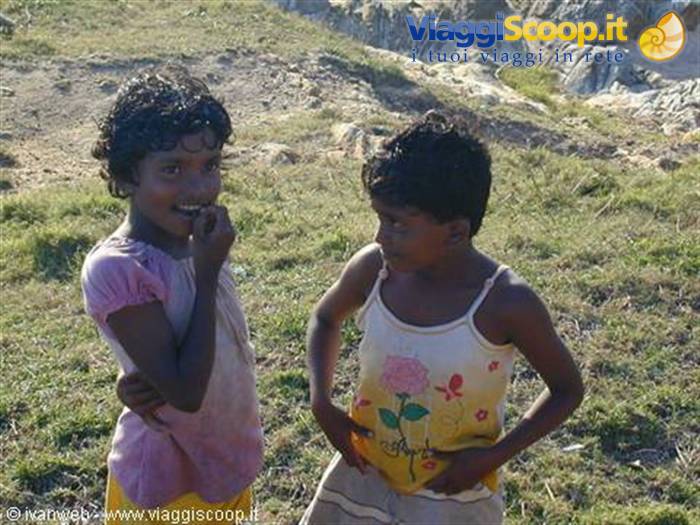
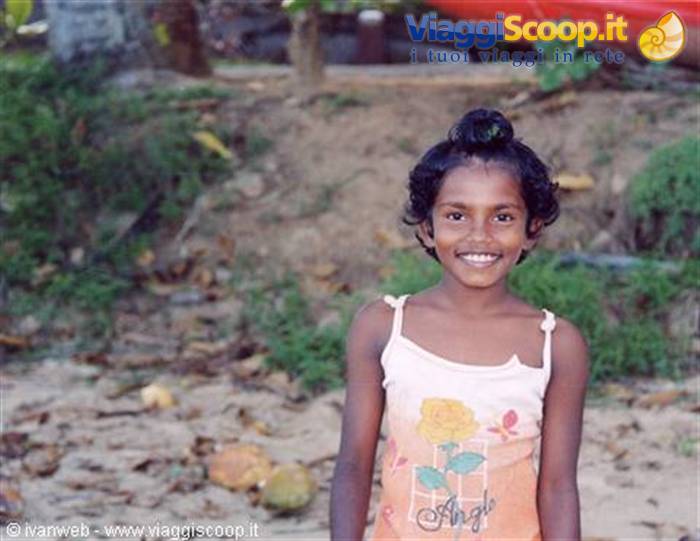
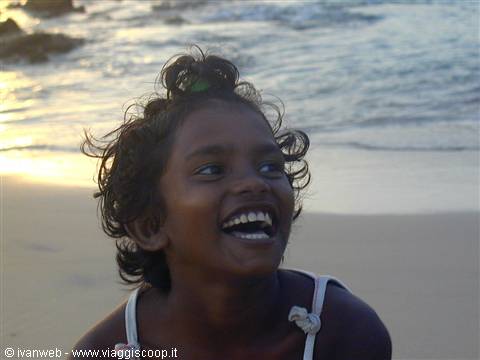
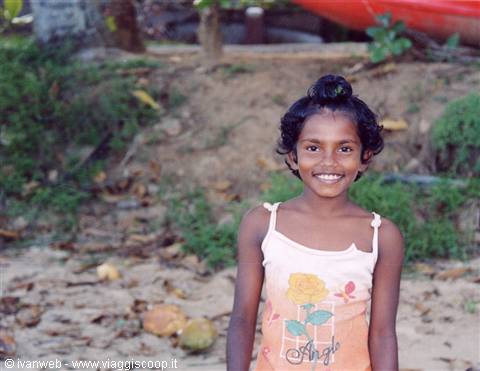
Here you see many more fishermen at work, while at the gate that opens onto the golden beach we are captured by the local children, who start speaking in Italian, surprising us quite a bit. There are three of them, one boy and two little girls, but the smartest is the girl who bears the name of Nilani. The children are very likeable and, between a few words in Italian and various gestures, we manage to find out their names, how old they are, where they live and what they do. At six o'clock sharp the sun sets, giving us a splendid and brief spectacle of an intense red color, which we do not fail to document with many photographs and video clips. Nothing left to do but return to the room and wait for dinner.
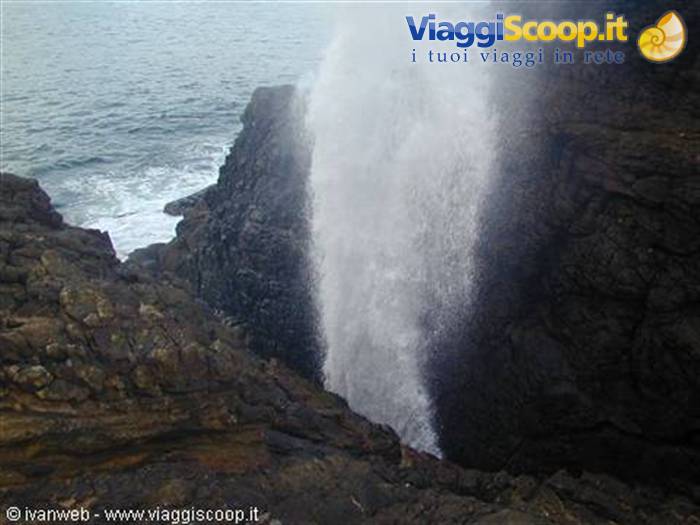
the Blow Hole, ocean blowhole
Day 424 Oct 2003
Tour to Mawella to see the "Blow Hole", the ocean's blowhole.
We return to the room and at 9:30 we see some of our group passing by. We join them and start the long walk toward the arc of golden beach, which starts from the Dickwella and stretches for a good three kilometers to the horizon. Some of the hotel boys come with us, and three others from the area, the so-called "Beach Boys". We remain a bit taken aback by the immediate squabble that arises between the latter and Gianna, with various accusations at times even heavy for various events that happened a few days ago. We try, as far as possible, to keep the discussion out of our sphere and not spoil the splendid landscape that surrounds us. The beach is at times wide and at times almost disappears under the very tall palms and the dense vegetation behind, forcing us to walk pleasantly in the warm water, almost at body temperature.
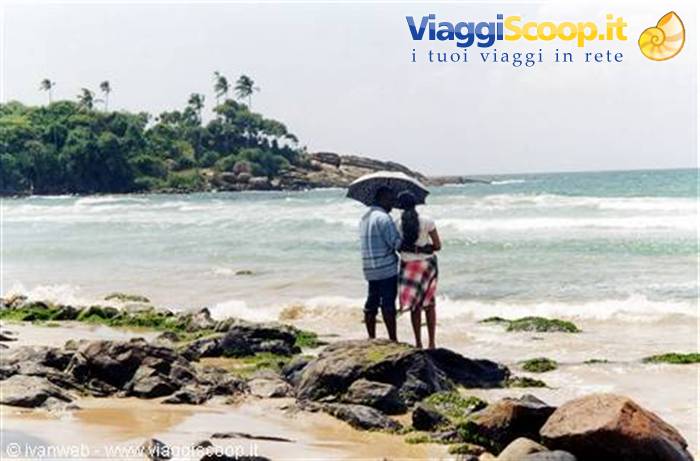
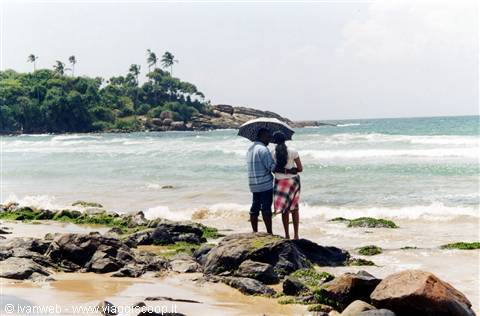
There is a lot of wind and the ocean is rough, so we are not inspired to swim even though the bottom is very shallow and would not pose any danger. The sun unfortunately is for most of the time covered by clouds, but at times, when it comes out, it gives the sea splendid colors with tones ranging from emerald green to the most intense blue. Not a single tourist can be seen on the whole beach to the horizon! There is only us and a few rare local Sinhalese going fishing, bathing their dog or taking a romantic walk with a parasol. The first animals we meet are some little dogs, many puppies and others a bit older, that live freely on the beach. They are obviously strays, and they must not have an easy life since they show evident signs of disease. Better not to stroke them for the moment, even though the poor things seem harmless.
Then we come across a couple of cows standing still, who knows, maybe sunbathing. I had never happened to see them in the middle of a beach before! Meanwhile the squabbles continue and the Beach Boys assiduously try to talk to us too, asserting their good faith and the fact that they are not swindlers. A somewhat difficult situation on which we do not feel like giving either judgment or criticism, since we have just arrived and do not know the rules of these places! In doubt we still try to avoid them and not give them any confidence. We are however struck by the fact that they too speak good Italian, with a decent knowledge of grammar and a broad vocabulary. The next appointment with the local fauna is the capped macaque, a very common monkey in Sri Lanka.
There are two of them to be exact, tied to a rope on a tree branch: one is drinking from a sort of baby bottle and the other watches us indifferently. We ask one of the Beach Boys beside us why they are tied, since it is evident that the first idea that flashes to us is that they are put there on purpose for tourists. He replies that this is not the case, they are there for other reasons and will soon be released as before. It is not entirely convincing, but we give him credit, he might also be right. We stay a bit behind the group, slowed down by the numerous photos and videos that are a must. We reach them after a while, stopped to admire an enormous hedgehog, quite different from ours, with very long black quills. We are also shown how a very strong rope is made with the fuzz from the coconut shell, of which nothing is wasted.
We pass some boats and fishermen's huts and arrive at the end of the beach, admiring the whole gulf to the horizon, on the opposite side, where the picturesque architecture of the Dickwella can be clearly seen. Franca is the only brave one to swim despite the wind, while the rest of the group, including us, is content to chat and look at the beautiful panorama. We head back, but not before observing a beautiful sea eagle soaring over the ocean in search of its daily prey. The rest of the group goes ahead while Ste and I linger for several minutes entranced by this magnificent specimen, which I manage to film well (and above all to see!) with my digital video camera, which with a 20x zoom is practically usable as binoculars too! This time we fall really far behind and only the two Beach Boys stay with us, two guys just over twenty named Gian and Upal.
Their knowledge of Italian is surprising and so, even if at first with a bit of diffidence and reluctance, we start a long in-depth conversation about their uses and customs. They explain that they are fishermen, but outside fishing hours they try to earn something extra with the Dickwella customers. They are neither procurers nor sellers, they simply act as companions, but they are able to procure, on request, almost anything. Their way of life is very essential, they have the basic necessities and the state helps them, distributing rice, school clothes for the children and so on. They explain this to us as we pass in front of a square behind the beach, where a crowd of people waits in lines listening to a voice on a megaphone. In the same place tomorrow the market will be held. Unfortunately it's the same the world over and here too politics plays a two-faced role.
The aid especially arrives in election periods, heavily involving women and children who generally stay more at home, while the men know well that once the elections are over everything will go back to how it was before. We respond appropriately with what happens in Italy, we too have our problems, even if at a different level. At three in the afternoon sharp we reach the reception together with the whole group. We wait for the minibus with Gianfranco for the tour to Mawella, which was offered to us at the cheap price of ten euros per person. The driver makes us wait, and after half an hour of delay we finally leave. The first destination is Flavio's house, an Italian (Gianfranco explains to us) who has invested here in Sri Lanka buying himself a magnificent plot with a breathtaking view and has built a house with a pool that is nothing short of enviable.
To get there we drive along a narrow dirt road that is very evocative, full of potholes and overlooking the coast. We are truly struck by the panorama once we enter Flavio's property. The estate stands on a green hill with tall palms, with a view over the ocean and over a small island connected to the mainland by a sandy isthmus that seems, during high tide, to even disappear. The sea is very rough on the right side of the isthmus and calmer on the left. It is here that we will do some snorkeling. We continue to Mawella, another village that has become touristy because of the so-called "Blow Hole", the ocean's blowhole, a rare phenomenon known in only twelve places on the planet, of which this is the second most important.
So says the Lonely Planet and we believe it so we can boast about it! All it is is a high and powerful spray of the ocean, which forcefully bursts out from a crack in the rocks (an actual hole) with the strong pressure that is created depending on the waves and the ocean current. It seems that in the best periods it can reach 25 meters in height, which is really a lot!
due to space reasons, the story continues on
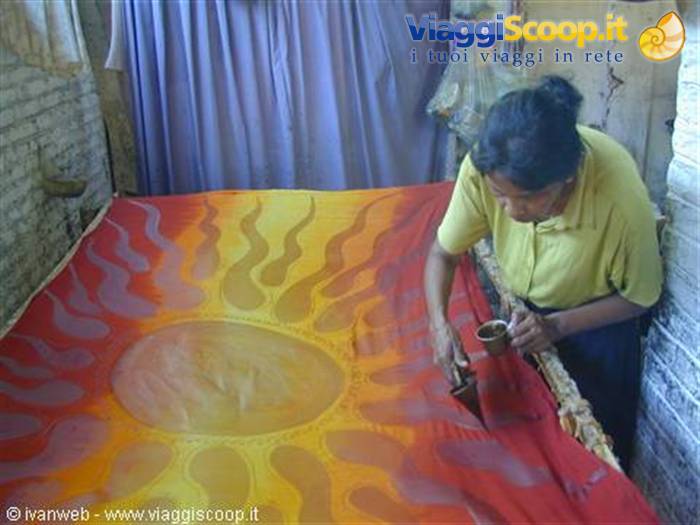
Handmade batik
Day 525 Oct 2003
Wewurukannala Vihara Buddhist temple. Tour: Weligama (gems), Matara (batik)
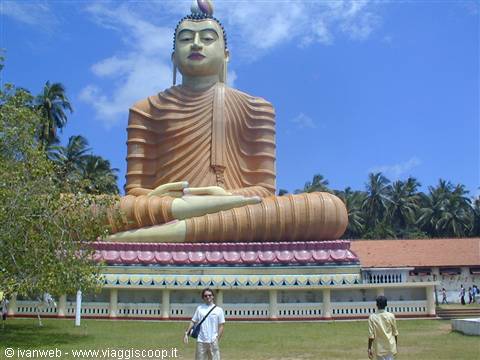
The temple is called Wewurukannala Vihara, and has mixed influences between Buddhism and Hinduism, which here seem to coexist and merge in sincere harmony. The ticket costs a trifling amount to enter, a bit more for those with a camera and video camera, but Gian and Upal charge us a flat rate for just the entrance. Obviously you have to take off your shoes. Only Ste and I enter the Buddhist part, remaining very struck by the peace and atmosphere of the place. Our improvised companions explain the meaning of various statues: reincarnation for example, represented in a row of over 50 buddhas one behind the other, or the difference between the position of the dead buddha and the sleeping one, which is perceived only by the alignment or not of the toes. We leave this first part of the temple and enter a side section, the one dedicated to hell.
I remain a bit bewildered, I really did not think that the concept of hell also existed for Buddhists, unless it is a Hindu influence. Religions are not my strong point! The Lonely Planet cites this part as a sort of cartoonish Disneyland and indeed it is not far from reality. At the entrance a series of terrifying but also somewhat funny statues in their execution, represent an atrocious torture of a man upside down while being sawed in two, starting from the lower parts (ouch how it hurts, come on!) and of the devil complete with horns. From here on a series of corridors follow, all meticulously painted on both walls, where in the upper part there are the misdeeds committed in earthly life, and in the lower part the corresponding infernal tortures.
A sort of gigantic Dante's hell with a few hundred circles! Unfortunately it is very dark and you cannot film well, while you can clearly see that the paintings are a bit left to the wear of time without any protection and maintenance, as in fact practically everything around here, and it is a great shame! Once this singular and very interesting visit is also over, we climb the stairs into the vast open-air space that continues toward the gigantic and colorful statue of the Buddha, and enter at its base. A long series of steps, broken at stages by several large rooms with walls also painted, climb toward the top. We arrive at a first panoramic terrace right behind the head of the statue and climb the last flight of stairs.
The view is stunning and worth the effort! We observe for several minutes the structure of the temple, the people tiny tiny below us, and the whole dense forest of palms to the horizon. You can even see very well the whole road we took to come here and the lotus flower field. Gian points to some trees in the distance explaining that there are lots of bats there and he can take us to see them. Interesting! But now there is no more time, so we promise him we will go tomorrow. We have to get back quickly to the Dickwella for lunch and to speed things up we take a tuk-tuk. The driver asks just 50 rupees (0.50 euros) for this trip and we don't think twice. Getting four people plus the driver into this small three-wheeled vehicle is an undertaking as fun as it is reckless! We thus experience this vehicle for the first time in Sri Lanka, completely identical to the Thai one of the same name.
We also experience, less pleasantly, the potholes of the road! After lunch the appointment is at 14:30 at the reception for the tour to Matara, which is included in our travel package. This time the minibus is on time and two even arrive to be more comfortable. The first stop is at Weligama: about three quarters of an hour of travel characterized by continuous overtakes and sporty driving by our driver who seems to be racing with his rival, who left earlier. The bets are made, amid the funny jokes of Mauro, Luca and Marzia together with us in the same minibus: who will arrive first? Having overtaken our companions in the Mercedes at the last moment it seems now a done deal, but our driver messes up at the last moment by taking the wrong alley once we arrive in Weligama! Once back on the road we are therefore last: bet lost.
Gianfranco accompanies us inside a house, which is in reality a true artisanal gem factory. We are offered something to drink in a salon, after which we begin the visit in the workshop behind, where we witness the actual processing of the stones. Several people skillfully handle precise tools and patiently, one by one, produce the gems step by step in a mini assembly line. The final product is then brought to a nicer and more refined salon, where the negotiations and sales take place. We linger to admire here these small and precious objects displayed in protected showcases, while someone from the group tries to negotiate and even conclude some purchases. We get back on the minibus moving toward Matara, a few kilometers away. Here we enter another artisanal house-workshop, this time of batik.
In a small open-air courtyard we find some women working the fabric, also them with an enviable patience and precision, covering with wax the part of a certain color of the design, which then has to be soaked and dried, removing the wax and putting it back on the part of the design that has another color. It is an incredible job, I would never have thought that all this could be behind those paintings and fabric sarongs hanging on the wall! Some are beautiful even though they are still waxed and therefore not finished. It is evident, as we are told, that the more expensive batiks are those that have more colors, because each additional color involves a further "pass" in the processing cycle. And again, crucially, a true batik is only the one that has the same design mirrored when turning the fabric from one side to the other.
If it is not so, it is "only" worked fabric, but not original batik. How many things you learn! The final product is displayed in a special room where the sale takes place amid the most heated negotiations. We see something nice but the crowd and the price, around twenty-five euros, make us desist from the purchase for the moment.
due to space reasons, the story continues on
Fishermen at sunset
Day 626 Oct 2003
Bats. Handicraft woodworking. Ayurveda massage. Visit to a local home. Local dances
We have an appointment with Gian and Upal on the beach to go see the bats. The tuk-tuk is improvised as a veritable jeep! We stop at the edge of the dense forest, near a rural house, a little better than a shack. A child comes out of the door and looks at us curiously, shyly. Gian signals to look at the tops of the trees, which are at least twenty meters tall, where dozens of bats can be seen sleeping head down hanging from the branches. We remain open-mouthed, but the best is yet to come. The driver also arrives, talks a bit with Gian and he tells us that now they are going to set off some sort of firecracker to make them fly. Their faces light up like those of two children about to pull a prank, but Ste and I do not agree to setting off those things, out of respect for those poor dozing animals.
In reality, they explain, they are not dangerous firecrackers and they don't even make noise. They are harmless smoke bombs that wake them up for a few minutes and then everything goes back to how it was before. They launch into their undertaking and disappear behind the trees of the forest. We hear a murmur in the distance and see the smoke, while at the same time hundreds of enormous bats begin to fly and screech above our heads circling around! We remain open-mouthed, there are an incalculable quantity of them, many more than those visible to the naked eye! Fortunately they fly up there at high altitude and do not come close. For us it was a great emotion! The driver makes a funny U-turn between the lawn and the very small path, after which we climb back in and put up once again with the chasms of the ground.
We pass back in front of the Dickwella and Gian asks us if we want to go see a house where wooden statuettes are crafted. But sure, why not, we are here now! We also pick up Upal since we are going in the opposite direction from the center of town and there are no checks. After a few minutes we arrive in front of another typical local dwelling. This one is much more welcoming than the one seen before, but still very modest. We enter the living room where we greet a child. There is a television and the furnishings are not bad. Behind is the workshop, let's call it that, of the owner who is currently out. I am surprised at how here everyone is a family, you enter other people's houses so easily without any kind of worry.
It appears evident that the artisan is currently out and so Gian and Upal take it upon themselves to show us how the tools of the trade work! They take hammer and chisel, rigorously made of wood in a completely simple and primitive way, and mimic the gesture of carving the still raw wood, before it becomes a small work of art. There are some models not yet finished that show the various stages of processing. It is incredible, it is all done by hand, statuette by statuette! There will never be one identical to another because there are no mechanical or industrial tools: here we are talking about one hundred percent pure artisanal work! After the demonstration we enter a room for the display of the final product. We have understood by now that it works the same way everywhere. The works are almost all artisanal, whether it be
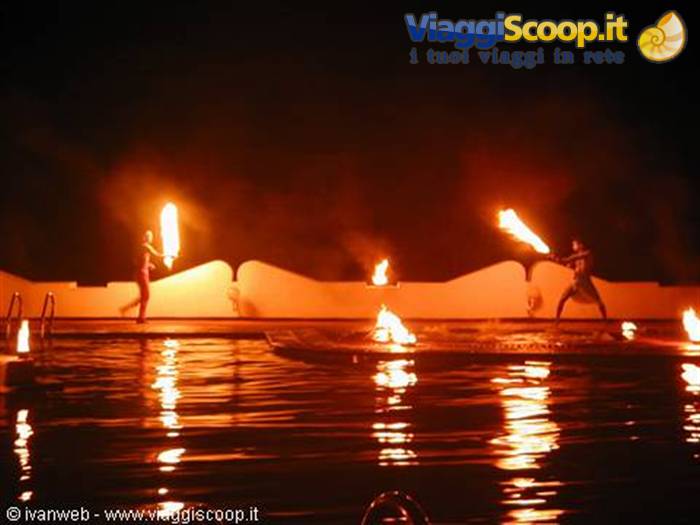
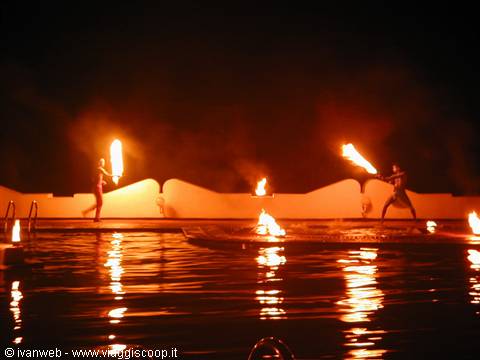
Fire fight at Dickwella
Day 727 Oct 2003
Safari to Yala National Park
We arrive at our destination at the first light of dawn. We have breakfast with a hot tea, then Saman goes to get our guide, who arrives with a beautiful, classic safari jeep: high, with lateral bench seats for the passengers and open on 3 sides with a covered roof. The six of us fit perfectly sitting comfortably, with our backpacks on the floor. There are also binoculars, which will be very useful. We travel a long stretch of unpaved road on the plain, admiring the landscape, which is stunning. We stop in a designated area that definitively confirms we are in Yala National Park: a shed used as a wildlife museum shows the geographical and road map of the place. We climb back into the jeep and after another stretch of road we finally arrive at the actual entrance, which looks like a sort of highway toll booth. Our tracker arrives, who is mandatory for the safari in this park.
He sits next to the driver and finally, at 8:00, we begin the safari! After a few meters we immediately encounter two specimens of monkeys of the species "Sri Lanka macaque," easily recognizable from the illustrations in the Lonely Planet. The dirt road is in excellent condition, we were expecting much worse. The encounters follow one after another, as do the beautiful and breathtaking glimpses of some stretches of the landscape, which open up suddenly behind some curve. We frequently see various fawns, boars, buffaloes, spotted deer and unfortunately we soon realize, as we had taken for granted, that we are at a great disadvantage for photos without a powerful telephoto lens. Our first objective, the driver explains, is to find the elephants because later, as the sun begins to heat up, they retreat into the forest and it is difficult to spot them.
We also ask him about leopards but, as we already knew, it is not a good time to see them and to find them you have to stay several days inside the park. In a clearing we find an iguana digging a hole, and behind it a male peacock fanning its tail as a sign of courtship. Unfortunately it never turns frontally toward us and the most beautiful part of the tail remains hidden. Further on, in wide green meadows with several small lakes, we find the herons, then the pelicans. We spot the eagle and the mongoose, even an ibex, but still no elephants. Toward half past ten we reach the boundary of the park facing the ocean. We park the jeep under the trees and get out to take a walk on the beautiful, long golden beach. We eat our breakfast packets while admiring the stunning unspoiled panorama.
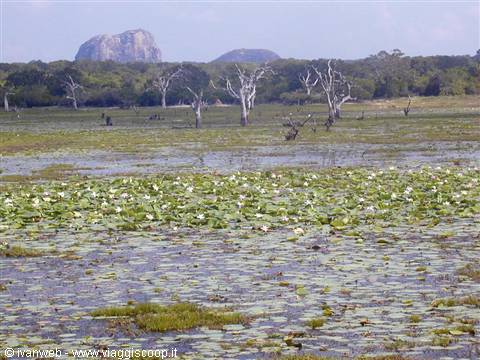
The enthusiasm of the safari has taken over and my car sickness has now passed, I feel much better! We resume our journey on the dirt trails of the park exclusively in search of the elephants. After a curve we stop to observe the landscape that for me is the most extraordinary seen so far: an enormous marsh, surrounded by lawn and flowers with hundreds of butterflies and a few groups of wild boar, with ghostly dry trees in the distance and a particular rocky ridge. All immersed in a perfect peace, such as only nature knows how to create. We begin to be seriously worried that we will not manage to see our beloved mammals, however, given that the sun is high and it is very hot. At this point the driver gives his best and tries to follow the tracks along a secondary trail. We thus leave the main road and take a small path where the jeep can finally demonstrate its potential.
We pass over a rocky carpet, several deep holes and brush against the vegetation in the narrowest points. This is the safari as I have always imagined it! Suddenly Gianfranco's shout arrives: "There he is! Stop!". The driver stops the jeep and goes back. The elephant really is there, hidden among the vegetation that it tears with its powerful trunk for its daily meal. It escaped everyone's sight but Gianfranco was great! With the engine off, we observe the animal for several minutes in perfect silence.
The driver says there are others, at least three; then they become five, but I always see only one! It's incredible but even though they are so big, elephants manage to camouflage themselves perfectly among the trees, I would never have said it! Our visible specimen in any case seems to have no way out: the only free path is the one that opens onto the road and so I am convinced that sooner or later it will have to come out into the open. Instead I am left open-mouthed when I see it disappear among the vegetation, clearing its way by uprooting everything around it without difficulty! Of course seeing them wild is a whole other thing, I had gotten used to the docile trained elephants of Thailand. After a few minutes, a couple emerge just a few meters away.
One hides perfectly behind a tree to eat: I wouldn't be able to recognize it if I hadn't seen it go in there! Then finally the whole herd comes out into the open. A mother leading and protecting a beautiful baby guides them, then others arrive behind. They follow the dirt road, they are right in front of us just a few meters away, it's a huge emotion! In the deep silence you can hear all our movements and the clicks of the cameras. At a certain point, right at the best moment while the elephants pass beside us, we suddenly hear the rewinding motor of the film roll: it's Saman who has run out of photos! He makes a deafening racket and we try to cover it immediately. Fortunately the elephants don't worry about it. After the last specimen has passed in front of us, the driver starts the jeep to stay behind the herd, which after a few dozen meters plunges back into the vegetation.
We have disturbed them and as soon as we arrive at the point where they disappeared, we find waiting for us the enormous head of the mother, leader of the group, emerging from the thick green with a powerful and terrifying trumpet! It freezes us with fear, the driver turns off the jeep and orders us to be quiet. There was no need to say it, we are to say the least petrified, including cameras and video cameras of various kinds. The elephant is in front of me, Gianfranco and Stefania, a couple of meters as the crow flies, right on the side of the jeep where we are sitting. We see it very well, it is enormous, it has a provocative and determined gaze: I believe I have never before felt such fear and at the same time respect for any animal. After a few seconds, it turns its eyes away and indifferently resumes eating, but for us it was a great lesson.
We are all convinced that if someone had shouted it would have charged us and overturned us without much ceremony, poor us and poor jeep! The driver explains that they are all females, and they become aggressive when they have their young to protect. Besides, it is very understandable. The one we see is the leader of the group, who always remains last to check the situation in the surroundings. On the way back, we witness the last exceptional event of the day: an eagle glides right in front of us and dives headlong onto the road a few meters ahead, catching a snake and carrying it up a tree. The whole thing lasts just a few seconds but it is truly one of those scenes that I thought you only saw in documentaries!
for space reasons, the story continues on
Children curious about the tourists. They speak Italian from the few tourists who reach Dickwella
Day 828 Oct 2003
Tour of Mulkirigala temple. The final fireworks show in the pool.
We sit on a chair while Upal brings us a pack of postcards we had asked him for, and we start choosing them. After about twenty minutes, the negotiations finally come to an end and we reach a grand total of 35! Before heading back, we leave them a tip as a thank-you for the company, the guiding and the friendliness they've given us over these days. Once in the room, I decide to also give my cap to Gian (who had kindly asked for it as a souvenir) and my old leather wallet to Upal. They're really happy about it and consider it an affectionate gesture to keep as a memento. I admit they've been a bit obsessive during this week, but they're very endearing, they're good guys. It's a beautiful sunny day and since it's still early, we feel the strong call of the pool, where we dive in for a brief, refreshing dip. Right after lunch, we meet the children to give them our gifts.
Mauro is there too, giving them some little clothes. We have the fabric to hand out and the backpack provided by the tour operator Azemar in Milan, which we've decided to give to them since they surely need it more than we do. The three girls get the fabric, while the backpack we give to another little girl who's watching us from a distance, all shy, hugging her father. A really tender and almost moving scene, as is the final goodbye to our dear, friendly and cheerful Sri Lankan children. At 3:00 PM sharp, we're at the reception to wait for the van that will take us to Mulkirigala, at the foot of a rock fortress where a rock temple has been built. The ride doesn't last long and once we arrive, we find ourselves in the midst of the greenery of a beautiful forest.
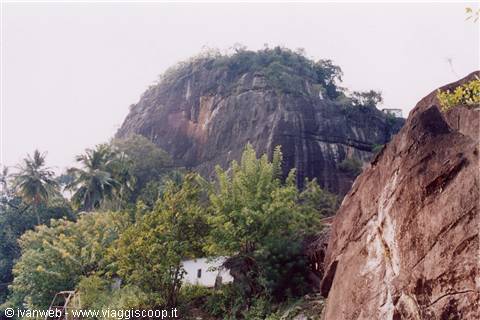
We glimpse the rocky outcrop that is our destination, to be climbed with over 500 steps! Right from the first steps, the landscape becomes very striking and the view shifts from a few-metre outlook through the dense, lush vegetation to open vistas, ever wider as we climb upward. At a first terrace, we visit a hall literally carved into the rock. The statues inside are too, they tell us, later painted and today vividly coloured as in every Buddhist temple. An elderly man comes up to everyone a bit, asking if we know English. Everyone promptly and cunningly answers no, while our slight hesitation will lead to this person sticking to us like a limpet for the rest of the route. At first he's calm, tries to explain something about the history and traditions of the temple, but we already have the Dickwella guide.
He's only useful to us because we stay separated from the group to enjoy the landscape in peace and to take photos and film as much as we like. After more steps, we reach another terrace with a great view, where you can even see our van way down, tiny tiny. We visit two more rock halls, and continue on the last stretch, which is a bit more complicated. The steps are also carved into the rock, small and shallow, but there are ropes to hold on to and help yourself with. The first macaque with a cap pops up, watching our ascent curiously. Then, once we're up top, dozens of them arrive to take the candies. They run and jump from one side to the other but still remain wary of getting too close or playing with us. They grab the candy and flee to the nearest branch.
Finally, another short walk leads to the actual summit of the mountain, a balcony with a drop of over 200 metres onto the forest! A beautiful thrill, enlivened by another solitary macaque that follows us through the trees and poses there, almost suspended in the void, enjoying the breathtaking view. It seems like one of those places that, in its position and isolation, appears typically suited to hermits and monks far from the world and humanity. Unfortunately, seeing a man asking for alms, equipped with a stall, chair and signs in the name of the good of the temple, makes me suspect that even here the smell of money has ruined the pure and religious atmosphere of the place.
A suspicion that is confirmed during the descent, when the man who has improvised himself as our English-speaking guide starts telling me about his large family to feed, about leaving a little help for them, and the usual things that by now, after a week, we're getting tired of hearing. The return route involves a sort of loop, so for a good stretch it's different from the way up. There are even more steps, which in total, all added up, seem to be about 530: not bad as exercise for the legs! Around 10:00 PM, we go down to the pool area, where they've set up chairs for us to watch the show. They'd really intrigued us by saying it's wonderful. The atmosphere is magnificent: absolute calm has fallen, the pool water is still and serves as a perfect mirror for the lights, and the temperature is pleasant.
The music starts and the usual presentation by Gianfranco, who explains the story of the performance we'll see tonight. It's a classic of the genre: a prince and a princess fall in love and live happily ever after until the "bad guys" come to kill the prince and imprison his beloved. But an angel will save the prince, who will face the number-one bad guy in a duel and free his princess. Well, even though it all may seem banal and predictable, the show is not at all: quite the opposite, it's more spectacular and exceptional than ever! The music always appropriately accompanies the unfolding of the story, but the show's strong point is the skill of the actors (the Dickwella entertainers) combined with the "special effects" of the fires and lights reflected on the pool.
When the protagonists pass with their torch to light other points of fire and light scattered around the great natural stage of the pool, you begin to feel the magic of this show. And when the bad guys arrive, from the roof of the Dickwella, soaring with blazing torches and descending from the very tall palms, it's a triumph. Someone, myself included, surely gasped at seeing that guy jump from the roof from a height of several metres straight into the pool, at its lowest point, without any protection! Not to mention the clash, absolutely memorable and unforgettable, of the bad guys against the prince, armed with fiery swords that have nothing to envy from Star Wars lightsabers, with the difference that this is real fire! The agility, the quick reflexes and the skills of these guys are truly incredible.
Calling them entertainers seems completely reductive to me; they have the potential to do so much more.
for reasons of space, the story continues on
A young couple on a romantic walk on the beach
Day 929 Oct 2003
Dickwella - Colombo
There's no denying it, it's a tough wake-up call at 3:30 in the morning, even when you're on holiday! We close our suitcases for good and go to the reception together with the rest of the group. This time, instead of a single bus as on the way out, we're split into three vans that arrive around four. We're handed the bundle with breakfast and take our seats, trying to find a comfortable position in the hope of catching a nap during the long hours that separate us from Colombo. A hope that is soon dashed by the absurd driving of our driver, who despite the initially light traffic (it's still dark, dawn hasn't even broken!) doesn't spare us his sporty pace with sudden accelerations, braking and continuous overtaking, on a road with a single lane in each direction and in conditions that are certainly not excellent. With us are Luca, Marzia, Mauro.
Gianfranco, up front with the driver, is the only one who amazingly manages to fall asleep despite his head visibly lolling abruptly from one side to the other. I understand that by now he's used to it, from doing this route every week to take tourists back to the airport and pick up the new arrivals from Milan. The journey thus turns into a kind of nightmare, which after a few hours turns into a sarcastic joke, the kind that become legends to tell your friends. Meanwhile, at 9:30, exhausted, we arrive at the shop where we had stopped on the first day to check the prices. We take the opportunity to hear the comments of the other members of the group, identical to ours: terrible driving with no reason whatsoever and nausea galore! We buy our last postcards and stamps, and sit outside to write them while we wait for the others.
Who knows why, I'm convinced there's only a little left to the airport, since we've already been in the built-up area for a while. I'll soon realise instead that it takes more than three more hours! Three hours stuck in Colombo traffic, with a built-up area that seems ten times more sprawling than Bangkok's and never ends, on a route I feel compelled to describe in the smallest detail. To start with, "stuck" doesn't mean stopped in a queue like ours generally in big cities. You're almost always moving but at reduced speeds and with sudden braking, Formula One sprints and overtaking driven by continuous lane invasions (now the road is wide, three or four lanes in each direction).
Everyone behaves the same way, that is, the equivalent of total anarchy! They do the impossible to overtake the car in front and gain two metres (which is precisely the length of the car given the traffic!) and there's no reason at all, since after a few seconds you're overtaken again in turn. The first five times we saw cars but above all buses or trucks much bigger than our van cut the lane and recklessly hurl themselves at us, we genuinely feared for our safety. Then, past ten, we realised that the tension was beginning to turn into sarcasm and it was useless to panic. After all, Gianfranco up front is so calm! I don't know by what incredible miracle (which isn't called Xamamina) I didn't feel sick: it's never happened to me, for someone like me who gets motion sickness on every vehicle on earth, to survive something like that. I thought Naples was a mess: ridiculous.
Even in Thailand I thought it was chaos: trifles. Compared to Sri Lanka, they're all model drivers. But let's talk precisely about the driver, because he's the star, the number-one protagonist! Aside from his eminently personalised way of changing gears, especially second, which engages with a theatrical and funny gesture, the icing on the cake is his excessive and obsessive use of the horn. A continuous, nagging use, which after hours of journey makes me and Mauro hilarous, and we start exchanging terrible jokes. But why does he honk? And how many hands does the driver have? He's always changing gears and always honking the horn, and on top of that obviously steering the wheel. And to not even have an accident, it's clear he's observing all the mirrors in real time to avoid scraping with the other madmen out there.
Conclusion: he's brilliant! There's no other explanation, he's been driving like this for six hours, without a moment's respite: he's a robot built to drive! We continue for hours joking about the use of the horn until, at noon, we arrive shattered at Colombo airport, after a good seven and a half hours of travel. The other members of the group are no different, and it seems instinctive to say a little sincere prayer of thanks for having arrived safe and sound and in one piece. A traumatic experience that will leave its mark! But just as it's also true that in a world of madmen, the unbalanced one is the one with sense, I realise, thinking it over, that probably the risk of an accident is lower than it seems. After all, driving like that, they're all used to having reflexes ten times quicker than ours, and they expect someone to come at someone else at any moment.
But try telling yourself that while you're experiencing it firsthand for seven hours!
the journey continues in the Maldives on this same site or, for all the photos and more information, on
Nilani, one of the little girls who was always with us on the beach...








0 reader comments