The story
Yangon - Bagan: after a short night of much-needed rest, at 6 a.m. we find ourselves at the airport again. The domestic departures area is a squalid big hall steeped in the smell of stale spices that seems to be the leitmotif of much of South-East Asia. In the apparent chaos of passengers and luggage, which recalls a 1950s coach station, boarding is surprisingly quick. On a short, smooth flight, the Fokker of Bagan Air takes us to Bagan. From above, the place is captivating: the red of hundreds of pagodas stands out against the lush green forest.
The archaeological site, which dates back to the 12th century, is constantly threatened by the forest, precariously held back by UNESCO's efforts; but the wild, overflowing vitality of nature, with its deadly threat, instils a soul of subtle melancholy in a place that, like a living organism, hangs in precarious balance on a thin ridge of shadows. It seems incongruous that foreigners appear more sensitive to the panic and numinous breath that blows from the tangle of bricks and roots. Our guide, for example, shows no appreciation of any difference between the wretched temples of tin and concrete, ramshackle backstreet jumbles of subculture, and the charm of a religious inspiration truly rooted in the soul and in popular history.
In short, more than materially poor, Myanmar seems spiritually deprived, dispossessed of its past, of that historical, religious and cultural awareness which alone protects against the indiscriminate embrace of foreign junk and against the loss of artistic and aesthetic coherence without which the ability to recognise and preserve beauty cannot survive.
Keng Tung: today trekking: we'll touch 4 villages with a wide loop through the forest. The walk promises to be beautiful and interesting; the path, at times steep, is of red earth and the forest surrounds us in all its lushness. It feels like walking the Ho Chi Minh trail. The villages give us an impression of genuineness perhaps never experienced before: they are authentic communities, cut off from time, living in stilt houses of straw and bamboo, with a Homeric sense of hospitality and an archaic agriculture, supplemented by the rearing of chickens and piglets. The women wear splendid headdresses, covered in silver spheres and coins, seemingly uncomfortable and heavy; children swarm everywhere, entrusted to nature's benevolence like broods of chicks.
We hand out sweets, toothbrushes, medicines to ease the aches caused by heavy farm work; yet we still have the impression of disturbing a harmony of life, with our being irreparably alien, no less than if we had landed from a spaceship.
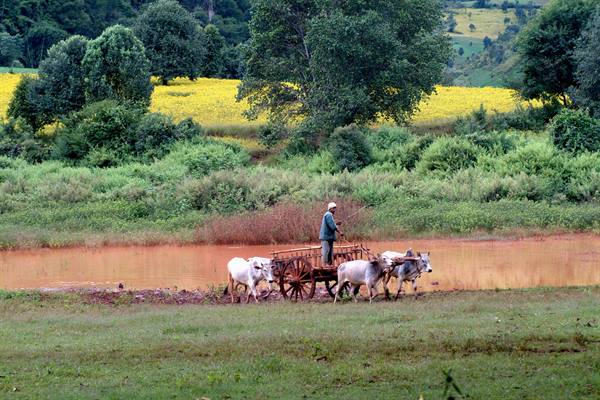
Inle Lake: we rise before dawn, after a sleep troubled by the sound of rain in the background. Luckily, the weather threatens but holds during the crossing to the "5-day" market, which, as it happens, is held in a place quite far away. The market is fascinating. On the muddy bank crowd ox-drawn carts, large and small pirogues and many varied stalls of sellers from different ethnic groups, each distinguished by different styles and colours of dress. There are huts with improvised food and drink stalls, already packed with customers; someone provides naive but welcome entertainment with a primitive device that rolls two giant dice, letting a large crowd join the game; and there are sellers of things that interest us too, such as daggers, wood carvings, jewellery, paintings and more or less fake antiques.
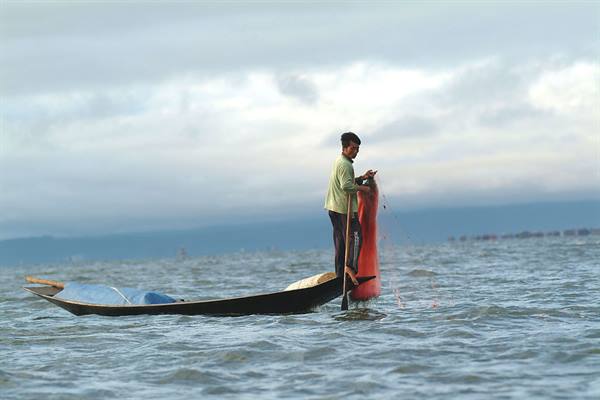
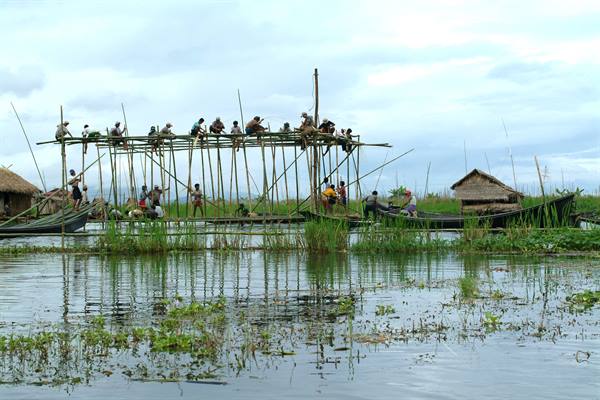
Anyway, we have fun, we buy and set off again, chased by the more tenacious sellers right into the water. We cross stilt villages, sailing channels barely kept free from the invasion of lotus flowers and water hyacinths, which form tangles capable of stopping and capsizing a boat; on the lake there are floating islands and vast areas cultivated with vegetables that a thin clod of earth suspends over the water; there are workshops and craft activities of various kinds that obviously benefit from tourism. We visit a cigar factory, a forge, where the glowing iron is struck by the hammers of workers beating in coordinated and risky rhythm, while an old man, seated up high, works his arms back and forth to drive the bellows; we watch the truly incredible spectacle of fabric being made from lotus stems.
The stem, broken by the spinner's hand, releases thread-like mucilage as fine as cobwebs that, twisted by skilled fingers, forms a thread, which is at once wound onto a spool; then it is spun and woven by hand until it forms a cloth rough to look at but, to the touch, soft and yielding as silk.
The journey's photographs
10 photographs · click to open them full screen




1 reader comments
Complimenti per le bellissime foto!!