Viaggio nella valle dello Zanskar
23/6
Manali – Darcha
Start of the trekking.
We're at camp. I'm in the tent and I'll be concise because altitude sickness is making itself felt. It's been a demanding day. A beautiful, evocative transfer, but truly exhausting, lasting about seven hours on an impossible road. Amusing scene at Rhotang Pass, over 4,000 metres, where many Indians on holiday seek out contact with the snow and rent ski equipment, obsolete in our eyes, only to immortalise the historic moment. Some prefer "technical" clothing with colourful suits, while others go for far more fetching fur coats, for both men and women, available even in tiger and leopard versions. From the pass we descend towards Darcha: the road is truly in a disastrous state, but at last high-mountain scenery opens up with a crystal-clear blue sky. The traffic of the other slope is gone, along with the hair-raising overtakes just centimetres from the precipice.
On the other hand, the constant jolts shake everyone up a bit, with Francesco and me vying for the title of most suffering. After a brief stop at a de luxe dhaba in Keylong, we arrive at Darcha where we meet Tashi, who warmly greets Johann, Dad and Massimo and then meets me and Francesco. His teeth strike me: blindingly white, strong, healthy. He has a smile that instils confidence and serenity, and skin and a physique forged by the sun and the mountain climate he lives in. After about ten kilometres, on a road under construction, worked by Nepalese families living in conditions that seem dramatic to our eyes, we reach the starting point of the trek. We get out of the car and the luggage is unloaded from the pick-up that followed us.
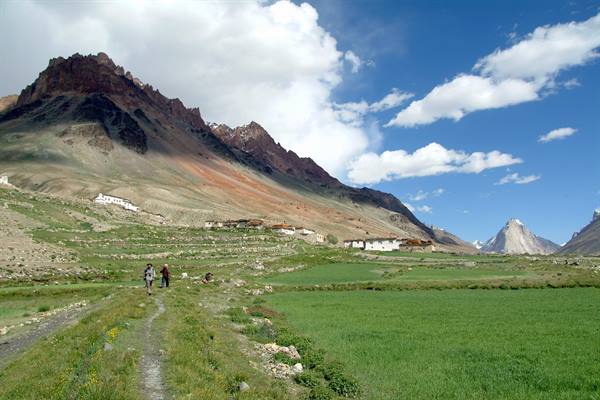
Besides us, Johann and Tashi, there is a friend of Johann's in charge of the cooking, Cham Chu, and a Nepalese boy, Padan, an expert climber who will lend us a hand. Then two men await us, in charge of the eight horses that will carry the provisions, plus a spare horse. Our condition, both from the journey and from the altitude (3,620 metres), is a bit critical: so we can do nothing but watch, with a touch of envy, the locals scampering here and there to pitch the tents and set up camp. We're at the bottom of the valley. The landscape is harsh, stony, with a river rushing down and waterfalls with spectacular drops. Here and there snowy peaks peek out, standing out all the more against the deep blue sky, like a polar bear plunging into the sea. Dinner is good; Johann's cook friend prepares a vegetable soup with fresh pasta that is really tasty.
A shame that the group's somewhat precarious condition doesn't allow us to enjoy it fully. Then we all go to sleep shortly after eight, when night falls. It's the first time I notice I have a useless object on my wrist; here the day is marked only by light and darkness.
24/6
First day of trekking.
After a splendid ten hours of sleep (thank goodness!) I wake up at 6, fully recovered from yesterday's ailments. Above all, I no longer feel nauseous and I don't feel dazed. After breakfast accompanied by the first moka coffee, much appreciated by everyone, we set off. Today about four hours of walking are planned and a little less than 400 metres of elevation gain. The walk goes smoothly. Of course, you can feel that we're at almost 4,000 metres, but all in all we hold up, even though we can't emulate Johann's lightning dashes as he occasionally races ahead to film his little movie, leaving us under Tashi's reassuring protection. We reach the clearing where we'll camp around one o'clock, after following the path along the river, which we even had to ford by walking on the stones like proper little boy scouts; with a Piazza in full "Grand Mughal" mode we came through brilliantly.
So we stop in a lovely green clearing crossed by a placid stream and surrounded by a long dry-stone wall. After a quick, uncooked lunch, Johann and the others set up camp, while we attend to various chores, including an old-timey laundry session at the river. Then rest and a nice, funny refreshing shower with the stream water, looking at the valley awaiting us tomorrow with a certain fear, while I dream of a little football game on this meadow at 4,000 metres.
25/6
Second day of trekking.
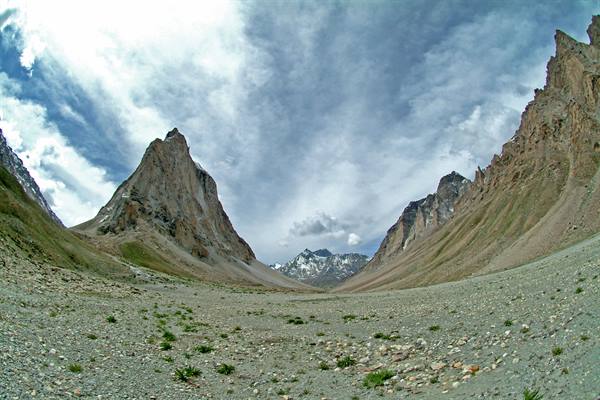
Today we reached the camp where we spend the night before facing the dreaded and fearsome Shingo-la. To tell the truth I'm writing this on the 26th because yesterday I wasn't feeling well. So let's speak in the past tense; The day had started well; despite the altitude I was climbing briskly along with Johann and so were the others, though at a slower pace. Between various stops during which we amused ourselves by measuring each other's heart rates, a practice Tashi avoided, we were climbing an austere valley characterised by moraines and imposing rocky slopes. Looking upwards, and even better with binoculars, we admired glaciers with vertical walls: I was amazed to see these formations that to my eyes cling to the rock by a miracle, despite some impressive crevasses scoring them from top to bottom.
We reached the camp, rather inhospitable, and after 5 minutes it began to rain heavily and turned cold. In the evening I felt unwell, but I wasn't worried. Rather, I was sorry to see the anxiety in the others' eyes, perhaps heightened by the fear of having to stay an extra day in this harsh, stony camp because of the half-invalid pain in the neck who is writing this.
26/6
Third day of trekking.
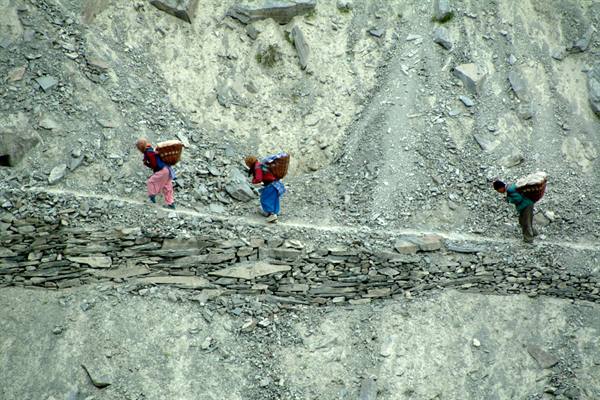
I've recovered. After a calm, restful night, we set off for Shingo-la pass. It should be the hardest day. You reach 5,100 metres or more at the pass, covering 500 metres of elevation gain and then descending again to finally reach the Zanskar region. I'm better, of course, but having eaten little or nothing and assimilated even less the previous day leaves me weak, so when the real climb begins, I get on a horse following Johann's advice. I'm sorry not to be able to climb on foot with all the others, but perhaps I really am too debilitated to face such an effort. The little black horse that heroically carries me saves me a lot of effort but certainly not a few scares. The path is narrow and crumbling, and it's truly a miracle (or at least that's how it seems to my eyes) that the animal doesn't fall into the ravine taking me with it.
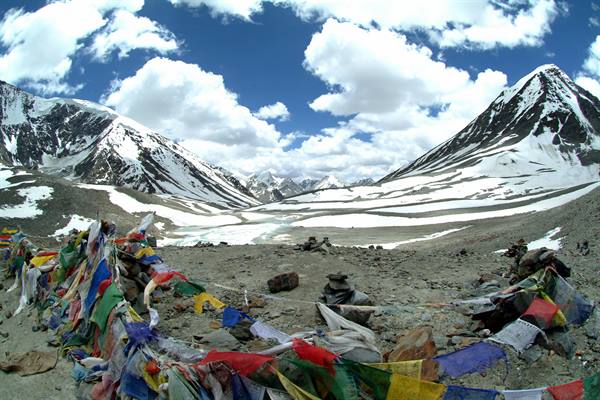
Fear aside, since I'm not short of oxygen, I can better appreciate the landscape that is gradually transforming. There isn't even a blade of grass anymore: majestic glaciers, blindingly white now that I'm almost touching them. The weather is fine and doesn't threaten rain. Looking down from the (all too) high saddle, I anxiously observe the truly steep path awaiting the others. Before reaching the pass, the whole saddle turns, evidently badly secured by the herdsman, and I fall off the horse onto my back, fortunately without consequences. The arrival at the pass is thrilling. There's a small plateau with ice and snow that, melting, forms a small pond. Beyond the last little climb, other mountains can be glimpsed. The wind typical of all passes blows, taut and whistling.
There's enough snow and some streams; to make the scene even more "prehistoric," the herdsman, a short, stocky Nepalese who "holds on a leash" my valiant horse, takes off his shoes and socks and crosses snow, streams and rocky ground barefoot. I'm stunned. After the pass, I wait, in a sheltered spot, for the others to arrive. It's with great relief that I see the whole group emerge near the prayer wall and the ba

1 reader comments
esperienza grandiosa e foto semplicemente fantastiche