NEW DELHI, AGRA, JODHPUR, JAIPUR, UDAIPUR, DIGGHIRI
When
26 Jul 2008 – 13 Aug 2008 19 days · trip of 2008
Who
Monica Amaglio · @Moni63 · Novazzano
How
Travel diary
The story · 12 days
WANDERING THROUGH A SMALL PART OF RAJASTHAN VIA NEW DELHI AND AGRA, VISITING THE GREAT MONUMENTS OF THE MUGHAL PERIOD. THEN TREATING OURSELVES TO A RELAXING WEEK IN THE MALDIVES
Day 126 Jul 2008
Departure
Why did I choose India (in the family the one who organizes trips is yours truly, otherwise...you risk staying at home)? Maybe because I let myself be fascinated by the photos of the majestic Taj Mahal, maybe for elephants (even though we already encountered the African ones in Kenya), maybe by Buddhism, maybe just the desire to know and visit another country, another continent and above all another people with their cultures and traditions. Whatever the stimulating element, at the end of December 2007 I contact my friend Carmela, travel agent at Kuoni Lugano to get some information. This time I "betrayed" my usual travel agency (forgive me Lino) because Carmela already undertook the trip many years ago with a backpack and could give me advice about it.
Flights booked according to my request, departure at 12:00 from Milan-Malpensa, Qatar Airlines flight with a stopover in Doha and arrival in New Delhi at, we move on to the ground program. I must say that I also contacted a local tour operator (Travel in India with Karni) recommended by several travelers from Turisti per caso, then I decided to stay with Kuoni even though the expense turned out to be more expensive…………………….
Travel diary
07.27.2008 ………….and so on Saturday 07.26.2008 we meet at Milan Malpensa airport for the ritual of check-in and boarding on the Quasar Airways flight at 12:00 with first destination Doha where we land after 5 hours and 30 of flight. Just the time to stretch our legs, a little tour of the airport and a snack and we board again and this time we reach the Indian capital Delhi at 03:30 local time. Baggage collection, meeting with our local contact and the driver who will accompany us throughout the trip. Heading to the Crown Plaza Hotel and the only and unwelcome surprise of the whole vacation: we don't have the room available except for the night of 07/27-28/2008. Despite our protests, our contact leaves us in the freezing lobby to "sleep" on the sofas. Around 07:00 from the reception (perhaps moved to pity) they inform us that a room is ready.
We seize the opportunity and get a sleep until 10:00, an abundant breakfast and at 11:00 meeting with the first of the several guides, Deepak. We set off for the first tour of Delhi (the rest will be done at the end of the tour)
TAJ MAHAL
Day 228 Jul 2008
AGRA
Wake up at 08:30, breakfast and.... meeting with our driver Vidjay heading to Agra. At this moment we realize the Indian traffic. We are already uncomfortable with driving on the left but what awaits us leaves us speechless. Just think that to cover the 205 km from Delhi to Agra it takes at least 4 hours. The almost paved roads are two-lane but become 3 or 4 depending on how many vehicles decide to overtake (we saw a truck overtaking a truck in turn overtaken by another truck and naturally there's whoever is coming in the opposite direction who has to move) During the whole tour I will have closed my eyes about twenty times expecting the worst!). Besides vehicles the roads are frequented by cows, buffaloes, dogs and pedestrians (who if they don't move risk.......going splat!!).
In the late afternoon we arrive in Agra, a city of northern India of 1,259,979 inhabitants, capital of the district of Agra and of the division of Agra, in the western part of the federal state of Uttar Pradesh, on the banks of the Yamuna river. Based on the number of inhabitants the city falls into class I (from 100,000 people and up). It was the capital of the Mughal Empire from the 16th to the 18th century.
We stop at the gates of Agra where we meet our local guide Sanjay and we visit Sikandra, the Tomb of Akbar, the most illustrious and famous emperor of the Mughal dynasty. Sikandra was founded by Sikander Lodi, the emperor of the Lodi dynasty that ruled the Delhi Sultanate between 1488 and 1517. The Lodi dynasty came from Afghanistan and had settled in India in 970. Sikander Lodi proved to be a skillful sultan; he expanded his kingdom and administered it leaving to the governors of the individual territories, the amirs (emirs), considerable autonomy. Under his empire the arts and culture flourished again. In 1504 Sikander moved the capital of the empire to Agra, building the city on the bank opposite the one where it currently stands. Sikandra returned to being a small village. It was Akbar himself who chose the place of his otherworldly dwelling.
The tomb stands in the center of a green and quiet garden, in which beautiful deer graze undisturbed. The monumental complex is accessed through an imposing red sandstone portal, which constitutes the most significant element of the work. The mausoleum is built according to the architectural typology, of Persian origin, of the garden-tomb, with the char-bagh module (literally garden in four, square garden divided into four parts by watercourses), introduced by the founder of the Mughal dynasty Babur (1483 - 1530).
An enlightened and tolerant sovereign, Akbar wanted to concretize in the mausoleum the canons of his syncretic religious philosophy, which he himself called Din-i-Ilahi (religion of God); a mixture of Hindu, Islamic, Sikh and Christian thought, a kind of liberal mysticism, of a universal and non-dogmatic religion, which the emperor announced in 1582 to his subjects, with the hope of quelling the bloody religious struggles and unifying the empire. Even in the architectural lines of the building the traces of Akbar's universal thought are evident; there is a harmonious union of Hindu and Islamic architectural modules, and of typically Buddhist decorative elements that happily marry with symbols of Jainism and Christianity. In agreement with the guide we also decide to visit Itamad-Ud Daula, this way the next day we dedicate ourselves entirely to the two most famous monuments of Agra.
Mausoleum of Itmad-ud-daula known as the "little Taj", it is located along the Yamuna river, about a kilometer and a half upstream from the Taj Mahal. It was built in 1628 by Nurjahan, the wife of Emperor Jahangir, to house the tomb of her father Mirza Ghiyas Beg, an imperial officer who had received the title of Itmad-ud-daula, or "Pillar of Government". It is the first Mughal structure entirely in white marble in which the pietra dura technique was systematically used
JODHPUR
Day 329 Jul 2008
the "TAJ"
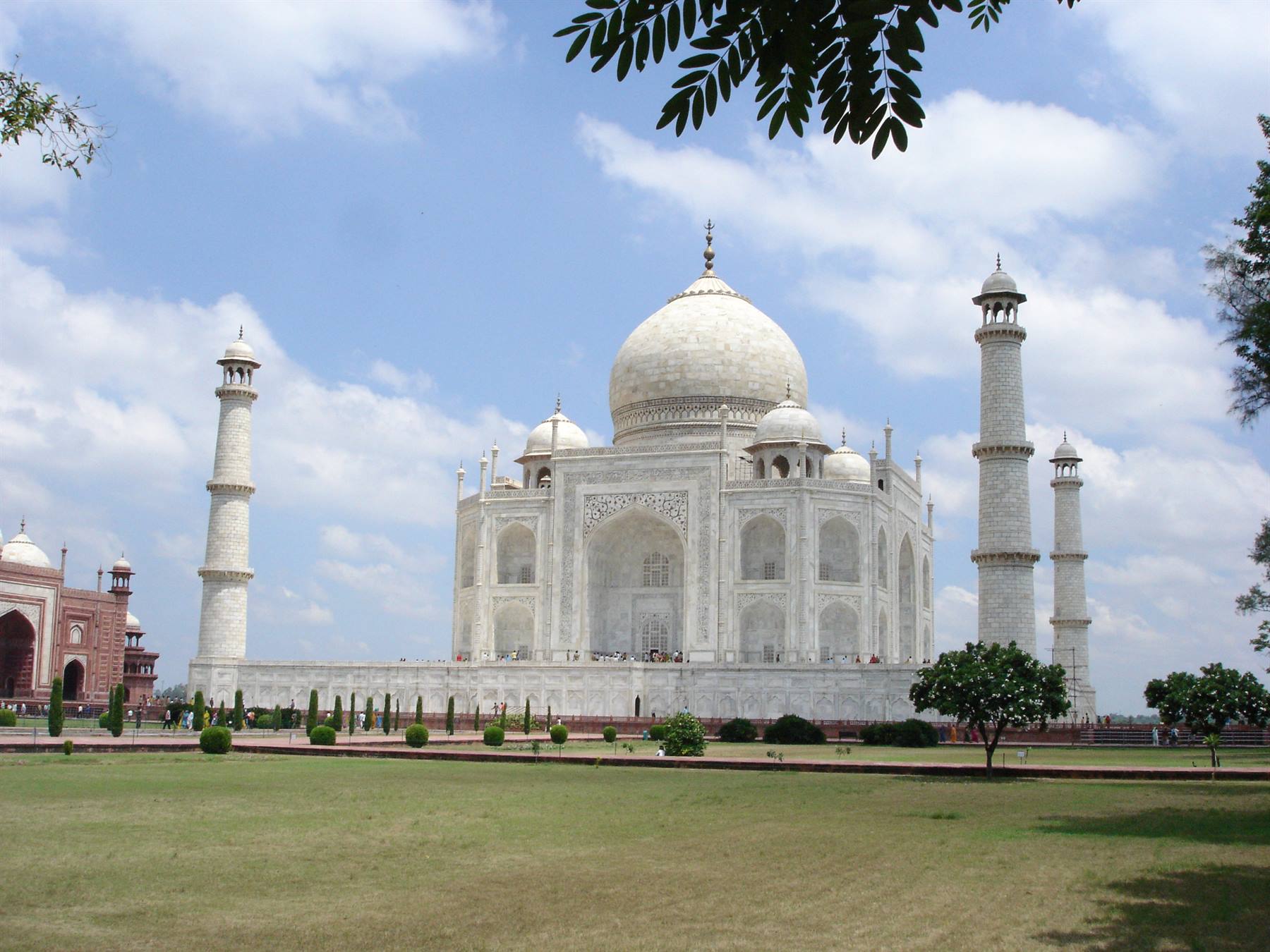
Wake up at 08:30, breakfast and we meet with the driver and guide who take us toward the so-called symbol of India, a UNESCO World Heritage Site and first among the wonders of the world, the Taj Mahal. To prevent the rains, time and pollution from ruining the white marble of the Taj, you can reach it on foot or by electric buses. Furthermore the factories in the surroundings have been closed for the same reason.
Let's say that the wait is worth it, you are left speechless in front of this construction and you admire the place, kept in perfect condition and pampered, far from the noises of traffic and the chaos of the city: whoever has seen the Sagrada Familia in Barcelona, on the other hand.....despite its beauty, is surrounded and squeezed by the city; even the pyramids of Giza once far from traffic, the last time we visited them they were starting to be closely surrounded by hotels and buildings. We visit the site with the guide who then leaves us all the time at our disposal to admire it. After having gone far and wide around the construction and the gardens we sit on a bench and observe it marveling at the perfection and the calm it transmits to us and we realize the great abilities of man, too bad that he uses them almost exclusively for weapons and wars.
There are many Indian tourists who visit it and we are fascinated by the colors of the women's saris that stand out against the white of the marble. One of them asks me to pose for a photo with her and her child and I gladly accept. The guide informs me that most Indian visitors come from the south and are not used to meeting Westerners. It won't be the only photo I pose for. Here is the story of the Taj
The Taj Mahal, described as the most extravagant monument ever built for love, has become, de facto, the tourist emblem of India. The Taj is of a surprising grace seen from any angle, but the most amazing thing are the details. Semi-precious stones are inlaid in the marble, forming beautiful designs, with a process known as pietra dura. The precision and care used in the design and construction of the monument are equally moving whether you admire it from the other bank of the river or from half a meter away. The mausoleum palace covered in white marble with delicate floral ornaments in polychrome semi-precious stones, is built on a platform 250 meters wide, at whose corners rise four minarets and stands in the middle of gardens and bodies of water, according to the best Islamic tradition. Of octagonal shape it is dominated by a large bulbous dome.
At the center of the octagonal building is the tomb hall, with large niches and doors that open onto the other halls and that are decorated with white marble reliefs that would be the work of the French sculptor Austin of Bordeaux. Here however only a fake burial of Mumtaz Mahal is located, enclosed by a pierced marble screen, inlaid with 43 types of semi-precious stones; next to it the Cenotaph of Shah Jahan. The tombs where the bodies of Mumtaz Mahal and Shah Jahan really rest are found in the room closed on the semi-basement floor, below the main hall (it is forbidden to photograph the inner hall). The interior reproduces the structure of Humayun's mausoleum in Delhi, while the large door has the shape of that of Akbar's mausoleum in Sikandra.
The mixture of styles takes nothing away from the charm of this imposing mausoleum and from the charm of its candid surfaces that change with the changing light. The beauty of this construction is made even more fascinating by the legend that surrounds it, in fact it almost seems like a fairy tale. Taj Mahal means "Palace of the Crown" and is in fact the most beautiful and best-preserved tomb in the world. The Taj Mahal is located on the banks of the Yamuna river. It was built by the fifth Mughal emperor, Shah Jahan, in 1631 in memory of his second wife, Mumtaz Mahal, who was a princess originally from Persia. Mumtaz Mahal died while accompanying her husband to Behrampur, during a campaign to crush a rebellion. She had just given birth to their fourteenth child.
Her death was a real tragedy for the emperor, to the point that his hair and his beard within a few months became completely white from grief. While Mumtaz Mahal was still alive, she had asked the emperor to make her four promises in case she died before him. As a first promise she asked him to build the Taj; the second was that he should marry again to give their children a new mom; the third promise was that he would always be good and understanding with their children; and the fourth, that he would always visit her tomb on the anniversary of her death. The construction of the Taj Mahal began in 1631 and was completed in 22 years. Twenty thousand people were employed for its construction, and it was designed by the Iranian architect Istad Usa.
The best way to appreciate its wonderful architecture and its precious ornaments is to see them with the eyes of the love that the Emperor had for his wife Mumtaz Mahal. It is surely a "symbol of eternal love."
We leave the Taj not without turning once more to look at it and we stop at a factory of marble objects, then hungry we stop at a small restaurant recommended by the guide for lunch. In the afternoon we visit the second great attraction of the city, the Agra Fort, a UNESCO World Heritage Site. The fort is also known as Lal Qila, Fort Rouge and Red Fort of Agra. It is located about 2.5 km northwest of the Taj Mahal. The fort can be accurately described as a fortified palace-city. The fortress owes its name to the material used for its construction: red sandstone. Akbar the Great (1542-1605) originally intended to proclaim Agra the capital of the Mughal empire, but, once the fortress wall and the towers were erected, he interrupted the works because he had already planned the construction of a new residence in Fatehpur Sikri, which he left after ten years.
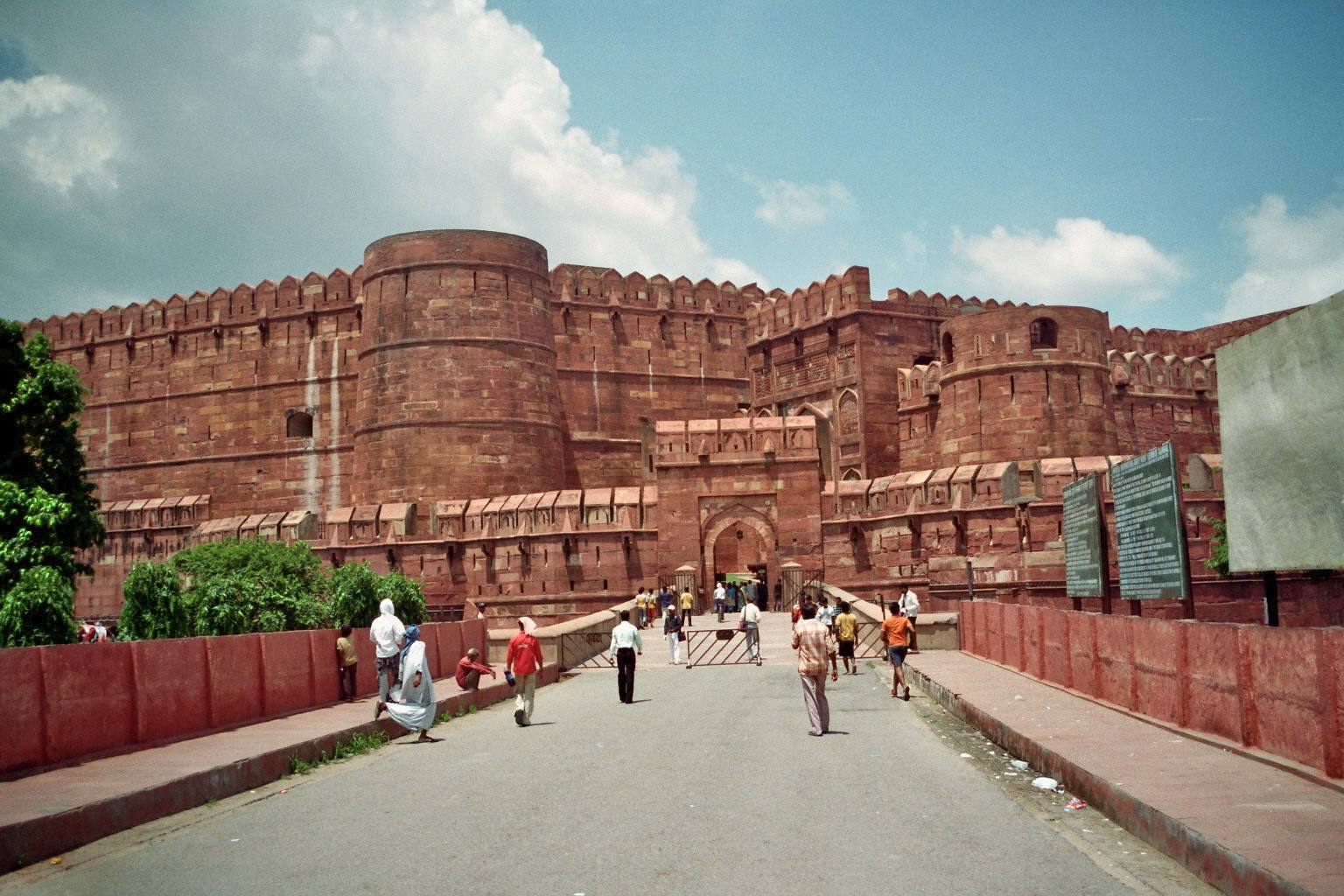
Later he reigned from Lahore and only shortly before his death did he return to Agra. His successor, Jahangir, did not do much for the city, which knew its maximum splendor from an architectural point of view only with the latter's son Shah Jahan, who reigned from 1628 to 1658 and lived here from 1632 to 1637. Sensitive to art, this sovereign had many of Akbar's buildings demolished and replaced them with magnificent palaces and mosques of white marble inlaid with semi-precious stones. The most fascinating examples of the almost musical lightness of the architecture that originated during the reign of this sovereign are the hall of audiences and the Pearl Mosque. A typical example instead of Akbar's style is the mighty Amar Singh gate, the main entrance, beyond the drawbridge over the foul-smelling waters of the moat.
The gate was built by Shah Jahan in 1665, to commemorate the daring of Rao Amar Singh, brother of the Rajput ruler of Jodhpur and court nobleman. The walls are grandiose, with a moat between the outer and inner walls. We leave the fort and the ride on the Tonga awaits us, a covered cart pulled by a horse. Honestly, given that it had to carry the weight of no less than 5 people, the horse didn't seem very sturdy to me and I felt sorry for it. During the ride the rain surprises us, cooling the hot day for about 20 minutes. At the end of the ride we find our vehicles again and we are escorted to the hotel.
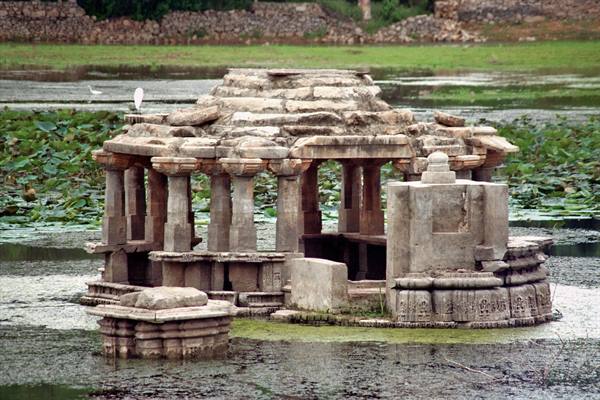
Ancient stone temple submerged in a lotus pond with carved pillars and an egret
Day 430 Jul 2008
FATHEPUR SIKRI - JAIPUR
Wake up at 08:00 and departure heading to Jaipur (235 km). After an hour we are at Fatehpur Sikri which we prepare to visit and study:
Akbar, despite the 300 marriages celebrated with clear diplomatic intentions (creating a climate of detente with the bellicose local Rajputs of Hindu religion) and the 5000 women of his harem, could not manage to have male children, or rather those he had had all died in early childhood. Desperate for this calamity, in 1568 Akbar went on pilgrimage to the village of Sikri to Shaikh Salim Chishti, lamenting his misfortune and asking him to intercede for him. The saint reassured Akbar and predicted that he would soon have three male children. The following year the first wife Jodhai Bai, returning from a pilgrimage made to Ajmer, conceived a son who was called Salim in honor of the venerable seer. (On the death of his father Akbar, Salim would ascend the throne under the name of Jahangir). In 1570 the second son Murad was born and two years later the third Daniyal.
Enthusiastic and happy at the fulfillment of the prediction, in 1571 Akbar decided to build near the small village of Sikri a new city, which he called Fatehpur Sikri, the city of victory, to celebrate the auspicious event and the defeat of the powerful Rajput of Chittor. For 14 years, from 1571 to 1585, Fatehpur Sikri was the capital of the Mughal empire as well as an important commercial, cultural and administrative center, overshadowing the city of Agra, which remained only the military stronghold of the empire. The city was abandoned, apparently due to the enormous difficulties of water supply. Akbar moved the capital to the more comfortable Lahore.
The place where Fatehpur Sikri arose, a low hill at the foothills of the Vindhya mountain range, had long enjoyed the reputation of a place rich in favorable omens. Akbar's grandfather and founder of the Mughal dynasty, Babur, had defeated here the Rajput forces of Mewar. He had thus named the place Shikri, thanks. There are no grand avenues or buildings that serve as a landmark; it is a continuous change of environments and visions, court after court, with a few isolated palaces in a network of constructions and admirable views. Perfectly preserved, this city restores the vision of the Mughal lifestyle at the height of their power. The city was designed according to Persian principles, but built and decorated according to Indian models that develop eclectic and elegant motifs. The city can be divided into two parts: the palace area and the mosque area.
The palace area in turn can be subdivided into: • administrative buildings • private quarters of the emperor • the Harem The administrative areas, in the eastern zone, are connected by means of courtyards to the emperor's quarters and to the city, while the harem area is reachable from the imperial zone through screened corridors that excluded any other external contact. The palace area is surrounded by a series of service buildings and the court, such as common areas, workshops, houses of the nobles, markets etc., all enclosed within the walls.
At the end of the visit we continue our journey toward Jaipur, not without realizing how people live in these parts, in dilapidated houses (if they can be called that) in front of which we find fruit sellers' carts and garbage of every kind. We arrive in Jaipur in the late afternoon (after about 5 hours) and stay overnight at the Country Inn & Suites hotel where we make our first purchases of fabrics (pashminas, tunics and even a sari that from an initial price of €30 we got for $15).
DIGGHIRI
Day 531 Jul 2008
JAIPUR
Jaipur is the capital of the Indian state of Rajasthan. Founded in 1728 by the astronomer Maharaja Sawai Jai Singh II, it today has a population of about 2.7 million. It is also famous under the name "pink city," because of the predominant colour of its dwellings. The city was built with modern concepts; in fact it has a grid plan with wide tree-lined avenues. Numerous are the bazaars and markets divided according to the various and many craft activities. To name a few: jewellery, precious stones, enamels, both printed and woven fabrics, carved objects.
Wake-up at 08:00, breakfast and departure for Amber Fort. We pass through the centre (?) of Jaipur to admire the Hawa Mahal from the outside. The Hawa Mahal (palace of the winds), symbol of Jaipur and an extraordinary example of Rajput architecture, was built in 1799 by the maharaja Sawai Pratap Singh. Of the five-storey building that overlooks the main street of the frenetic old city, only the façade and little more remains. The "Palace of the Winds" is characterised by refined honeycomb windows in pink sandstone, originally designed to allow the women of the royal household to observe the processions and daily life in the streets. We reach Amber and on elephant back (as tourists are expected to do) we climb toward the fort, a collection of palaces and pavilions, built starting in the 17th century, as his own seat, by the maharaja of Jaipur who however later moved to the nearby city.
The fort rises on a hill, mirrored in the waters of an artificial lake below. We return toward Jaipur, stopping to admire the lake with the palace at its centre. We arrive at Jaipur and at the entrance to the City Palace we are surprised by the rain. We wait for it to stop but it really seems unwilling to, and we decide to visit the palace running from one side to the other to enter the various rooms. City Palace is the name given to the royal residence inside the fortified city. It stops raining and we have the chance to visit the Jantar Mantar, an astronomical observatory built by Jai Singh II, the maharajah with the "hobby" of astronomy and astrology, to whom the one in New Delhi, Mathura, Benares and Ujjain is also owed.
Jantar Mantar derives from the Sanskrit Yantar (instrument) Mantar (calculation, formula) and is a grandiose complex of astronomical instruments distinguished by enormous precision. Among the instruments of the observatory stands out the Samrat Yantra, a great sundial designed by Jai Singh himself, on which one can read not only the solar time of Jaipur (Indian Standard Time) with the precision of half a second, but also the celestial coordinates of the Sun at that moment. The time of the visit and the rain begin again, so we decide to have lunch and in the afternoon we take a rickshaw ride and then return to the hotel.
DIGGHIRI
Day 61 Aug 2008
PUSKAR - JODHPUR
Swiss national holiday. Andrea is wearing a red and white T-shirt with the words "Swiss since 1291" and a matching cap. We set off in the direction of Jodhpur (330 km, about 7 hours) but on the way we stop at Pushkar, considered, together with Varanasi (the ancient Benares, where the Ganges flows), the most sacred city in India. It is in fact known for its sacred lake and for the only temple dedicated to the god Brahma existing in the world. Legend says that this lake was formed where Brahma — the creator of the universe in the Hindu religion — dropped a lotus flower on a day of full moon. Hindu tradition considers it auspicious to bathe in those waters, especially during the autumn full moon. Pushkar has thus become one of the most frequented places of pilgrimage not only in India but in all of Asia.
It is rich in temples, at least 500 in all, and in 52 bathing ghats — staircases, places of prayer along the path of the river. Here, as in Varanasi, every day hundreds of pilgrims go to perform ablutions and purification rites. But the difference from Varanasi is tangible: in Pushkar, on the ghats that slope down toward the lake, no cremations are performed. Today unfortunately the temple of Brahma is closed due to adverse astrological conditions. We wander the streets with their shops and bazaars and then arrive at the lake where, with the local brahmin, we pray and leave our donation for the poor. The guide, Nandu, explains to us that Pushkar is also famous for the Camel Fair. Every year, in fact, in November, coinciding with the full moon period, thousands of camels, horses and other livestock are put up for sale, amid races, dances, music and other entertainments.
About 200,000 people arrive punctually every year to take part in the festival. Over 150,000 animals led by their owners, merchants and breeders, come from all over India. In a state based on a predominantly rural and agricultural economy, where for many owning a camel is already synonymous with wealth and well-being, the Pushkar fair constitutes the most sought-after opportunity of the year to make good earnings, destined, in large part, to face the dark winter period now at the doorstep. Lunch in Pushkar and journey toward Jodhpur, where we stay at the Ajit Bhawan Palace, in a little villa situated in the beautiful garden of the resort that takes me back to the colonial period.
DIGGHIRI
Day 72 Aug 2008
JODHPUR
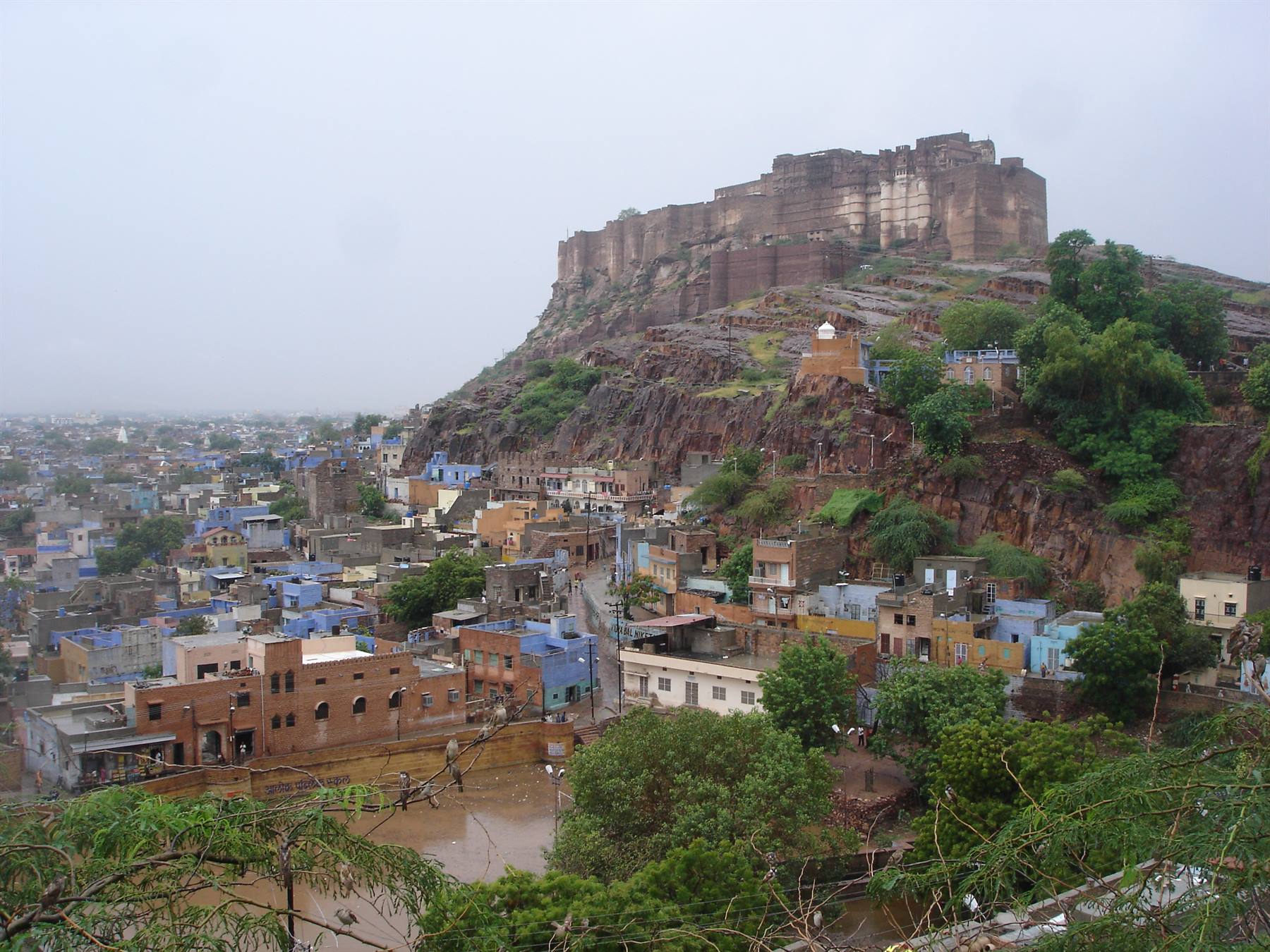
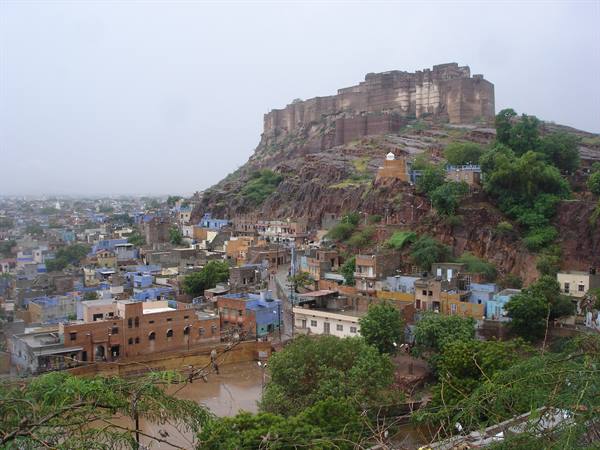
If Jaipur is the pink city, Jodhpur could be called the blue city, because of the typical blue colouring of its houses. Initially the colour indicated the house of a brahmin because many centuries ago, according to tradition, some of them painted their houses this colour after discovering that it kept mosquitoes away. Today Jodhpur is the second city of Rajasthan, but in many respects it has not changed compared to the old fortified city that grew up at the foot of Mehrangarh Fort. Wake-up at 08:30. It is pouring rain. After the first breakfast we meet up again with Vijaj in the company of the guide Ashir, heading for Mehrangarh Fort, a majestic fort, perched on a rocky slope 122 m high. The fortress is decidedly imposing and, with its walls and projecting cylindrical towers, seems to be one with the cliff on which it rises.
Following a winding climb and passing through seven fortified gates, one enters the fort. As I said, it was pouring rain and at the end of the visit we found ourselves soaked to the bone. Suffice it to say that in crossing a terrace the height of the water reached our calves. We go out in the rain and head toward the mausoleum of the maharaja Jaswant Singh II, built in memory of Maharaja Jaswant Singh II in 1899; the imposing white marble monument marks the site of the royal crematorium. The four cenotaphs portray the successive sovereigns in memory of their acts of courage and their generosity. We return to Jodhpur for lunch, hoping that it will stop raining. Unfortunately it does not, and we have to content ourselves with a car ride by the Clock Tower and the city centre.
Before returning, the guide takes us to a carpet shop? but when we enter and go down into the dark basement, the moment the lights come on we feel as if we are in Aladdin's cave: numerous objects carved in wood, iron, marble and mountains of fabrics. Inevitably I buy two pashminas (and that makes 5 since the beginning of the trip).
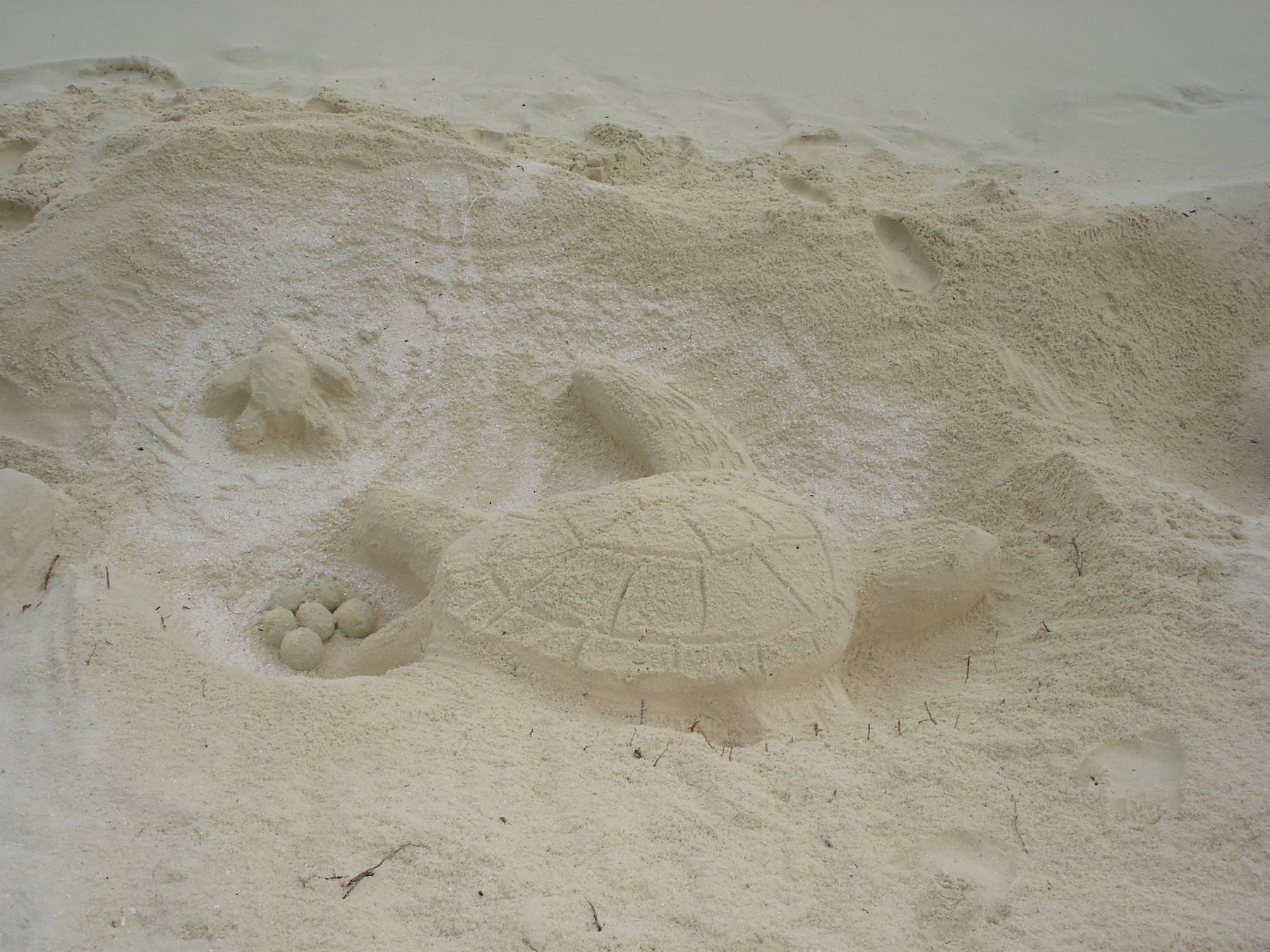
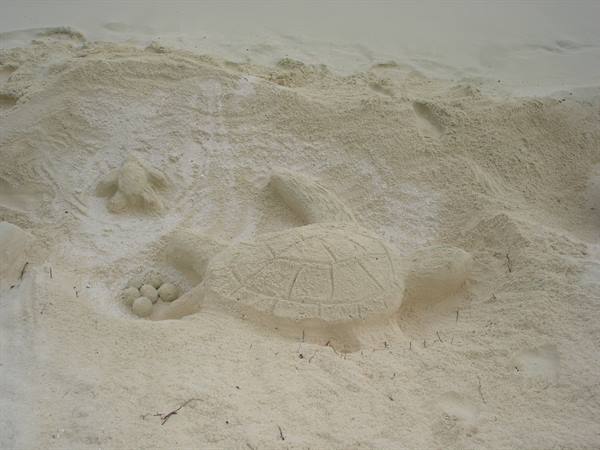
SCULPTURES ON THE SAND
Day 83 Aug 2008
TOWARDS DEOGARTH
Wake-up at 08:00 and after the first breakfast we leave Jodhpur in the direction of Deogarh (120 km – 4 hours). I always gladly appreciate the images and colours of this part of India that parade past the window. Along the way, a stop at Ranakpur.
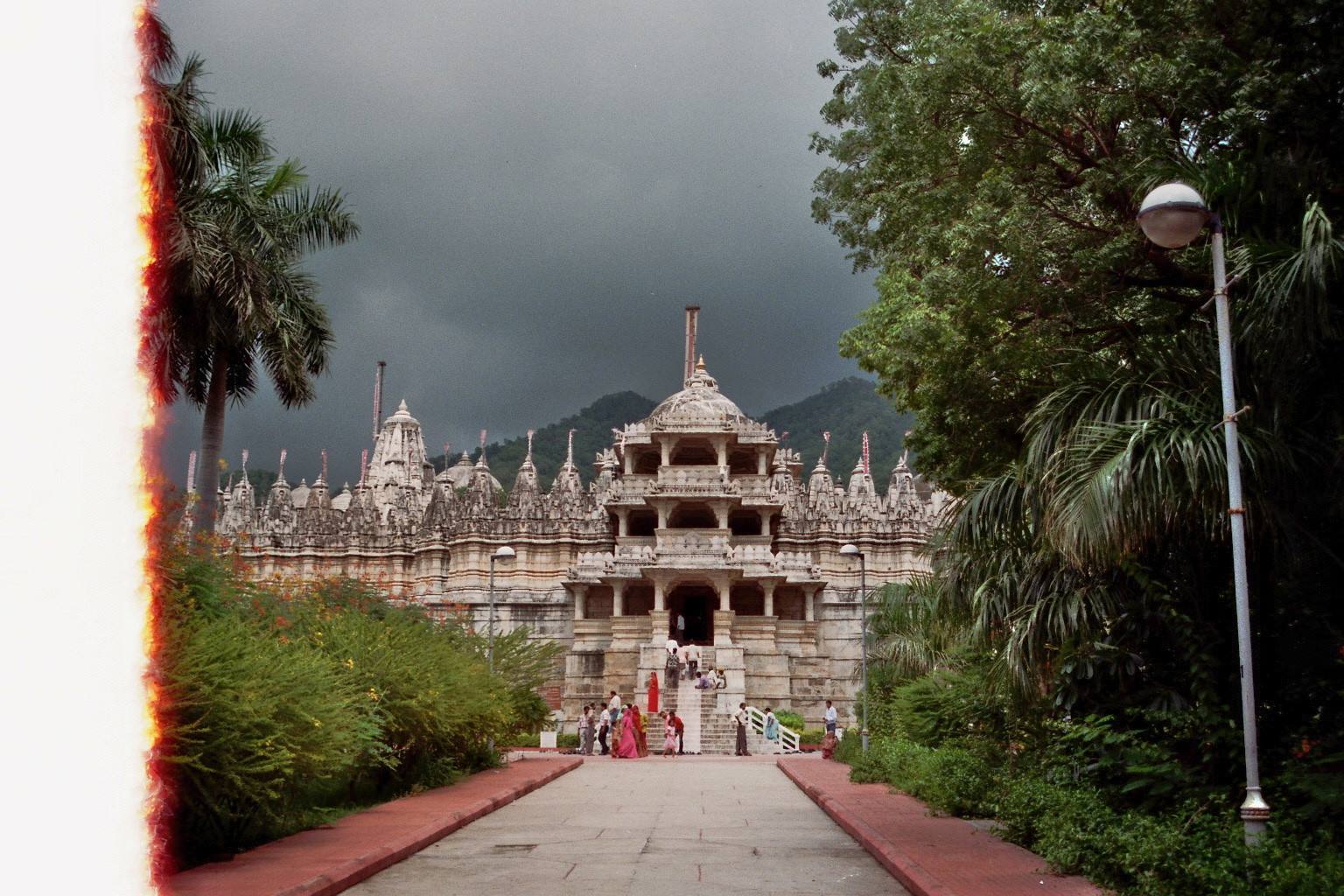
Built in a quiet valley of the Aravalli range, 60 kilometres from Udaipur, the splendid temples of Ranakpur constitute one of the largest and most important Jain complexes in India. The most important temple of Ranakpur, the Chaumukha Temple ("Temple of the Four Faces"), is dedicated to Adinath, the first tirthankar. The imposing marble temple is built on a high plinth/base, reached by a majestic staircase, and topped by three levels, of which only the first is accessible to tourists. This great marble sanctuary, richly decorated and in an excellent state of preservation, consists of 29 halls, supported by 1,444 columns all different from one another. What peace; here too we sit inside the main temple and remain in contemplation watching the visitors.
Then calmly we leave the place and return to the road toward Deogarh, which we reach in the late afternoon, and we are accommodated at the Deogarh Mahal, a castle converted into a hotel by its current owner Rawat Nahar Singh. One part of the Mahal is still occupied by his relatives.
Tourists walk toward Agra Fort's massive red sandstone ramparts
Day 94 Aug 2008
UDAIPUR
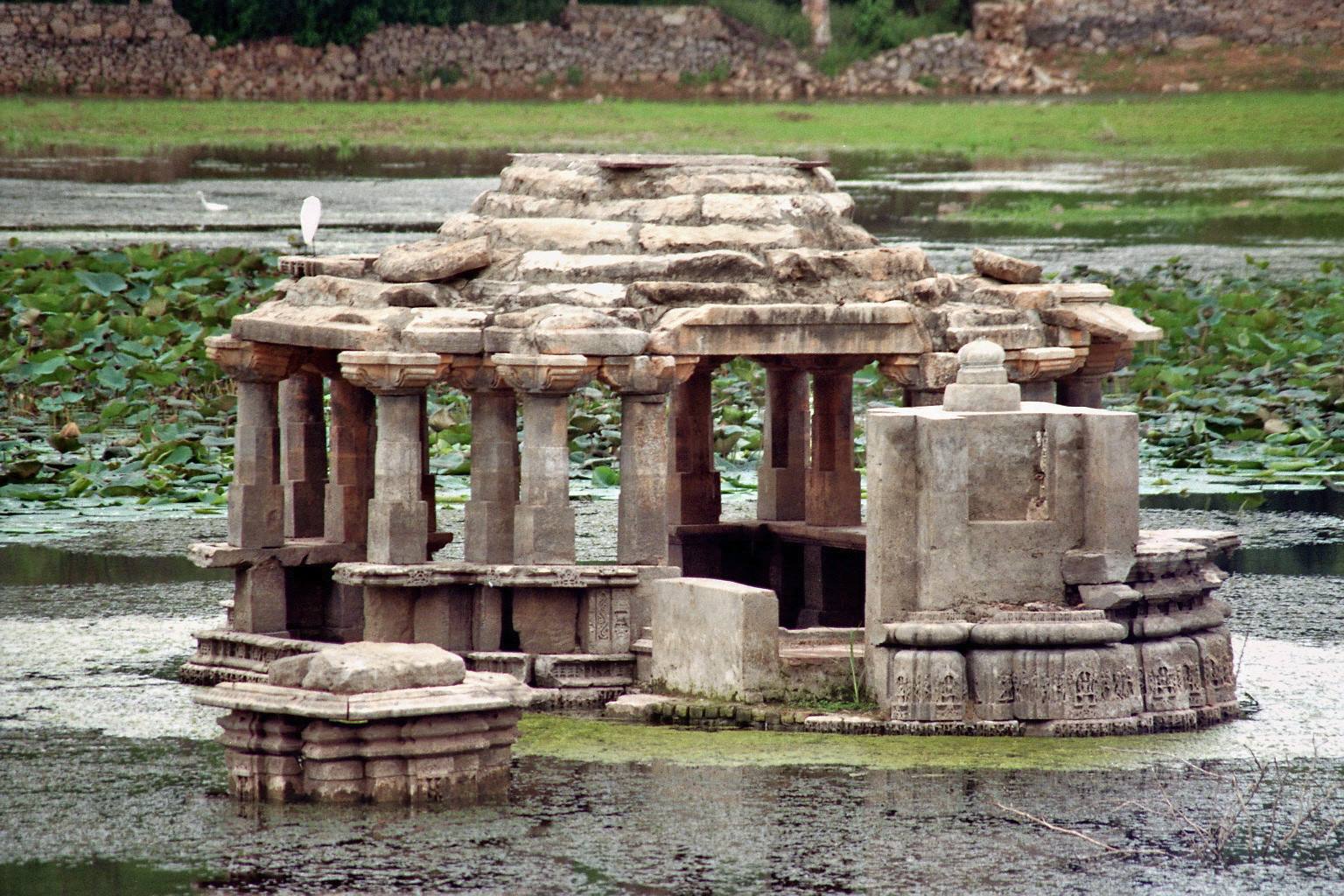
A pity that in Deogarh we spend only one night, and so wake-up at 08:00 and departure for Udaipur (135 km – 4 hours), where we arrive in the late morning. On the way our driver decides to stop in a village and invites us to visit its Hindu temple. Unfortunately I did not note down the name of the village, which I don't remember, nor the name of the lake where we find a small temple in the middle and further on another complex. Arrival in Udaipur in the late morning and check-in at the Shiv Niwas Palace hotel. We arrange with the guide for the tour on Lake Pichola in the afternoon.
It starts to rain but fortunately, while we are on the boat, we can count on a lull. Lake Pichola shelters the city along its long shores. After founding the city, the maharaja Udai Singh II enlarged it by having a masonry dam built, with which he submerged the village of Pichola, the place from which the lake took its name. The water of the lake is very low and so the tour is quickly done, even though we admire first the City Palace complex, the Lake Palace, former summer residence of the sovereigns, built by the maharaja Jagat Singh II in 1754 and transformed into the sparkling white Lake Palace Hotel by the maharaja Bhagwat Singh. The Lake Palace occupies the whole of Jagniwas, an island of about 1.5 hectares. Together with the Shiv Niwas Palace and the Monsoon Palace, the Lake Palace was used in 1983 as a film set for the James Bond film Octopussy.
Behind Jagniwas there is a smaller island called Asi Vilas, built by the former maharaja of Udaipur to enjoy the sunset. Jag Mandir, better known as "Lake Garden Palace," is situated on an island in Lake Pichola and its construction was begun by Maharana Karan Singh II (1620–1628) to be completed under his successor and son, Maharana Jagat Singh I (1628–1652). Today it is used as a luxury hotel. Besides its luxurious marble decorations, the palace is famous for its magnificent gardens, especially rose gardens, interspersed with palms, fountains and pools. Darikhana is a terrace surrounded by columns and used as a restaurant. It is said that the Mughal emperor Shah Jahan drew from this building some ideas for the construction of the Taj Mahal after having been in Udaipur in 1623. We return to the hotel and it starts raining again.
Later, dinner, a stroll along the City Palace complex and good night.
Tourists walk toward Agra Fort's massive red sandstone ramparts
Day 105 Aug 2008
UDAIPUR
Udaipur: it is considered the most romantic city in India. Wake-up at 08:30 and, as soon as we are ready, we first visit the temple, Jagdish Mandir, built in 1651 and dedicated to Vishnu. 150 m north of the entrance to the City Palace stands this Indo-Aryan temple, accessible along a staircase flanked by elephants. We climb the steep staircase and then, barefoot, we find ourselves before a tabernacle with a statue of Garuda, the half-man and half-eagle deity who is the vehicle of Vishnu. We enter the temple into a large circular hall, where several faithful sing, play drums and pray before the black stone statue of Vishnu, represented as Jagannath, the Lord of the Universe. We go out and walk around the building. The sculptural decoration is exuberant, the stone prolific in a thousand figures of elephants, nymphs, musicians and strange characters.
At the end of the visit we head back toward the City Palace, which we are about to visit. The major attraction of the city is this royal residence, the largest in Rajasthan, whose construction began in 1559 at the time of the maharana Udai Singh II (1537–1572) and was not completed until two centuries later by his descendant Sangram Singh II (1710–1734). It rises on the slope of a hill in a dominant position over Lake Pichola. Seen from the outside, the complex gives the impression of a single palace adorned with octagonal domed towers. In reality it is a complex of 4 major buildings plus countless smaller ones, connected to one another by a series of courtyards, gardens, staircases and corridors so as to constitute an inextricable labyrinth, and to visit it all it is necessary to resort to the services of a guide. Zanana Mahal was the place intended for the zenana (women's quarters).
From the windows of the City Palace we observe the Sajjan Garh (Monsoon Palace), built on the mountain range and abandoned for many years and reminiscent of a fairy-tale castle. It was built by the maharaja Sajjan Singh to house an astronomical centre and later became his residence during the monsoon season and finally a hunting lodge.
We leave the City Palace and reach our car, which takes us to the garden of the princesses, the Saheliyon Ki Bari, located in the northern part of the city. It is a small and picturesque ornamental garden designed in 1710 by Sangram Singh II for the 48 maids who formed part of a princess's dowry. There are beautiful fountains, kiosks, marble elephants and a delightful little pond on whose waters lotus flowers float. At the end of the visit we ask the guide to take us to a bazaar where we buy the last fabrics. Return to the hotel, lunch and …………. a free afternoon, sheltered from the rain that has started falling again (a pity, one could have gone to the pool).
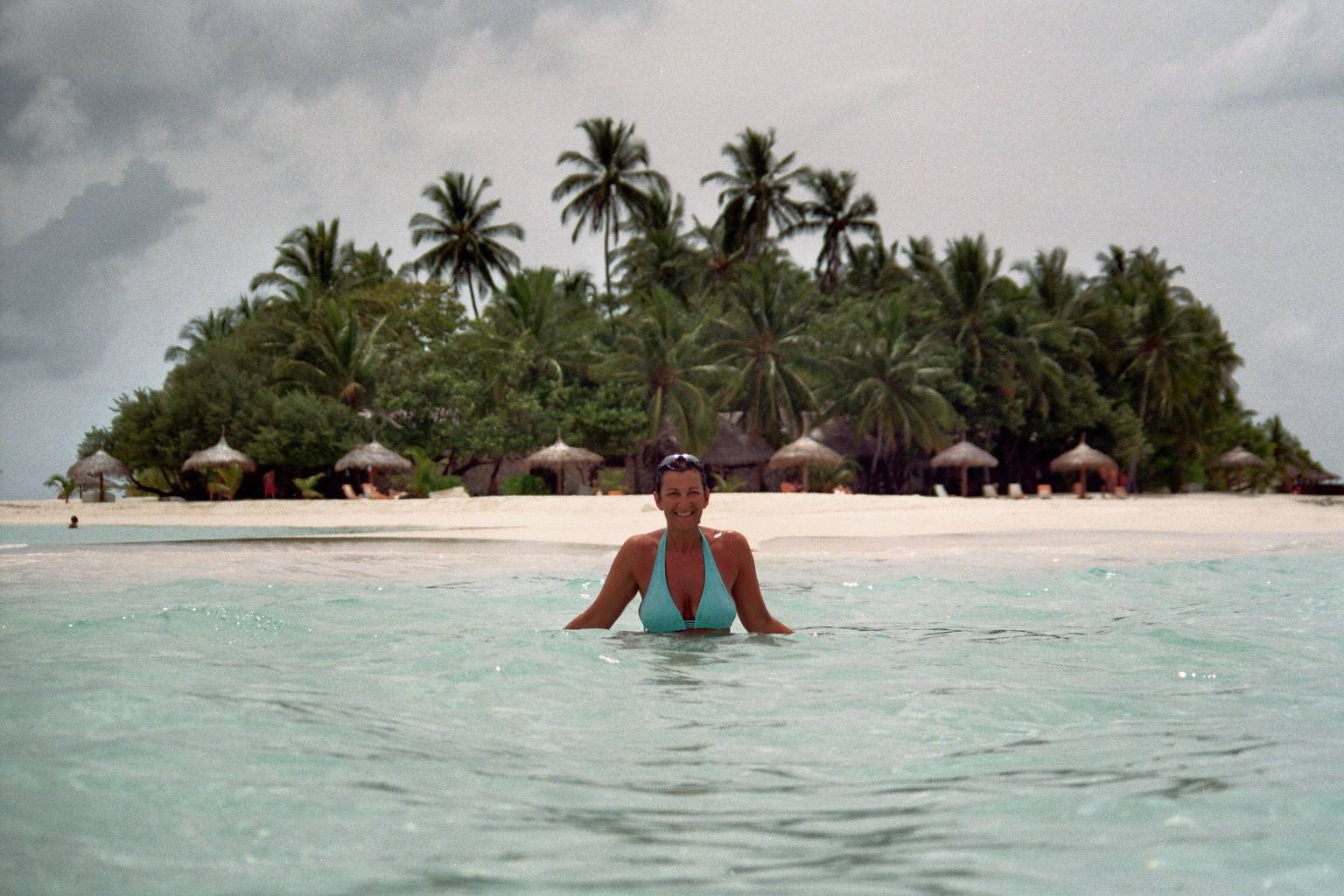
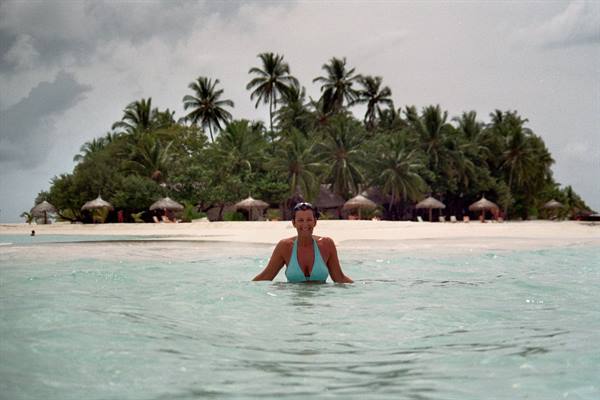
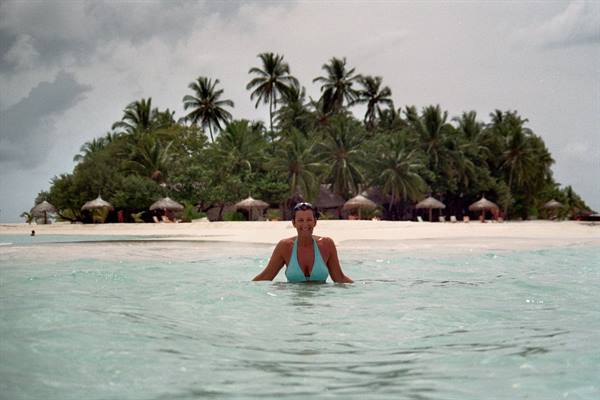
Woman in turquoise swimsuit wading by white beach with palm trees
Day 116 Aug 2008
NEW DEHLI
Wake-up at 06:00, quick breakfast and departure for the airport, where an internal flight takes us back to Delhi. We said goodbye to Vijai, who must necessarily take the Toyota Innova back to Delhi, a journey estimated at 15 hours. In Delhi we meet up again with Deepak, with whom we take a tour of Old Delhi.
Jama Masjid: one of the architectural gifts left by Shah Jahan, the Jama Masjid is one of the largest mosques, not only in Delhi, but in all of India. Completed in 1658, the mosque has three gates, four towers on the sides and two 40 m minarets, and it is built in red sandstone and white marble. The main entrance is distinguished by the number 3. Visitors must wear modest clothing (otherwise you have to wear little skirts that are provided by the custodian) and remove their shoes at the top of the staircase. The courtyard of the mosque can hold up to 25,000 people. From here it is possible to enjoy a bird's-eye view of the city.
We pass in front of the Red Fort and reach the place where Mahatma Gandhi was cremated.
Raj Ghat: a beautiful and tranquil garden in which a marble platform constantly covered with flowers marks the place where Gandhi's body was cremated. I think it is a must to read the biography of this man. Our visit to India is drawing to its end. After freshening up in one of the many hotels in Delhi located on the road to the airport, we are indeed taken to that place where we board the Sri Lanka Airways flight bound for Colombo and then onward to Male, which we reach at 01:30.
RANATPUR
Day 127 Aug 2008
MALDIVES DIGGHIRI RESORT
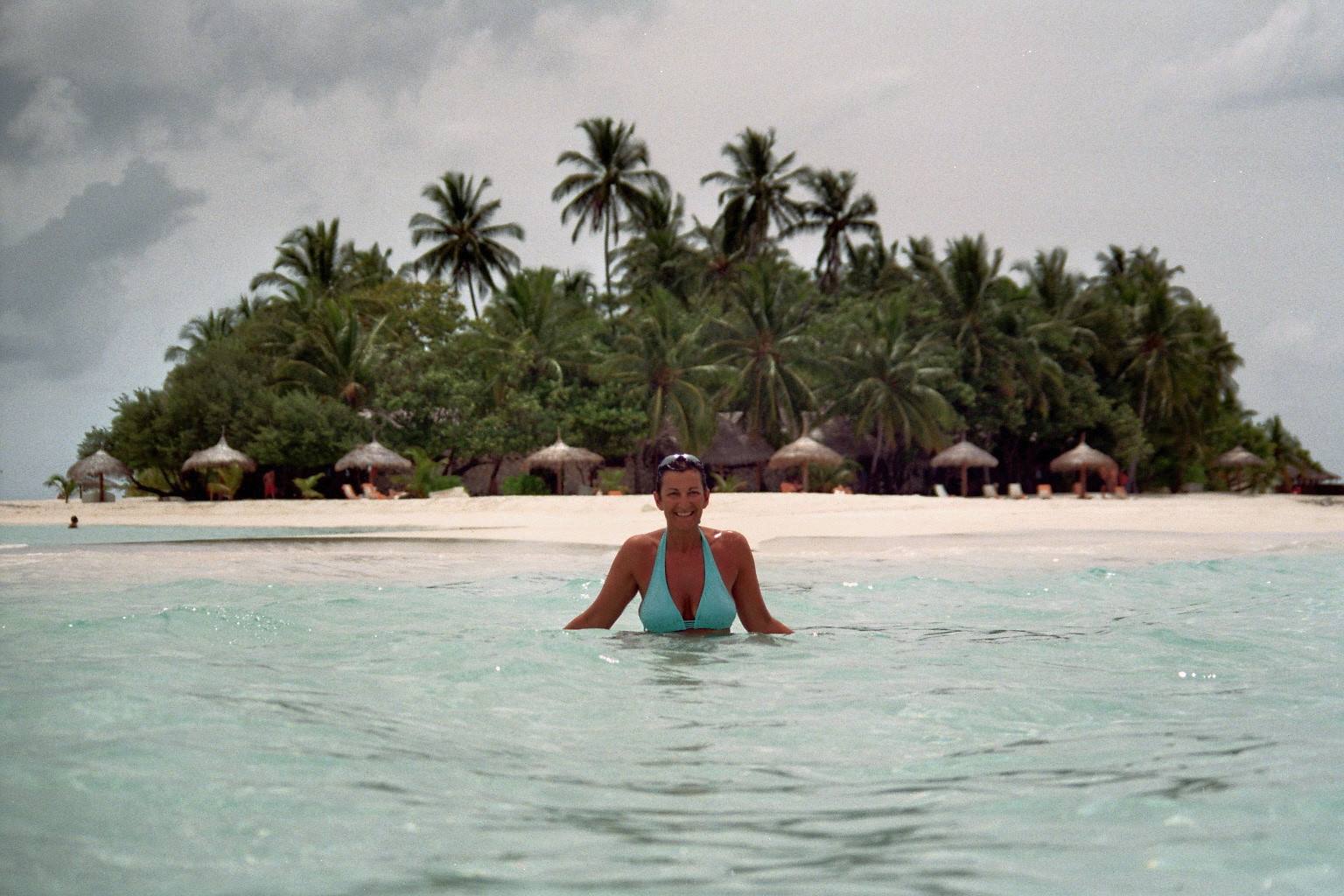
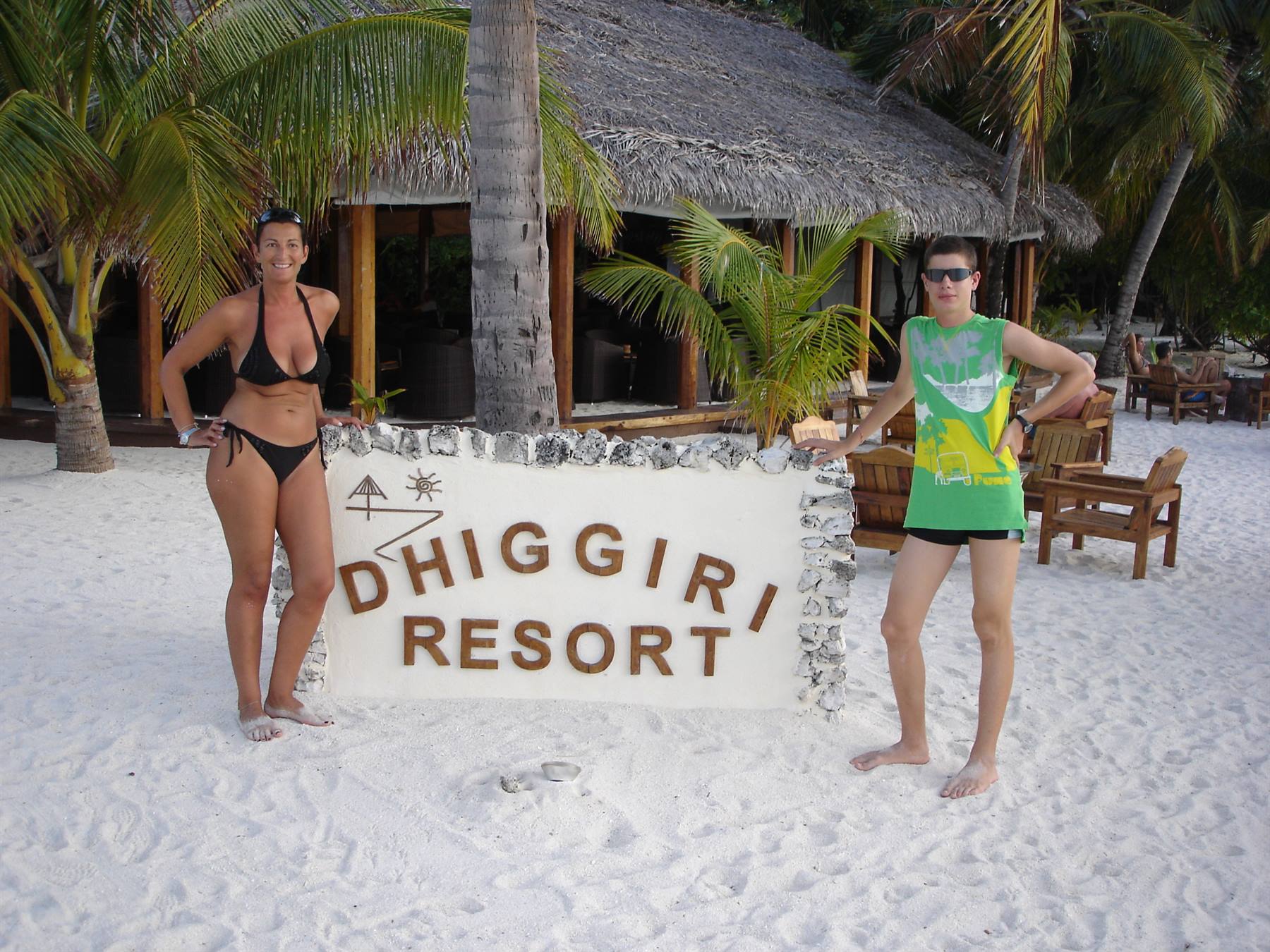
In Male we stop for the night at the Hulule Island Hotel. In the morning at 07:30 we board the seaplane that takes us to our atoll, the Dhigghiri Resort. A small island, ideal for those seeking contact with untouched nature. The island is part of the area recently declared a protected National Park. Italian-managed, in the Felidhu atoll, 30 miles from the airport, it is reached in 90 minutes by speedboat or 20 minutes by seaplane. 25 circular beach bungalows, immersed in greenery, each with a wooden patio covered with coconut leaves. 20 bungalows on stilts on the beach. Restaurant with buffet service alternating with table service. Bar with a terrace over the sea.
Here we spend 6 wonderful days in complete relaxation, with plenty of sun and sea and………….without shoes!! Truly fantastic!!! On our departure on 13.08 we say see you again to the Maldives……………we'll be back! The return flight was "fast" and without hitches, again always operated with Qatar Airways.




0 reader comments