Lake Manyara, Serengeti, Ngorongoro, Tarangire, Zanzibar · I parchi del Nord
When
24 Jul 2010 – 7 Aug 2010 15 days · trip of 2010
Who
Monica Amaglio · @Moni63 · Novazzano
How
Travel diary
The story · 8 days
Photo safari in the great parks of Tanzania with a seaside extension in Zanzibar. Tour operator: Territori Discover the World Organisation: excellent Ideal budget for quality and price: EUR 2'900'000 per person
Day 124 Jul 2010
Departure
Meeting at Milan Malpensa airport at 15.30.00 for the ritual of check-in (crowded airport) and boarding on the Egyptair flight MS704 scheduled for 17.00 but delayed to 18.15 with destination Cairo where we land after about 4 hours and 30 minutes of flight. Waiting for us is an airport employee who escorts us together with another 20 passengers to the next flight MS 849 Cairo Nairobi, delayed to allow us the transfer. And the hurry plays a nasty trick on us.
On our arrival in Nairobi two out of three duffel bags do not reach their destination: we almost pulled off a strike!! After the initial dismay, we move on to the ritual of filing the report and hope for the best, We are reminded of the joke by Diego Parasole (Zelig): "The flight generally doesn't cause problems, but then you think 'but will my bags have arrived?' When you see that your bags haven't arrived you think: Look how the way of travelling has changed: Christopher Columbus set off for unknown destinations. Now the world is all known, the only ones who still set off for unknown destinations are our bags" At the airport exit we find our driver Hamza (or Hamzar as Andrea insists) who provides his boss with the details for the baggage search.
He informs us, however, that it could take 2 or 3 days and that it will be impossible to have them available during the safari because we will already be travelling in the Serengeti. Count of the clothes available: 1 pair of long trousers and one 3/4 length, one t-shirt, two pairs of underwear, one denim jacket, 1 pair of socks and shoes as far as I'm concerned and a pair of 3/4 trousers, a t-shirt and a pair of sandals for Claudio. We ask Hamza(r) to be able to do some "shopping" on our arrival in Arusha as well as to fish out some clothes from Andrea's duffel bag (which, however, is not my size nor Claudio's).
Serengeti
Day 225 Jul 2010
Lake Manyara
After almost 6 hours of travel with the Toyota Land Cruiser provided to us by Wildbeest Safari and the crossing at the Namanga border we arrive in Arusha. A tour of the city and we stop at the "Green Hut* for lunch and from this moment the main menu becomes almost exclusively "grilled chicken" even though the manager of the place, at my hint that I am not particularly carnivorous, prepares an excellent vegetarian burger for me. The portions are and will always be abundant. We rely on Hamza(r) for the currency exchange and the replacement shopping. First in a supermarket where we buy the necessities for personal hygiene (us women's monthly visits always come at the least opportune moments and most of what we needed had been left in the suitcase!) then in a local market where after bargaining we buy trousers, shoes and sweaters. We can't find any T-shirts but we can also try again later.
The journey continues to Lake Manyara National Park for a first safari. Lake Manyara National Park consists of a strip of land about 50 km long and between 6 and 8 km wide that includes the lake of the same name and extends to the steep western slope of the Rift Valley. The park is located not far from the Masai village of Mto Wa Mbu (in Swahili: river of mosquitoes), along the road leading to the more famous parks of Ngorongoro and the Serengeti, only 130 km from Arusha. Since 1981 it has been a biosphere reserve. The northern end of the park is occupied by a dense primary forest. Then follow landscapes typical of the savannah, dotted with gigantic baobabs, acacia groves, and gallery forests along the waterways. The park is in fact crossed by many streams and by the Endabash river. At the southern end there are also the Maji Moto hot springs.
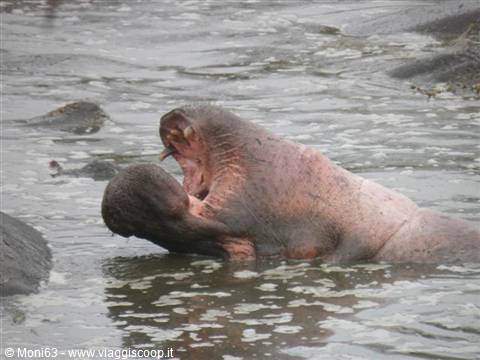
Our first encounter with the park's wildlife is with a colony of baboons, then we proceed towards the lake where we stop to admire the elegant flamingos and their pelican colleagues as they take off and land. We also manage to glimpse some hippos dozing in the water. We return to the jeep and tour a part of the park in search of other animals that we duly encounter: zebras, giraffes, antelopes and various varieties of birds. The tiredness of the journey makes itself felt and Hamza(r) also tells me that he hasn't slept for 24 hours.
We leave the park intending to return the next day for further exploration (we arrived late given the problems at the airport) and return to the Twiga Lodge / Camp Site where we stay overnight in a comfortable and spacious room and where an abundant dinner awaits us, at the end of which we take a stroll around the Camp Site: there are many tents ready for the night. Many tourists choose the camping option with a cook and a driver following them. We return to our little house and………….good night, sheltered under the mosquito net.
Tarangire
Day 326 Jul 2010
Serengeti
Wake-up at 07.00, breakfast in the company of Hamza(r) (the previous evening he didn't manage to join us for dinner, he collapsed before) we load the few bags (not everyone uses a cabin trolley as a backpack!! and to think we were undecided about the size of the backpack to bring, which was left in one of the abandoned duffel bags) we do a second safari in Lake Manyara National Park without, however, the luck of encountering ferocious big cats. At the end we take the road towards Serengeti National Park with a stop in the Ngorongoro Crater reserve for a picnic lunch: chicken, hard-boiled egg, bread, banana, biscuits and fruit juice. In the early afternoon we reach Serengeti National Park, one of the most important protected natural areas of East Africa.
It has an area of 14,763 km², and is located in northern Tanzania, in the plain of the same name, between Lake Victoria and the border with Kenya. It is adjacent to the Kenyan Masai Mara park and to other important wildlife reserves. It was declared a UNESCO World Heritage Site in 1981. The park represents one of the main tourist attractions of Tanzania, and the most important of a system of four protected natural areas called the "Northern Safari Circuit", which also includes Lake Manyara National Park, Tarangire National Park, Arusha National Park and the Ngorongoro Nature Reserve. The name of the park, in the language of the local Masai peoples, means "endless plain".
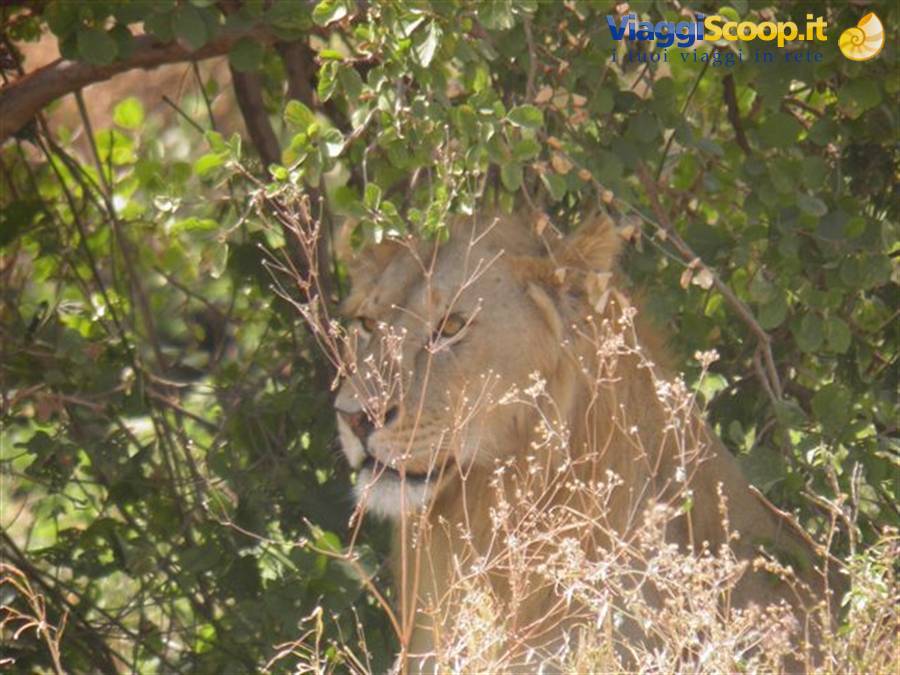
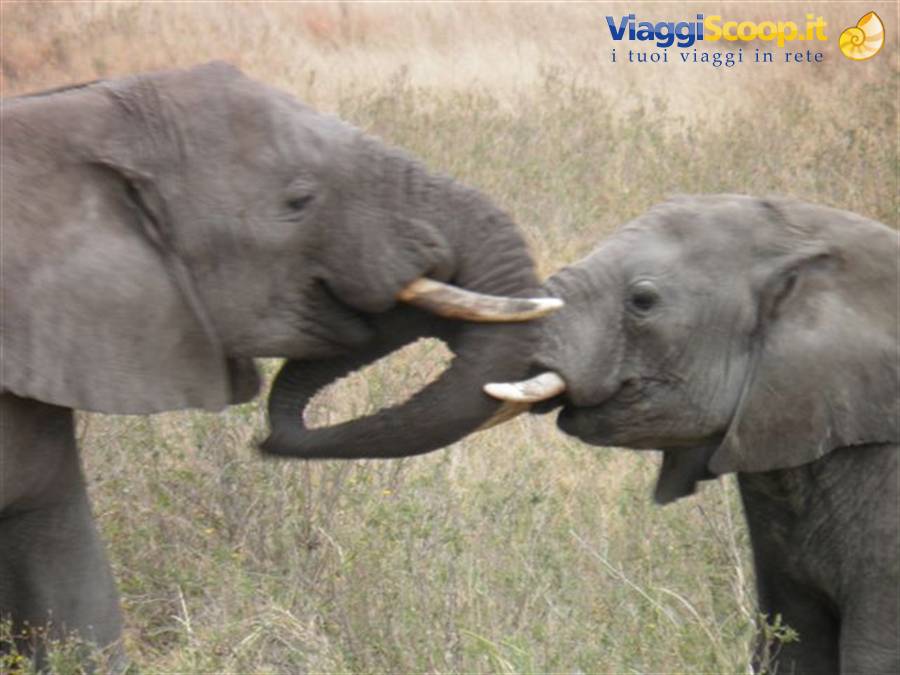
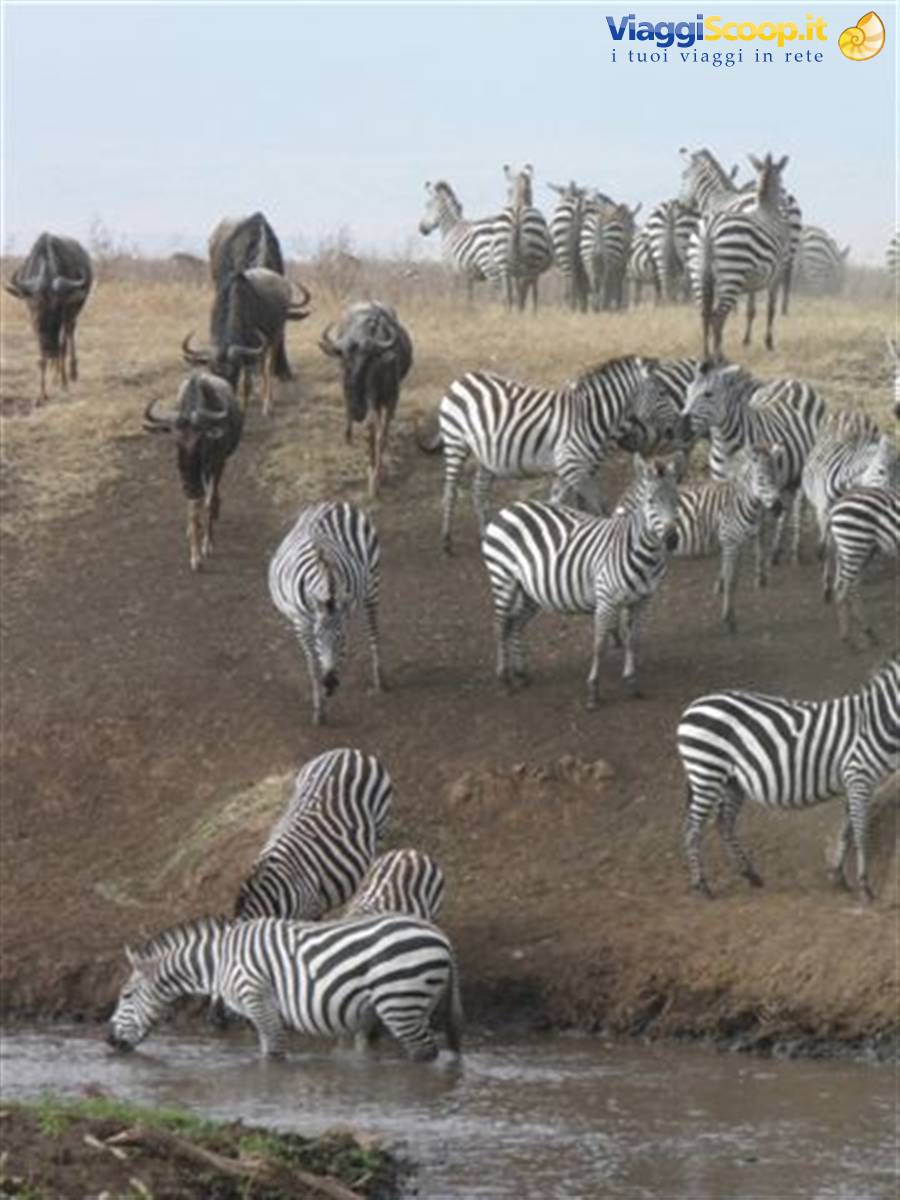
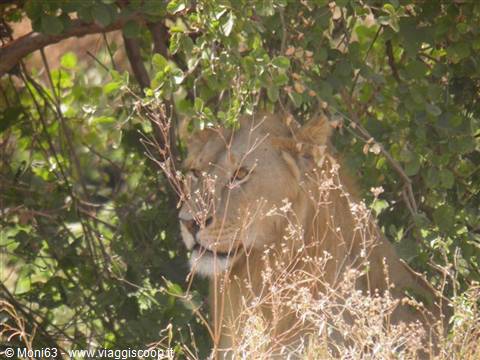
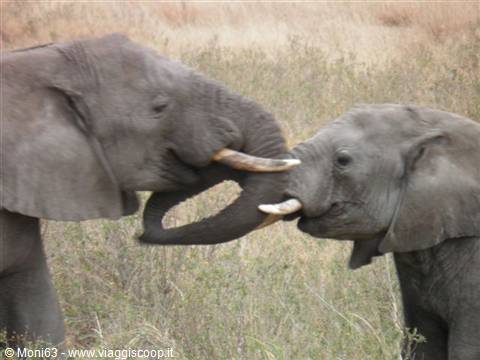
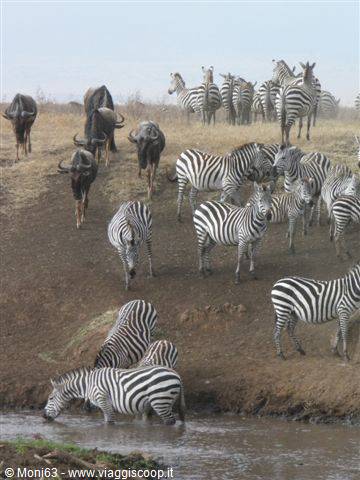
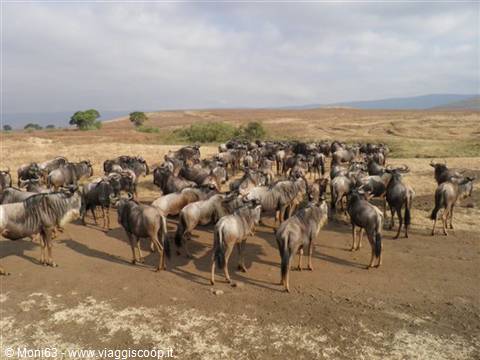
The first encounter is with some giraffes right at the entrance to the park, then ostriches, antelopes, some hyenas, the first elephants and in particular the first group of lions, a good 8 adults that are consuming their meal. From our observation point you can hear the crunching of their jaws on the bones of the dead animal. There are also some cubs that the tall grass hides from us and we cannot see well. At the end of our week of safari there will be a good 48 lions encountered. We continue our tour among giraffes, zebras and wildebeest. The latter, as Hamza(r) explains to us, are bosom friends (the herd is always made up of zebras and wildebeest) because they protect each other in case of danger. Time flies and the kilometres covered are many. Our driver realises he is slightly late in leaving the park, by 18.00, and so at great speed we head to the exit, which we reach at 18.05.
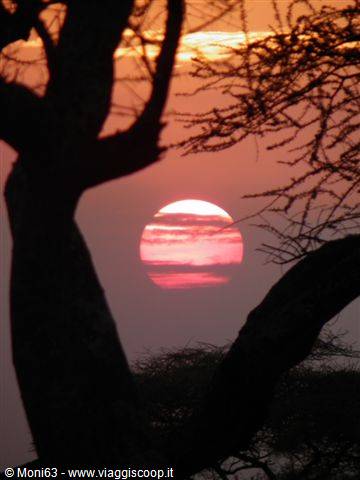
Then we push on to our refuge for the next two nights, Ikoma Safari Camp ( where two original large and cosy tents await us along with the warm hospitality of the manager Pepe. We watch the sunset, shower and dinner for all the guests at 19.30 then…………off to bed.
Serengeti
Day 427 Jul 2010
Serengeti
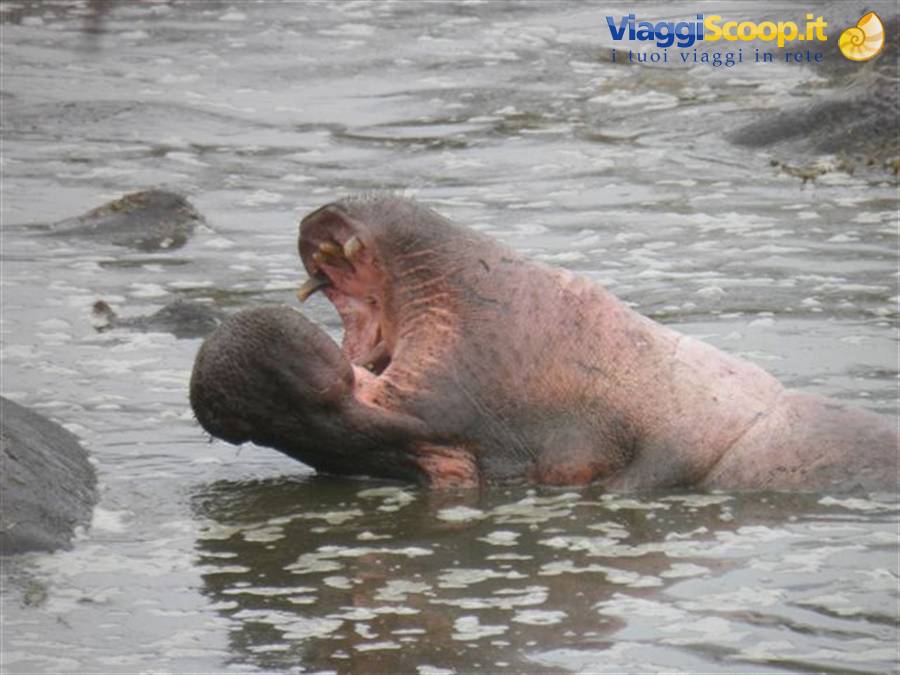
Wake-up at 07:30, breakfast outdoors under a straw roof, and after being reunited with Hamza(r) we set off again for the Serengeti. We encounter another of the big five, the buffalo, then we stop at the "hippo pool." Honestly, even if we hadn't seen the sign we would have realized who populated it from the unmistakable smell hanging in the air. On the shore there are also some crocodiles.
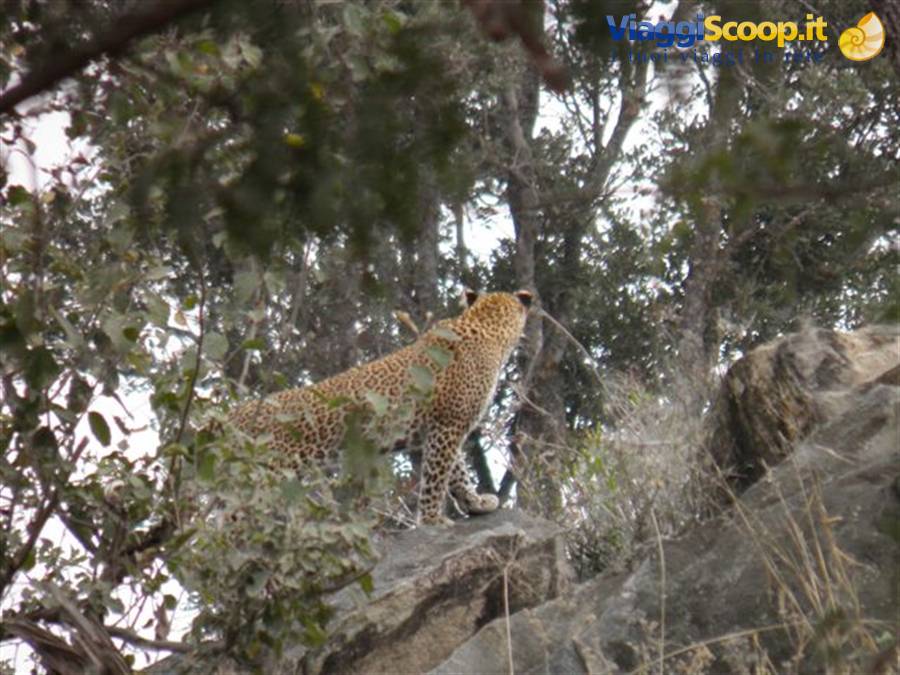
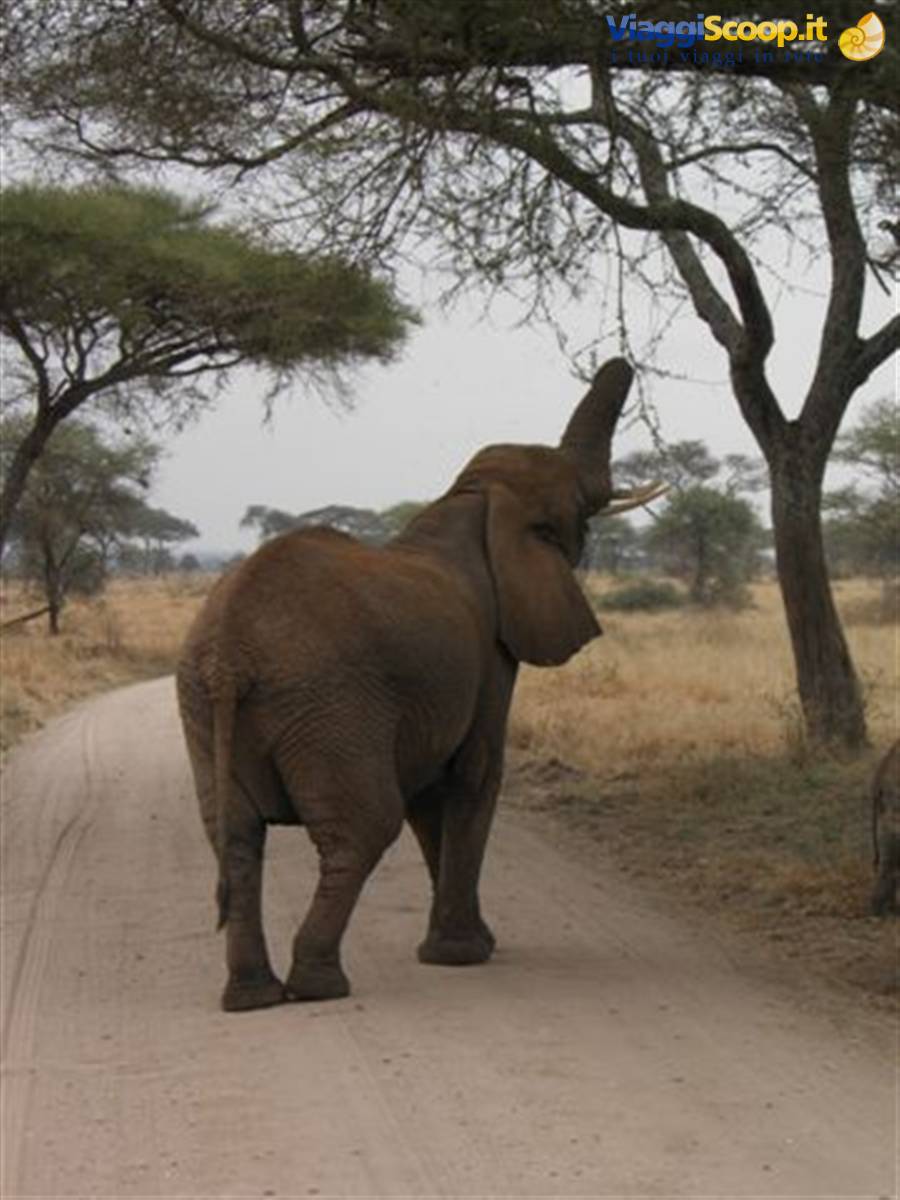
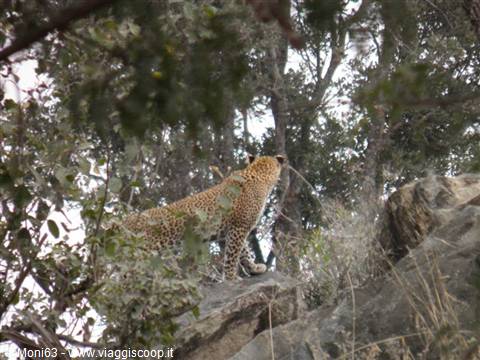
The day unfolds through the park's landscape, following the various tracks that bring us closer to the animals: zebras, elephants, warthogs, lions rolling on the ground like cats, varieties of birds, and only in the afternoon after our picnic at the park's "tourist site," where I buy a spare T-shirt (clean and in the color I want, only in XL!) for $20 (when you're looking for T-shirt vendors for a few euros you can't find them), we have one of the encounters we were hoping for: a leopard "perched" atop a tree while on the nearby one its prey is lying. Unfortunately we were far away, but with the help of binoculars and a camera the feline was captured forever for our memories. We leave the park on time and return to camp for our evening.
Ngorongoro Reserve
Day 528 Jul 2010
Towards the Ngorongoro reserve
After breakfast, we leave the Ikoma Safari Camp and re-enter the Serengeti National Park for one last morning safari. We still have one animal to find, the cheetah. Hamza(r) heads toward the most likely area. We drive around for a long time without encountering any living beings except for a few zebras, then finally our search is rewarded by the sight of no fewer than 3 cheetahs busy with their meal. Our guide explains how unusual this number is because the cheetah does not live in groups. They are three brothers. At the end of the meal they move away and their place is immediately taken by some hyenas and by the vultures that had been fluttering about waiting for their turn. After lunch we leave the Serengeti satisfied and head toward the reserve and the most famous crater in the world, that of Ngorongoro.
Before reaching the reserve, we stop at Olduvai Gorge, an important African archaeological site. It is a depression about 40 km long, enclosed by steep walls, located in the Serengeti plain. The finds made in this area have played an important role in understanding the development and origins of the human species. At the end of the visit we reach the Rhino Lodge ( and an evening and nighttime temperature ranging between 10 and 0 degrees!! How I miss my padded, lined fleece left sleeping at the airport. Dinner and a night's rest.
Zanzibar - Mnarani beach Cottages
Day 629 Jul 2010
Ngorongoro Crater
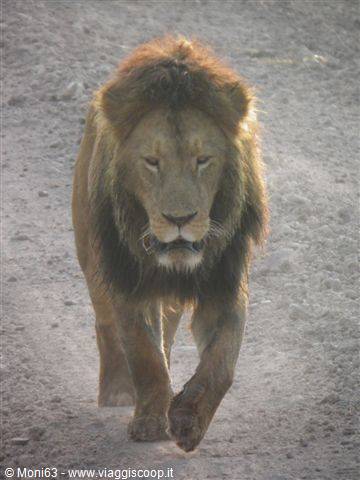
Wake-up at 06:00, breakfast in the company of Hamza(r), and descent into the Ngorongoro Crater. It is a volcanic crater and the area around the crater constitutes the Ngorongoro Nature Reserve. It lies at 2,200 meters above sea level, measures over 16 kilometers in diameter, and occupies a total area of about 265 square kilometers. It is the largest intact caldera in the world. Along the crater's rim runs a single road, on the southern side. There are four roads connecting the rim with the interior of the crater; the route takes about 30 minutes by off-road vehicle. The air is chilly, but the sight of three male lions coming toward us on the track makes us forget the clouds and the cool breeze. It seems incredible how close they are and how they snub us with their slow, lanky gait.
We leave the lions and continue our tour among zebras, wildebeests, varieties of birds, ostriches, buffaloes, lionesses with cubs, elephants, jackals, hippos, baboons. The rhinoceros is missing from the roll call, even though Hamza(r) spotted one in the distance, but from where we are it looks like a dot in the middle of nowhere. Picnic on the shores of the lake and then, after another tour, we climb back up the slopes of the crater and leave the reserve. Hamza(r) hurls himself at breakneck speed down the downhill road, but we all arrive in one piece at the end of the ride. During the safari our jeep had some cooling problems and Hamza(r) decides to stop in a village to fix the gasket.
While he is busy with the mechanic we take—or rather try to take—a little stroll around, but we are immediately "assailed" by various vendors, so at the end of the stop we find ourselves with 10 little necklaces, a painting, a T-shirt, and a flag of Tanzania. We satisfied everyone with a few dollars and by giving away a few phone earbuds (which they had given us on the plane). We get back on the road and it takes us to Tarangire National Park and to our lodging, the Tarangire River Camp ( or We are assigned a tent for 5 people, spacious and cozy: a real luxury. Dinner served for everyone at 19:30 and then, after a stop at the bonfire, the evening comes to an end
Zanzibar
Day 730 Jul 2010
Tarangire National Park
Breakfast at 07:30 and then a visit to Tarangire National Park, a protected natural area of northern Tanzania. It is located about a hundred kilometers west of Arusha, on the road leading to Dodoma, southeast of Lake Manyara. It takes its name from the Tarangire River, which crosses it. Before entering the park, one of their staff floods the jeep with insecticide to prevent a tenacious type of mosquito from following us (I didn't understand which "mosquito" it is). We spot the first zebras, then a traffic jam of jeeps tells us there must be something big. And so it is: hidden among the rocks, a leopard. We wait patiently and after 30 minutes here comes the spotted coat of the feline, which shows itself to us for 10 minutes and then disappears into the vegetation. We continue our tour among lions, elephants, giraffes, zebras, wildebeests, antelopes, gazelles, dik-diks, warthogs.
A stop for lunch with a nice surprise. Instead of the usual bag, Hamza(r) unloads a cooler containing a picnic blanket, meat rolls, fruit, carafes of tea and coffee, baskets with fresh bread, fruit juice, cutlery, glasses, cookies. After the refreshing stop we resume the park's tracks, admiring not only the fauna but also the flora and vegetation. The landscape of Tarangire compared to parks like the Serengeti is more verdant; around the river there are extensive swamps and floodplains, but also woods. It is the Tanzanian park with the highest concentration of baobabs. At the end of the long day we return to camp for a refreshing and relaxing shower and the last dinner of our safari week.
Serengeti
Day 831 Jul 2010
Zanzibar
We leave the Tarangire River Camp at 08:00 for Arusha and above all for the Impala Hotel, where we are reunited with our luggage. During the trip I chat with Hamza(r) about religions, politics, and sports. When he asks me which sports are practiced in Switzerland, besides skiing and ice hockey, I also mention soccer, swimming, and tennis, naming our best tennis player Roger, whose name lights up a look of surprise on Hamza(r)'s face: "do you come from the same country of Roger Federer? He is a very great and famous person!" Well, who would have said that we Swiss are known also for Roger's sports results and not only for chocolate, cheese, watches, banks, and UBS's troubles!! Great Roger. Arusha airport is not very big and is the departure point for fly-in safaris.
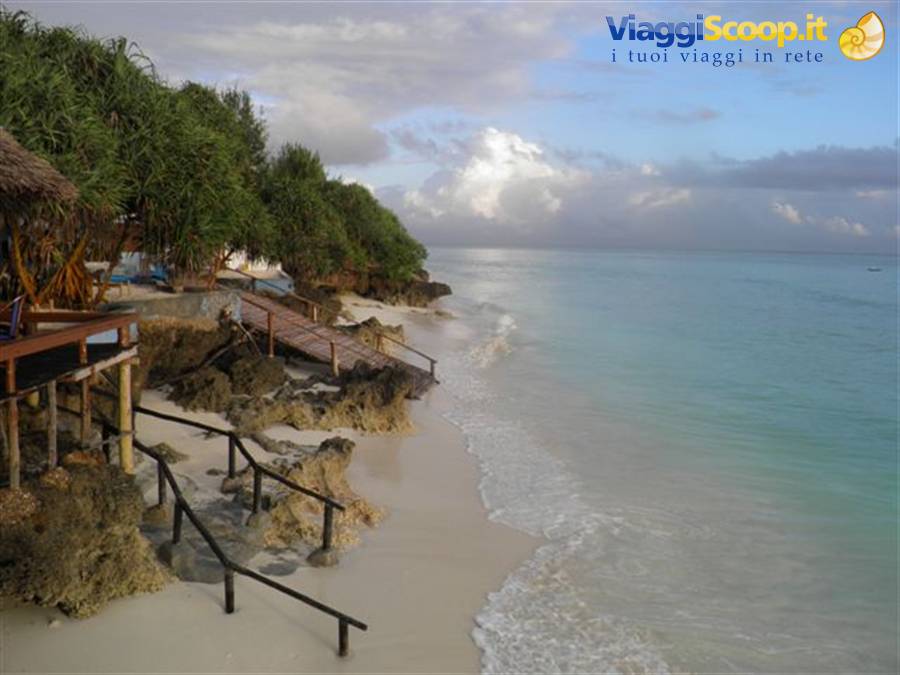
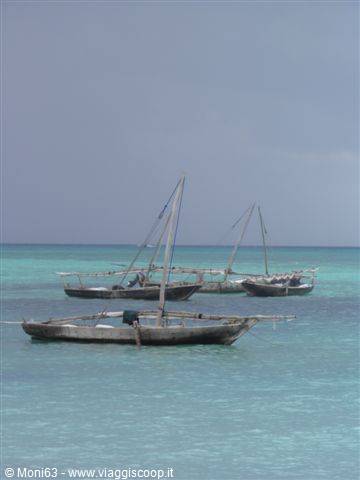
We say goodbye to and thank Hamza(r) and proceed to a very distinctive check-in: everyone in line (which extends outside the small office), weighing of luggage and hand transport of the same by the airport staff, open-air waiting room, and do-it-yourself boarding gates. But even better in Zanzibar, where your luggage is handed to you by hand over a counter. This time they're all there and at the exit we find the minibus from the Mnarani Beach Cottages ( where we have booked a standard and a deluxe room. 31.07.2010 – 06.08.2010 Days of full relaxation, with clouds, rain, sun, and sea between the high and low tide of the Indian Ocean. The rooms are spacious and well laid out; as for the food, lunch is excellent because it's à la carte, while in the evening we didn't always enjoy it to the fullest, except for the grill. The staff always kind and helpful.
Sono Grazia da torino.
Complimenti per il diario sui parchi del nord Tanzania.
Anche noi vogliamo fare più o meno il vostro viaggio il prossimo inverno : anche noi voliamo su Nairobi e poi ci trasferiamo ad Arusha con un bus privato.Ti disturbo perche vorrei sapere:
-voi avete fatto il visto di ingresso in Tanzania qui in Italia oppure direttamente alla frontiera di Namanga ?
Sento in giro pareri discordanti e non sappiamo come fare!
- alla frontiera di Namanga vi hanno chiesto il certificato di vaccinazione per la febbre gialla?
- sappiamo se fare la profilassi anti.malarica oppure no.
Scusa le tante domande e grazie da GRAZIA
Moni63 · 11/10/2011
ciao Grazia, sono contenta che il mio diario ti sia piaciuto.
Abbiamo effettuato il visto direttamente alla frontiera di Namanga e anche quello per il Kenia la puoi fare alla dogana di Nairobi. Avevo con me il certificato della vaccinazione della febbre gialla ma il funzionario non l'ho controllato forse perché ha visto che ce la avevamo. Non sono molto per le vaccinazioni ma una mia amica è rimasta tre settimane in ospedale perché aveva contratto la malaria (che può ripresentarsi in qualsiasi momento) quindi abbiamo preferito effettuare la profilassi. Spero di esserti stata utile. Non so se tu sei già stata in Africa sopratutto quella nera ma armati di pazienza e viaggia ai loro ritmi "pole pole no arraca arraca". Buon viaggio, x me `stato stupendo. Ciao Monica





2 reader comments
Sono Grazia da torino. Complimenti per il diario sui parchi del nord Tanzania. Anche noi vogliamo fare più o meno il vostro viaggio il prossimo inverno : anche noi voliamo su Nairobi e poi ci trasferiamo ad Arusha con un bus privato.Ti disturbo perche vorrei sapere: -voi avete fatto il visto di ingresso in Tanzania qui in Italia oppure direttamente alla frontiera di Namanga ? Sento in giro pareri discordanti e non sappiamo come fare! - alla frontiera di Namanga vi hanno chiesto il certificato di vaccinazione per la febbre gialla? - sappiamo se fare la profilassi anti.malarica oppure no. Scusa le tante domande e grazie da GRAZIA
ciao Grazia, sono contenta che il mio diario ti sia piaciuto. Abbiamo effettuato il visto direttamente alla frontiera di Namanga e anche quello per il Kenia la puoi fare alla dogana di Nairobi. Avevo con me il certificato della vaccinazione della febbre gialla ma il funzionario non l'ho controllato forse perché ha visto che ce la avevamo. Non sono molto per le vaccinazioni ma una mia amica è rimasta tre settimane in ospedale perché aveva contratto la malaria (che può ripresentarsi in qualsiasi momento) quindi abbiamo preferito effettuare la profilassi. Spero di esserti stata utile. Non so se tu sei già stata in Africa sopratutto quella nera ma armati di pazienza e viaggia ai loro ritmi "pole pole no arraca arraca". Buon viaggio, x me `stato stupendo. Ciao Monica