ONE COUNTRY, ONE DREAM Flying to Cambodia would have been convenient and immediate, you just had to fork out 170 dollars and you were in Phnom Penh (simply read Pnom Pen) in an hour. By bus the story is different: you pay 6 dollars, you cross the border on foot and it takes eight hours. Obviously we choose the bus. We say goodbye to Saigon and Vietnam, and after three hours we arrive at the border, at Moc Bai. The Vietnamese have built a huge granite building, where they have us sit down. We're all tourists, no more than 50, and two Buddhist monks with improbable woollen caps. It's very hot, above all they make us wait a long time. Almost two hours, just to leave the country. The olive-green uniforms have arrogant and obtuse faces, the faces of those who think they hold the whip hand, and don't know they're just a little stupid.
These faces don't look at yours, when you leave Vietnam, they just smile, indolently, among themselves. And take too long, to register your departure. They manage it, finally, and we're in no man's land between the two countries. Burned by the sun, Cambodia begins there. And it begins with a series of shacks, where the soldiers wait for us. There are no queues or waits: they glance at faces and visas, have us fill in a form, and in five minutes we're enlisted. Just beyond the border, another bus awaits us, which will take us to Phnom Penh. About three hours, to the capital, on a road that allows you to go a bit faster than in Vietnam, given that in Cambodia there aren't so many cars: above all pigs, and cows, and dogs, to avoid. We arrive in the city around 5 pm: the usual crowd of people offering lodging, food.
Our choice, for the hotel, isn't a happy one, but Cambodia can't offer the quality of Vietnam, not always at least. And if there's no hot water, or if the air conditioning has gone mad and you can't turn it off, you have to make your peace with it. And you do so quickly, because this country is a dream, a marvel. Because here you're assailed by mutilated people, cripples, the blind, dirty children, and alone, and in rags, and by thin and hungry little girls. And you feel awful, of course, but you also feel wonderful, because it really feels like being in the heart of Asia. In Vietnam they look at your mobile phone with interest, whereas in Phnom Penh, if you look at your mobile phone with too much interest, you risk getting squashed by an elephant when you cross the road. Here there's a different air, magical, and you can't help loving Cambodia.
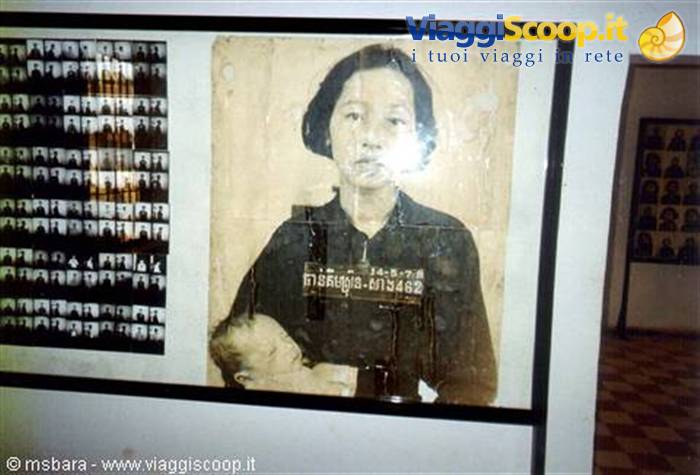
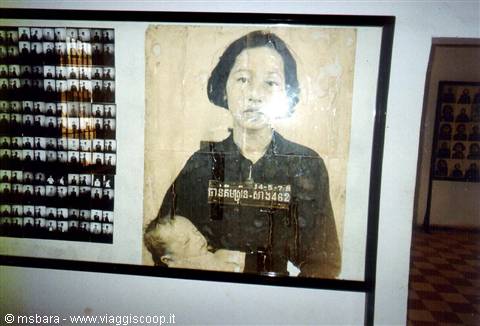
A country that has suffered the unimaginable, that in Pol Pot's extermination camps, the next day, we saw piles of skulls, and mass graves, and human bones everywhere. And only Cambodia, I believe, could have given birth to the S21 school-prison, where the Khmer Rouge, until 1979, tortured those they considered counter-revolutionaries. And they brought more than 14,000 people there, children included, and killed them all: all except seven miracles, saved by the arrival of the Vietnamese. In their lucid madness the Khmer, before torturing and killing them, photographed those 14,000, filed them, registered them. And now, when you walk among the classrooms of S21, you can see, in the photos, the faces and eyes of all those dead who weren't dead yet but knew very well they would die, and you can't help feeling awful, and you can't help loving the new Cambodia.
A young country, that has lost entire generations (1.8 million dead between 1975 and 1980, about a quarter of the total population), and that is trying to start again, after years of oblivion and of infinite pain, which there no family was spared from that madness. Phnom Penh is an extreme experience, and a schizophrenic one, a city that can offer S21, and boundless misery, and dirt roads right into the centre, or the incredible opulence of the Silver Pagoda and the Royal Palace, and a beautiful riverside, where the Mekong meets the Tonle Sap. And where dreams meet reality, because this, in the end, is the Asia we were looking for.
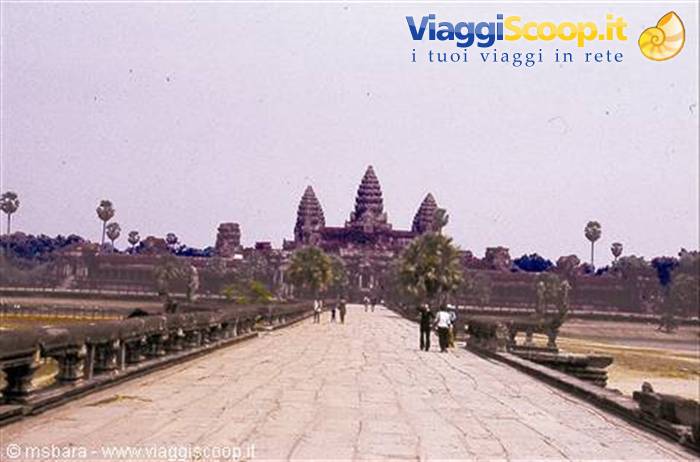
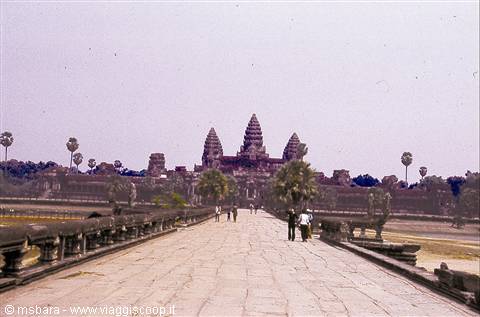
Tourists walk on the stone causeway toward Angkor Wat towers
Day 28 Mar 2005
ANGKOR, BEFORE IT'S TOO LATE The next morning the usual early rise, a boat awaits us, or rather a kind of torpedo, that will take us to Siem Reap. Three hundred kilometres of lake, in the heart of Cambodia. On board all tourists who, except the older ones, or the scaredy-cats, settle on the roof. This transfer will last seven hours, seven hours that start under the warm sun of dawn and end under the scorching sun of two in the afternoon. A sun that turns the microcosm of the torpedo, at first made up of enthusiastic observers (and photographers) of the surrounding world, into a mass of bodies flattened on the roof, cooked by the sun and exhaustion. Cooked by a boat that can't move forward, because the lake level in March is too low, and the propeller scrapes the bottom.
You have to go back, and look for a gap, and everyone move to the bow to try to lift it, this blessed propeller, and try to get there, somehow. To avoid having to spend the rest of the journey in one of the many stilt houses that adorn the lake's shores. But Cambodia is also this, indeed it's above all this, and if it weren't so you wouldn't leave your heart, and a piece of your soul, in this incredible country. Which then in the end always works out fine, and we did get to Siem Reap, even if late, and with sunburnt skin. At the pier (pier... four planks crossed just so as not to get your feet wet) two guys with the usual motorbikes await us, who take us to see the Coconut Guest House (this one I remember). We go there, but without commitment, just to take a look at the room.
Instead we then stay there, because it's nice, clean, has air conditioning, hot water and very kind staff: the price? 15 dollars. I've lost the name of the guy who carried me, as usual, while the one who had carried Virna is called Ren, and it will be him who becomes our guide for the three days we stay there. With his «tok tok», a kind of very comfortable motorised calash, he takes us where we want, to do what we want, for as long as we want. Ren is 19, speaks English as sputtery as his little motorbike, is friendly and is a dream of a person. Helpful, kind but not servile, he always laughs. At us, sometimes, but he laughs with us, more often, with a contagious, cheerful, lopsided laugh. Ren is a show, and he makes himself loved. He never says no, at most he shakes his head a little, and laughs in the face of all requests, even the weirdest ones.
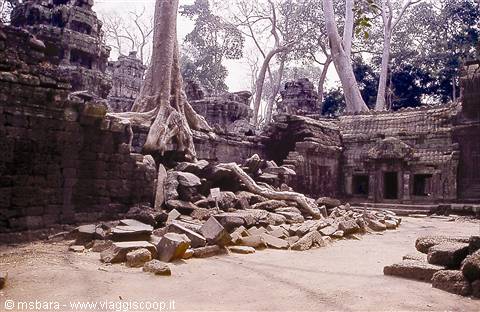
And he wouldn't want to take us to the elephants, which are «too expensive», too costly (then we did go, 15 dollars for half an hour; no Ren, they're not too expensive), but he wants to show us all the temples and palaces he can. And the next day he really does show them to us, taking us around from morning to evening. Laughing, louder and louder, when we came back to his «tok», each time more drenched in sweat, shattered by those 40 degrees. Describing Angkor Wat, or the Bayon, or the Terrace of the Elephants, or what nature is doing to Ta Prohm, simply isn't possible. You have to see it, because if the world tears its hair out over Egypt or the Aztecs of Mexico, I don't know what it's waiting for to rush here, to admire what the Khmer were capable of doing, a thousand years ago. The real ones, not the red ones.
In Siem Reap we had a wonderful time, but sooner or later it had to end, and on the third day it ended: in the evening we had a plane to Bangkok (150 dollars, against the 6 for the bus, but given the roads we didn't feel up to it, because if something broke we'd still be there), and Ren accompanied us to the airport too. In the previous two days we had given him 17 dollars, for this last run he asks for 5. Once we arrive at the airport I see that he has to pay 4,000 riel (one dollar) to enter, and I promise myself I'll reimburse him. Only that when he stretches out his hand to take the 5 dollars, he then immediately closes it again, to make me understand that those were the agreed terms. And so I reopened that hand, and dropped several dollars more than agreed into it. And he first was amazed, and then smiled, and then laughed, and then put his hand on my shoulder, and I on his.
And then he looked at us, pointed at us with two fingers and said «Love for you». Love for you too, Ren, and good luck, truly. Truly. When we climb the steps onto that plane that will take us to Thailand, we realise that the enchantment is about to end, that Cambodia is about to fly away, that Vietnam is already a memory. Soon, too soon, it will be time for memories for me too, for us too. Time to reflect, and maybe admit mistakes. Admit that we had always avoided Asia out of fear, admit that Asia isn't frightening at all, admit that Asia is fascinating and magical, and that it welcomed us as well as it possibly could. Admit that we should have come sooner, admit in the end that we'll be back soon. Very soon, if possible. Before Cambodia changes forever too.
Framed prisoner photographs at Tuol Sleng museum, Phnom Penh

0 reader comments