Dedicated to all the people dear to me who, for reasons of work, age or health, could not share the beauty and harmony of these enchanting places.
Raffaele Banfi
This is the part of the trip about Cambodia; for the complete account and the part about Myanmar, see the story in the "Myanmar" section
Day 123 Oct 2006
Towards Cambodia
Wake up, breakfast and before leaving the hotel I leave with Sosò the few kyats I have left along with some T-shirts and trousers to give to the lepers; Sosò thanks me also on behalf of his people. With all our suitcases we board the coach and, crossing Yangon one last time, we head to the airport. We stop to take the last photos of the city, we pass near the Shwedagon Paya, which was the first pagoda we visited; the sun is on the opposite side, almost as if it wanted to hide the beauty of the golden stupa, the sky is turquoise blue; I interpret this sight as a fine farewell and an invitation to return to this wonderful land dotted with thousands of golden pagodas. We quickly arrive at the airport and Sosò, with a colleague from the agency, sees to all the departure paperwork; truly an excellent and complete service provided by the Burmese agency.
Once the suitcases are checked in, we say goodbye to Sosò and the whole group, passing through check-in, stops in the waiting room waiting for the plane to Bangkok. I look at the airport, which is under construction; on the runway some planes are parked, every now and then a military plane takes off in various shades of color, green, brown, blue and white. We are in a hall of the old airport structure, and you can tell it's dated. We take off on a Thai plane; the on-board service is always excellent, the journey is enlivened by a snack of fish and rice. In my backpack I put away the Burma guide and take out the Cambodia one; I take advantage of the flight to read about the history and some information on the country we are heading to.
Moving from one state to another, even if they are close, is always a considerable mental leap; culture, history, traditions, customs that are different always create some difficulty in the immediate adjustment. The "zero knowledge" technique always works: never take anything for granted or as known, but always adapt to the country you are going to. We land in Bangkok; I can finally turn on my mobile phone and read the text messages that had arrived in the meantime; here it is mid-morning and in Italy it is still night, it is "a bit indelicate" to call at that hour.
I send text messages saying where I am and that I'm fine, and during my stay at the airport, a few calls and a few text messages arrive from Italy, "welcome back to civilization...." reads one of the messages; indeed it's true, used to the services offered by technology, not being able to communicate freely was a bit limiting. After a few hours of waiting we board an ART 72 of Bangkok Airways; the aircraft is full, we take off late. During the flight we fly over endless cultivated plains; mountain ranges seem absent, from above you only see a few small hills scattered here and there. It looks like enormous expanses cultivated with rice; I notice green patches near the villages and along the river courses, they are palm trees and stretches of forest. For several minutes we fly over flooded land; I don't understand what it is, until I notice that the water laps the airport runway.
I will later discover that it is Lake Tonlé Sap, which due to the abundant rain of the previous days is at its maximum level. We land at Siem Reap airport (L114 – M92), a city in northern Cambodia. At the airport customs we must present our passports, visas, photos and everything required by Cambodian bureaucracy. Waiting for us is a representative of the local agency, who collects all our documents and takes care of our entry; we leave the airport and board a 30-seat coach, while the suitcases are loaded onto small vans and will be delivered directly to the hotel. We get to know the guide who will accompany us during this short stay; his name is Sarath, he speaks non-fluent Italian, but with attention he is understandable. Due to the flight we are late; we should have seen the sunset over the lake from a hill, but given the time the program is changed.
With the minibus, as we approach the city we see many people on bicycles leaving the city center heading toward the countryside. Sarath explains that they are construction workers who get up at 5 in the morning, arrive in the city where they work until 5 p.m.; to get to work they travel up to 20 km. Siem Reap is 310 km from the capital of Cambodia; a state that after the Khmer Rouge dictatorship, which ended in 1979, has still not recovered. Along the way I notice that the houses are made of bamboo, teak and brick, all on stilts, and the supporting pillars are of teak or concrete. After crossing the city, we quickly arrive at Tonlé Sap (L51 – M91); the lake, due to the rains, has a very high level. We board a boat and, sailing, we see a floating village; the dwellings are built on rafts or barges; during the navigation the sun setting behind the mountains creates a suggestive effect.
We stop at a boat that serves as a shop and bar; adjacent to the boat, an enclosure in the water contains crocodiles bred for leather. We head back toward dry land in the dark; the helmsman guides himself by the stars and the reflection of the water; toward the shore a boy with a flashlight helps him illuminate the lake surface and avoid running over any pirogues. From the floating houses you can see scenes of daily life; the boats serve as homes, shops, bars, even a hospital and a church. The whole floating village follows the movement of the lake's water. After the rains the lake's surface becomes 10,000 square km, while at the end of the dry season the surface is reduced to 3,000 square km. In the dwellings, I notice men and women lying on hammocks, children playing, families at dinner, TVs working; in short, a cross-section of the normal daily life of these people.
Many Vietnamese immigrants live here, whose children, on dry land, insistently beg for charity. The calm navigation is disturbed by swarms of mosquitoes that descend on us; we dock, leave the boat and, once on the minibus, head to Siem Reap; the traffic has noticeably decreased, along the road you can see small markets. One detail catches my attention: the traffic lights are equipped with a timer that indicates the time remaining before they change color; it stops for 30 seconds on red and 30 seconds on green. The impression is of being in a country very different from Burma; here mobile phones work, many cars drive around, there are gas stations, hotels and shops appear tidy and clean; the people's features are different from the Burmese. We arrive at the hotel; it is large and luxurious, truly a different level of comfort compared to Burma.
Dinner is a buffet, with Oriental cuisine trying to come close to Western taste, or perhaps it's just an impression because we've changed country? At the end of dinner I try to go out of the hotel, but the humid heat is unbearable; I go back in and with the air conditioning it is decidedly better.
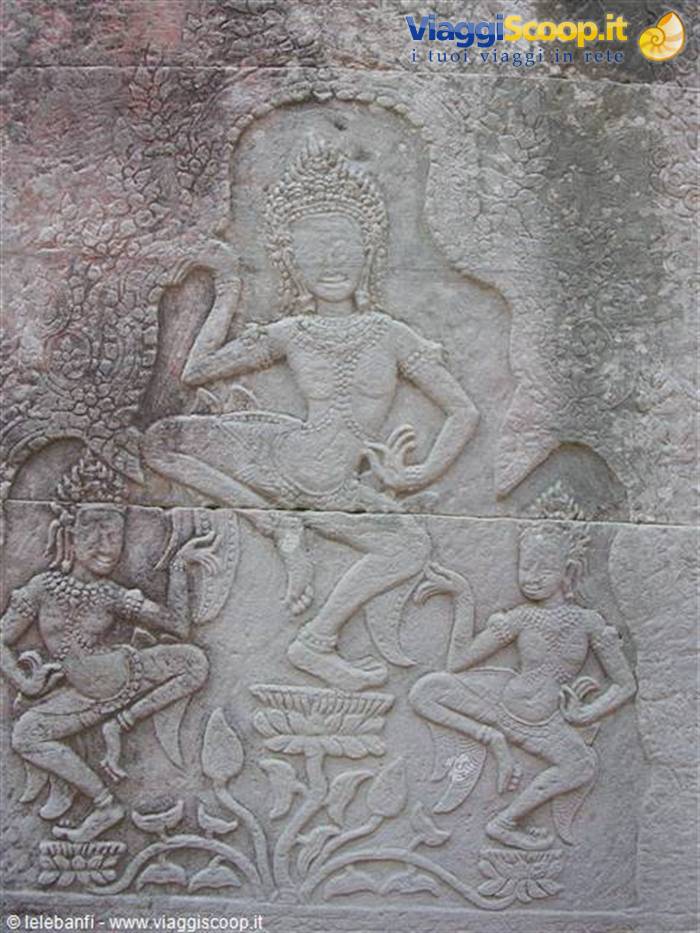
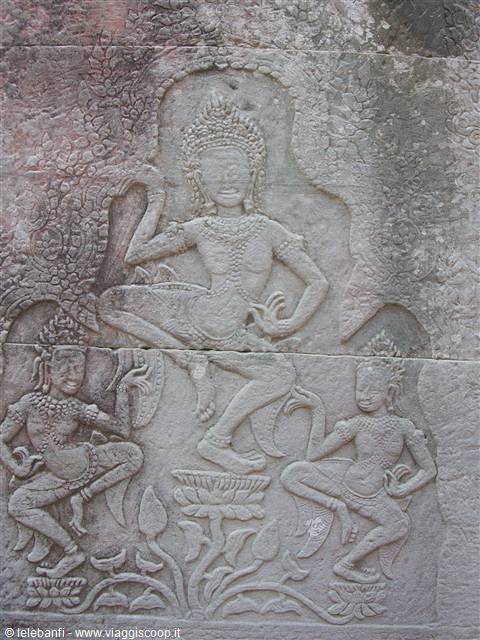
Bayon - Bas-reliefs - Dancer
Day 224 Oct 2006
Angkor Thom - Part One
Wake up at 7:00; the hotel is full of Japanese; at breakfast they look like starving locusts, devouring everything, and as tradition dictates, they are armed with every technological product; with their cameras they photograph everything, including the hotel lobby and the adjoining rooms. We set off for the day's excursions on the minibus; this is the standard for the buses that travel here, 30 seats calculated on the size of Asians; we struggle to stay seated for long, our legs are practically wedged between the seats. We set off and cross Siem Reap; Sarath, striving to speak correct Italian, explains some things about Cambodia. The nation is predominantly Buddhist at 90%, illiteracy is at 25%, 70% are peasants.
Currently the nation is focusing on tourism as a primary source of hard currency; for this reason many hotels are under construction, partly with the participation of foreign capital. The construction of the buildings I can see along the roads is curious: once the roof is finished, the exterior finishes are immediately done and then the interior work continues, as if to show off the beauty of the building. Sarath sometimes confuses Italian terms; you need a lot of attention to listen to him, and taking notes under these conditions proves a bit complex. Crossing the city we arrive at the archaeological zone of Angkor Thom (L159 – M112); we stop at a check-point, we are given personal passes with name and photo, valid for accessing the archaeological zone.
From an organizational point of view, truly a great idea to be able to tour all the temples without having to queue further to pay for tickets; this could be a model to import into our Italian cities of art. Angkor (L137 – M101) was the capital of ancient Cambodia; the temples built in the area were constructed from 802 to 1434, during the two periods of "classical Cambodia". We will see works dating from the Hindu period up to the Buddhist period; these two religions are a constant presence. The entrance to the zone is through an enormous portal set in the outer wall. The stone used for the construction of most of the temples is sandstone; the gray color of the stone blends with the green and brown of the lichens that have grown on the stone itself.
The color and shapes strongly recall the Maya temples in Mexico; after all, here the only thing separating the two cultures was "just" the Pacific Ocean. Before entering the gateway we cross a bridge on whose sides are placed statues supporting an enormous serpent, the naga, the mythical serpent of Buddhist tradition, often depicted with multiple heads, up to seven; it is a symbol much used in Angkorian architecture. These figures, positioned at the entrance, protect the entire structure. On the wall and on the door, carved into the sandstone, we see decorations depicting lotus flowers, dancers, elephants and a five-headed horse. The enormous entrance portal is decorated on the sides with a three-headed elephant.
The bridge, the statues and the portal are partially damaged both because of the forest that until a few years ago covered everything, and because of the wars and the Khmer Rouge domination, during which many monuments were used for target practice. We pass through the portal and enter what was once the religious zone and the site of the royal palace. We board two small minibuses that take us to see the monuments in this area. The stones used for the construction of these temples come from quarries 50 km away, transported here on rafts; the construction of these structures required the employment of thousands of workers.
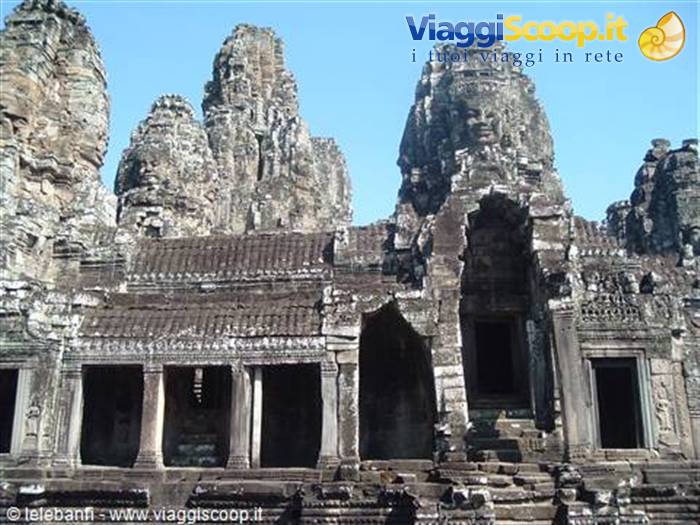
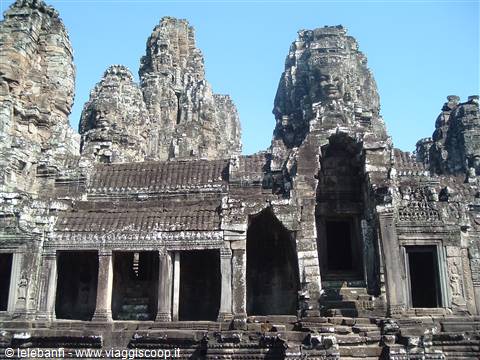
Once inside the archaeological area, the first temple we see is the Bayon (L160 – M113); the temple's name was changed under French rule; part of the structure has collapsed due to time and the advancing forest; Cambodia, having alluvial soil, is not subject to earthquakes. Starting from the outer wall you can see remains of naga supported by angels, as well as by lions; the outer wall of the temple is completely covered with bas-reliefs depicting 15 stories; the extent of these bas-reliefs is 1,200 meters. The temple, built on three levels, had 54 Gothic-style spires containing 216 gigantic faces of the king; practically, the impression while moving inside the temple is of being constantly observed and watched by the king. Entering the second level of the temple, we see stories of Buddha, with polychrome coloring from the 12th century.
Here restoration work is underway by Japanese archaeologists. From the base, the complex with its spires appears as a jumbled mass of stones; only by climbing to the third level, where unlike the other two square levels there is a circular platform, do the king's faces clearly appear and, as the builder intended, the king's gaze always watches you. The temple was begun in 1181 and finished in 1190. The symbolism identifies the ruler with the deity, and we will find this characteristic everywhere in these temples. We leave the Bayon temple and a few hundred meters later we find the Baphuon (L163 – M114), a monument that is the representation of Mount Meru, a building constructed before the Bayon; this building also has three levels, with 12 side towers plus a central one. It is currently being restored by a French team.
The temple's stones rested on a sandy bed; over time the roots of plants penetrated between the blocks, displacing them, thus allowing rainwater to penetrate and wash away the sandy bed beneath, which made the temple collapse disastrously. In 1960 the first restoration work began by the French, interrupted due to the civil war; currently the restoration continues, and thanks to photographic documentation from the last century the sandstone blocks are put back in their original position, and if they are too damaged, they are replaced with new blocks faithfully reproduced with the help of the archival documentation; today you can see two of the 12 towers, faithfully restored. The temple's entrance was to the east, preceded by a 200-meter-long sandstone platform.
We continue our tour of the immense area and, after passing a wall with a perimeter of 600 by 350 meters, we enter through a portal, restored in 1990 by Indochinese archaeologists, into what was the Royal Court (L164 – M115). The first temple we see is Phimeanakas (L164 – M115), the "Palace in the sky"; it dates back to 944. It too is a depiction of Mount Meru; it served exclusively for the coronation of rulers; two basins are visible that were used for royal ablutions. The royal palace in gilded wood stood 50 meters from the temple, but it was destroyed in the war against the Siamese. Leaving the walled perimeter we directly access (from the south) the "Terrace of the Elephants" (L165 – M115), a gigantic grandstand 350 meters long, which was dedicated to public ceremonies and circus shows; here buffalo fights, cockfights or boar fights were organized.
In the same area, when a sovereign was crowned, a celebration lasting 5 days took place. Facing each other and positioned at the opposite ends of the area, towers stand; between them ropes were strung on which tightrope walkers performed. For the Cambodian people, the terrace takes its name from the elephant sculptures carved on the facade. At the end of the terrace stands a wall with two three-headed elephants, a symbol representing the three Hindu deities.
Bayon
Day 324 Oct 2006
Angkor Thom - Part Two
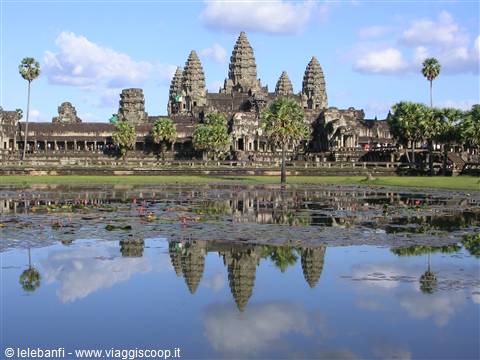
A short distance away, a smaller terrace has a statue at its top; originally it was the statue of the "God of death" and was positioned in the place where kings were cremated; people have named it "the statue of the leper king" (L165 – M115). The origin of the popular name derives from the fact that the sandstone statue has mutilated fingers and, looking at it so aseptically, it really resembles a leper. We leave the archaeological site and return to the hotel; buffet lunch, a short break and then we set off again. We return to the temple zone; check-point where the permits must be shown and are scrupulously checked by the guard, and shortly after we arrive at Angkor Wat (L154 – M108). This building is the second complex protected by UNESCO: the temple par excellence of Angkor, begun in 1113 and finished in 1150.
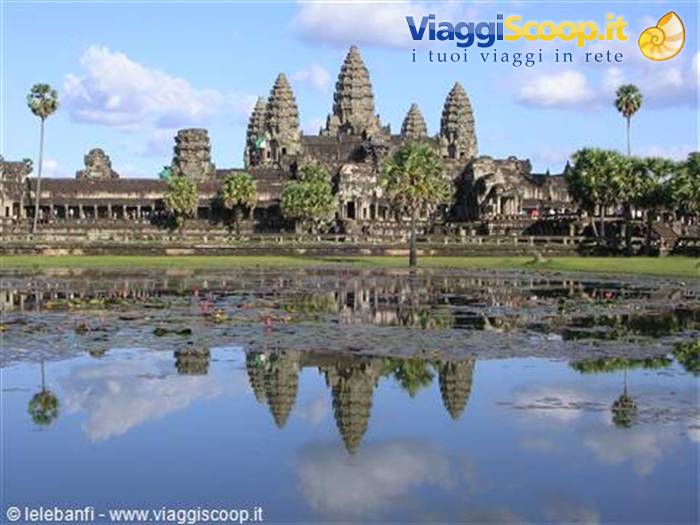
We enter from the west entrance, the one intended for the passage of rulers. The sun illuminates the building, instilling a particular light; it truly is one of the wonders of the world. The building of Hindu origin is majestic and imposing, also made of sandstone; it represents Mount Meru; it is surrounded by a moat symbolizing the seven mountains and the seven seas that must be crossed to reach the sacred mountain. Near the moat, in the calm waters covered with water lilies, the temple is reflected, creating an atmosphere and a sight worthy of the most beautiful photos. We come across a group of Italians from Milan; exchanging a few words with fellow countrymen is always nice.
We walk around the moat, we approach the imposing building; the entire outer wall is surrounded by a colonnade; on the wall a bas-relief is carved with Hindu stories; in the 16th century the bas-relief was painted, and some traces of color are still visible. On the raised level the building has four courtyards surrounded by fully covered colonnades; in the center of the courtyards, accessible by a flight of steps and surrounded by an edge, there are pools that served to collect rainwater. The sandstone has been deteriorated by time and the forest; this temple too rests on a sandy bed, so in the pools it is good that rainwater remains as little as possible in order to avoid further damaging the structure (only the outer moat, which we saw earlier, has a non-sandy base that allows water to remain).
In the porticoes there are 1,000 statues of Buddha dating back to the 16th century; the cornices of the portico roof are decorated with the head of the naga, the sacred serpent. The portico consists of a structure formed by four columns topped by a ceiling with a particular shape; the columns are arranged to create a wider central passage and two narrower side passages; in the two side passages the ceiling is a quarter circle, where the lower part is on the outside and the upper part on the inside. In the central part the ceiling consists of two sandstone walls that rise vertically and then of blocks, also of sandstone, that slope triangularly upward to close the vault. Continuing our visit of the building, passing through a narrow and steep staircase we reach the second level, where in a courtyard the terminal pyramid is located.
The group stops in the courtyard and only a few of us climb the pyramid; access to it is via a steep staircase that narrows as you go up; from the top the view ranges over the surrounding temples and the details of the structure below. The descent is aided by a rope; the pyramid's steps are truly tall and narrow; I wonder how the Khmer managed to go up and down, given that their height is not great. We leave the temple as sunset approaches, illuminating every detail of the stone in orange; the sight is truly evocative, it really is one of the wonders of the world. We continue the tour and a short distance away the coach stops because we are at the base of the hill where the temple of Phnom Bakheng (L168 – M111) stands. It is possible to reach the top of the hill using an elephant-back transport service.
Some of the group take advantage of this service, but since there is no more availability I climb on foot along a forest road that gently winds around the 60-meter-high hill. At its summit stands the temple, a destination for many tourists more to see the sunset over the plain below than to visit this structure built on 5 terraces with staircases adorned with lions. From the top you see the sun setting, gilding the water of the lake and the plain at the base of the hill; the contrast with the forest is always strong, light and shadow struggle perpetually and the light gives way to the darkness of the falling night. We descend the hill when night now prevails; the last meters are done in the dark; luckily someone had flashlights. We return to the hotel, shower, buffet dinner and then.... the group gathers in the hotel bar; it's Luigia's birthday, which we celebrate with a good cake.
Happy birthday!! This tour is characterized by birthdays; really nice. At the end of the celebration, a bit of conversation with some of the group and finally a restorative sleep.
Terrace of the Elephants - Leper King
Day 425 Oct 2006
Angkor Thom - Part One
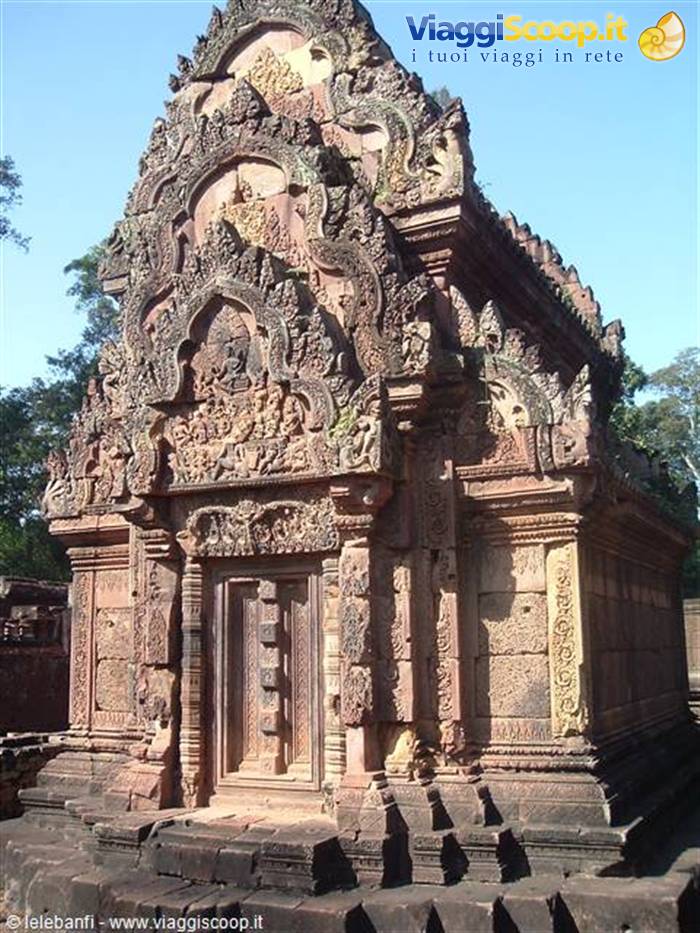
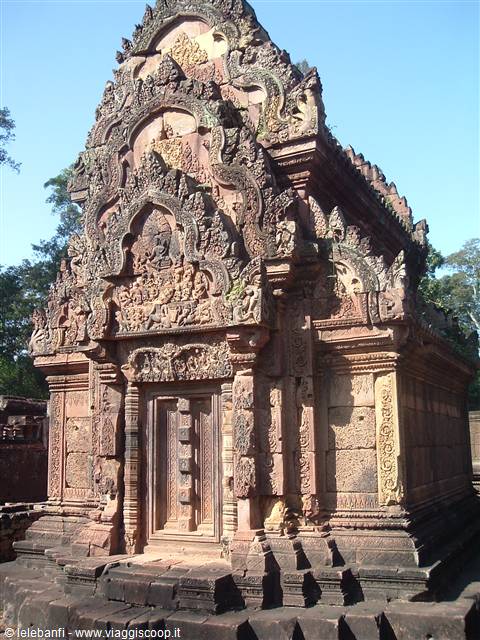
Breakfast and then departure for the tour of the last temples; Sarath always greets us with "good morning ladies and gentlemen, how are you, all well?"; it's a greeting that has become a pleasant ritual. Like all Cambodian guides, Sarath wears his uniform: black shoes, blue trousers, khaki shirt with tourist guide badges on the sleeves. While touring the temples, the guides are always easy to spot. We return to the archaeological zone and the first temple we see is Banteay Srei (L178 – M123), "The temple of women," built in 967; it is made of pink-yellow sandstone that gives it a very pleasant appearance; the colors are delicate and the entire structure is fully decorated. In the portal the bas-reliefs illustrate Hindu stories of the god Vishnu; inside the wall, next to the main temple, stands a finely decorated building, the library.
Some bas-reliefs "taken" by a Frenchman (and still present in Paris museums) have been replaced with faithfully reproduced copies. The bas-reliefs carved in the colored sandstone give the sensation that the structure is made of carved wood and not stone; the colors are warm, harmonious and enveloping. Outside the temple, insistent, at times exasperating sellers try to sell souvenirs. Along the road there is a small market: comparing prices with Burma, in Cambodia they are much higher; it could be the effect of a much more widespread tourism here than in the other country. We set off again toward other temples and along the road we stop in a village where the peasants prepare sugar using the fruits of the palms.
With Spartan ladders, practically a simple bamboo pole with leaf offshoots tied to the trunk, the peasants climb the trees collecting the products of the female plants (coconuts still in the embryonic stage) and the pods of the male plants: they bring them to the ground and, using a rudimentary tool, crush them to release the liquid they contain. This liquid is boiled in ovalized pots placed over a wood fire, and after two hours of cooking the product is left to cool; a brown and very sweet sugar is ready. We leave the village and continue to the temple of Banteay Samré (L174); this temple too was built by Hindus for the god Vishnu; originally it was the peasants' temple, but it was used by the Khmer Rouge as a prison.
The entrance to the temple, raised above the surrounding ground, is located at the end of an avenue set on a terrace flanked by statues of lions and naga; the internal structure of the temple is made of gray sandstone, while the enclosing walls are built with brown laterite; the interplay of colors creates a nice chromatic contrast; inside the temple there are other enclosing walls and a series of courtyards, as well as a series of colonnades and bas-reliefs. As we head toward the hotel, along the way we see the temple of Pre Rup (L174 – M119), a unique structure with four towers positioned toward the cardinal points and one central one; the imposingness of the five towers can be seen even from a distance.
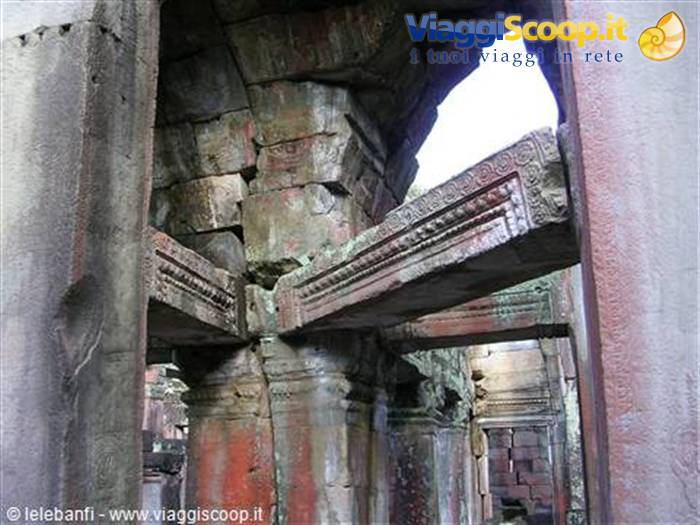
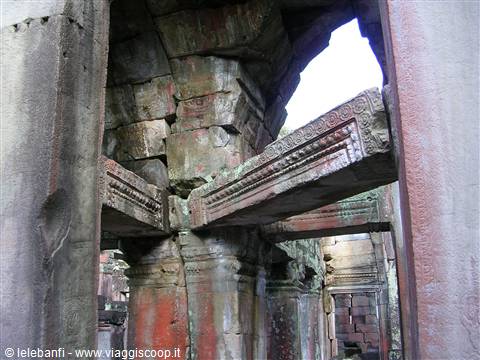
We return to the hotel for the buffet lunch, a short break to avoid the heat, and then we set off again to visit the temple of Preah Khan (L171 – M119); the temple was completely enveloped by the forest, which made it collapse; partially restored by the Americans, it has many sandstone blocks scattered disorderly on the ground. The temple, of Hindu-Buddhist origin, has bas-reliefs on the walls and on the architraves supported by colonnades; there are a series of bas-reliefs depicting dancers. The center of the temple is characterized by a room from which, on the four cardinal sides, corridors open, lined with columns topped by beams. The optical effect is truly beautiful; wherever you look, the perspective is the same (apart from the collapsed and unrestored parts). We continue the visit and see the fourth temple of the day, Preah Neak Pean (L172 – M120).
The temple is built on an embankment where, all around, a water containment dike has been built for irrigating the rice fields; access to the temple is via a dirt road surrounded by water. The complex consists of a central part and four side pools. The square central part is also surrounded by a pool; at its center a round building constitutes the temple; at the base there are two naga with crossed tails, their heads facing east and their tails facing west. It was once a place of veneration and healing of the sick, who drew water from the central pool and used it to be cured of their ailments.
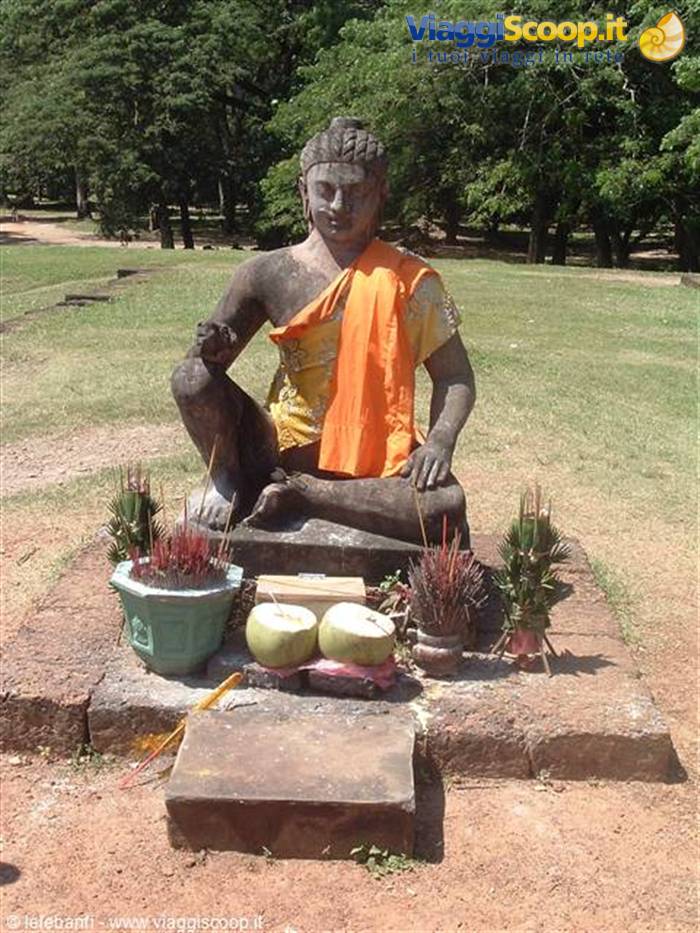
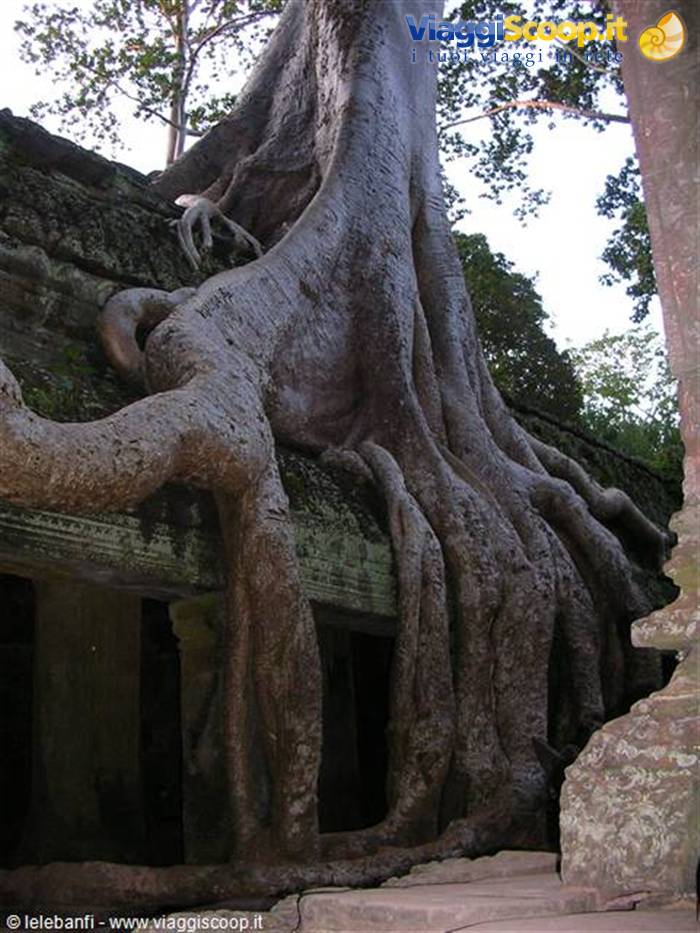
At the sides, adjacent to the four side pools, are four chapels, each containing a statue/symbol: to the east the statue of the man, which means wisdom; to the north the statue of the elephant, which means happiness; to the west the statue of the horse, which means speed; to the south the statue of the lion, which means power. We continue the tour by visiting the last temple of the day, Ta Prohm (L166 – M117); perhaps it is the most famous temple in the area, completely enveloped by the jungle, it is photographed and appears in all tourist guides. The plants, having placed roots among the sandstone blocks, grew and tore apart much of the complex; enormous plants, with their large roots, cling to the enormous sandstone blocks. Restoration works are currently underway. Inside the temple there is a statue of Buddha with incense lit.
Originally the statue was adorned with precious stones, which over time have been removed. We return to the city and stop at a tourist shop; here too you have to haggle over the price, but the goods, even if artisanal and traditional, are very much aimed at tourists. During the return, Sarath explains the situation of Cambodia and Siem Reap; the city has 80 hotels; in Cambodia there are only seven tourist guides who speak Italian, since Italians have been present in an organized way for only two years. We pass by elementary schools, which are present throughout the country; middle schools, however, are located only in large cities, and for peasants it is impossible to send their children to school because of the costs to bear.
Farmers grow rice, of which they make only one harvest a year, and then they sow watermelons; to increase their earnings, they cut timber in the forest and process sugar from the palms. The rice fields are well kept; the annual natural flooding is well exploited; the lands are surrounded by palms for coconuts and for sugar production. In Cambodia there are some artificial basins that serve to retain rainwater to feed the rice fields. State employees receive a salary of about $50 a month; corruption, here too, is very widespread. Cambodian houses are stilt houses with pillars of wood or cement; the height of the dwellings serves to avoid floods or as a store for rice and various products; to access the upper floors there are always large and decorated wooden stairs.
We pass near a structure under construction; it is the Siem Reap fairground; on November 25 there will be an international fair with the presence of 121 foreign countries; around the fairground access roads are under construction; we see a truck carrying sand overturned in a ditch due to the ground giving way.
Angkor Wat
Day 525 Oct 2006
Angkor Thom - Part Two
The Cambodian economy is based on rice production, which in the end is sufficient for national needs; fruit is imported from nearby Thailand and Vietnam. As exports there is clothing and silk; the manufactures are exported to China, Malaysia and the United States. We return to the hotel in the evening; shower and then an outdoor dinner enlivened by a show with Cambodian dances and music. After dinner, a few words with the group and then off to bed.
Banteay Srei
Day 626 Oct 2006
Phnom Penh - Part One
Wake up at 6:15; we prepare the suitcases for the return home; the heavy clothing is kept within reach to be retrieved this evening before boarding for Italy, where the temperature is decidedly less hot than here in Cambodia; for the last day we wear light trousers and a T-shirt. Breakfast and then, before leaving, we give Sarath some clothing to distribute to local peasants and workers. Leaving the hotel we head to the city airport to take the flight direct to the capital; in order to board we must pay an airport tax of $6. Once the tax is paid we can access the waiting room and with an ART 72 we fly to Phnom Penh. In Italy it is 3 o'clock; here it is 8. I notice that the airports of Cambodia and previously of Burma display the ISO 9001 wording everywhere, almost to demonstrate that everything is fine, that they comply with the regulations and the international quality system.
We take off and fly over the ordered rice fields surrounded by palms; I see the expanse of Tonlé Sap, then more rice fields; a river furrows the plain and with sinuous curves disappears on the horizon; a mountain range covered with forest interrupts the rice fields that stretch as far as the eye can see. We land at Phnom Penh; we find the guide who will accompany us for the whole day; his name is Ra, he is Cambodian and spent seven years in Italy, working as a metalworker in the province of Brescia; he speaks correct Italian with a Brescian accent. Driving through the capital's streets we notice that traffic is a bit "free"; indeed, bicycles and scooters seem to move without any rules, and the rule of "whoever gets there first goes" seems to apply.
Ra tells us that in Cambodia insurance is optional for Cambodians but mandatory for foreigners; in the event of an accident matters are settled between the two parties involved, and in the event of a fatal accident there is prison. We observe that Cambodian women tend to cover their faces; Ra explains that this serves to avoid getting sun. The belief is very widespread that tanned people are peasants, and consequently women who are not very tanned have a better chance of finding a husband. The first stop in the capital is at the National Museum (L80 – M73); the museum is structured following the four historical periods of Cambodia, and the rooms are organized by objects made with similar materials, almost to show the evolution. The tour of the museum begins with the room containing bronze statues from the 11th to the 18th century; some of very high craftsmanship.
In the next room there are sandstone statues, schist and marble statues; many of them come from temples, since before the 14th century there were no monks in the temples, only statues. We continue through the museum and see chairs for monks and saddles for the royal elephant; famously an albino elephant. Royal palanquins made of bamboo and embellished with golden fabrics are on display. In other rooms we see fabrics, ceramics, terracotta vases; finally a room containing statues of Buddha from various pagodas. We leave the National Museum and head to the Russian Market (L104 – M75), where in a covered structure you can find everything: clothing, artisanal products, hardware, jewelry, music products; prices are sometimes negotiable, sometimes much less so; among the group some buy and some just wander among the stalls.
We cross the city to go to a restaurant on the riverbank; along the way we see the building under construction of the parliament, and in a square the colossal and modern Mausoleum of Independence (L83 – M77). We arrive at the restaurant; finally the chance to taste real Cambodian cuisine and not just the international buffet offered by the Siem Reap hotel; peanuts, rice rolls, rice pasta with shrimp, Cambodian carpaccio (beef, onion, peppers, all seasoned with local fruit juices), sautéed vegetables, a local dish (fish, mushrooms and lemongrass), desserts (pineapple in rice batter and fried, coconut pulp in banana leaf and other local desserts); at the end of the meal, fruit: pineapple, banana and watermelon.
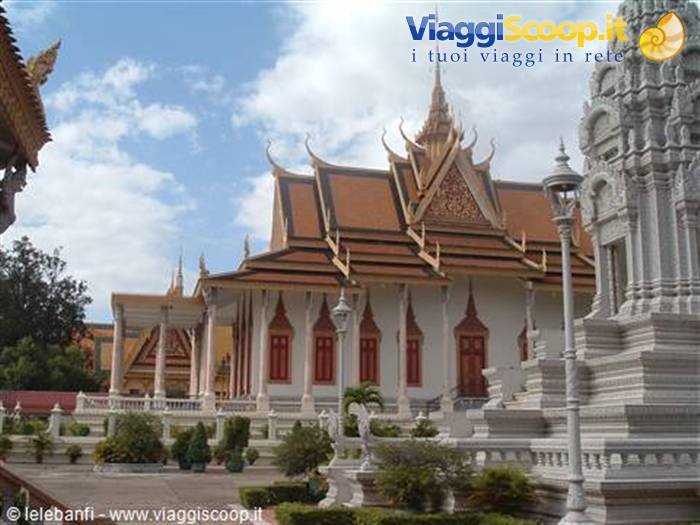
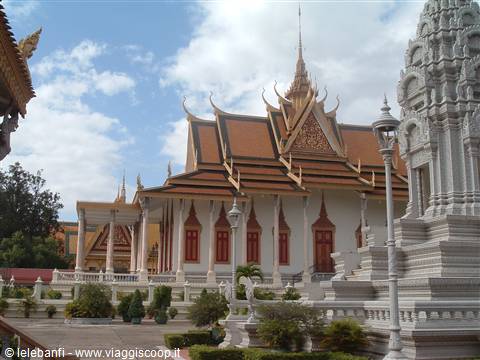
We leave the restaurant to head to the Royal Palace (L78 – M69); in the courtyard the Cambodian flag flies on a flagpole; this means the king is in the country, otherwise the flag would be positioned lower. Near the palace a very decorated building catches the attention; it is the place where rulers are cremated. We enter the palace, in the part accessible to the public. The palace, built in 1913, in strict respect of tradition, was only made of wood; today rebuilt, it is a solid masonry structure embellished with golden decorations. The palace has a total of five entrances, each dedicated to a specific type of passage, such as: the king's entrance, the one for the people, the one for monks, the one for the exit of deceased rulers; the visitable part of the palace is only three sections.
All the buildings are decorated and colored with four colors: green, which represents vegetation; blue, which represents the royal color; yellow, which represents Buddhism, and white, used for the columns, which represents Hinduism. We enter a courtyard and a series of buildings all finely decorated appear before us; the harmony is remarkable, the gardens are perfectly kept, the atmosphere is profoundly royal. An imposing building with a wide staircase indicates the throne hall; to enter you must remove your shoes as a sign of respect; you walk only along the right side of the hall; the hall is imposing, the ceiling is frescoed with stories of deities. The golden throne is used only for the coronation of the king; the side walls are frescoed with geometric and floral motifs in white and yellow that give a unique touch of preciousness.
Behind the throne used for the king's coronation, the queen's throne can be glimpsed. We leave the throne hall and on the left (looking at the entrance of the hall) we visit a museum where the clothes of the king, the queen, and the soldiers of the royal palace are kept; they are all gilded and finely worked. At the back of the room, mannequins wear the clothes used by the king's handmaidens; there are seven models, in seven different colors representing the seven days of the week and seven planets. In display cases along one wall you can see silver objects and priestly vestments used in royal ceremonies. A short distance away, a decorated iron building is the pavilion donated by Napoleon III to Cambodia. We walk through the courtyard, pass beyond a wall and enter another section of the palace, surrounded by porticoes entirely frescoed; in a courtyard we see
Preah Khan - Architraves
Day 726 Oct 2006
Phnom Penh - Part Two
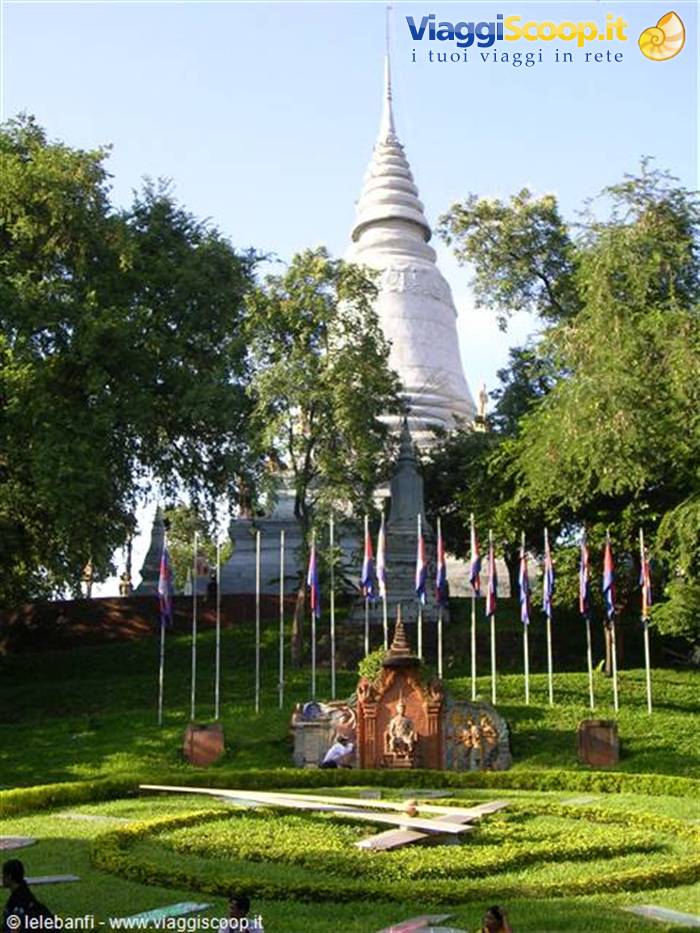
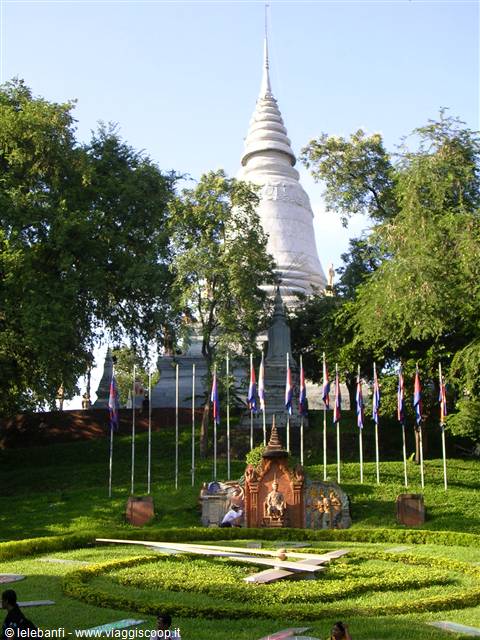
The surveillance service is discreet and constantly present; in the structure there are no large electronic surveillance systems, but if anyone merely attempts to steal any object, the guards raise the alarm and the "unfortunate" is subjected to a "summary judgment" by the people in the public square. A simple and effective method to discourage any ill-intentioned person. We leave the royal palace with its colors, its gardens and its buildings that display refined beauty, and crossing the city we arrive at the base of an artificial hill: Wat Phnom (L82 – M77). Commissioned by Princess Penh, the hill was built in 1372; the name of the capital derives from this union: "the city of Phnom and the hill of Penh".
At the top of the hill is a temple, still today a destination for many pilgrimages; inside, an altar with four gilded wooden Buddha statues; at the center of the temple another statue of Buddha. The walls are studded with paintings, oil on wood panels, depicting the life of Buddha. We leave the temple and go down the hill surrounded by children who want to sell everything; along the descent we find beggars and from the surrounding park monkeys appear. We continue the route towards the airport and stop to see Wat Ounalom (L82 – M77), the central monastery; inside there is a stupa with an inner temple that encloses an eyelash of Buddha; the golden 14th-century stupa has recently been restored; the internal structure of the temple is in sandstone.
Outside there are 13th-century bronze statues; they come from various temples and, as we already saw at the national museum, they were the statues present in the temples before the arrival of the monks. On the right and left sides of the central stupa there are a series of six smaller white stupas. We resume our journey and stop to see the confluence of the four rivers that merge into one; here some stalls sell delicacies for Cambodians. I look carefully, and I cannot believe my eyes! I go closer and realize that my sight is not deceiving me; on the stalls, arranged in well-ordered and divided piles, there are: black spiders, cockroaches, silkworms, shrimp, grasshoppers, all fried, as well as roasted quails and crabs.
The seller, delighted with what he is displaying, invites someone from the group to taste these "delicacies"; a polite refusal seems the best choice; we get back on the bus, struck by the particular taste of the Cambodians. We continue the city tour and stop to photograph the modern Mausoleum of Independence that we had glimpsed in the morning. We resume the journey towards the airport amid chaotic and disorderly traffic, where it really seems that whoever passes first has priority wherever he wants to go. Ra tells us that in Cambodia public healthcare is for everyone, but the healthcare that works is private; pensions exist only for state employees. We leave Phnom Penh as the sky is clouding over and threatening rain; we really experienced post-monsoon days, a few downpours, but all in all we didn't get very wet.
We arrive at the airport and before checking in the suitcases headed for Milan, we take out the heavy clothes we had prepared. The 31 suitcases are checked in; moving as a group increases waiting times a little, but when there is organization everything goes well. The exit checks are rigorous and "rigorous" is also the unexpected airport tax to leave the country, 25 $, a real theft. But it is an "elegant" way to ask for a contribution for the construction of the airport and a new bridge; if the Italian state adopted this system, we would avoid part of our taxes. We fly towards Bangkok; the flight proceeds smoothly; after about an hour a myriad of lights appears below us; we are in Thailand; we land in Bangkok; as soon as the plane turns I see four planes behind us preparing to land.
For the umpteenth time we pass through the airport; a few hours of waiting for the flight to Italy; we change, abandon our light trousers and t-shirts and put on our sweatshirts. I take advantage of the stop to organize my notes and write the first reflections of the trip. We board, welcomed by the hospitality of Thai; the flight to Milan Malpensa is smooth; at 7:40 Italian time we land; in Burma it is 12:40. In my eyes are the thousand golden pagodas, the hundreds of Buddha statues, the imposing constructions of Angkor.... Writing this diary, my mind retraces the whole journey like a long film, and I hope that the reader too can be carried away by these sensations. And..... as a good curious traveler, even though Burma particularly struck me with its beauty, my mind is already thinking about where to go on the next trip....
Ta Prohm - Plant
Day 827 Oct 2006
Three good reasons to go to :
Cambodia
• Going to Cambodia is equivalent to coming into contact with a nation that has only recently emerged from the repression of the Khmer Rouge. It means being able to observe a civilization that is in full evolution, where cities are expanding urbanistically and where rural life is still the predominant characteristic. • Visiting Cambodia today allows you to see, in the archaeological area, many temples still enveloped by the forest and thus to be witnesses to the rediscovery of the signs of an ancient civilization. • Traveling in this nation means making use of tourism that is already perfectly organized, where Italians are well regarded and awaited by the Cambodian people.
Phnom Penh - Royal Palace
Day 927 Oct 2006
Acknowledgements
At the end of this work, I feel I should express my personal thanks to all those who made this beautiful and fascinating trip possible; rich in religious, historical and cultural sites but also imbued with the humanity and dignity of the peoples and people I had the chance to meet. Gratitude also to those who urged me on and to those who assisted me in creating this diary.
Special thanks to: • Don Maurizio Corbetta, Parish Priest of Rovello Porro (CO), creator of the trip. • The travel agency Alohatour of Pavia ( - tel. 0382.5395.65) for the overall organization. • The tour operator Antichi Splendori of Turin ( - tel. 011.8126.715) for the well-structured program and for the useful information provided. • Sosò, the Burma guide, for the high professionalism demonstrated; for having brought us closer, with competence, preparation and absolute respect, to Burmese culture and tradition. • Sarath and Ra, the Cambodian guides, for the effort demonstrated in speaking Italian and for their preparation. • The corresponding agencies in Burma (Interconnection Travels Myanmar) and in Cambodia (Monsoon Tour Phnom Penh), for the excellent competence demonstrated in organizing the stays and all land, river and air transfers. • The company Micro-e of Saronno ( - tel.
02.9602.887) for the technological and IT material and for the assistance provided to me in creating the multimedia version of the diary. • To those (Francesca, Natalia, Francesco, Laura and Pietro) who in various ways contributed to the planning, presentation and correction of the diary and to the creation of the hypertexts.



0 reader comments