Last summer, during our holidays, we met two friendly motorcyclists, Walter and Fulvio, who were traveling on their motorbikes, the first to China, and the second to Turkey (like us). With their travel tales they sparked in us the curiosity to attempt an adventure in the desert, to discover, as they put it, "the magic of the sands". "It doesn't take much time, a week is enough for a first experience...." they told us "....of course, going alone you won't be able to venture deep into the desert, that would be reckless and too dangerous, but you can certainly tackle some stretches and experience new travel emotions...you just need to go to Tunisia, which isn't that far away."
Africa, the desert, the sands... one certainly can't remain indifferent to places that in my imagination I have always considered too distant and fantastic to be real, and that since childhood have fueled my dreams... but Walter and Fulvio claimed that those places weren't so unreachable, indeed, all in all, one could get there fairly easily.
Since our interlocutors seemed to us anything but naive, as soon as we returned from our holidays (in the summer of 2004) we immediately set about gathering more information, both on how to reach the desert and to understand what commitments in terms of both money and time would be needed.
I won't hide my joy when we discovered that in just 24 hours a ferry would take us to Africa; it was enough to reach Genoa by motorbike to board. We would disembark in Tunis, and from there with just 500 kilometers of road we would arrive directly at the Sahara.
We organized everything, requested time off, booked a ferry (there are several companies operating the Genoa-Tunis route with departures on different days, so it's possible to choose the one that best suits your needs), prepared the motorbike for the trip (with the ever-present support of my dad) and, thanks to the help of Katja and Fabio, we equipped ourselves with the right winter clothing.
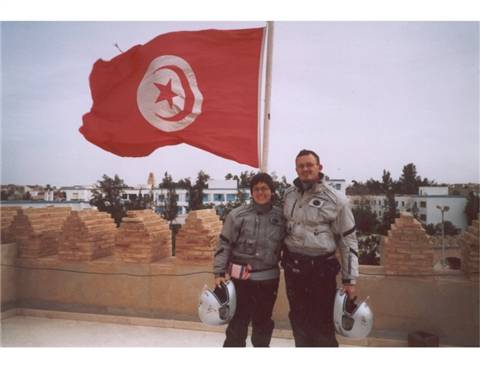
Departure! 16 February 2005, the ferry leaves Genoa in the afternoon at 18:00. Luckily today it isn't raining, in fact there's even nice sunshine, but the cold is tremendous! During the crossing we spend our time with a friendly retiree from Piedmont who is going to Tunisia in his Fiat Tipo for a tourist trip and to see again the people he had met the year before. We disembark in Tunis the next evening when it's almost dark. Getting out of customs is a bit of an adventure, mainly because of the customs officers who, being corrupt, ask you for money to save you from trouble and wasted time. We immediately understand that this must be a widespread habit, so we limit ourselves to haggling a little over the price (here too you bargain), since the weather outside isn't the best and we want to find a hotel before it gets dark; we manage with 20 Euros (the head of customs had asked for 50.....
it makes you really angry that they want money to do their duty, but we can't even report it since it's precisely the head of the guards who runs the racket). We catch a few drops of rain on the stretch of highway (the only one in all of Tunisia) that connects Tunis to Hammamet, where we stop for the night.
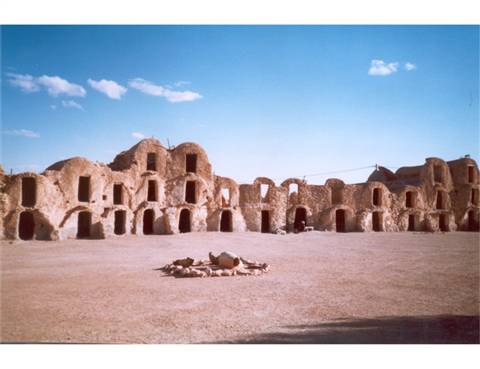
Tataouine and the ksour In the morning we set off for Tataouine, a city famous because it's the starting point for visiting the ksour (fortified granaries). We arrive in the afternoon and immediately find a hotel for the night; we're in the southernmost city of our trip. The Ksour (singular ksar) are fortified granaries made up of many rooms (ghorfa) covered with a vault. The "ghorfa" are stacked on top of each other until they create built-up screens up to 4 stories high (4 ghorfa stacked). These screens close around a central square. The access openings of the cells all face the central courtyard, thus showing only a solid wall to the outside....in short, it's a sort of little fortress. Improbable brick stairways allow access to the higher ghorfa.
We noticed some branches sticking out from the roof of the upper floors: in our opinion they served as a hook for the winches used to hoist the grain, which was then deposited inside large skins walled into the floors of the ghorfa. I couldn't figure out where the grain came from; throughout the trip we never encountered such crops, mind you... plenty of palm groves, orchards and vegetable gardens... but not a trace of grain.... maybe that's why it was such a precious commodity. Every town and village has its own ksar. It's certainly worth visiting the most touristy ones (widely indicated in any guidebook), which are in fact the most photographed precisely because they're the most beautiful. However, it's also very interesting to take a stroll in the "non-touristy" ksour.
It's very peculiar indeed to see how some of these structures are still used today in daily life, certainly no longer as granaries, but as warehouses, small workshops, parts of dwellings. I recommend going to see Ezzara, where the courtyard of one of the ksour present has become one of the main squares of the settlement; it's a truly peculiar and evocative setting (although not mentioned by the tourist guides we had with us). While visiting it we discovered that shortly before it had been used for a photo shoot for some girls who would take part in Miss World 2005. In the evening we head back to the hotel in Tataouine: tomorrow we leave for Ksar Ghilane!
Ksar Ghilane It's an oasis (with its ever-present ksar) located within the Eastern Erg, that is, among the sands of the Sahara... though only at its beginning. We're thrilled; for us it's the first time going into the desert! We know perfectly well that it's an extremely touristy destination and by now easily reachable by any means (perhaps with a bit of patience). You can get there by following the track that runs alongside the gas pipeline crossing Tunisia from South to North, starting from the road that connects Matmata with Douz. We, however, intend to reach Ksar Ghilane using the track that starts right after Chenini (near Tataouine) and then arrive at Matmata by evening using the route I described above (in total about 230 km).
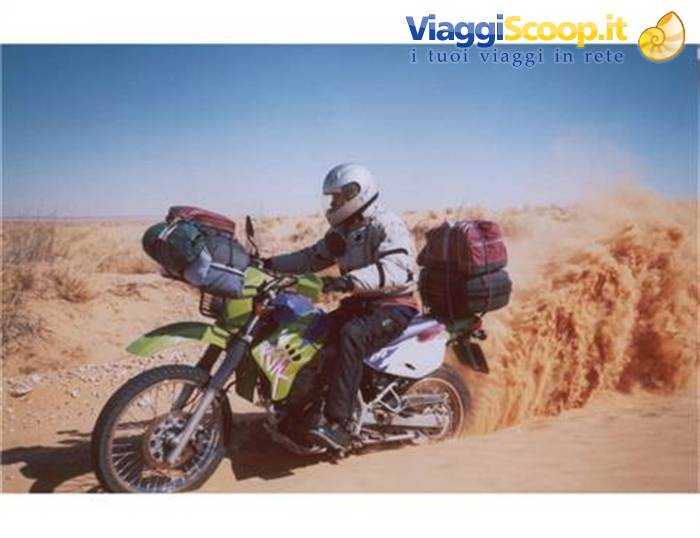
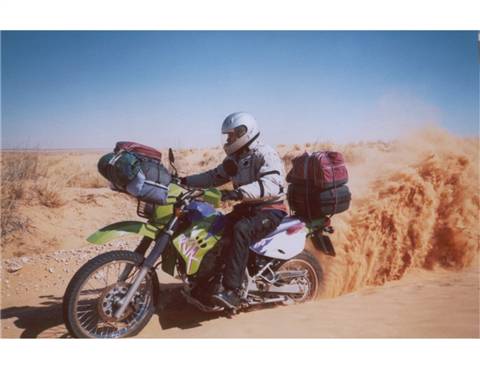
To reach the destination, where among other things there's also a small lake fed by a thermal spring, our map indicates a route of about 120 km (starting from Tataouine) of which 100 are track. Before leaving we informed ourselves well about supplies; there's no petrol for the entire stretch...and since our little motorbike has a range of about 220 km, we have to carry extra petrol, which we stash in a jerrycan. Off we go!! The first kilometers of track are devastating! The track surface is hard and not sandy but seems made of an endless series of miniature dunes 2 or 3 cm high that cause a really annoying blender effect... At a certain point I remember that someone had told me that you needed to find the "right speed" to let the vehicle "glide" over the little dunes and avoid the annoying vibrations.
They also said that this speed can vary from vehicle to vehicle depending on weight, tire diameter and the size of the little dunes. These factors in fact give rise to the frequency of vibrations...which in the long run break your back. I do a few tests....found it!! They hadn't told me a lie! Now it goes much better. After about thirty kilometers the barren hills disappear and all around is sand! Here we are in the desert!! What a thrill, the track keeps its solid (and undulating) surface. Further on we pass a sort of bar made in an improvised shack and run by an enterprising Tunisian who tries in every way to make us stop to consume
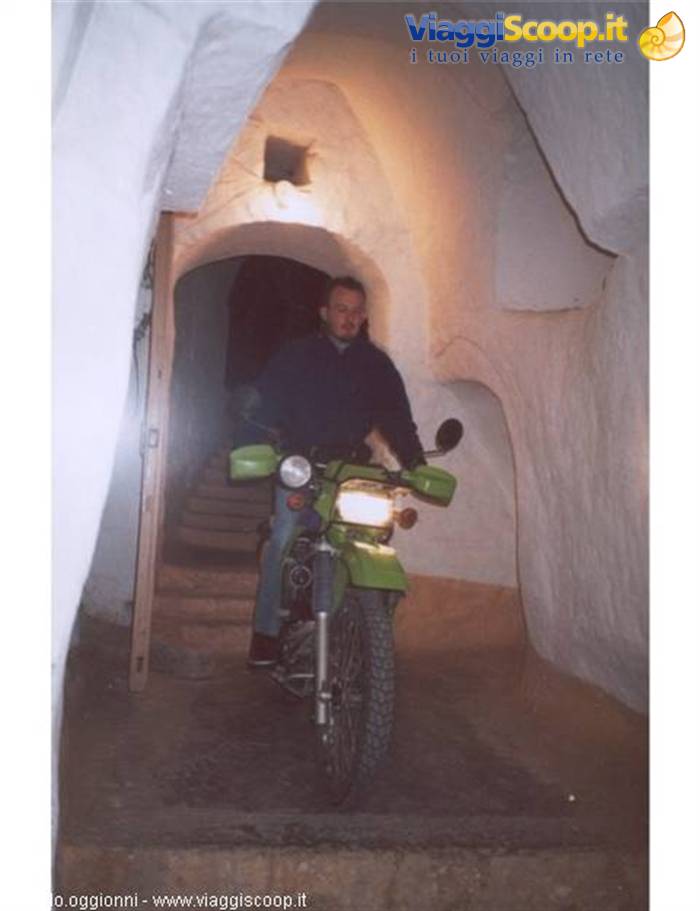
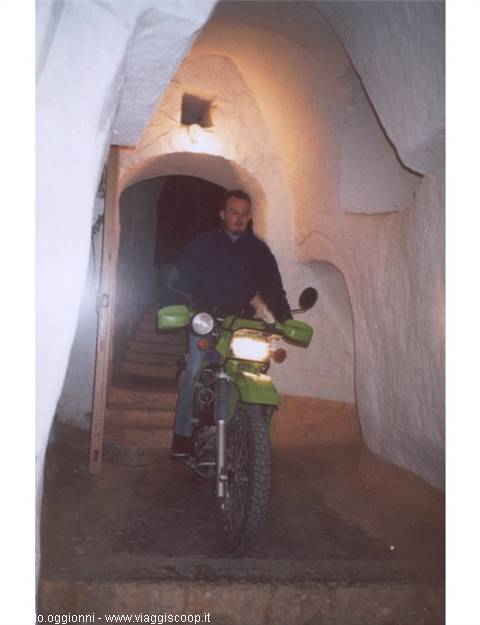
Man on green motorbike inside a whitewashed arched alleyway
Day 216 Feb 2005
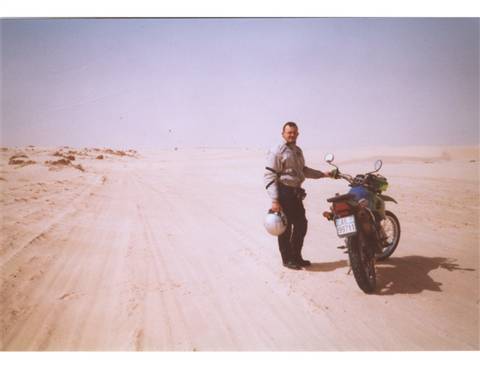
I realize I'm on a sort of "main road" of the desert, and I imagine that in periods of greater tourism it's furrowed by off-road vehicles taking tourists to visit the oasis of Ksar Ghilane. Well, since we're alone, at least we know that if something were to happen there's a point of reference. We've covered about 70 km of track when we start having some little problems. The wind that has persisted for several days has moved the dunes, covering stretches of the track, so I'm forced to get past those stretches alone, while Jana follows on foot. Luckily each stretch is only a few dozen meters long. We cover another 10 kilometers or so at a slower pace where, after a long uphill, the track disappears completely into the sand.
We try to get through anyway (me on the bike and Jana on foot) but this time it's impossible to get past the sand, which is very soft and deep (the track must be quite a bit lower than the dune moved by the wind). We do one stretch...but the bike is too loaded and I get stuck in the sand! It takes quite a while to get out of the fix and get the wheels back onto something hard. We assess the situation... we've already covered about 80 km of track and soon the last stretch should begin, which on our map is marked as "not always passable...." Damn! We realize that it's really not worth trying to continue, also because if before you'd occasionally recognize on the track the sign of a recent passage of tires, in the last stretch there's no trace of those signs. It's not worth playing the hero, so we turn the bike around and head back toward Tataouine.
Since we had passed the mountainous stretch and the track had entered the desert, we had seen how it branched into several stretches that I believe were alternatives to the main route. We always followed the track that seemed to us to be the main one, as it was the most worn. The fact is that on the way back we get a bit mixed up with these alternative routes and get lost, wasting time and energy (falls and getting stuck in the sand, and so on). It's really true that inexperience comes at a price! We arrive in Matmata in the afternoon by taking traditional roads; Ksar Ghilane remains in our minds with a tacit promise: "we'll be back anyway...next time we travel light." To console ourselves (especially me) we'll spend the night in one of the troglodyte houses of Matmata, the Sidi Driss hotel, where they filmed Star Wars.
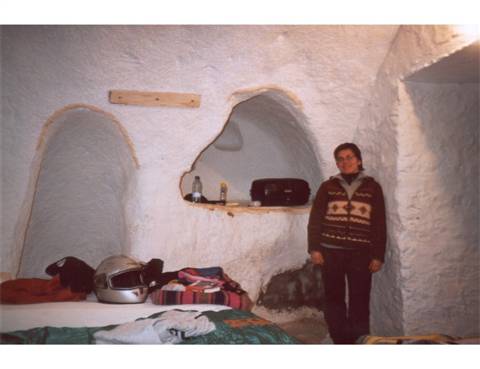
Matmata I must admit that sleeping in young Luke Skywalker's house lifted my spirits. We're the only 2 guests in the hotel carved out of the troglodyte house; the rooms (which are dug underground and reached through a stepped tunnel) are extremely evocative and, although there's no heating, they're not even too cold. The innkeeper explains that since the house is dug into the subsoil, the rooms maintain an almost constant internal temperature, or at least compared to the outside they're warm in winter and cool in summer. Indeed, in the room it was about 16-17 degrees, which compared to the 5-6 outside is a lot... we sleep very well and without suffering too much from the cold. For extra safety the innkeeper provides us with several blankets and, in any case, we have our sleeping bags. Dinner (which is brought from the kitchens of the nearby hotel) is served to us around 18:00...
by 20:00 we're already in bed.... No big deal, the day has been hard and we're exhausted! Before sleeping the caretaker asks me to bring the motorbike into the courtyard of the troglodyte house by going down the stairs... we're a bit baffled... in our travels we had gotten used to the fact that innkeepers often wanted you to put the motorbike in the hotel lobby, but I thought the troglodyte house was considered a historical asset. Anyway, I obey! On waking, after a good breakfast, we take a stroll around Matmata and realize that it's a very short visit, since the interesting part of the town (that is, the area with the troglodyte houses) is very small. So we set off for Douz; at a certain point along the way we pass alongside the oil pipeline that marks the track to Ksar Ghilane (where we were supposed to come out according to our plans).
We follow it for a short stretch, just out of curiosity. More than a track, it's an unpaved highway. If we'd had enough petrol we would have gone all the way, but unfortunately we don't, and there are no gas stations until Douz, so after a short detour we get back on the road to the city. There's a lot of wind today and it deposits sand on the asphalt, making curious patterns that resemble those made by snow when it's very powdery and blown by the wind.
Douz The city is fairly large and is divided into two distinct areas: the tourist zone, full of luxurious hotels, which is right in front of the desert, and the actual town. We find the market square in the old town very characteristic: an enormous square, porticoed, with large entrance portals at the center of the four sides. Our guidebook describes Douz as a sort of "desert playground"; indeed we realize that precisely because it's right on the edge of the dunes, the city has organized itself to welcome the many tourists and offer them the chance to practice various activities on the sand: trekking on foot and by camel (there are countless camels waiting for busloads of tourists for a stroll in the desert), mountain biking, tandem, Quad excursions, jeep or motorbike.
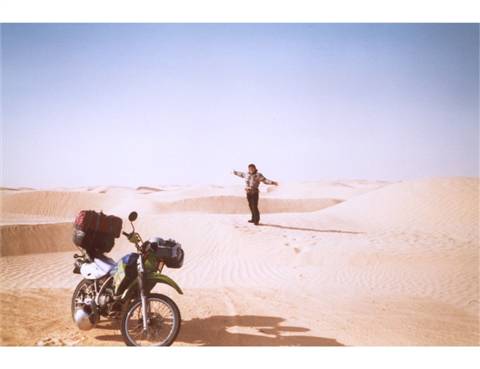
There's even a sand track for Quads and hovercraft and also a "camelodrome" (this is worth seeing, it's not beautiful but it's very curious... especially if you find someone to explain how the races take place). We take advantage of the unloaded motorbike to take a short ride among the dunes. Indeed the main attraction of Douz isn't the city but the desert itself. Having visited the city, we take a ride around the surroundings and reach Zafrane, but there's too much wind and it starts to get cold, so we go back to the hotel...the dunes stretching as far as the eye can see are beautiful.
We leave Douz early (we stayed in a small hotel that I highly recommend: the Hotel 20 Mars, very close to the city center, clean and cheap) and head to Tozeur, but first we stop for a couple of hours in Kebili because today is market day! Guys, the local market is beautiful! Perhaps because of the season we're the only 2 tourists and, partly for that reason and partly because of our motorbike gear, we're looked at with curiosity, and people even let out a few smiles. There are so many people and they really sell everything: foodstuffs, artisan workshops (carpenters work their products right on the street), clothes, animal sellers (especially goats, horses and donkeys), sellers of old things (even used clothes and shoes), household appliances.... In short, a real open-air bazaar.
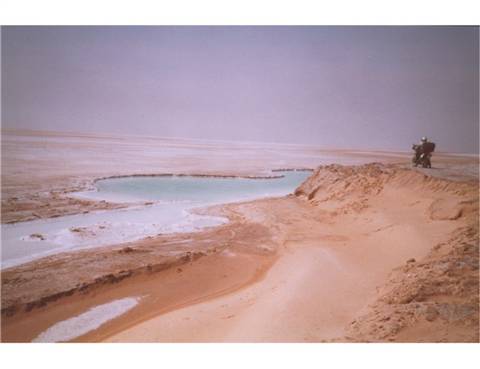
We resume our journey toward Tozeur; reading the guidebook we understand that to get there we'll take one of the most peculiar roads in Tunisia: the one that crosses the "Chott el Jerid". It's an immense salt lake that stretches out on both sides of the road; every so often you find possible access points to the lake bed that allow you to do a bit of "off-roading". There are no gas stations but plenty of rest areas with refreshments and tourist shops. The scenery is breathtaking... all around the horizon is flat, the lake bed is white because of the salt, and due to the refractions that are created it's possible to see mirages.
Helmeted rider with luggage raises sand while riding through the desert
Day 316 Feb 2005
We make quite a few stops for photos and, despite being fully loaded, we attempt a few stretches off-road. The surface is flat, sandy and covered by a thin crust of salt that breaks under our weight. Right below the salt crust (perhaps because it's still winter and the sun isn't too hot yet) the sand is soaked with water and for this reason it's extremely soft. So you risk getting stuck....better to stay on the road!
Tozeur
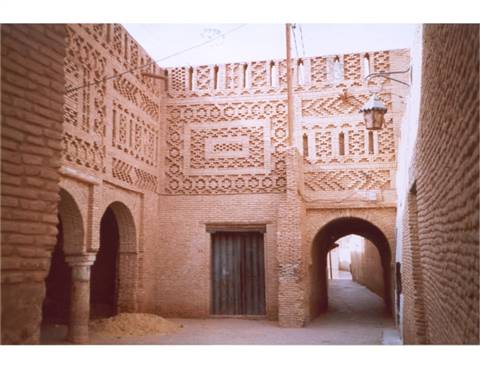
Tozeur is beautiful; we take advantage of the afternoon to visit the medina (old town), characteristic for the Berber decorations of the houses. The walls use the alternation of exposed bricks to create geometric patterns in bas-relief (similar to those seen in carpets). A local guide (this time in the flesh, not the usual book we use) introduces himself as the president of the guides of the medina of Tozeur and talks our ear off! In the end he wins us over (today we're really not in the mood for haggling) and he accompanies us through the whole tour. Luckily at least he's friendly. At a certain point we arrive in front of a decorated wall that he explains is a special place because here you can perform a characteristic good-luck ritual, typical of this city.
You have to make a wish and throw a pebble at the wall in front of us; if the little stone stops among the brick decorations the wish will come true. Some German tourists are trying...we watch them while chatting with our companion. I feel like telling him that in my city too there's a place where people go to make wishes and seek good fortune; he interrupts me, explaining the religious origin of the custom we were observing. After his interjection, to avoid misunderstandings, I slide onto another topic.... How can I tell him that in Milan "you squeeze the bull's balls"? Once out of the medina we take a walk around the city and the enormous palm grove.
To the west, in the tourist area, there's the panoramic viewpoint of Tozeur: a rocky formation about fifteen meters high (a lot considering that everything around is flat) that they've enclosed within a vast area that is becoming a city park (under construction at the time of our visit). Even though it's nothing special, it's worth dedicating half an hour to it, at least to see the tremendous fake-rock faces of the Tunisian president that aim to emulate the famous portraits of the American presidents carved into the mountain.
The mountain oases
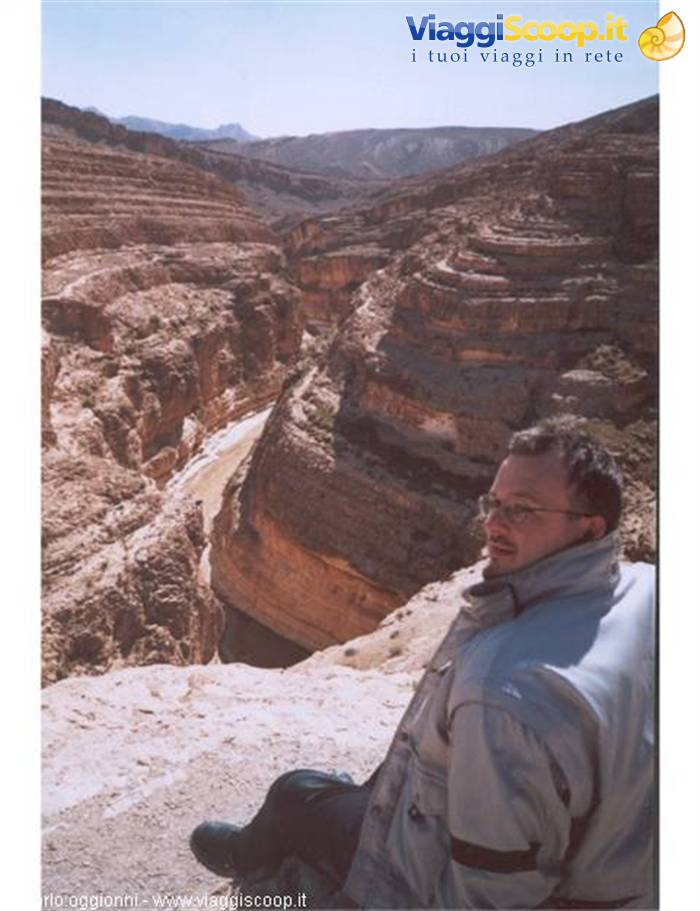
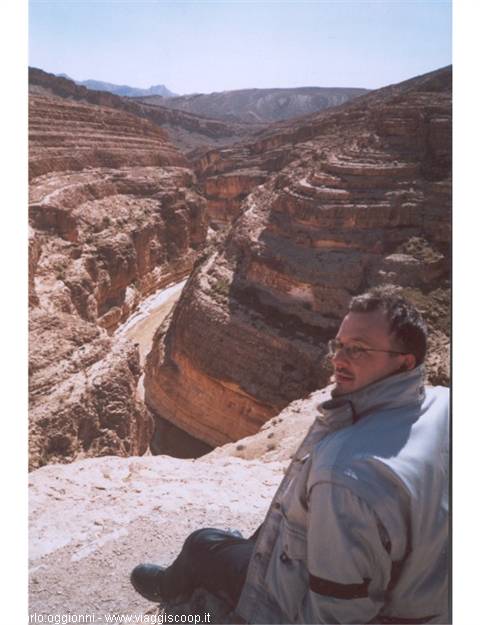
We leave early, as usual, but this time with the unloaded motorbike to go and visit the mountain oases. To get there you cross another salt lake, the "Chott el Gharsa". The surface is drier and the bike has no luggage, so we head in to do a nice stretch off-road in the chott and see what effect it has. Beautiful, if you get the chance I recommend it. When we arrive at the mountain oases we realize they're truly fantastic. I won't go into how they're built and why they're now uninhabited. You can read that in any tourist guidebook. The settings, however, are truly breathtaking; it would be a shame not to visit them, especially Chebika - because of the hot spring that feeds its palm grove - and Mides (1 km from Algeria) because of the enormous canyon it sits on.
We return to Tozeur in the late afternoon, but before going to the hotel (mindful of Battiato's song) I want to see the railway and its trains. By now there's only one day left before the ferry departs, so we prepare for the return. We've decided to travel at night to reach Kairouan, so we can visit it calmly the next day before returning to Tunis for boarding. By chance, before leaving the city we run into the retiree from Piedmont whom we had met on the ship; a pleasant and unexpected encounter.
Kairouan
It's the "holy city and city of carpets". Here is the largest mosque, not only in Tunisia but in all of Africa...truly spectacular. The city is also famous for its carpet production. We walk around all day and that's enough to see everything, also leaving a bit of time for shopping. The city is truly beautiful and less touristy than I expected. In the late afternoon we leave for Tunis; our ferry is at 22:00.
Return
The only curious thing about the return to Italy was finding snow (quite a lot, actually) along the roadsides and in the surrounding fields. To be honest there was another interlude worth telling. On the ship we met Silvano, a guy who spends part of his time accompanying groups of off-road enthusiasts on raids in the desert. He told us about several trips he'd made, planting a little bug in our heads, just as Walter and Fulvio had done at the beginning of our story. Talking with Jana about our next motorbike vacations, we realize more and more that that little bug has already started working, influencing our fantasies, and the country name most recurring among the various hypotheses for the next vacation is that of Libya. We'll see.
Period: February 2005
Bike: Kawasaki KLR 650 Crew: Carlo and Jana e-mail: carlo.oggionni@tiscalinet.it
Man sitting on rock in front of a sandstone canyon with dry riverbed


0 reader comments