The idea of our 'South Africa on the road' was born from the wish to take a trip to a fascinating corner of the world. The truth is that at first we had chosen Patagonia (Chile and Argentina) as our destination, and reaching the extreme south of the American continent, Cape Horn. Unfortunately (or perhaps, with hindsight, fortunately), because of the difficulties we encountered (the complicated flight routes didn't let us make the most of the 12 days we had available), we opted, not without misgivings, for South Africa. In fact we set off without too many expectations, and perhaps precisely because of that, South Africa turned out to be a truly wonderful country, to be travelled far and wide in complete freedom... Before leaving we had planned the various stages of our trip roughly.
The idea was to cover the whole coast from Port Elizabeth to Cape Town, then cut north-east towards Johannesburg, and finally spend the last two days in a Private Reserve so we could take part in a photo-safari; the only certain things were having to arrive on the morning of 23/01 at Mossel Bay for an excursion already booked via the internet from Italy, and being in the early afternoon of 28/01 at the Ingwe Lodge inside the Karongwe Game Reserve (also booked before leaving). The flight routes to reach our starting base were: Venice-Munich, Munich-Johannesburg, Johannesburg-Port Elizabeth (about 18 hours of travel in total from Venice to Port Elizabeth). The return, on the other hand, was planned from Johannesburg to Venice via Frankfurt (about 15 hours of travel in total. Cost of all the routes: about 960.00 euros).
Day 123 Jan 2003
First day: from Port Elizabeth to Tsitsikamma National Park - Km 215
After a good number of hours of flying we finally land in Johannesburg. Our stay in the airport was fleeting, just enough time for a sandwich and to buy, for the modest sum of 69 Rand, the right adapter for the electrical sockets (which are probably used only there, since we had never seen that type before then). Finally, after almost an entire day spent on planes or in airports, the last flight takes us to Port Elizabeth, from where our journey would effectively begin. In Port Elizabeth we're greeted by perfect weather: the warmth of a blazing sun, tempered by a light breeze coming from the ocean (so much for the wintry January climate back in Italy!!!). First thing, we go to pick up the car we had already booked from Italy. We don't panic too much about driving on the left because we're all already vaccinated by previous driving experiences in Great Britain.
Setting off with great enthusiasm, we decide to stop right away at the seaside to celebrate the start of the adventure with a dip in the Indian Ocean, as well as to "wash away" the tiredness of the journey and get comfortable. We follow the N2 heading west to reach our first destination, Tsitsikamma National Park, but about halfway there we decide to make a little detour to Jeffrey's Bay, known homeland of surfers. The town doesn't seem anything special, but the people who live there really give the impression of being very "cool". We stop here only long enough to make a couple of purchases at the Billabong Surf Shop [tel: (042) 296-1797]. We resume the journey. Right after the bridge over the Storms River we stop for a quick lunch at a sort of fast-food place (there was nothing else nearby).
We sink our teeth into something that was meant to resemble a cheeseburger (and we prefer not to comment on the French fries). To wash it all down we even try the grape Fanta... Attracted by an information sign we stop along the road for about half an hour to go and see the Big Tree: via a very easy path through a thick forest, you reach a tree of remarkable size that towers impressively over the others, but honestly it doesn't seem like much to us, or at least it wasn't worth the stop. A little further on, with a left turn, we leave the N2 to head towards the entrance of Tsitsikamma National Park. In theory you should pay to get in... but it was late and, on the pretext of just taking a few photos, we get in for free, hoping to be able to sleep at the Storms River Mouth Rest Camp [tel: (012) 343-1991; fax: (012) 343-0905; or directly at tel: (042) 541-1607].
The initial idea was to sleep in a tent "by the ocean", but the strong wind and threatening clouds push us to rent one of the many bungalows (Forrest Cabin, for 225 Rand) nicely positioned inside the "campsite". In the accommodation there are only two beds (which we adapt to without problems), a table and nothing more; outside the room there's a grill for BBQ (the first thing we think is that the company isn't ideal given such a romantic place... but what can you do!). Before dinner we walk along the rocky coast along the Otter Trail. The trail (which would require 5 days of walking to be completed entirely) turns out to be gripping, also thanks to the spectacular crashing of big waves on the rocks. Climbing over various rocks and crossing dense thickets, after uncovering the lair of a cave, we try to reach a waterfall marked on the map before dark.
Unfortunately the setting sun forces us to return to our accommodation. We have dinner at the lovely Storms River Restaurant (the restaurant attached to the campsite) where we of course try to sample typical South African cuisine, tasting springbok (antelope) and ostrich. An excellent dinner for only 400 Rand for three. After a couple of games of chess, which virtually continued the challenges begun on the plane, we collapse into a deep, restorative sleep.
3.1 - On The Road
Day 224 Jan 2003
Second day: from the Storms River Mouth Rest Camp to Knysna - Km 110;
We wake up very early (7:30) because of the one window stupidly left open all night. Outside there's a beautiful sun, so much so that we allow ourselves to have breakfast (100 Rand) shirtless on the terrace of the same restaurant as the night before. We decide to go and see the Suspension Bridge at the mouth of the Storms River... a lovely walk!! Back at the starting point we notice the possibility of an excursion with small boats along the river, but unfortunately it had to be booked the day before: nothing doing, we have no time to waste, so we fall back on another particular attraction: BUNGEE JUMPING [tel: (042) 281-1463]. You jump from the Bloukrans River Bridge: the flyer explains that it is certified by the Guinness Book of Records as the highest in the world...
the date isn't specified, so either it is, or it was!! Either way it's still a good 216-metre jump!! After a subtle work of persuasion, I manage to draw Marco into the madness of the jump, while Michele decides to follow us onto the bridge only to watch the show (...I had already done about ten jumps in the past). The wait was fun, because it was lived between his growing terror, my apparent calm and Michele's pure amusement at seeing two reckless people like us. Just crossing the bridge gave you the shivers (especially if you dared to look down), but the presence of a sixty-year-old who was going to jump before us made it become a matter of pride, especially for Marco... The flight, as always, is something indescribable and intense (about 6 seconds of free fall), so much so that even Marco in the end is enthusiastic about it.
Jump, videotape of the launch and T-shirt for 690 Rand each (very little compared to what you pay back home for similar emotions). We set off again immediately, and after 20 km, again from the N2, we turn left to visit (72 Rand) Monkeyland [tel: (044) 534-8906; It's a sanctuary that houses about 200 primates of 14 different species waiting to be rehabilitated and reintroduced into the wild. The guided visit lasts about an hour and is worth doing! For lunch we head to Plettenberg Bay, a lovely holiday resort. On the Main Road we stop to have lunch at the Blu Bay Cafè, in a small lay-by in the shade of a tree, and then plunge onto the beach for a couple of hours of relaxation. After the first real blast of sun, quite a bit sunburnt, we continue to Knysna, our second planned destination.
There we find a lovely little guesthouse (565 Rand for three with breakfast in the room), the Wayside Inn [48 Main Rd, tel/fax: (044) 382-6011; wayside.inn@pixie.co.za] with a bizarre black man at the reception, whom we nicknamed Jeffrey. In Knysna it's obligatory to taste the oysters, so, following the advice of the guidebooks, we go to the Knysna Oyster Company [on Thesen's Island, tel: (044) 382-1693]. We dine by candlelight (840 Rand including the tip), we taste both farmed and "wild" oysters, as well as excellent scampi, all accompanied by a delicate Sauvignon from Stellenbosch (an important winegrowing centre in the famous wine region situated on the doorstep of Cape Town). We end the evening by returning to the Main Road to have a drink at "Zanzibar" [tel: (044) 382-0386].
3.9 Oudtshoorn - CangoCaves
Day 325 Jan 2003
Third day: from Knysna to Mossel Bay - Km 490;
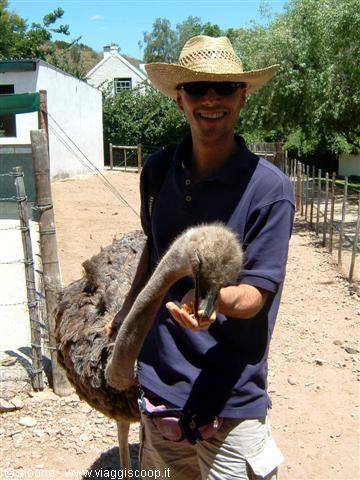
Before resuming our journey we fill up: 28.8 litres for 111 Rand!! We decide to move away from the coast, and therefore from the Garden Route, to head north towards Oudtshoorn, though via an alternative route, made largely of pure dirt road, where our "sporty" guide is, for the occasion, exalted. In Oudtshoorn we choose (very much at random, or rather because it was on the way) the Cango Ostrich Farm [tel: (044) 272-4623; as the ostrich farm to visit. The possibility of riding them makes the guided visit even more interesting. After some technical explanations about the characteristics of the bird, its large eggs, its soft feathers and its prized leather, we are taken on a brief tour of the farm. First they show us the funny chicks, then we're led into the pen where two handlers are busy capturing the "steed".
The operation is done by means of a hook (which serves to immobilise its neck) to make it easier to hood the head. We were struck by how, once hooded, the ostrich becomes completely still... and it's only then that you can manage to mount the animal. You hold on firmly to the sturdy wings, concentrating on keeping your weight backwards to stay better balanced. Afterwards the hood is removed, and in that exact instant the ostrich starts running at high speed.
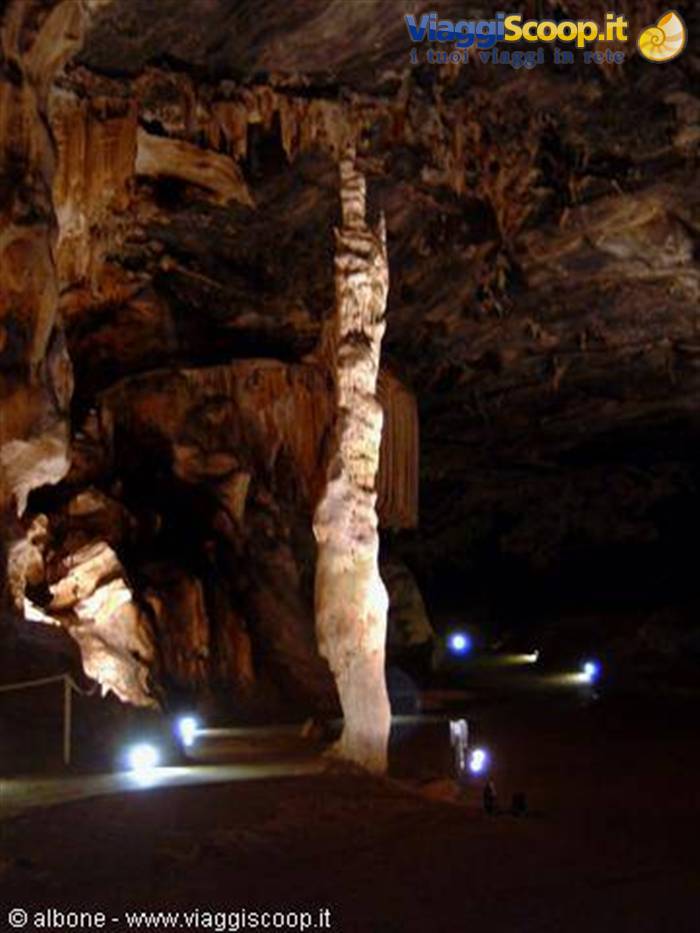
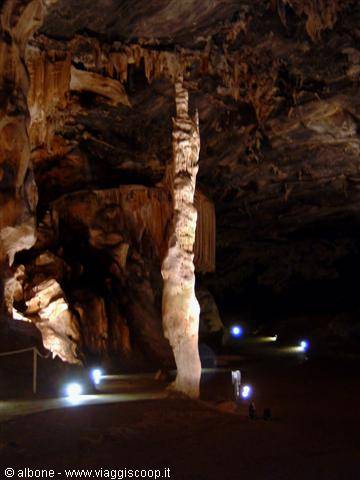
How do you dismount from an ostrich? When the run becomes unbearable for the novice rider, you "just" have to jump backwards and you come out unharmed and amused, unlike what Michele did, who was spectacularly thrown off, with a corresponding dusty tumble to the ground!! Ah, to ride them you shouldn't weigh more than 75 kg, but given such a fun attraction, it's well worth telling a little lie, a bit like I did, "barking" off a couple of kilos. Nearby, the Cango Caves should absolutely be visited too [tel: (044) 272-7410; Lingering over lunch, based on ostrich of course, we miss the Classic Tour by just 5 minutes, so we decide to fall back blindly on the Adventure Tour that was starting shortly after. Our guide accompanies us through the various chambers, making us admire stunning stalactites and stalagmites, suitably illuminated by effective lighting effects.
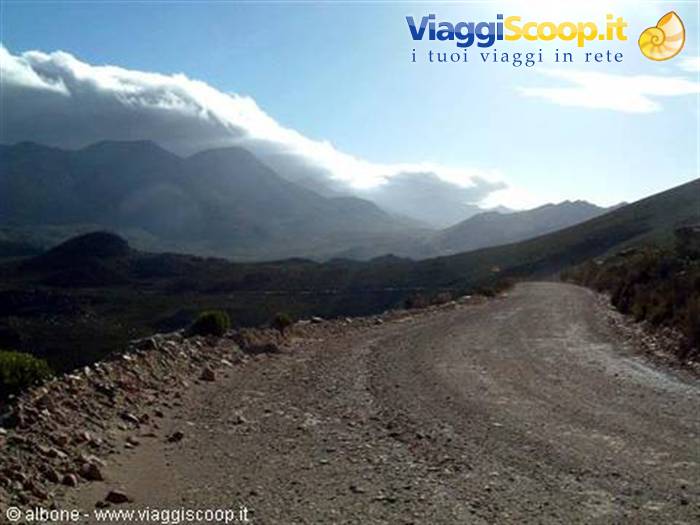
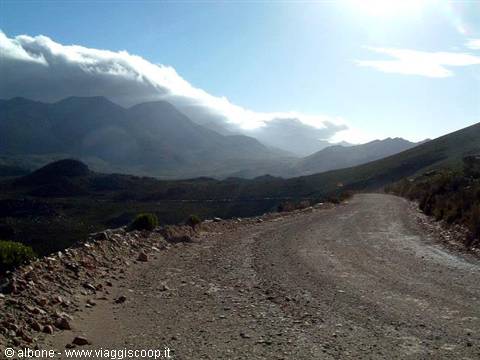
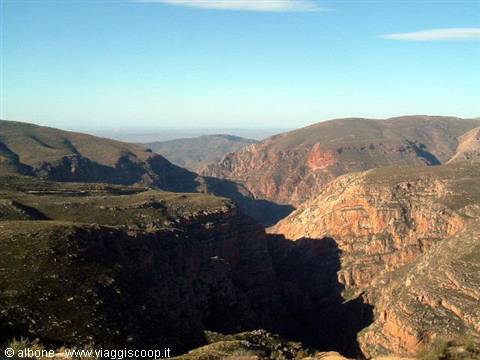
The visual spectacle is very beautiful but the guide seems a bit too contrived to us, especially when he strains to make the rock formations resemble just about anything. The whole thing instead becomes infinitely more gripping when we venture into the heart of the Adventure route... after a steep staircase we literally start crawling through narrow passages barely wider than us. The thing is, in quotation marks, demanding, especially physically (the internal temperature sits at around 18°C but the humidity reaches 95%), so it needs to be tackled in the right spirit. Coming out of the Cango Caves dirty and sweaty, we get back in the car for another little mountain drive: in fact we're aiming for the Swartberg Pass, continuing along the road that brought us here. To cross it we cover 24 km along a spectacular dirt gravel road. Descending then, you enter a fascinating gorge of intense red.
After some lovely hours spent in the car among splendid mountain landscapes, it's time to head back towards the coast because we have to reach Mossel Bay for the night, where the next day the boat excursion in search of the great white shark awaits us!! Although the demanding day had left us rather "unpresentable", in Mossel Bay we choose to dine at the elegant Jazzbury's [11 Marsh St; tel: (044) 691-1923].
This turned out to be probably the best restaurant we tried in all of South Africa, both for the quality of the food and drink (an excellent wine, South African of course: a Pinotage from Paarl, another renowned town of the Cape Winelands), and for the impeccable service (840 Rand for three, including the generous and well-deserved tip)! After a glass of local Brandy and a lively discussion about art, we ask the waitress for information on where to sleep (it was already around 11 p.m.)... out of pure kindness (at that exact moment we still had to pay the bill, and therefore leave the tip) she phones a B&B and, given the difficult directions to follow to reach it, insists on accompanying us...
in the end they send us to a nearby pub where an equally kind lady was waiting for us, who takes us to the Highview Lodge [tel: (044) 691-9038, A distinguished gentleman in a dressing gown rents us a magnificent apartment (850 Rand, including full breakfast) with a view over the bay. It's really a shame not to have had enough time to enjoy such a lodging, since the alarm is set for 7:00 to be at 8:00 at Shark Africa. We sip a vodka-tonic on the terrace, and then slip under the covers.
4.19 - Gansbaai
Day 426 Jan 2003
Fourth day: from Mossel Bay to Klein Bay (Gansbaai) - Km 660;
After a rich breakfast at the Highview Lodge we go down to the harbour, electrified by the idea of being face to face with the greatest predator of the oceans, the great white shark!! The surprise was not at all welcome when we found the Shark Africa office completely closed. Worried about our excursion, we call the phone number we had conveniently written down, and to our astonishment the person on the other end informs us that the work on the boat we were supposed to go out on had not yet been completed, and therefore... ok, ok, we get it...
what a rip-off!!! But we don't give up, because here it's not just about seeing white sharks (something you can also do in a well-equipped aquarium back home) from a boat, but rather there was the possibility of diving inside a cage, so as to admire them a hand's breadth from your nose and in their natural habitat! The biggest base for Shark Cage Diving is in Gansbaai (R43 south-east of Hermanus), a small town positioned exactly halfway between Mossel Bay and Cape Town... so a fair amount of road for us. From a flyer we get the phone number of a company in Klein Bay (a small harbour on the side of Gansbaai) and so we manage to book the excursion there for the following morning. So now it's a matter of finding something alternative to fill the day and, at the same time, of getting closer to Gansbaai.
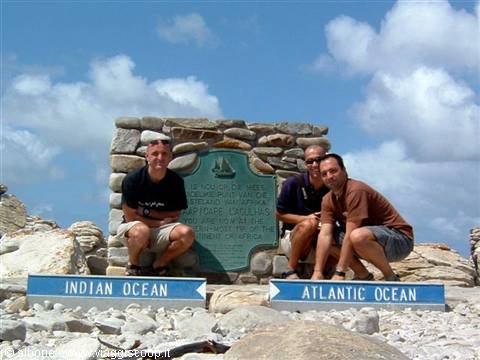
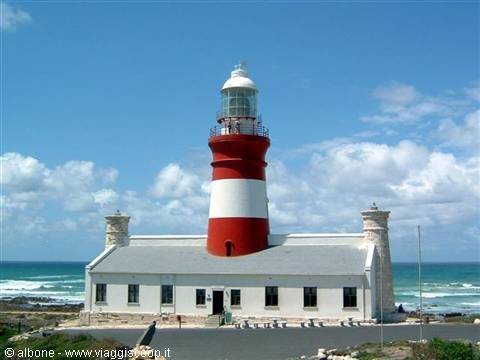
We decide to go to the southernmost point of the African continent, which as many think is not the Cape of Good Hope but the little-known Cape Agulhas, on the rocky east side of the Danger Point promontory. Here we find only the classic white and red lighthouse and a very simple stele recalling that this is where the two oceans, the Indian and the Atlantic, meet. The rough sea and a strange light give that stretch of coast a particular atmosphere. There's not much to do, so we decide to use the abundant free time left to us to go and visit one of the famous wineries situated in the region north-east of Cape Town. This stop was theoretically to be made once Cape Town had been visited and left, but given the mishap with Shark Africa we change our plans on the spot.
Along the road we're surprised by an encounter with a family of baboons roaming freely along the road in search of some tourist who will stop to feed them (a very serious mistake). Among the renowned localities of the Cape Winelands — Stellenbosch, Boschendal, Franschhoek and Paarl — our choice falls very randomly on the first, and specifically on the Morgenhof farm [tel: (021) 889-5510; This winery, founded in 1692, now owned by the French Huchon-Cointreau family of Cognac, offers the chance to have lunch outdoors, immersed in a splendid garden, in the shade of a big centuries-old tree. We eat very well, and of course drink even better, dining on an excellent 2000 Pinotage Reserve (lunch for 300 Rand for three).
Lost once again in a strange eco-environmental discussion, we realise we are the only ones left along with a solitary peacock on the whole estate, so, blissful, we rouse ourselves from the sweet relaxation of the moment and head to the tasting room (to be tested are pinot, pinotage, merlot, cabernet sauvignon and sauvignon blanc-chenin blanc, for a total of 10 Rand per person for 5 tastings). Enchanted by the superb wine, we can't help but make a quick stop at the little shop attached to the estate to buy ourselves 3 bottles each of the South African nectar, especially after noticing the impressive quality/price ratio!! There's also the possibility of having them shipped home or to an Italian airport, but the cost would increase even tenfold the price of a single bottle, so we decide to carry them with us. Back in the car, we reach the coast and then head straight for Klein Bay.
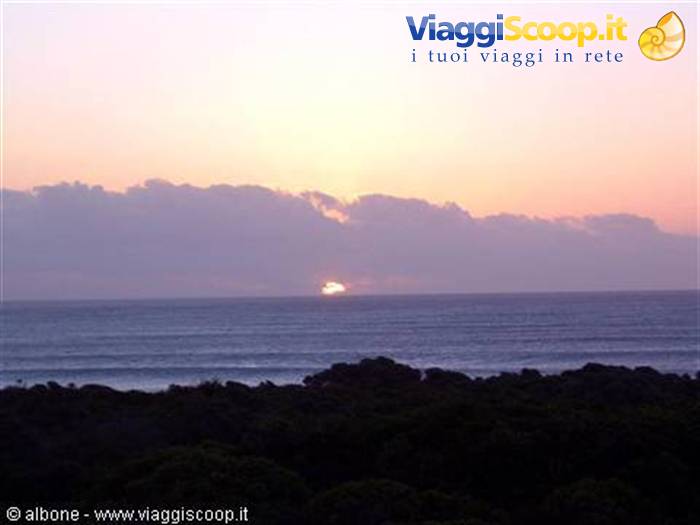
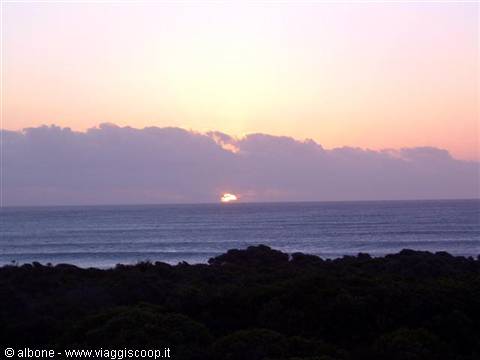
The area is battered by strong winds that make the landscapes spectacularly "wild". Between Hermanus and Gansbaai we're overwhelmed by a magnificent sunset over the ocean that will accompany us all the way to our destination. Without having much choice, given the size of the small town, we have dinner (before throwing ourselves into bed we continue the unmissable chess challenge between me and Marco... unmissable especially for me since Marco can't win even once), sleep, and will then have breakfast at the Tourism Center of Klein Bay (for a total of 1200 Rand).
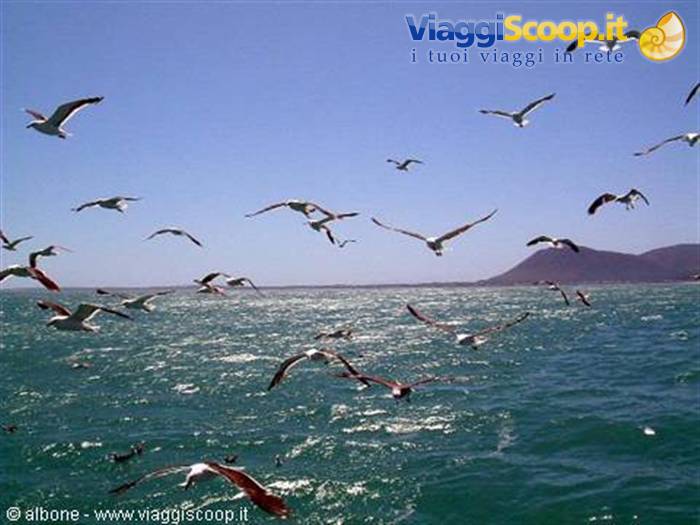
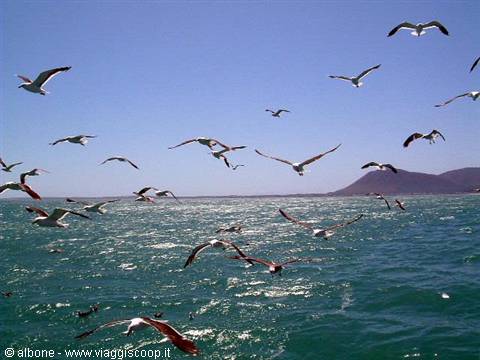
Seagulls flying over green sea with a hill on the coast
Day 527 Jan 2003
Fifth day: from Klein Bay to Cape Town - Km 180;
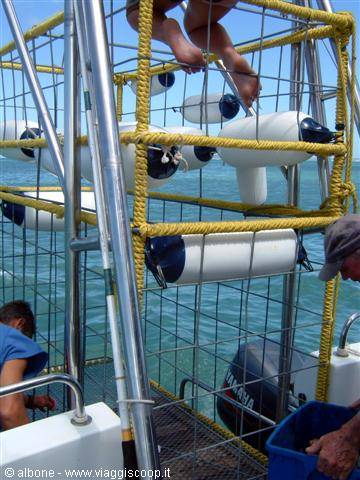
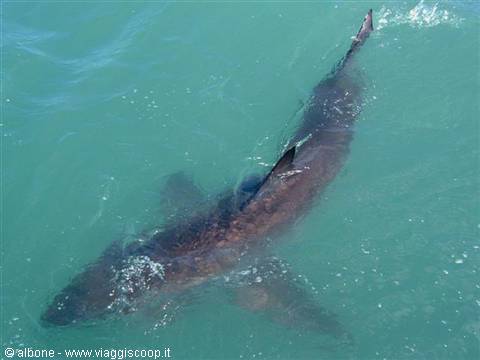
We finally manage to get out to sea in search of the sharks!! After riding the waves for about half an hour we drop anchor near the other boats, also there with the aim of pleasing tourists with shark sightings and diving inside the cage. Our boat, the Predator II, was captained by an elderly, tanned and wrinkled character (Bryan), the classic icon of the old sea dog. The sharks are attracted by big baits, made up mostly of tuna heads and other offal of various fish. Every now and then a piece of polystyrene shaped like a seal (which sharks are fond of) is also thrown into the sea, so as to recreate its shadow at the water's surface. After some time we finally manage to see a first shark. This is then followed by a second and a third. They come really very close to the boat, so the captain and his crew lower the cage into the sea.
However, he explains to us (and indeed you can see it) that the visibility in the water is very poor. The disappointment is great, because after an endless wait, we have seen (from very close, it's true, but from the boat's deck) only 3 "modest-sized" sharks (probably about 2 and a half metres long) which nonetheless have their charm... but we were hoping to come across a big beast of at least 5 metres!! Discouraged by the terrible visibility conditions, no one wanted to dive into the cage. After a long pause (rather boring to tell the truth), the excursion is "lifted" when from Dyer Island we move to the nearby Geyser Island to observe a very numerous colony of seals with their pups... beautiful (apart from the smell)!! We return to port in mid-afternoon, nicely roasted by the scorching sun, and after paying for the excursion (2520 Rand for three), we head towards Cape Town.
Here, so as not to waste too much time searching for accommodation, we plunge into the centre on a fairly large street teeming with hotels. We stop at the first decent one we come across, and for 1050 Rand we rent a suite (!!) at the Cape Town Lodge. As a suite it couldn't help but be beautiful, as well as big (so big you could play football in the living room!!), but unfortunately time is a tyrant, and since it was Friday evening, it was only right to enjoy the evening rather than the room. After consulting our guidebooks we decide to have dinner at the Africa Cafè [108 Shortmarket St, tel: (021) 422-0221; a restaurant furnished in ethnic style, offering dishes from all over the continent (675 Rand for three, including the pre-dinner drink had at the bar while waiting for the table).
It works like this: for a fixed price they bring you a dozen tastings of typical dishes from all over Africa and then you freely choose whether or not to have seconds of any of them... in short, you could eat endlessly! Very nice is the performance by the staff (barefoot, dressed in traditional costumes and suitably made up) who at a certain hour intone a tribal chant accompanied by involving percussion. After dinner we take a taxi and have ourselves taken to Long Street. As soon as we get out of the taxi we receive the classic offers of drugs of all kinds... it seems the Magic Mushrooms are the most popular... We slip into the Kennedy's Jazz&Cigar Club [251 Long St, tel: (021) 424-1212] to drink something and listen to a bit of jazz.
We change venue and try the Mama Africa [178 Long St, tel: (021) 426-1017] because we're attracted by a small band that with only voices and percussion creates an electrifying atmosphere. Inside we let ourselves be carried by the rhythm, and following an incredible magical flow we start dancing and singing without stopping. I'm even chosen by one of the group to collect the tips among all the customers in the place... a truly unforgettable evening!!
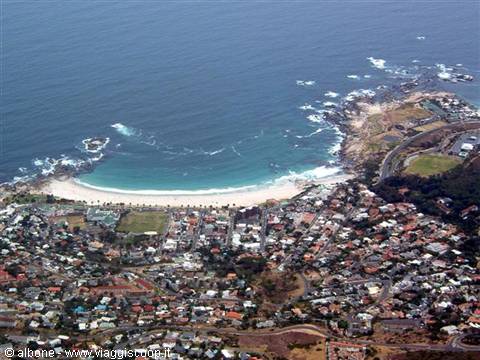
We dedicate a couple of hours of Saturday morning to the City Bowl district of Cape Town, and in particular to the little market of Greenmarket Square (parallel to St George Mall, a lively pedestrian area where local groups often perform), where we buy a few objects of local craftsmanship. Then by car we go to the Lower Cableway Station [tel: (021) 424-8181; to be able to take the cable car that will take us up onto Table Mountain to enjoy the panorama from a height of just over 1000 metres. A particular and fascinating atmospheric effect often manifests itself on Table Mountain: the clouds settle on its summit forming the famous "tablecloth". Once we've come down we head south towards the Cape Peninsula National Park [tel: (021) 786-2329; skirting its panoramic and steep western coast along which, looking back, you can make out Devil's Peak and the tablecloth on Table Mountain.
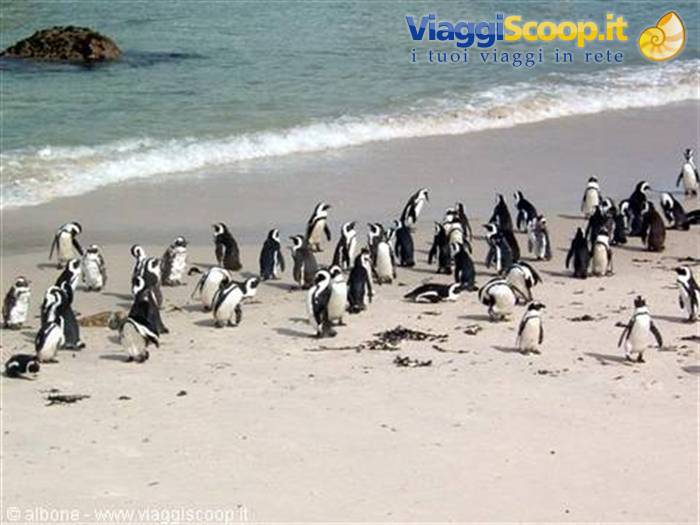
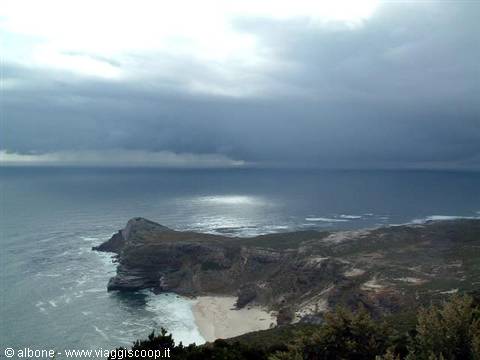
We make a brief stop at Boulders Beach (10 Rand) to see the beautiful protected land colony of 2300 African penguins that lives there. It's the breeding season so many penguins are in the middle of the scrub tending their eggs. Temperature permitting you can swim near the little creatures... we don't dare, also because the weather is turning bad. Then, following the M65, we reach the Cape of Good Hope Nature Reserve (26 Rand) [tel: (021) 780-9204] where baboons greet us along the road. After a short walk under an annoying drizzle we reach the courtyard of the Cape Point lighthouse and linger a few moments to admire the vastness of the ocean and the Cape of Good Hope. The next destination is Kimberley, so, having almost 1000 km to cover, we take the N1 and try to clock up as much road as possible.
We stop to eat at a service station along the motorway near Worcester and then continue to Laingsburg where we find accommodation at the Grand Hotel (360 Rand with breakfast). The hotel's name is quite a statement, since it's really run-down and decadent (it's enough to say that Marco had to improvise as a plumber to stop the incessant gush from the toilet...!).
Seventh day: from Laingsburg to Johannesburg - Km 1240;
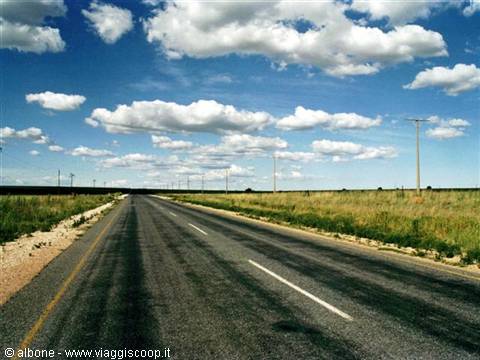
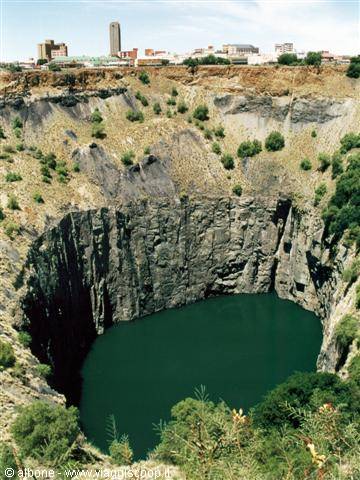
Today is a big transfer day!! Crossing the arid interior region had been planned in the hope of witnessing a continuous variety of landscapes... in reality there aren't that many, even though there's no shortage of breathtaking views. About halfway along the route is Kimberley, with its diamond mines to visit (once owned by the De Beers Mining Company, today by the Anglo-American Corporation). The city is famous for having been, at the end of the 19th century, the center of the world's largest diamond rush. We only stop briefly, just long enough to visit the Kimberley Mine Museum [West Circular Rd, tel: (053) 833-1557]. This "open-air" museum village, made up of historic buildings meant to recreate the atmosphere of the place from over 100 years ago, seems to us rather poor and uninteresting, but the visit is a must to admire the Big Hole.
This mine, closed in 1914, considered the largest man-made crater in the world with its 800 meters of depth (of which the first 240 were dug by hand), yielded 2,722 kg of diamonds for a total of 14.5 million carats. Kimberley offers nothing else: a quick lunch at KFC (on the corner of George/York St and Bultfontein Rd) to try to reach Johannesburg for the night. We arrive in Jo'burg (as it's commonly called) as the sun sets, and entering it we can't help but notice Soweto, one of the most sadly famous townships of the South African metropolis. Even the city center doesn't appear very reassuring to us: surely influencing our judgment are the many precautions expressly emphasized by all the guidebooks, as well as the gloomy appearance of the poorly lit streets themselves, frequented by groups of black youths who, at first glance, don't seem reassuring.
Here in Jo'burg we don't want to stay long, we're only interested in finding a hotel that has ESPN, because tonight there's SUPERBOWL XXXVII, which Marco and I absolutely don't want to miss. After trying all the major international hotel chains, in a Holiday Inn we find a very kind receptionist who points us to, as the only hotel with a sports bar attached, the competitor "The Gardens Protea Hotel" [Tudhope and O'Reilly Sts; tel: (011) 484-5777; located outside the center. After slipping him the proper reward, we finally head to this hotel; here we make the most of its facilities, treating ourselves, even though it's already dark, to a fleeting dip in the illuminated pool. After a refreshing shower we treat ourselves to an excellent dinner and calmly start getting ready for the sporting event.
Although disturbed by a group of noisy Englishmen, we manage to enjoy the legendary Superbowl, accompanied by a few liters of beer. Unfortunately, though, the game was rather disappointing and one-sided, so, a bit bored and dead tired from the exhausting day spent in the car, we reluctantly decide to trudge sadly off to bed between the 3rd and 4th quarter.
9.7 - On The Road.jpg
Day 830 Jan 2003
Eighth day: from Johannesburg to Barbeton - Km 600;
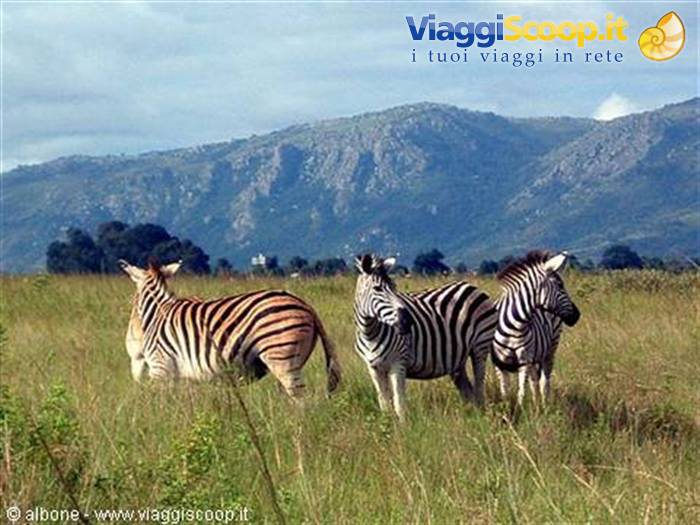
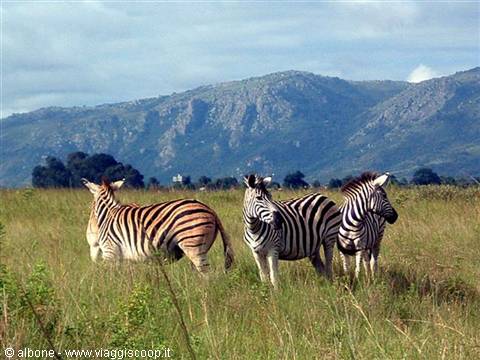
We need to make the most of the day and a half we have left before the stay booked from home at the Karongwe Game Reserve. So we choose to cross the border into Swaziland, just to see a different reality and, why not, to be able to plant a new little flag on our world map of places visited. After taking care of the bureaucratic formalities at the Sandlane border post, we venture into the interior of the small African country. Along the E20 we find the Milwane Wildlife Sanctuary Nature Reserve [Tel: (09268) 528-3944] and decide to visit it. This reserve gives us a first and significant taste of the wonderful animals we'll encounter on the following photo-safaris. We can follow the trails with our car... We manage to see several zebras, warthogs and antelopes up close; we even recognize some wildebeest, but our curiosity is drawn to the small pond where we spot a small group of hippos.
We stay in position in sacred silence for a good half hour, but they don't want to give themselves to the attention of us "photographers." Unsatisfied with having seen only nostrils, eyes and ears of hippos (impatient with the great heat, these big pachyderms prefer to stay completely submerged), we continue our march toward the capital, Mbabane: nothing exceptional. We therefore re-enter South Africa through the Oshoek border post, near Ngwenya (open from 7 to 22, but the 13 crossings have different hours and some close at 16), and continue north. Since there are no major cities in the area, we prefer to stop in the first one we come across, Barberton. Here we stay (300 Rand with breakfast) at the Phoenix Hotel [on the corner of Pilgrim St and President St; tel: (013) 712-4211; fax: (013) 712-5741], and while we're at it we also stop there for dinner.
Michele and I, struggling with the translation of the menu, unknowingly order an inedible liver of who knows what animal. Since we're the only guests in the hotel, during a brief absence of the waiter we take the opportunity to throw the contents of the plate outside the restaurant (for the good fortune of some cat...). We go to our room very early to get a proper rest. It hasn't always been mentioned, but the chess challenge between Marco and me continues incessantly, and always with the same result in my favor!!
9.25 - Karongwe Game Reserve (Lions).JPG
Day 931 Jan 2003
Ninth day: from Barbeton to Karongwe Game Reserve - Km 290;
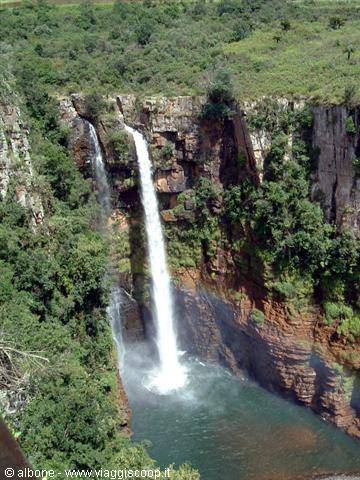
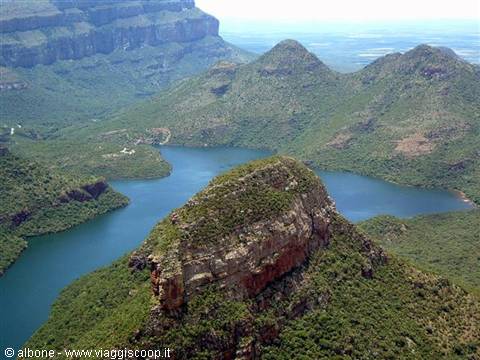
The route that will take us to the Reserve gives us the chance to cross the Blyde River Canyon Nature Reserve, but before getting there we decide to visit some waterfalls along the R532. MacMac Falls, Lisbon Falls and Berlin Falls reach heights ranging from 70 to 90 meters. At all the accesses to the waterfalls we find nice local craft markets where you can buy and take home a "piece of Africa." We continue toward the canyon; there a beautiful natural spectacle of rocks carved by the strong current of the Blyde River awaits us. The magnificent slopes covered in evergreen shrubs, the shapes of the escarpments and the rock formations (such as the Three Rondavels, which look like Zulu huts) form a breathtaking Nature Reserve. We have a quick lunch at a resort near the canyon and then continue toward the Reserve: 6,000 hectares of savanna with 4 Lodges inside.
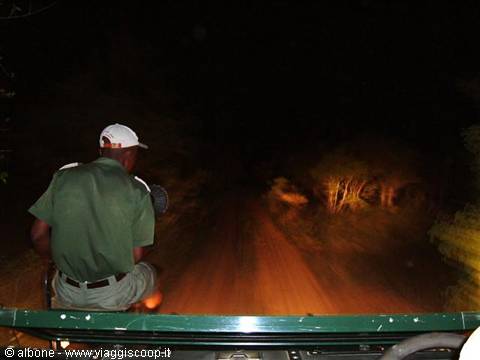
Ours in particular, the Ingwe Lodge, is really not bad at all, even though the choice made from home had aimed at one of the cheapest among those offered by Turisanda near Kruger. We settle our luggage, relax at the edge of the pool for a couple of hours soaking up some sun, reading and playing chess. Four in the afternoon arrives and finally we set off for the first Safari. The entire Lodge staff welcomes us with a small buffet of pastries and tea. Meanwhile Michael, our tracker, approaches driving an open-top Land Rover capable of seating 9 passengers (in addition to the driver-ranger and the tracker positioned on a small seat above the hood). In the meantime our ranger, Sunday (armed with a sawed-off shotgun), shows up, and off we go.
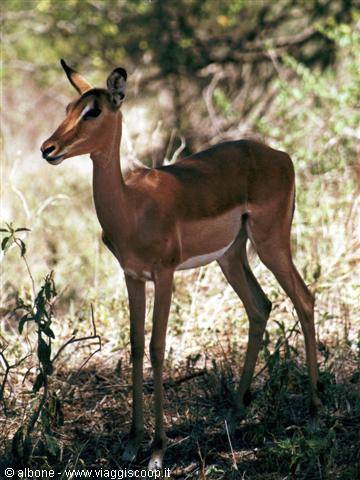
After half an hour we still haven't spotted anything, and among us the nightmare already experienced in Gansbaai while waiting for the enormous shark starts to creep in!! Finally a warthog shows itself, wallowing in the mud of a small pond, and then various types of antelopes (springbok, bontebok, oryx, kudu, and impala among others). Meanwhile we're struck by the quantity and size of the termite mounds (they're even more than a meter tall!) that we come across along the road. Time passes but of the Big Five (Rhinoceros, Elephant, Lion, Buffalo, Leopard) there's not even a shadow. By the way: unlike what one might think, they're called the "Big Five" not because of their size but because in the past they were the most sought-after hunting prey, whether for their coats, for their ivory, etc.
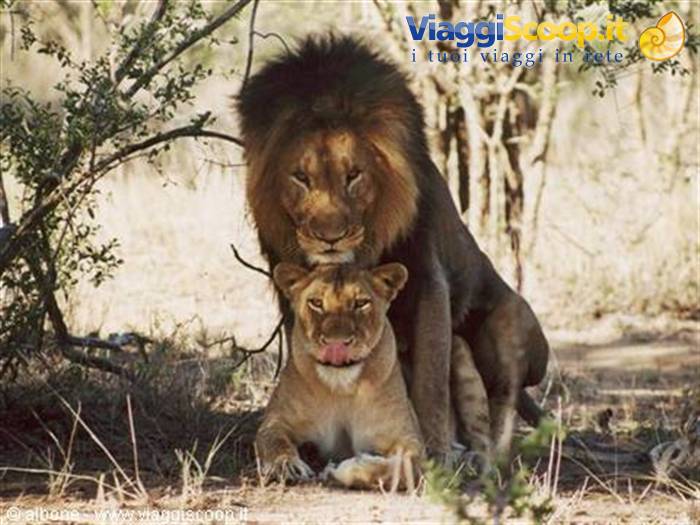
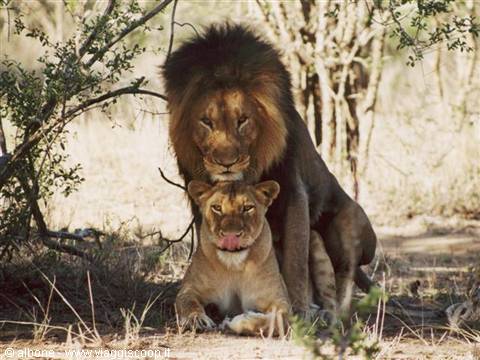
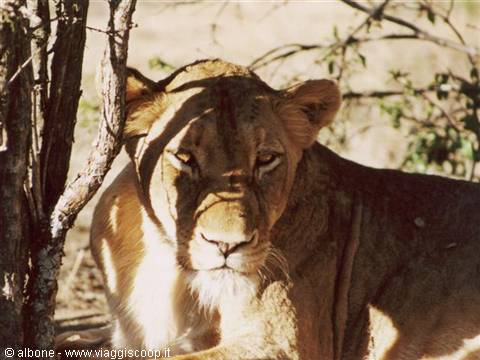
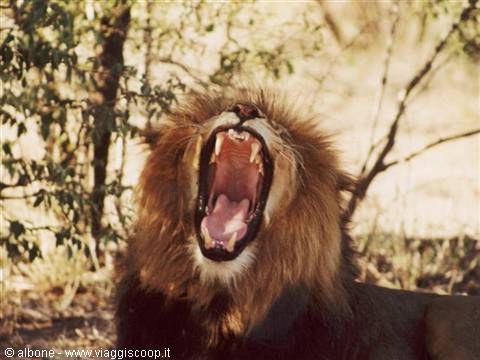
Suddenly Sunday stops the off-road vehicle and starts observing the ground looking for tracks and prints. We're increasingly perplexed... it all seems a bit staged ad hoc for the classic stupid foreign tourists. Shortly after, however, we're resoundingly proven wrong by the incredible beauty of a lion, a lioness and their 3 cubs crouched in the shade of a tree. We silently approach to within 5 meters and with teary eyes start snapping an absurd number of photos. Our happiness, mixed with curiosity and amazement, is literally palpable. We manage to capture the lions in every possible position, even during a quick mating phase. After a good quarter of an hour spent in their "company" we move on, regenerated and enthusiastic, in search of other animals. Quickly we manage to notice an eagle, a small fox and a couple of zebras.
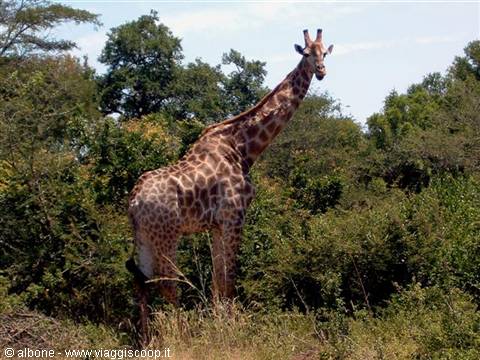
Now and then we still catch a glimpse of some small group of antelopes. Returning to the area of the pond we spot suspicious movements at the water's surface... there are a couple of hippos, but as in Swaziland they don't give themselves to our lenses. As we leave, among the shrubs we see a giraffe, but to our great amazement Sunday doesn't stop, thus preventing us from getting any shots. Honestly, we're annoyed by our ranger's attitude, because even a brief stop to admire a giraffe interests us a lot since you don't often see them where we're from. Continuing on, we notice some wildebeest and some wild dogs. Sunday stops to observe some dung along the road and from there the search for the elephant begins. Finally we reach it.
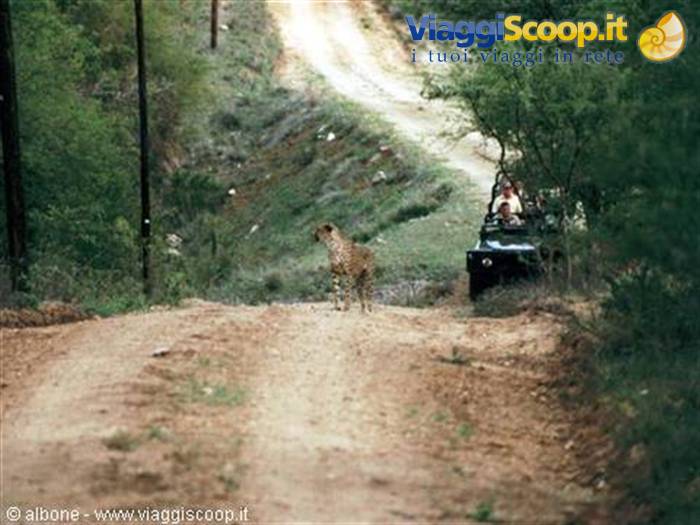
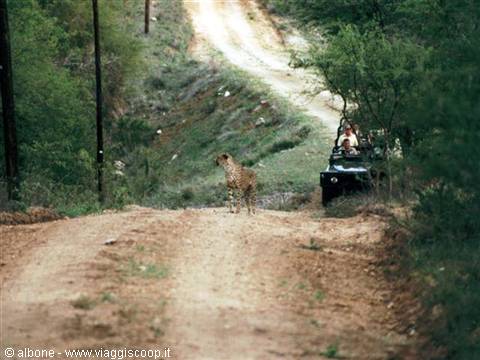
The elephant is busy eating and so we can't get too close, otherwise it would get annoyed and run away; we stay where we are but because of the dense bush we can only catch a glimpse of it. The last animal worthy of note that we manage to see on this first safari is a small cheetah with its mother, both confined within a large fenced area. The purpose of this safety measure is to preserve the cub from the presence of numerous predators within the Reserve. We return to the Lodge enjoying an incredible starry sky and truly satisfied with the experience just concluded. The evening ends with dinner by the light of an oil candle.
Cheetah on dirt road in front of safari jeep with tourists
Day 101 Feb 2003
Tenth day: Ingwe Game Lodge;
Wake-up at 5:15 am because the second of the four planned safaris departs at dawn, at 6 o'clock to be precise. No proper breakfast, but the usual cup of coffee with a pastry. The real breakfast is scheduled at the end of the safari, that is, after 3 hours! The "extreme" timing of the morning safari is justified by the fact that at those hours the temperatures aren't high yet, so it's more likely that the animals aren't hidden in the shade of some bush. The first animals to show themselves are, as usual, the gazelles. We admire them nimbly jumping across the road one after another. Then the wildebeest appear again, and then a giraffe. This time Sunday pulls the off-road vehicle over and finally we manage to capture it.
We resume our race in search of another big piece, and after a couple of tips received by radio from another ranger we manage to find a massive and peaceful black rhinoceros busy grazing on some grass. On our faces is painted a smile of satisfaction at having tracked down our second Big Five. The rhinoceros is quite still, so the subject is perfect for our shots. On the way back to the Lodge we manage to cross paths with two adult cheetahs, this time free within the immense Reserve. It always has a certain effect to find yourself face to face with the fastest four-legged creature on the face of the earth!! At the Lodge we enjoy a succulent breakfast. Given the tiredness, the infernal heat and full bellies, we invest the 3 hours separating us from lunch in a restorative nap in the room, under the fan blades.
After lunch we start packing our bags in view of the next day's departure, and we dedicate half an hour to the usual ritual postcards. At 4 in the afternoon the third safari departs. Of the Big Five we're still missing the buffalo, the leopard, and maybe an elephant seen properly. By now, absurdly, we're even tired of seeing gazelles left and right, because we're aiming for the big "prey." We begin a very long tour of the Reserve that initially seems fruitless. Sunday confesses to us that on that day he intended to track down a leopard, a very aggressive animal but at the same time very shy and timid, and therefore difficult to find. Apart from the "usual" animals, among which another couple of giraffes, the search for the leopard immediately proved very demanding.
Meanwhile, traveling along a dirt road that ran alongside the bed of a dried-up river, on the other side of the embankment we manage to catch a glimpse of an elephant on the move. It's impossible for us to reach it, so once again the pachyderm escapes us. Okay, let's say we "dodged" the third Big Five by a hair. We resume the chase for the leopard also thanks to the precious tips of a ranger, who with very precise directions (incomprehensible to us since in the middle of the savanna there isn't, at least apparently, even a single landmark) helped us in the search for the exact spot where one had been spotted a few minutes earlier. At dusk we venture with our indestructible off-road vehicle into a super off-road route among bushes, dry shrubs, rocks and brambles.
All of a sudden Sunday asks us to try to sniff the air, but to us "ordinary city mortals" the air just seems particularly clean, nothing more. After only five minutes Michael points out to us, with the beam of his flashlight, the remains of a small impala and only then do we manage to perceive its smell. That, Sunday explained to us, was the leopard's prey; probably the noise of our approach must have alarmed the feline, abruptly interrupting its feast. Sunday gets out of the off-road vehicle shouldering his rifle to scout the area... we even try to wander around a bit with the Land Rover in those parts, but by now it's impossible to flush it out. It's almost 8 pm and the third safari has inexorably come to an end.
We just have time for a brief stop in a very dark atmosphere: enveloped in deep darkness and illuminated only by the headlights of the off-road vehicle, we set up for a quick nocturnal picnic. We return to the Lodge where a dinner prepared around the fire awaits us. Since the next day another dawn wake-up awaits us for the last safari, after a bit of chatting at the table, it's straight to bed!
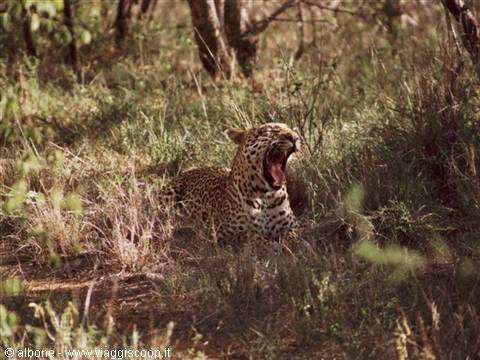
11.3 - Karongwe Game Reserve (Leopard).JPG
Day 112 Feb 2003
Eleventh and last day: from Karongwe Game Reserve to Johannesburg International Airport - Km 7
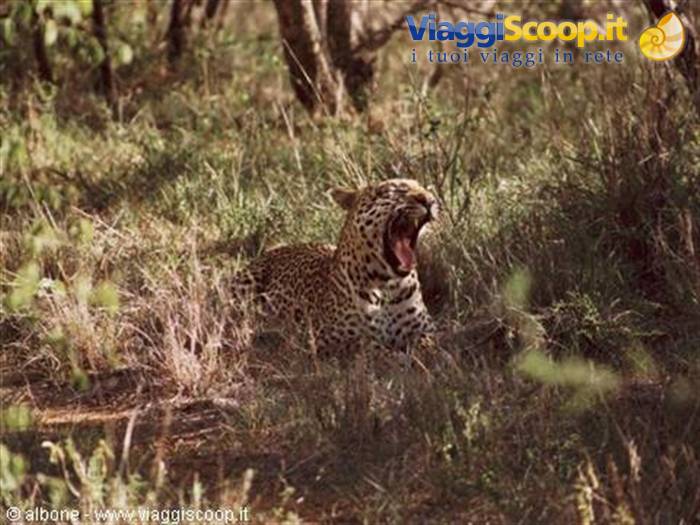
Even on our last day in South Africa the alarm goes off at dawn. At 5:30 we're woken by the relentless ringing of the phone with which the Lodge management makes sure all safari participants are operational for 6 o'clock sharp. This is our last safari here at the Karongwe Game Reserve, and on the Big Five list we'd only be missing the leopards and the buffaloes (and if there were ever the chance, maybe also a baby elephant seen really, really well...). Sunday intends to give them all to us, so off we go in search of the leopard. After almost an hour of scouting and a dozen tips given and received with the other rangers, we manage to track down a beautiful leopard specimen. We stay at a safe distance admiring it; in that quarter of an hour, between one photo and another, we also notice that the animal is entirely intent on devouring a prey (probably the one hunted the previous evening)...
Unfortunately time is short and Sunday warns us in advance that our requests regarding the elephant cannot be fulfilled. Indeed the reserve is very extensive, and elephants and buffaloes are usually found at opposite ends of it, so, after the latter we certainly wouldn't have the time to see the others. We travel along a dirt road outside the reserve that quickly leads us to a fenced area where a herd of buffaloes lives. One of them, curious about the off-road vehicle, approaches us and tries to stick its enormous snout inside our cabin; it slowly approaches Marco, who gently tries to stroke it. The animal is very docile and certainly doesn't scare us, but we fear that, driven by a gesture of affection, it might stick out that big drooling tongue of its.
Meanwhile Sunday explains to us that the armor covering its head, which in practice is one with the horns, is so resistant that if it were hit by a bullet at that point, it probably wouldn't die. We return to the Lodge to fortify ourselves with an abundant breakfast. Since we have to vacate the rooms by mid-morning, we decide to set off again immediately, so we load the luggage and distribute the proper and well-deserved tips both to the Ingwe staff and in particular to our 2 formidable guides. The plane takes off at 19:55 so we have the whole afternoon left to make the most of.
We head without too much hesitation toward the Kruger National Park [tel: (012) 343-1991; fax: (021) 343-0905; which, with its 19,633 sq km (just to give you an idea, the park is slightly larger than the entire Veneto!!), is the largest national park in South Africa and undoubtedly one of the best nature reserves in the world. At around 10:30 we enter through Orpen Gate, in the Central Kruger, and head south to then exit at Crocodile Bridge. Here the safaris are completely different from those done previously. You enter with your own vehicle and therefore you can drive freely within the park, obviously respecting the strict rules imposed, starting with speed limits and collecting your own trash.
Surely there are also guided tours available, but we only notice large closed minibuses with 20-30 people racing along the only paved roads, and not even one open-top off-road vehicle similar to the one with which we raced through the bushveld. Unfortunately we cross the park during the hottest hours (the worst ones) but impala, zebras and giraffes still show themselves. Although qualitatively this safari turned out inferior to the previous ones, we still experienced the excursion in a fun way, because it was done sitting outside on the edges of the car windows, ready to film anything and snap some absurd photos while moving. Toward the southern part of the park, shortly before our exit, on the bridge that crosses the Sabie River we notice a parked car and 2 people intent on photographing something.
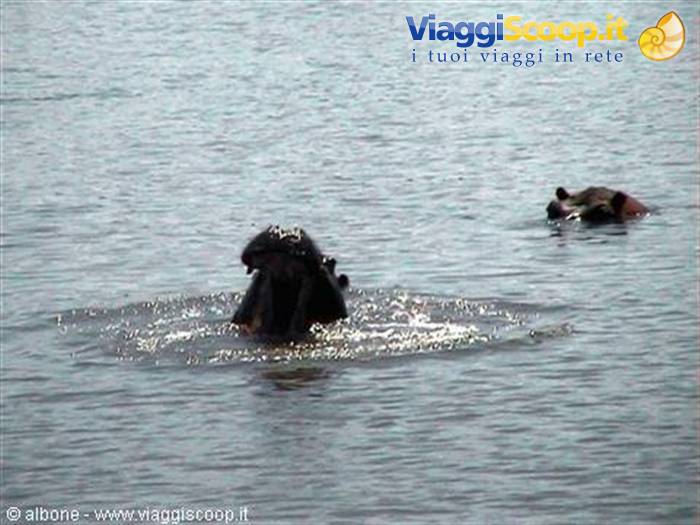
Of course we stop too: hippos!! Once again they're almost completely submerged in the water. We try to wait a bit hoping to immortalize at least one of them in its entirety, or at least to catch in the instant its infamous yawn. After almost twenty minutes we're partly rewarded by an immense, wide-open mouth emerging from the water's surface. We exit the park at 14:30 and in order not to miss the plane we have to keep a good average speed for the 400-some km separating us from the airport. Given the big risk we're running, we keep a very brisk pace.
After the hundreds of photos taken of the natural beauties of the place, this time, very probably, much to our chagrin, we become the subjects for the Johannesburg authorities: dazzled by a powerful flash we're convinced we've got ourselves, as a last souvenir, a nice speed camera!!! We manage to arrive at the airport in perfect time, and after gathering all the trash accumulated on the back seats into a good 4 bags (just to give an idea of the pigsty we've been wallowing in for almost 2 weeks) we hand over our legendary Hyundai Elantra (which by now would be better off scrapped given how we've pushed and treated it). The odometer reads 4,932 km traveled!! Unfortunately on the plane we don't have seats next to each other, so the return trip turns out pretty boring, and especially for Marco it will be impossible to recover the 20 to 0 chess deficit.
The stopover is in Frankfurt, where we change planes and return to Venice. FAREWELL FABULOUS SOUTH AFRICA!!!








0 reader comments