Here there's more sky than you've ever seen, flat and blue horizons, or frayed with hills that confuse the distances. Land that fills with light: and it is solitude, magnificent and paltry. ("Free state," F.D. Sinclair).
9/18: CAPE PENINSULA It takes a whole night of flying to get to South Africa. We're over Cape Town at eight on a gloomy but sunny morning. The Boeing 747 lands on the drenched runway, which reveals traces of very recent rain: although spring has just begun here, it will be the first and only evidence of rainwater for all 14 days of our vacation. The Cape airport is small, neat and tidy, and even though the airport staff, the customs police and the Hertz employees who hand us the rented Opel Corsa are all rigorously people of color, it doesn't feel like we've just landed in an African airport, but rather in a quiet northern European town. The first impression, though, is often the wrong one, and this time it crumbles as soon as we leave the airport.
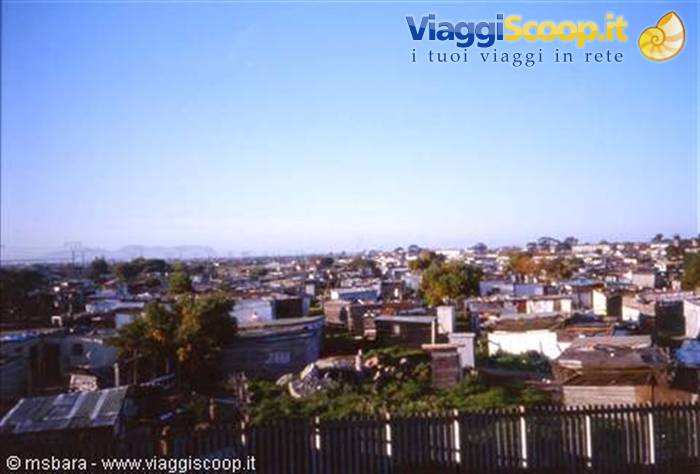
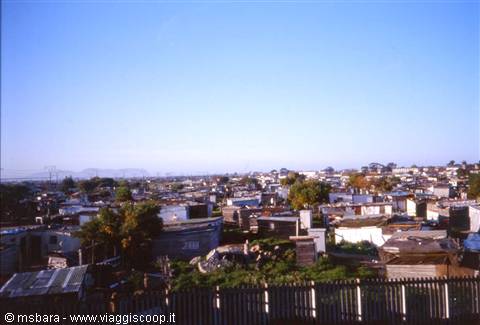
The highway connecting the airport to the city in fact runs alongside an immense shantytown, one of those notorious ghettos I'd heard so much about during the apartheid era. An impressive series of shacks, built with wood, cardboard, sheet metal and whatever else, enclosed within a high fence that nonetheless doesn't block the view for those passing along the road. A shocking sight, one we weren't prepared for; we knew this wouldn't be a trip like the others, that racial segregation was abolished less than ten years ago and that the country is still torn by internal conflicts far from being resolved. But what we didn't know, and discovered quickly, is that discrimination has given birth to a social and economic inequality (all, naturally, in favor of whites) that only time, perhaps, will be able to heal.
After a few kilometers, finally leaving behind that wretched sight, following the directions sent to us by e-mail and driving along the southern part of the city, we find the B&B (bed and breakfast, booked thanks to the internet) in Hout Bay, a small town located 10 kilometers from Cape Town: it's a pretty construction, of wood and brick, built in the middle of a damp, cold forest. As damp and cold as our room. Before setting off for the Cape Peninsula, our initial destination, we leave our backpacks and turn on the electric heater to ensure a warmer return. Trying to remember that here you drive on the left, we throw the car southward, in the direction of the Cape of Good Hope. After not even 20 kilometers a sign announces that we've entered the Cape nature reserve. It doesn't seem possible, because around us there are cars, houses and even the railway.
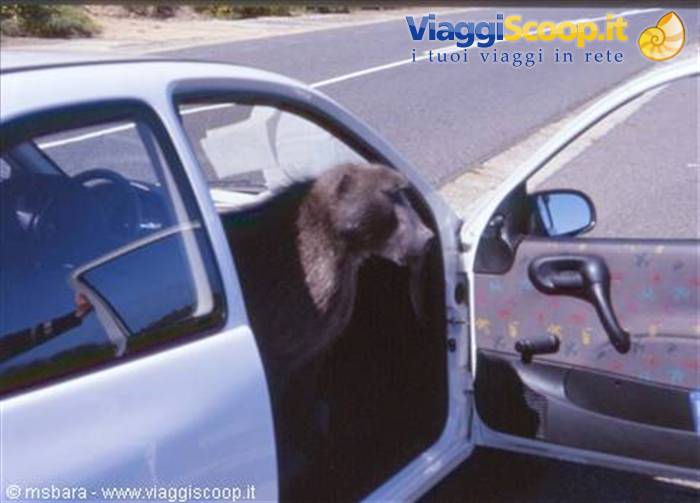
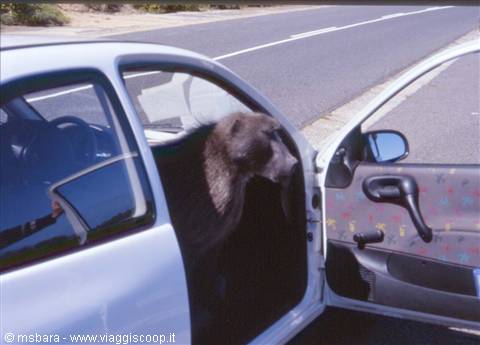
But after a curve we surrender to the evidence: a group of baboons is stationed along the sides of the road. The little ones play hopping everywhere, while the adults stay calm, sitting in the low grass. We stop to take photos: we get close to them and they don't run away, evidently used to humans. Once we've digested the emotion and run out of shots, we head back to the car. But there's a problem: the passenger seat is occupied by a male baboon, who got in through the window left rolled down. He's rummaging through the backpacks, looking for food which fortunately isn't there. Virna approaches him, opens the door and tries to get him out, but the reaction isn't encouraging: he extends a paw and tries to hit her, or maybe just to grab her. For us it's more than enough anyway, and to avoid a brawl with a at best uncertain outcome, we move away.
At what seems to us a safe distance we await his decisions, which aren't long in coming: after not even five minutes he gets out of the car and chooses to devote all his attention to the fur of a female, whom he begins to groom carefully. Once we've dismissed the monkeys we set off again toward the peninsula. Two more curves and a sign warns: "Baboons are dangerous and attracted by food." Interesting. Another 20 kilometers and we arrive at Cape of Good Hope. Certainly thanks to the encouraging name, in my imagination I've always contrasted it with the terrible Cape Horn, but now I don't dare think what the Argentine tip might be like if here the lighthouse overhangs a nasty, dark sea, which boils against the coast and explodes on a expanse of emerging rocks.
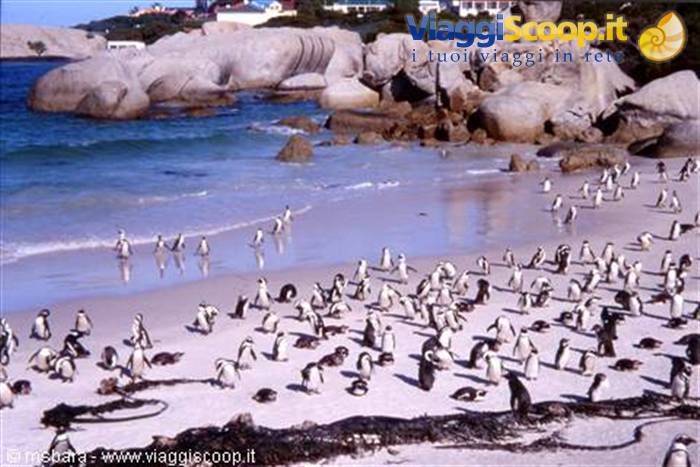
A disturbing scenario, but made extraordinary also by the awareness that it is the (theoretical) point where two oceans meet: the Atlantic and the Indian. In the parking lot, meanwhile, a few baboons amuse themselves hopping on the cars: but ours, this time, is well closed. After the night spent on the plane, the shacks, the baboons and Cape Point: as a first day you could be satisfied, also because we're a bit cooked. But instead it's not over yet. Heading back up toward Hout Bay we pass through Simon's Town: here a stretch of stunning coastline, which alternates enormous smooth rocks with very white beaches, hosts a colony of African penguins. They're funny animals, decidedly smaller than the Antarctic ones seen so many times on TV, who freeze and stare at you when you get close.
Better, though, not to overdo it: Virna, after tasting the beak of a decidedly touchy specimen, probably won't forget it anymore. The first South African day ends with a fish dinner consumed in a restaurant in Simon's Town: on the entrance door a disturbing "Right admission to reserve" with which the owner reserves the right to let in whomever he wants. Inside the place, run by people of Dutch origin, there wasn't a single Black person, but I couldn't swear that there was necessarily a connection between the two things. The suspicion, though, I carried it home with me, because we found these warnings just about everywhere.
Colony of African penguins on white sand among large boulders at Boulders Beach
Day 219 Sep 2001
19/9: CAPE TOWN We dedicate the second day to visiting Cape Town. It immediately appears to us for what it is: stunning. Clean and tidy, with very little traffic, it alternates buildings of clearly Victorian origin with very recent constructions, African craft markets with internet cafés. But what strikes you most, obviously, are the mountains. Of the most varied shapes, flat like "Table" Mountain, or pointed like "Lion's Head," their slopes stretch all the way down to the sea, dividing the city into various sections and giving it a particular charm. Everywhere you look you see these majestic massifs looming over you.
To do a complete tour of the city we take an open-top, double-decker bus, red like the London ones: it takes us to the Waterfront (right on the harbour, a tourist area full of shops) and then to "Signal Hill," a hill from which you can see "Robben Island," the little island that was Nelson Mandela's prison for 25 years and is now a museum. Once the tour is over, sitting on a bench we decide to refresh ourselves with water and chocolate, but two children come up. "We're thirsty," they say, and we can't not give them something to drink. "Hungry too," they insist. And the chocolate goes as well. They leave smiling, while my stomach growls. My conscience a little less. The road that takes us back to Hout Bay runs alongside a very beautiful stretch of coast, purely touristic. The sea is fantastic and so are the beaches, but the temperature would only appeal to penguins.
i'm in it too
Day 320 Sep 2001
20-21/9: GARDEN ROUTE Hermanus, the day of disappointment. The bay that more than any other is loved by whales and therefore by tourists is about 150 kilometres from Hout Bay. The road is beautiful, all perched over the sea, but also tiring: when we arrive we're informed that there are over 20 whales in the bay. They're visible from land and, naturally, even better from the boats that, for a fee, take you right up close to the cetaceans. Since despite the hysterical shouts of the other tourists from the shore we can only see sprays (whales? rocks? waves? even the binoculars don't help), we opt for the boat: the same one Steffi Graf took, the photos displayed in the office where you book show. But we won't be going anywhere: despite a two-hour wait there's too much wind, and the boat that's supposed to take us out can't even make it back into port.
As we head back I think we've wasted a day and also 300 kilometres (our car doesn't have unlimited mileage), but then on the coast another penguin colony, which we photograph abundantly, serves to console us. After the third and final day at the Cape, we head east. We cross the whole of the Western Cape, one of the nine regions of South Africa, travelling the legendary (at least that's what they call it here) "Garden Route." As the name suggests, it should be over 300 kilometres of forests, flowers (above all the "protea"), trees and impeccably kept gardens, but perhaps the real blooming hasn't arrived yet, because the scenery, though very beautiful, seems to us always the same as what we admired in other areas too. We sleep in Knysna, a small seaside town, where for the first time we're told that you can even walk around, since crime is under control.
Indeed we don't see any ghetto, and when we go out for a stroll everything seems calm; on the street I catch the eye of a Black woman, and I smile at her. She returns it with a ringing "Jesus loves you."
i'm in it too
Day 422 Sep 2001
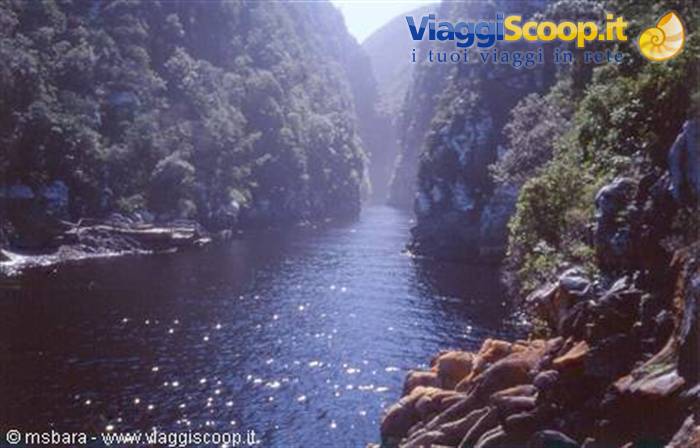
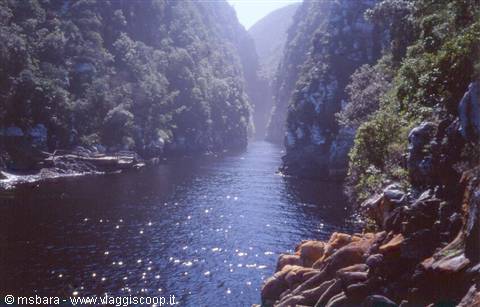
22-23/9: EASTERN CAPE We leave Knysna early in the morning, noticing that the temperature is changing. We put on shorts and T-shirts for the first time, and when we arrive at the "Tsitsikamma Forest," not before having encountered a herd of ostriches, it's actually hot. It's a nature park that winds along a rugged and very beautiful coast, with fjords alternating with white beaches. Brave tourists swim in the transparent, cold water, but I only go in with my feet. And that's enough for me. In the early afternoon we set off again, and after about 250 kilometres we arrive at King William's Town. Despite the name it's a predominantly Black city, the first we encounter.
The B&B where we stay is also run by Black people: but more than in the African year 2000, this building shows such British origins that it feels like being in 1850s London, and even the lady who hosts us could have been transplanted from another era. In her manner and physical features she resembles Mammy from "Gone with the Wind," and she's clearly worried about how thin we are, because in the evening she cooks us rice, stewed chicken, broccoli mould, roast potatoes and pudding, washing it down with wine, fruit juice and water. The bill? 50 rand, about 15,000 lire each. In the morning we set off a little worried, because the hardest task of the whole trip awaits us: crossing the Eastern Cape, the former Transkei, a poor and arid region, inhabited only by Black people of Xhosa ethnicity.
About 600 kilometres, but what worries us more are the road conditions, which two English people we met the previous evening described to us as disastrous. "You'll make it to Umtata" (only 250 kilometres ahead), they prophesy with the sole result of scaring us. But they exaggerated, because we're in the capital before noon, having dealt with only a 16 km stretch of dirt road and a few brief forced stops. Umtata is strangely beautiful on the outskirts and a real chaos in the central area: people everywhere but above all filth, crumbling buildings, battered cars. Even the "Protea Hotel" is devastated, despite belonging to one of the most renowned hotel chains in South Africa. Not bad either was our idea of taking the wrong road and ending up in a sort of very crowded market.
We have to manoeuvre in the middle of hundreds of people: I feel all eyes on me and I won't deny I had a shiver (the guidebook describes Umtata as one of the poorest and most dangerous cities in South Africa). But more than anything I realise I've aroused surprise, perhaps a bit of ironic compassion. After Umtata the car speeds towards Kokstad, where the Eastern Cape ends and KwaZulu Natal begins. But there are still over 300 km to go, which we travel through a hilly region, a succession of pastures where goats, sheep and cows alternate with villages of low houses and round huts with thatched roofs. Perhaps the poverty is the same, but I certainly see better living conditions and more dignity in these villages than in the shantytowns that adorn the outskirts of every city.
Along the roadsides lots of people on foot, carrying buckets of water on their heads and asking for rides to who knows where: many of them have their faces painted white. In the middle of the afternoon, with the temperature having become really hot, a crowd of people grabs our attention: a football game is being played, complete with goals, teams in kit and spectators around the yellow rectangle (the grass was anything but green). Too bad the pitch isn't level but has a continuous series of obvious bumps: never more than in this case will the switching of ends at half-time preserve the fairness of the match... When, a couple of hours later, the Eastern Cape is behind us, we arrive in KwaZulu Natal. We sleep in Howick: the B&B is ugly, the breakfast awful. But we're exhausted, a clean bed is more than enough.
an illegal immigrant in the car
Day 524 Sep 2001
24-25/9: BUSHMEN AND ZULU We return to being tourists with backpack and camera, and we climb up the "Drakensberg," the Dragon Mountains, the highest range in South Africa. The peaks are in fact covered in snow, but we, after a good hour's walk, stop lower down, where we find caves with rock paintings by the Bushmen, the first inhabitants of these areas. Mikka, our Zulu guide, explains that there are practically no more Bushmen in South Africa. They were driven out by his own ancestors, who in turn were driven back into these remote lands by the advance of the English and the Boers, towards the end of the last century. In the caves, in fact, along with the Bushmen's graffiti dating back even a thousand years, we also find the carvings of English soldiers, left between 1890 and the beginning of the twentieth century.
It's a taste of what we'll see tomorrow, because this region was the theatre of all the most important battles between Zulu, English and Boers. On the road I see a Black albino walking: Oliviero Toscani photos aside, it's my first time. In the evening we sleep in Dundee, at the "Royal Hotel." In true old England style, it's old and also a bit dilapidated. But I like it: each room is dedicated to an officer of the Crown, there are display cases with rifles, uniforms and books, on the walls paintings and maps depicting the battlefields. After a decent dinner and a night disturbed by the clamour of a crowd of elderly South Africans who had chosen this very hotel for a merry reunion, we set off for "Blood River," the theatre of one of the most famous battles.
The Dutch Boers, advancing north up the region, found themselves facing the Zulu army: where the crucial clash took place there's a museum, monuments and plaques, and also a full-scale reconstruction of the Boer camp, with wagons and cannons. Fifty metres away there's also the museum dedicated to the memory of the Zulu massacred in the river of blood, but you can't go there. Or rather, to get there you have to leave the museum dedicated to the whites, walk along a mule track avoiding stones, sheep and goats, beg the cows to move, and finally ford a stream: only thus do you reach the Zulu museum, which is opened specially for us. Needless to say, of the large group seen at the Boer museum, only I and Virna took the trouble to make it this far.
The map indicates a whole other series of battlefields located in the surroundings, but the truth is that these wars were not fought with any regard for the needs of tourists. You have to drive dozens, if not hundreds, of kilometres on often unpaved roads to reach the various battlefields, and so after "Blood River" we decide to give up, pointing the car north. In the evening we sleep in Nelspruit, the most important city of Mpumalanga, the African name of the region the Boers had called Transvaal. The heat has become aggressive, and nature too is now truly African: our B&B is slightly outside the city, in the middle of a scrubland from which at night comes the impressive din produced by birds, insects, amphibians and who knows what else. But the sky also astonishes: clear as we've never seen it, it shows thousands of stars. Indeed layers of stars, so many as to give a sense of depth.
an illegal immigrant in the car
Day 626 Sep 2001
26-28/9: KRUGER PARK From Nelspruit it's about fifty kilometres and you arrive at Kruger Park. It's the largest in South Africa (roughly the area of Veneto), and hosts an astonishing number of animals (25,000 antelopes alone). Inside there's no more room to sleep, so our base will be the "Matumi Lodge," just outside the park. You can visit it by car (strictly at 40 per hour) and to get around it properly, even if not quite all of it, takes at least two days: during the first, under a terrible heat, apart from hundreds of antelopes, impalas, buffaloes, wild boars, we also see zebras, giraffes, hippos and crocodiles. Everywhere signs warn that getting out of the car is dangerous, and the park management declines all responsibility. But we, somewhat rashly, get out often to take better photos.
By mid-afternoon, however, with the help of other tourists we spot a lion crouched a few metres from the road: we realise we've overdone it, it's better not to risk any more. The next morning we get up at 5 and enter the park at dawn, because the animals too move more willingly in the cool. We see hundreds more, but not the elephants, our goal for the day. We'll have to wait until early afternoon, when two huge males cross the road just a few metres from our car. One stops, looks at us shaking his head and ears, and seems to want to come closer. Panic takes hold of me, I engage reverse well knowing that, in the worst case, we could go very little distance. But then, tusks and trunk pointed towards the bush, he leaves: still a little trembling, I shoot a whole roll of film of him. After a few kilometres a hyena, which approaches the car looking for food.
It has a capacious mouth and sharp teeth: it will get nothing from us. After these encounters we've practically exhausted our stock of emotions, and even three lions, seen in the distance, crouched under some trees, don't affect us that much. In the late afternoon we leave the park and go and throw ourselves into the pool at our Lodge. It feels so good that the next day we stay in the water the whole time: while I swim I have to shoo away big frogs that want to keep me company. Meanwhile a small herd of antelopes has come to drink the pool water. Before dusk we go for a ride in a jeep in the Lodge's private reserve. A young man, a white South African, leads us along a very rough route: we ford rivers, cross fields and see the now usual animals.
We stop to watch the sunset, the absolute silence broken only by his questions: he asks us what brought us to South Africa, and the answer is obvious: "Nature, the animals, but also the culture." "The culture?" he repeats, astonished. "Yes, African culture," Virna clarifies. He gives us a sideways look and replies: "What culture?" We prefer not to insist, he might leave us in the middle of the savannah.
South Africa is also this
Day 730 Sep 2001
30/9: TOWARDS JOHANNESBURG Friday morning we leave the "Matumi." We cross a piece of the "Northern Province," the northernmost region of this immense state. It's a very poor area too, but more mountainous, with vegetation we could also see in our own valleys. The towns, all with African and basically unreadable names, are ugly and dirty. We need money, but we can't even find a bank. Luckily in Graskop there's one. We go in, and queue up. Given the varied humanity ahead of us, we think it must be payday, pensions and benefits day. I notice we're the only white people, and the cashier (also white) notices too, and lets us go ahead of everyone. I turn around expecting to see irritated faces, but they've understood we're tourists, and no one complains.
With some more money in our pockets we head for the "Blyde River." The third highest canyon in the world offers a fantastic sight, in some ways comparable to the one seen in Arizona though much less publicised. It really is a beautiful green area, dotted with waterfalls and small lakes. After a quick tour and some purchases in the shops of local objects, we arrive at Sabie, which will be the town of our last South African night. We sleep in a B&B run by Sergio Battaglia, a man from Turin who emigrated here about half a century ago. He's a very helpful person, overjoyed to be able to chat a bit in Italian. We explain that we come from the Cape, that we've travelled over 4,000 kilometres across the whole of South Africa. He confesses he's never seen Cape Town: too far.
At first this surprises us, then, after saying goodbye, in the car, I do the math and absolve him: I've never been to Palermo either, and it's even closer. In the early afternoon we arrive in Johannesburg, founded in 1886 but now the largest city in South Africa, of which it is the economic and financial centre. To the south is Soweto, the enormous Black township (2 and a half million inhabitants) in the past the theatre of extremely violent clashes. It might perhaps have deserved a visit, but it's dangerous, and we think that seeing another ghetto, albeit gigantic, wouldn't have changed, nor enriched, our South African experience. The visit to the city is limited to a superficial glance: skyscrapers, casinos, even a "Caesar's Palace" like the one in Las Vegas. Then it's just the airport, waiting to return.
The next morning a foggy, grey London awaits us, and driving rain greets us in Bologna. Africa, with its colours, is already very far away.

0 reader comments