The story
30 June Casa-Milan Departure at 20:00 for Tana The Air Madagascar plane leaves 4 hours late. We paid 2350 euros for the two of us for the round trip and three internal flights. Apart from this inconvenience, the airline will prove efficient, the staff professional and the meals good enough. 1 July Tana We arrive in Tana, where our guide is waiting for us; we have been in touch with him from Italy via the Internet. Mahery speaks Italian, French and English. We stay at the Sakamanga, where the food is excellent. The room, 25 euros, is within the country's standards. In the evening we wander around the city and have our first close encounter with sellers and beggars. 2 July Antsirabe In the morning we leave at 8 with the driver, who in Mada is obligatory if you use a private car. We don't recommend the taxi-brousses, which are a means of transport for masochists.
We reach the town in the afternoon and visit its market and craft workshops. We are surrounded by thousands of pousse pousse. The thermal baths are in absolute decline. We are at 1500 metres and at night the temperature drops to 1 degree, while during the day it is around 18 degrees. 3 July Ranomafana We pass through Ambositra to see the Zafimaniry woodwork and buy a chessboard and some sculptures. We then arrive in Ranomafana (the town of hot water). In the evening we do the two-hour night walk in the park to see the microcebus (a tiny lemur) and the fossa fossana (a small lynx). The torches we brought prove particularly useful. 4 July Fianarantsoa In the morning we stay in Ranomafana, where we take a four-hour tour of the park with an Italian-speaking guide.
The lemurs we see are bamboo eaters and the primary rainforest we see has remained intact because bamboo grows back easily, making it impossible to use the land for farming or grazing. The Malagasy have in fact burned almost all their forests with a crude technique called Tavy. The vegetation is lush and we manage to see 6 different types of lemur. In the afternoon we reach Fianarantsoa, where we make friends with some children in the Rova area (the royal palace) and at the end of the tour give them twenty notebooks bought in a nearby shop. 5-6 July Ranohira Isalo We leave at 7.30 because the journey is long. We stop at Ambalavao to see the cattle fair and feel as if we are in a western film, with zebu inside immense pens. We also watch the making of antemoro paper. We sleep two nights at the Isalo Ranch.
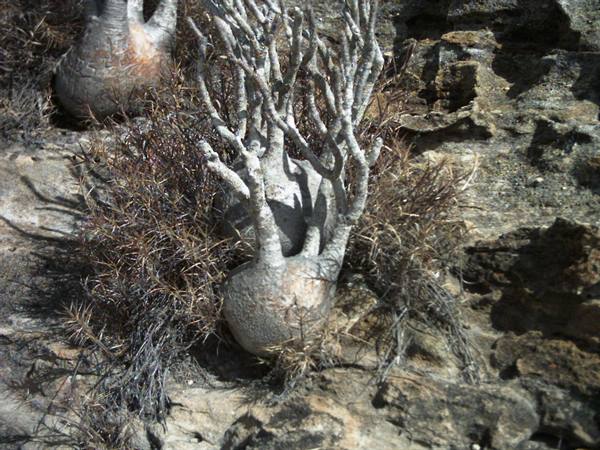
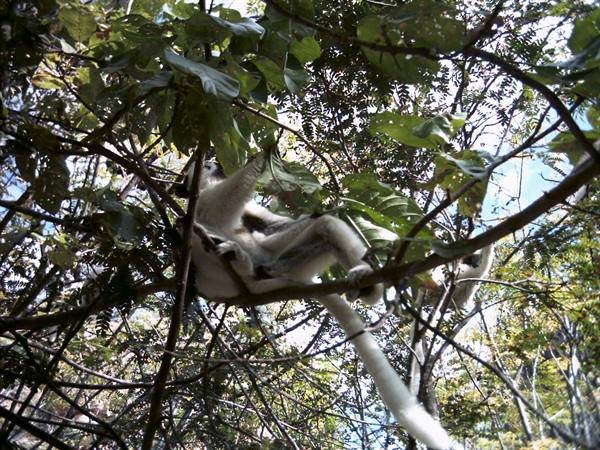
The following day we go to see the lemur canyon and admire, up close, four propithecus verreauxii. We are in the territory of the Bara, notorious cattle thieves. In the afternoon we go to see the natural pool, a compulsory stop for tourists. On the way we are lucky and see several lemur catta. The landscape is magnificent: it recalls Colorado or Arizona. 7 July Ifaty We leave at 7 after a hearty breakfast. A 280-kilometre journey awaits us, with the last 40 on a pothole-ridden dirt road. We pass through Ilakaka, a town I already knew by reputation, having seen it on French television. Ilakaka and its surroundings are a deposit of precious stones, of sapphires that have drawn thousands of Malagasy in search of fortune. We stop at the Antsokay arboretum before Tulear. A Swiss botanist has gathered there endemic plants of Madagascar. We want to see the different species of baobab.
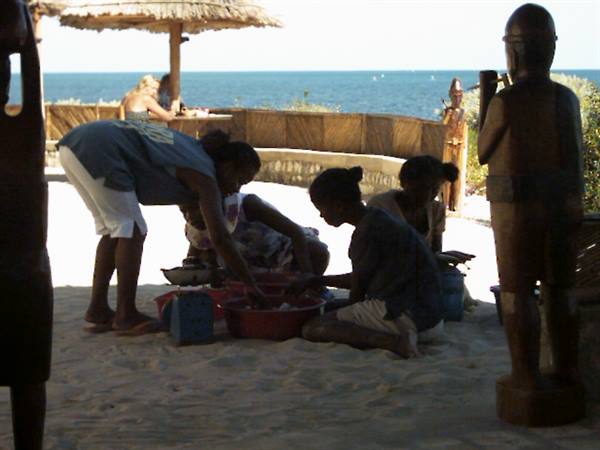
Legend tells that the Gods, tired of seeing the baobabs grow so proudly, tore them from the earth and replanted them upside down: the reduced foliage at the top and the massive trunk give the impression of roots turned towards the sky. There are numerous other endemic plants whose characteristics we carefully note down. After lunch we reach the Hotel de la plage, which lives up to its name thanks to the bungalows' closeness to the sea. 8 July Tulear In the morning we stay in Ifaty and go to see the mangroves, three kilometres from the hotel. On the way we find a Vezo village whose inhabitants live in primitive conditions, surviving on fishing alone. Before 12 we leave the bungalow and take our suitcases to the hotel, eat and pay the bill. The driver, called by phone, asks us 33 euros to take us to Tulear, but considering his travel time there and back the fare isn't so high after all.
The Tulear hotel is on the outskirts, close to the Taxi Brousse station. We wander around the city a little, but at 17.30 there is the usual curfew. 9-10-11 July Tana We learn that the plane that was to leave Tulear at 8.55 has been moved to 11.30, so we take our time. At the airport a line of annoying beggars enters the waiting room. Fortunately we catch the plane and in Tana we find a new driver waiting for us who will accompany us on the second part of the trip. We have added two days of sweet idleness. The following day we leave the hotel early and D. looks for a hairdresser located a little above the Saka, after the outcool bar (where there is a well-functioning internet point). Thirty minutes of work and four euros and we get it off our minds. We walk along Araben ny Fahaleovantena, the part of the lower city commonly known as Avenue de l'Indépendance.
Right in front of Analakely (the market that replaces the one once known as Zoma) we climb the characteristic staircase to see Kianja ny Fahaleovantena (Place de l'Indépendance), in the upper city, par excellence the area richest in shops. We walk back and rest in the afternoon. On the third day, at 8.00 Léonard, Mahery's cousin, comes to pick us up at the hotel reception. We have had a good breakfast and are fresh and rested. We have agreed on four places to see. It is always best that we decide. At 8.00 Léonard, Mahery's cousin, comes to pick us up at the hotel reception. We have had a good breakfast and are fresh and rested. We have agreed on four places to see. It is always best that we decide. The first place is the crocodile farm. Right after, we go to the Digue market where, after strenuous haggling, they manage to sell us 2 fake crocodile-leather wallets at 30000 A. each.
The Digue craft market is an opportunity for shopping and will be the last chance to find decent products at a good price. Aside from the fact that our suitcases are already sufficiently full despite the clothes given away or left in the hotels, and those we will leave at the Sakamanga in the evening together with two old backpacks. We then go to the Tsimbaraza, the zoological and botanical garden (20000 A. for the two tickets). It is four kilometres south of the city centre, whereas the Croc Farm was 3 kilometres from the airport. In the afternoon we go to see the Andafiavaratra museum. Then, tired, we retire to the Sakamanga hotel, where in the evening we enjoy an excellent dinner.
The journey's photographs
6 photographs · click to open them full screen


0 reader comments