"MARHABAN BIKUM FI LIBIYA". That is, welcome to Libya, land of nature, art and adventure. A country where the atmosphere of the desert is still authentic, as is the friendliness of the people who, with a handful of ripe dates, announce to you that you are welcome. A Libya with a thousand faces and a thousand doors. The one that serves as the entrance to the journey of discovery of the immense archaeological heritage, but also of the spectacular natural landscape with deserts, lakes and volcanoes, is called RAS JEDIR, the Tunisian-Libyan border where, for the first time, the traveller meets the proud gaze of Mohammar al-Kadhafi, the host, better known as Colonel Gaddafi.
A frequent encounter, that with the images of the colonel, author of the "green revolution" and omnipresent on the billboards at the entrance to cities and towns, in the portraits hung on the walls of bars and shops, in souvenir shops and even printed on restaurant menus. A land, the Libyan one, that smells of history, sand and traditions. A country where everything smacks of archaeology and nature. The first one is encountered at LEPTIS MAGNA, a small Carthaginian landing place that, thanks to its merchants and its most illustrious son, the Roman emperor Septimius Severus, became the "Rome of Africa".
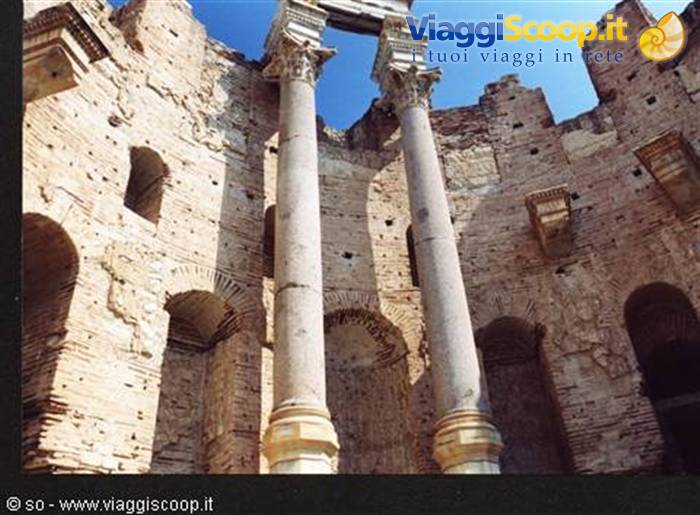
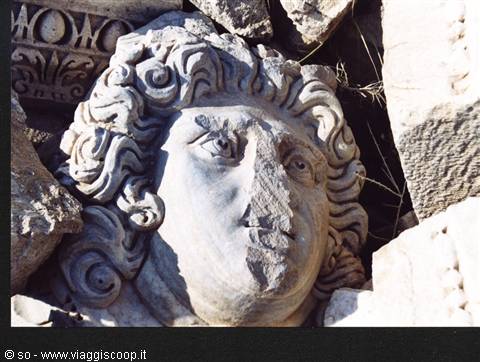
One of the best-preserved archaeological sites that overlooks the Mediterranean with its Theatre - among the oldest built in stone in all antiquity - donated by the merchant Hannibal Rufus, with the Arch of Septimius and the Market, Leptis fascinates today as in its time it enthused emperors, merchants and navigators. Appearing and vanishing, almost as in a mirage, as one wanders among the Mediterranean scrub, are streets and markets, baths and basilicas. Statues in porphyry, granite and cipollino: precious marbles that make Leptis superb and majestic. Magna, just like its name. From the Roman vestiges, reached by travelling the road that runs along the coast and that makes one cross the crowded capital Tripoli, the journey plunges towards the interior of the country.
The GPS indicates southeast when the Toyota crosses WADAN and ZILLAH, where Akhim, the soldier, and Ahmed, the guide, await us, who will accompany us during the three weeks of the journey. After the oasis of TAZERBO - where we take advantage of the diesel refuelling at Mohammed's petrol station to buy limes at the local market and browse in a Sudanese tailor's shop - the spectacular landscape that greets us is that of BOUZEMAH, an old abandoned Tebu oasis among date palms, zeribe and a stretch of water: a salt lake with purplish hues immersed in lush vegetation. A landscape that demonstrates to perfection how mistaken those who think the desert is only an endless and monotonous expanse of sand are. This is the desert.
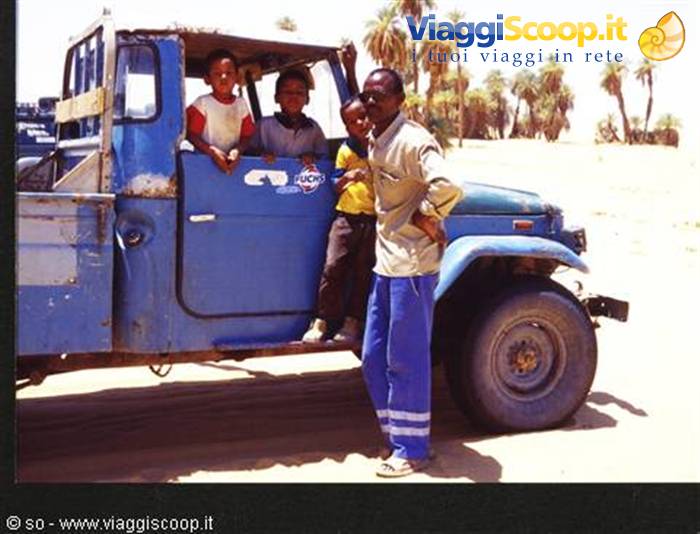
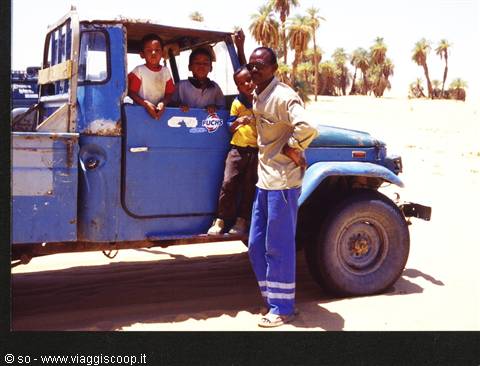
A hundred kilometres among whale-back dunes, a stretch of track with black stones mixing with the sand and then here is the oasis of REBIANAH opening its doors to us: huts of mud and earth, palms with tufts full of dates among leaves of a thousand shades. And above all the children of Rebianah with their brightly coloured clothes, braided hair and a smile that leaves you speechless. In the oasis, at the diesel station lit even by day thanks to the generators that supply power to the whole town, we meet Salem Yaya and his three sons aboard his light-blue Toyota. Since 1985, Salem has been a guide, accompanying tourists and travellers on excursions in the Libyan desert. For 12 years he has lived in Rebianah but he is originally from DJANET, in Algeria, from where he left for safety reasons. I ask him whether he prefers his homeland or Libya.
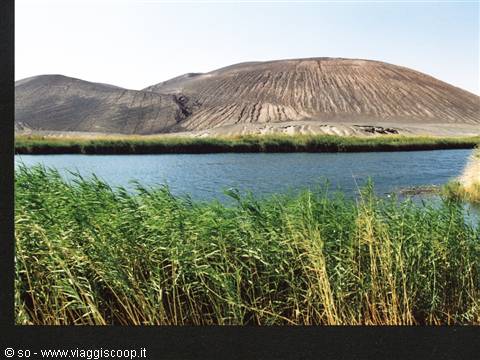
He, without thinking too much, tells me that he is a man of the desert. It doesn't matter whether it is that of Algeria, Libya or another country, what matters is that his home is the desert. A last goodbye to Rebianah and then on towards the GEBEL NERASTRO where the temperature exceeds 50 degrees. After kilometres among black stony ground and a climb that seems endless and of which one becomes aware only from the roar of the engine, here appears the lunar landscape of the volcano WAW AN NAMOUS (whose translation "crater of the mosquitoes" says a lot about the most frequent encounter...). An immense expanse of grey and bluish sand with the massif of the volcano at the centre, surrounded by reed beds and salt lakes with a thousand shades. A place difficult to reach, hosted in one of the most remote zones of the eastern Sahara.
But the tracks of fennec and gazelles on the sand and the sudden flight of a flock of herons rising above us repay so much effort. Three hundred kilometres of asphalt, monotony for off-road enthusiasts, and then again among the dunes, the red ones that accompany one on the Mandara lakes tour. Welcoming us is a splendid sand amphitheatre: a long climb at full speed and then here we are travelling along one of its banks to climb over a high dune. A few kilometres to admire a spectacular and bizarre trick of nature: among ochre sand and date palms, Lake Mandara, now dried up. But to immerse oneself in the lukewarm waters of one of the lakes one does not have to wait long: here comes UM EL MA'A (the mother of all waters), immortalised in photos with its deep blue hues and the palms bent under the weight of the dates.
Among the other lakes of AWBARI, there is MAFHOU, with its strong smell of sulphur, and GABROUN, with its "daoud", tiny red crustaceans, basic ingredients of a tasty cake cooked under the sand. Because the desert is not only the soft mattress on which to sleep but also the kitchen in which to prepare the typical dishes of Libyan gastronomy. Desert is also a concert hall for spreading a gentle music. A magical atmosphere, that around Lake Gabroun, thanks to the engaging and rhythmic music coming from the drums and the "Sukrà", the double flute, played by the skilled hands of a group of dark-skinned workers on their midday break. To conclude the journey, after IDRI and BIR GAZEIL (Italian airfield 415 km from Tripoli), here is GHADAMES, the "pearl of the desert".
A Unesco heritage site since 1986, the old part of the oasis has been uninhabited since the Eighties, when the inhabitants moved to the new houses wanted by Gaddafi. A walk among the covered alleys of the city where one still finds cool shelter in the hottest hours of the day and a visit to one of the dwellings sumptuously decorated with mirrors, carpets and red murals are absolutely unmissable. Because if souvenirs, diesel and the journey have a price, the sunset on the slope of a volcano or a walk among Roman ruins and old alleys are priceless. Just as a well-known advertisement goes.
PRACTICAL INFORMATION
Form of government: socialist people's Arab republic headed by Colonel Mohammar al-Kadhafi
Capital: Tripoli (Tarabulus)
Area: 1,759,540 square kilometres
Population: 5 million inhabitants (3 per square kilometre) of whom almost 90% are distributed along the coastal strip. Arab majority, with groups belonging to different ethnic stocks including Berbers, Tuareg and Tebu.
Climate: Given its geography, the climate is affected by the influence of the desert to the south and the Mediterranean to the north. The best season to visit the country is from November to March, months during which the climate is cool and temperatures hover around 20 degrees, with lows that can even drop to 5 degrees. In the Saharan region (about 85% of the territorial area) the climate is dry and the mercury can leap beyond 45 degrees with strong temperature swings between day and night.
Language: The official language is Arabic although many Italian words that have entered the spoken language are in use. Among the other widespread languages: English, French (on the borders with Algeria and Tunisia), Berber dialects, "tamascek".
Religion: Islam (98% Sunni majority)
Currency: Libyan Dinar (LD) divided into cents called Dirham



0 reader comments