A safari in Kenya's Tsavo National Park, setting off from the coast at Watamu.
Day 18 Sep 2005
Arrival in Watamu
Five years have now passed since that magical September of 2005. That summer we were very confused about the destination to reach for our vacation. I don't remember wrongly at all in saying that we chose Kenya as our final destination, almost as a fallback, compared to all the other alternatives we had discarded due to budget issues. Well! Not that I had never dreamed of the savanna, and precisely that of Kenya, so I can only say... excellent fallback!!
Although some time has passed, the memories of those days are still very vivid in my mind. We bought a stay at one of the Resorts in Watamu, a village on the coast 25 km south of Malindi and 120 km north of Mombasa. The Temple Point, at the time managed by a well-known tour operator, had a very nice, comfortable environment, managed in a reasonably cheerful and engaging manner. My experience is quite dated, but I did some research online and I must say that the beauty of the place has remained intact. The main structure is a few hundred meters from the private beach, reachable by walking along a little road in the village park, within which the various bungalows are scattered. In the park there are many little monkeys that live in freedom and approach the edges of the pools and the refreshment points, attracted by the presence of humans.
The private beach is also accessible from an external road; for this reason, despite the vigilant presence of guards, it is a sought-after destination for "beach boys." These anxiously await the village guests to sell them excursions, souvenirs, or simply to strike up acquaintances and maybe ask for some items, like t-shirts, jeans, flip-flops... There are also many kids who, instead of going to school, attach themselves to the older boys. You can make many acquaintances, more or less pleasant; sometimes one of these kids can steal your heart. Every day it's possible to reach a nearby beach, with a shuttle provided by the village or by taking a nice walk on foot.
The "Long Beach", a very long stretch of white, "floury" sand, where you can take long walks, lie in the sun, or take advantage of low tide to wade on foot toward the horizon, until reaching areas where the water is very warm, heated by the currents or by the sun which, in the very shallow water, creates a Jacuzzi effect.
But in a country like Kenya you absolutely cannot just do a beach stay and linger long in such a structure; it's a real waste. You just need to organize well and use the village as a base for short excursions. You certainly can't miss a safari in the savanna.
Tented camp
Day 29 Sep 2005
Departure for Tsavo Park
The park closest to Watamu is Tsavo. Reachable in a few hours by car, you can organize two-day mini safaris, spending at least one night in the savanna, surrounded by predators, prey, and mammoth animals like African elephants and buffalo.
With a total area of 21,812 km², Tsavo is the largest natural park in the country. It belongs to a system of adjacent parks that includes Chyulu Hills National Park, Ngai Ndethia Nature Reserve, and South Kitui Nature Reserve, for a total overall area of over 23,000 km². The park was opened in April 1948, and in May of the same year it was divided, for administrative purposes, into Tsavo East National Park and Tsavo West National Park. The two parks are divided by the road from Nairobi to Mombasa (the A109) and by the railway, part of the Uganda Railway built by the English at the end of the 19th century. Both are administered by the Kenya Wildlife Service. The nearest town is the village of Voi, in Taita District, Coast Province. The park takes its name from the Tsavo River, which runs through it.
Tsavo East Park is mainly flat, with large areas of savanna crossed by the Galana River, but the main elevation is the Yatta Plateau, which at 190 km in length represents the largest lava surface in the world; it was created by the activity of the Ol Doinyo Sabuk volcano. Among the very many animal species that populate the park one can mention jackals, yellow baboons, dik-diks, cheetahs, African wild dogs, African dormice, elephants, giraffes, African hares, impalas, leopards, lions, servals, waterbucks and Grévy's zebras. You can easily see herds of red elephants, or hippos taking a bath. Tsavo West is more mountainous and humid, with alluvial plains and a lake, Lake Jipe. It is less wild and less rich in animals, but offers visitors numerous trails leading to points of great scenic interest such as the view of Kilimanjaro.
Compared to Tsavo East it has a greater variety of environments and ecosystems. Not far from the small town of Kimana stretches the landscape known as "the green hills of Africa" described by Hemingway. The inner hilly area is stupendous: there are hills of volcanic origin all covered in thick vegetation, among which numerous volcanic cones can be recognized. The altitude is quite respectable because some mountains exceed 2,000 meters.
After the first days at the seaside in Watamu, one morning at dawn, we hop into a safari jeep and set off for Tsavo East.
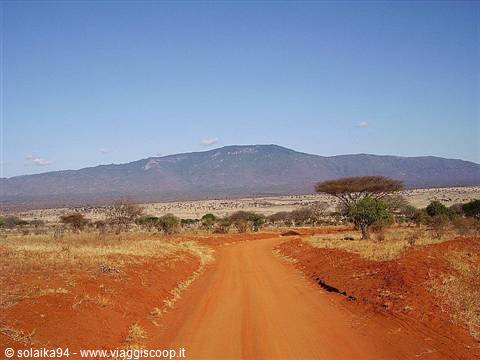
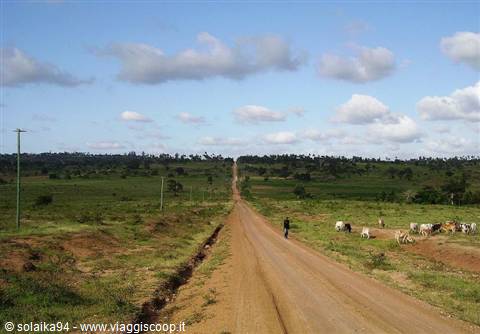
The roads in Kenya are among the most dangerous I have happened to travel so far. The asphalt surface is very neglected; there are large, deep potholes on both sides of the road. Drivers take advantage of the asphalt to reach high speeds, slaloming to avoid the potholes, often invading the oncoming lane. Fortunately, to reach Tsavo, the distance to cover along this type of road is not very long. We leave the coast to go deeper inland, traveling along dirt tracks immersed in nature. There won't be potholes in the asphalt, but there are the natural potholes of the ground. Fortunately there is no coastal traffic and the driver significantly reduces speed. We arrive in the morning at the entrance to Tsavo East, greeted by a passing drizzle.
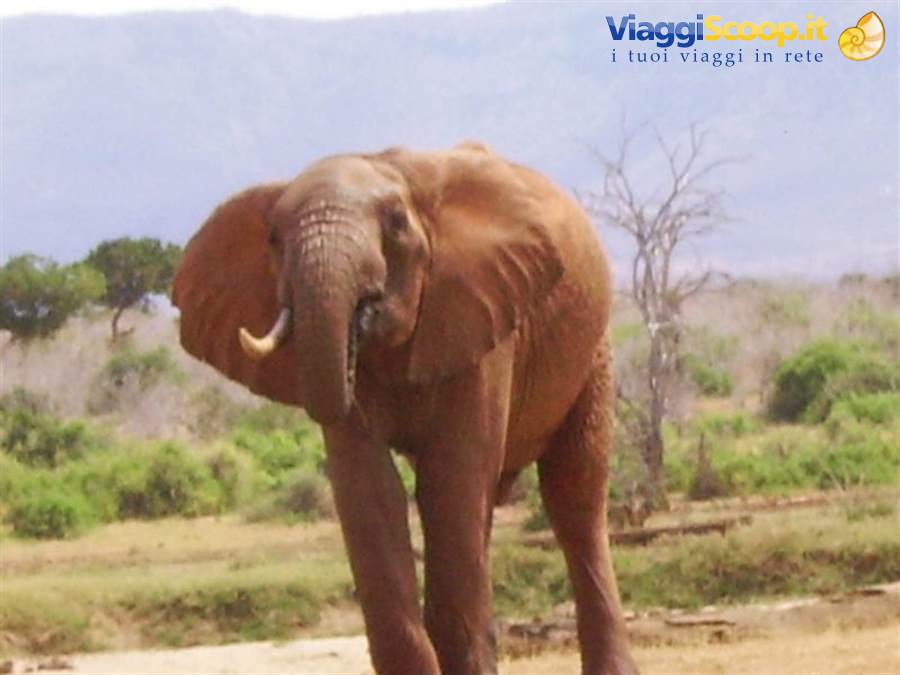
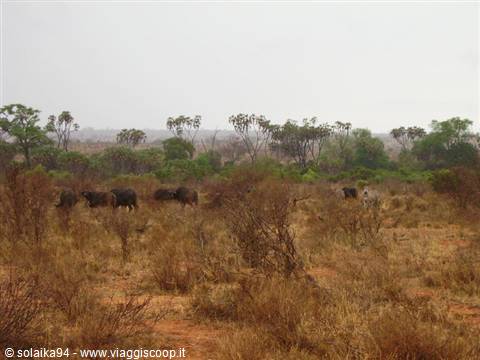
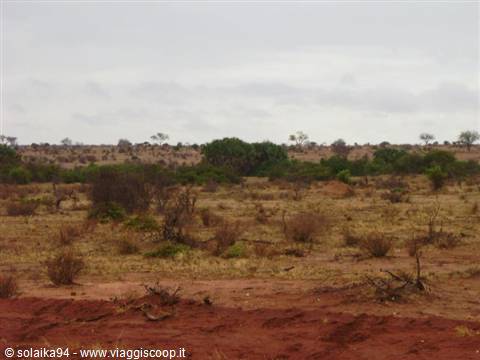
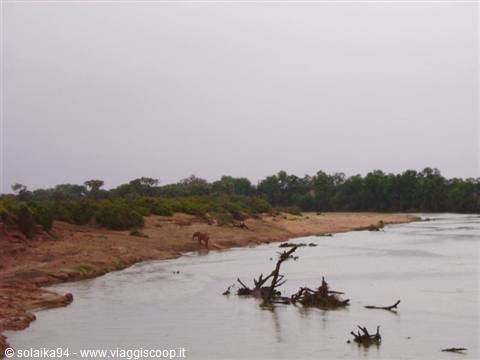
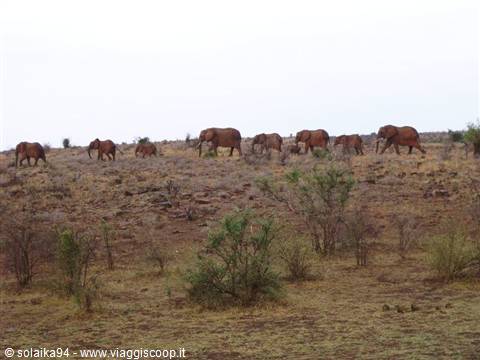
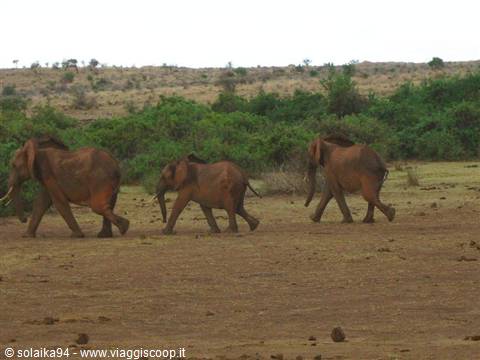
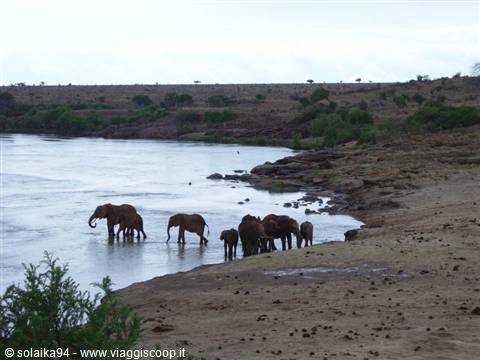
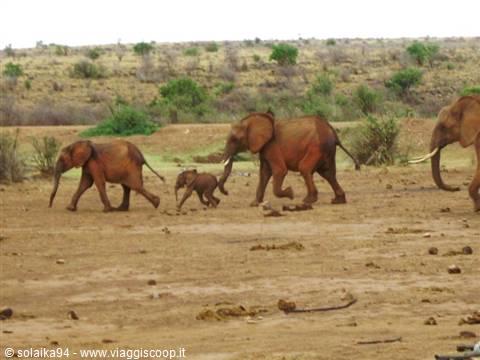
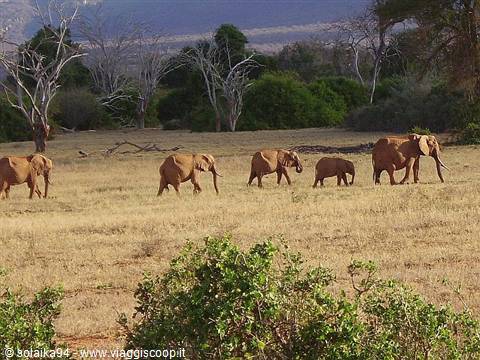
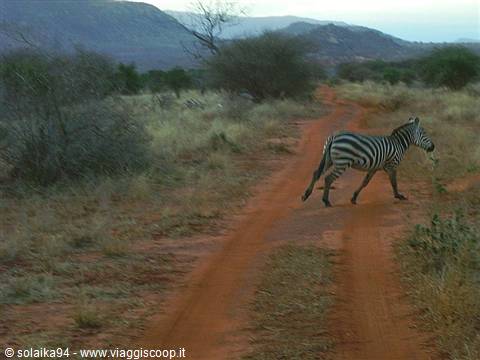
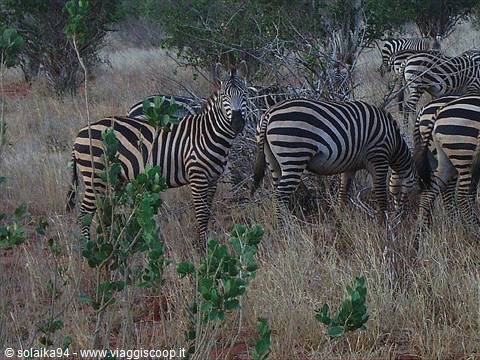
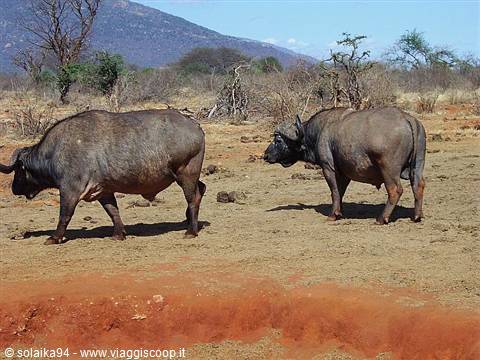
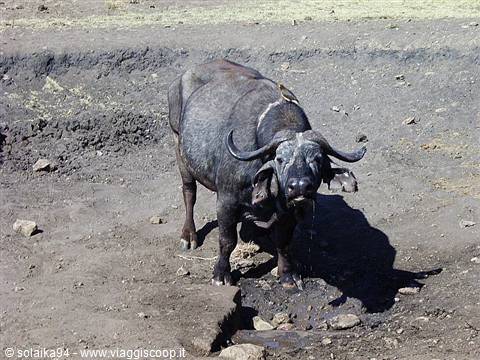
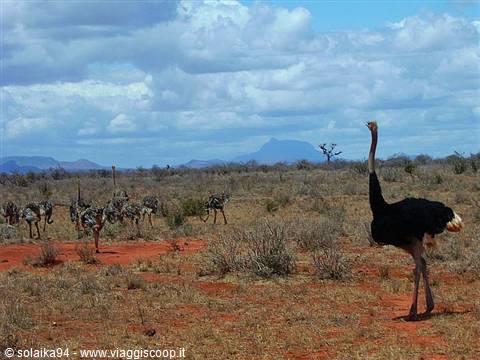
As soon as we enter the park, the guide opens the roof of the jeep and to our immense surprise we can immediately observe the numerous species of animals surrounding us. Thus begins our safari, our first adventure in the African savanna. The first groups of buffalo, close to numerous zebras, can be glimpsed in the distance in the vegetation. The landscape around us shows a flat expanse, with the typical vegetation of the savanna. We drive alongside a watercourse and on its bank we spot the first elephant, isolated, probably having moved away from its group to drink. But not much later, a short distance away, a numerous group of other specimens of the pachyderm to our right. All in a line, big and small, the little ones gently urged on by their mothers with little taps of the trunk. We stop to let them cross the road.
They head into the vegetation, disappear, and there they are again, all back in line toward the watercourse, where they immerse themselves to cool off and drink. What an emotion. During these first encounters it's hard to capture them with my camera, since they are very far away. However, I immediately notice the difference between African elephants and Indian or Asian ones, which I had the chance to see in Sri Lanka. The first difference that catches the eye is the size of the ears. These African elephants have a much larger ear flap compared to the Indian ones. This difference almost makes it seem that the latter have their ears turned downward compared to the others, though I think it's just a matter of size. The skin coloration is also clearly different.
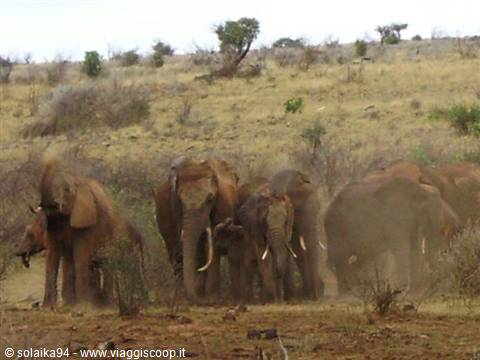
Both species are characterized by a gray coloration, but while the Indian ones are a pure gray, the African ones are a variant in which a reddish tone prevails, very reminiscent of the color of African red earth. Is it because they live in this environment that their skin takes on this coloration? Are they impregnated with this earth magically colored in this intense red? I don't know, but they are truly beautiful. The tusks are also much larger. In any case, whether African or Indian, the experience of being able to encounter these pachyderms is unique; what our eyes have been able to observe remains in our hearts, an unforgettable emotion, both here in Kenya and in Sri Lanka. We continue along the dirt track and encounter the first specimens of antelope, with colors strongly similar to the vegetation, but we will later have the chance to see them in much larger groups.
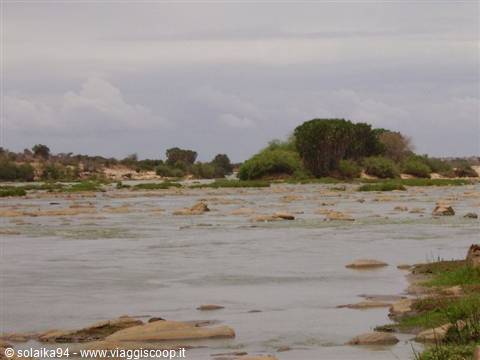
Certainly it won't be easy for me to remember the name of all the antelopes encountered—in fact, I'd say I practically don't remember any, which I'm sorry about, since the guide, like every local expert, did his utmost to provide us with as much information as possible, but unfortunately a lot of time has passed. Our path is interrupted by a specimen of baboon that shows itself to us along the road. It is without any shame, posing for us, not at all disturbed by our presence. We make a stop at Ippo Point where we can watch the hippos basking in the water. It's not very easy to capture them; they are very far away, but I try anyway. The riverbed here is very wide; it's easy to mistake the rocks in the middle for the back of a hippo. The vegetation, especially on the small islets that form in the watercourse, is remarkably green and magnificent.
Someone says they spotted a lioness on the other bank of the river, but I don't see anything. Our guide jokingly warns us to watch out for crocodiles; I'm a bit incredulous, but then we spot one, fortunately very far from us, on a stone, not visible to the naked eye, a little more so with my camera lens. We leave the hippos and continue our route, encountering other groups of elephants, numerous monkeys, and also the first giraffes. But we'll have other chances for more sightings. Lunchtime is approaching, which we'll have inside a tented camp.
Watched by the zebras
Day 39 Sep 2005
Afternoon in Tsavo Park
We leave the hippos and continue our route, encountering other groups of elephants, numerous monkeys, and also the first giraffes. But we'll have other chances for more sightings. Lunchtime is approaching, which we'll have inside a tented camp. When we get there, fortunately the weather has improved considerably, the clouds have cleared and the sun comes out warm and imposing. Our meal is served under an open-air tent. We are in the middle of the savanna, in an open-air structure, and there certainly is no dishwasher, so it's clear to us that the dishes are immersed in pots of hot water to keep them clean. Everything goes smoothly and once the meal is over, some doze a bit in the sun and some, like me, wander curiously around the camp.
There are various tents, well equipped, with hot water and a private bathroom with shower, and we are still in the savanna!! The outermost ones have a direct view of the savanna. The camp is surrounded by barbed wire that marks its perimeter, but I really don't think it could stop the animals in any way. The monkeys are kept away by the guards who scare them with newspapers; the elephants are attracted by water holes that tend to keep them in the areas immediately adjacent to the barbed wire, but no further. Scanning the horizon I spot one right there drinking, immediately outside the camp. Its bulk is remarkable, but I notice it's missing a tusk—poor thing, who knows how it was deprived of it. In the distance you can also see other animals including zebras, monkeys, various birds; unfortunately though I can't capture their image, the distance is too great.
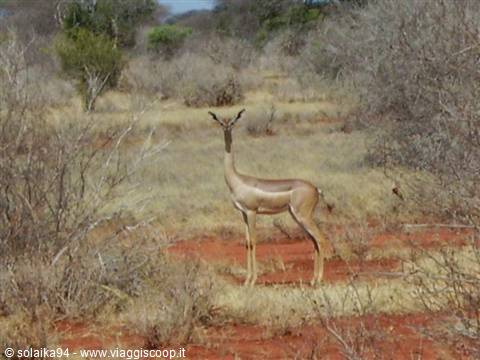
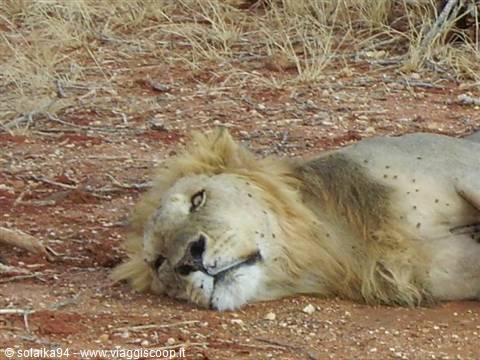
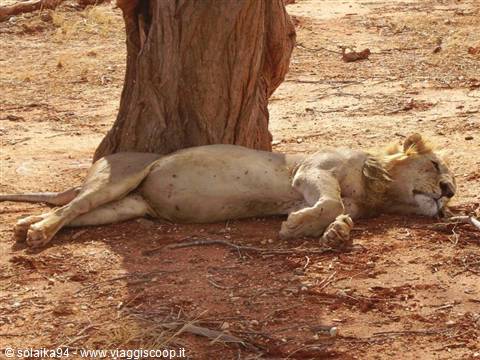
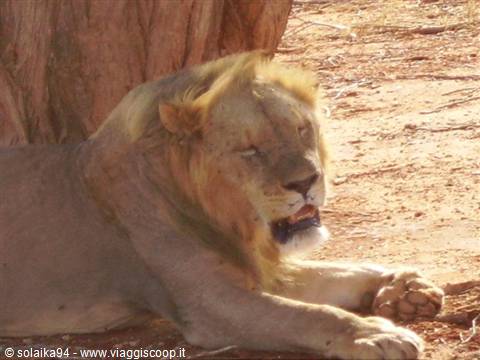
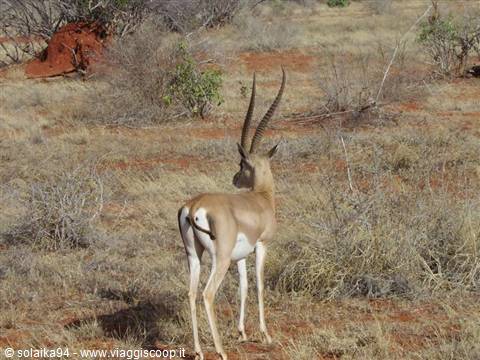
They are very quick in their movements, but my eyes can reach where the camera cannot; the memories are still very strong. At the camp entrance there is a board where the sightings made each day are posted. There's really everything—cheetahs, lions... it must be fascinating, but at the same time very "demanding" to spend an entire night there. After a short rest, we resume our journey through the savanna. We come across very interesting sightings, first a splendid animal that, with its long neck, observes us from afar with a very refined air—the gerenuk. It is truly very beautiful. Continuing on, our guide receives extraordinary news: another group has just spotted a lion. The guides obviously all know each other and are used to passing this type of information among themselves. We head toward the indicated spot. There he is.
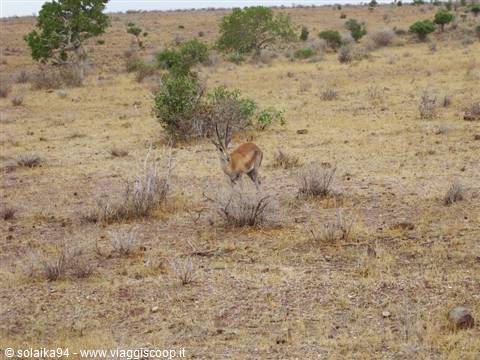
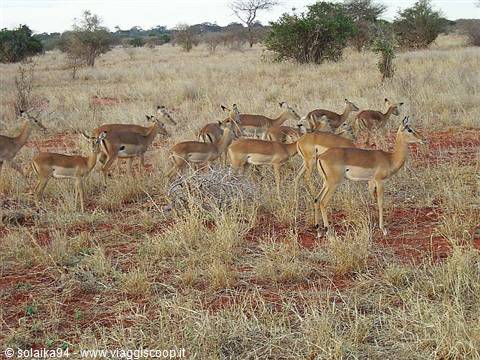
He doesn't seem to have any intention of moving; he is completely undisturbed by our presence, even though we keep circling him with the jeep. Our driver somehow manages to get his attention and finally he raises his big head. He certainly doesn't have one of those beautiful manes worthy of a King, but he is undoubtedly a fine lion. We leave him alone like that, sheltered from the sun under a tree, to continue his nap. During the rest of the journey we can make numerous other sightings. The gazelles, or antelopes, with their horns and elegant bearing, almost seem to do it on purpose, but they almost always show us their rear end, which by the way is equally admirable, with the short little curled tail! There are also many monkeys, visible but very difficult to capture. They are in the meadows, in the trees, standing out against the patches of red earth of the savanna.
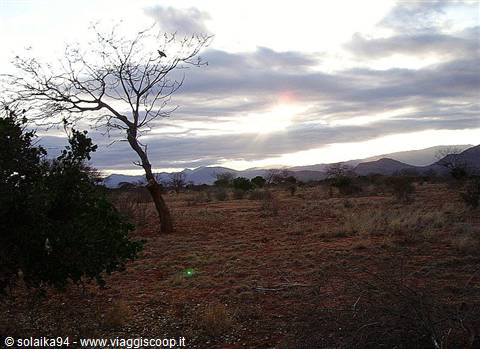
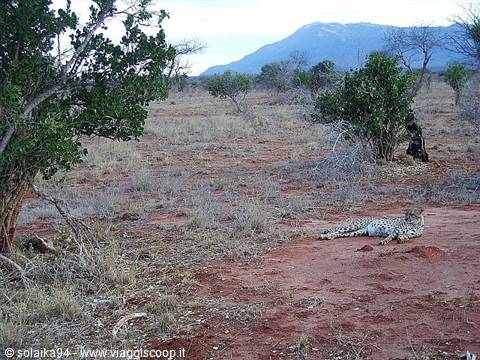
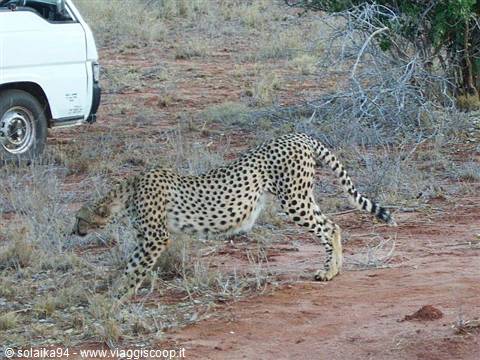
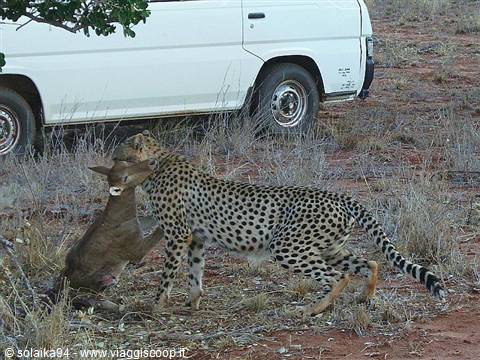
And again groups of elephants in single file across the savanna grasslands—spectacular. The sun is starting to set and everything around is tinged with an intense red. We enter the private part of the park, where we will spend the night, at a truly special structure. But first we manage to spot another truly beautiful and fascinating specimen busy enjoying its meal. We in fact glimpse a cheetah lying not too far from a tree, toward which its gaze is very attentive. Shifting our attention toward the tree we notice a dead animal. After some preening, stretching and scratching a bit, the cheetah heads toward the tree and continues what is its meal. Thus, before our eyes, a sad act is performed—sad but natural at the same time; the food chain cannot be interrupted, and so the cheetah feeds on its prey. Perhaps a dik-dik or a small antelope.
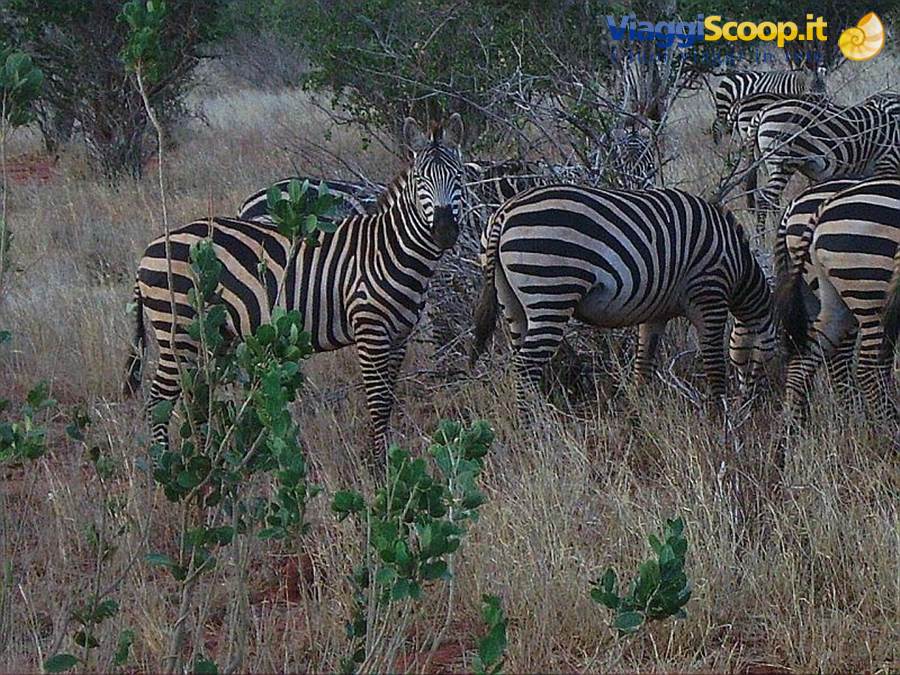
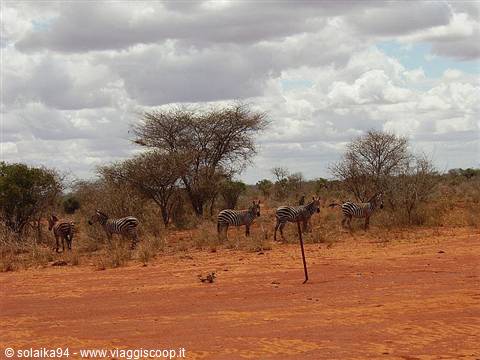
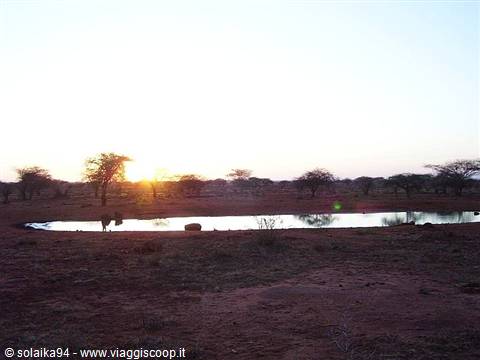
Along the last stretch of the route we have the chance to spot numerous specimens of gazelles and very many zebras running quickly as we pass; they observe us, they simply keep eating. Upon reaching the lodge we are welcomed very courteously. A cool towel is offered to refresh ourselves; the traces of the red earth that covers most of our bodies and clothes will remain. We immediately realize the uniqueness of the location. The central structure serves as reception and dining room, equipped with a large terrace, with a majestic view over the savanna. In front of us, a few hundred meters away at most, a water hole, which will serve as a stage for a long parade of savanna specimens. Elephants, buffalo, birds, and at night a large group of lionesses, with their offspring in tow. On the sides of the central structure branch off those that house the bedrooms.
The entire complex is raised off the ground like a stilt house, to stay protected from the possible "attack" of the savanna animals, which will surround us throughout the night. We have our dinner and before going to sleep, from the lodge terrace, we can admire the first elephants arriving at the water hole. It's truly a great spectacle, but nothing compared to what we will see during the night. In fact, once in our room, which also has a small terrace with the same view as the main one, we can continue to observe the animals approaching the water hole. Even from the bed, from a window, you can comfortably enjoy the same panorama. It won't be long before the group of lionesses arrives. The lodge light illuminates them; there are truly many. They approach one by one along the edge of the water hole, leaning their big muzzles over the water to drink.
Soon the cubs arrive too, and when they have all arrived, there will be a long line of felines right in front of us. And they will also make themselves heard throughout the night, with their roars; they will seem even closer. I don't rule out that they are used to coming much closer to the structure and walking beneath it. I admit I did not spend a peaceful night; I woke up several times and several times I saw these animals moving, chasing each other, calling to each other, and even encircling a buffalo in the middle of the water hole. Unfortunately I wasn't brave enough to attempt even one shot with my camera. However, from that night I retain a splendid and evocative memory, made of images and sounds that I will hardly forget.
The regret of not having been brave enough to fully enjoy the experience I was living, but the hope of being able to repeat another one sooner or later, taking heed of the first.








0 reader comments