My first trip into the heart of black Africa... My first encounter with the smile of the children... In other words, love at first sight
Day 16 Feb 2006
Preparations and departure
It was February 6, 2006 when, departing from Fiumicino airport, my wife Stefania and I were preparing to leave, without any regret, the European cold to go and meet for the first time the equatorial sun of Kenya. We had booked online through the agency lets the Angel's Bay Village, near Malindi - cost 750 Euros each, including incidental expenses -. After about 8 hours of flight, very comfortable, with Air Italy we arrive on the island of Mombasa. The customs formalities immediately appear slipshod and I suspect that some travelers were giving, at the policemen's request, some little tip so as not to have their luggage opened. From me, however, they ask the value of the video camera I was carrying by hand and it is recorded on my passport together with the entry visa.
After about four hours by bus, through bumpy roads crowded with vendors and artisans working outdoors, as well as a multitude of children who greeted us shouting "Jambo!!" … little goats crossing the road … chickens fleeing in fright, we arrive at our village.
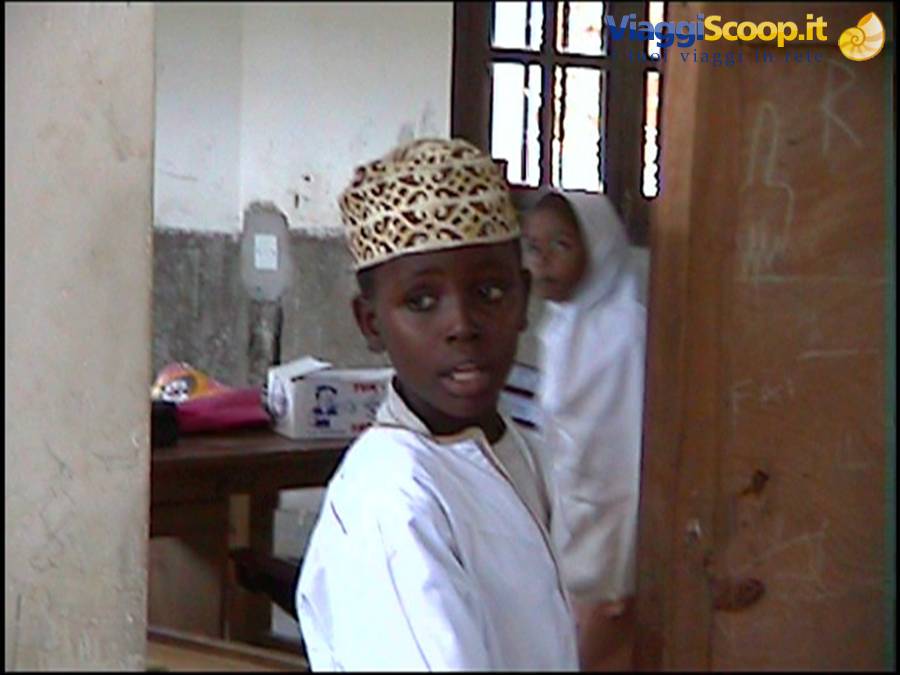
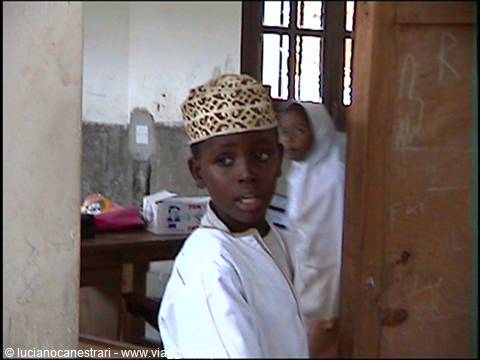
Malindi : child in the islamic school
Day 27 Feb 2006
The village:
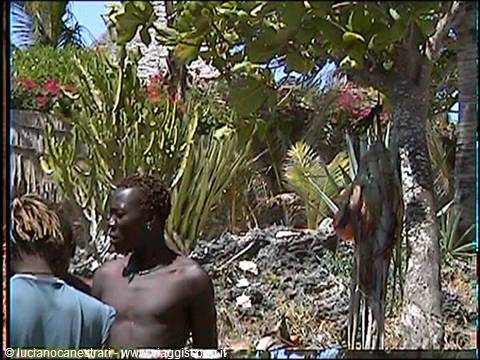
The welcome from the staff, almost exclusively Italian, and the olfactory and visual impact of an immense flowered garden immediately manage to erase the hours of stress accumulated during the journey. The rooms are essential, equipped with air conditioning—very noisy—and solid wood beds protected by mosquito nets. During the first briefing with the Italian staff of the village, the problem of malaria is immediately addressed and we discover that none of our assistants or entertainers followed any type of prophylaxis. Confirming the information we already had, namely: pharmacological prophylaxis (Lariam, Malarone etc...) strengthens defenses against a possible bite without however guaranteeing immunity.... And in very many subjects it can also cause serious disorders...
So, although we had brought Lariam with us and given the total absence of mosquitoes, we opted for the use of fragrant repellents – Autan -.
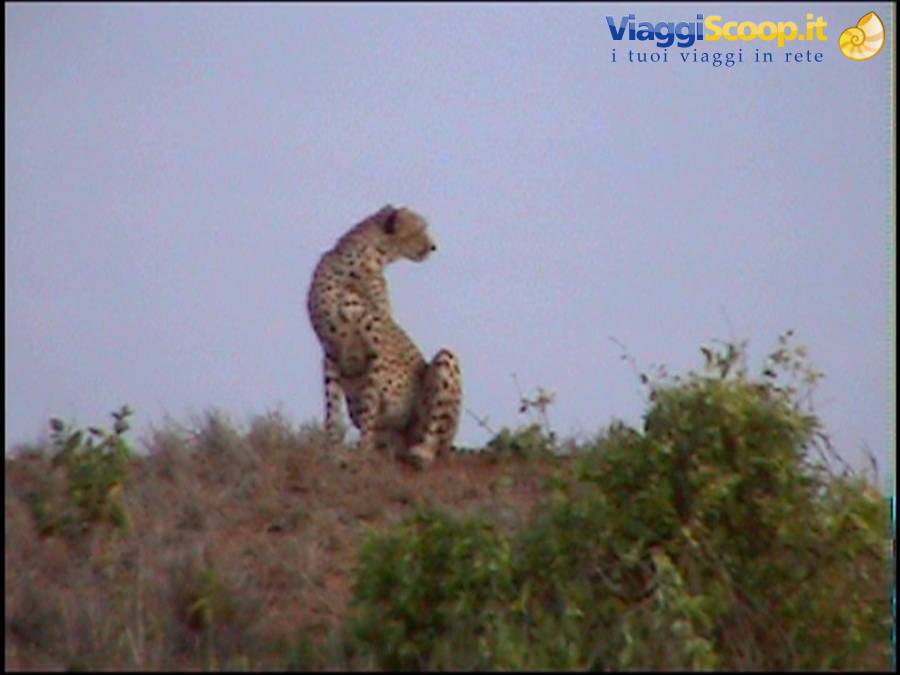
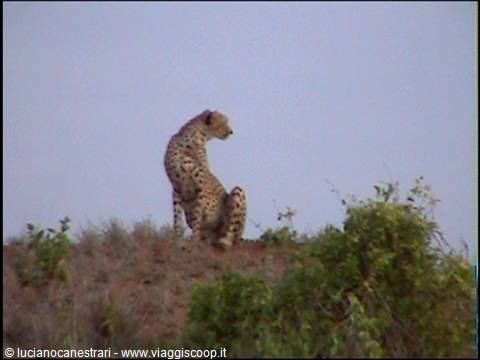
Tsavo East: Leopard on the lookout
Day 38 Feb 2006
The sea in front of the village
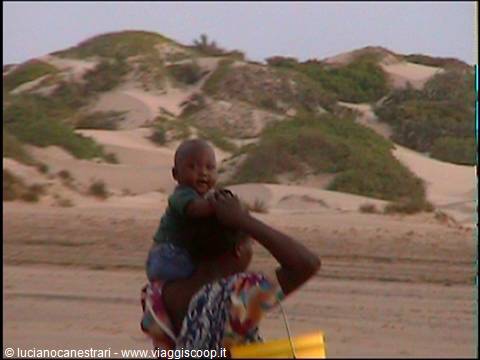
The sea in front of the village is not really accessible for swimming because of a dead and disfigured coral reef; the beach, on the other hand, is very usable, fine sand that, during low tide, is used by Europeans as a track for 4x4 cars which, as they pass, send clouds of birds of all species flying up. While the local population uses it in the morning at dawn as a shortcut to reach the nearby town and barter Mnasi for some fish (– Mnasi, wine extracted from the coconut palm – carried on the women's heads inside yellow plastic containers). The village beach, equipped with sunbeds, bars, and an attendant/masseuse, is protected from the possible intrusiveness of the beach boys by an askari armed with a stick.
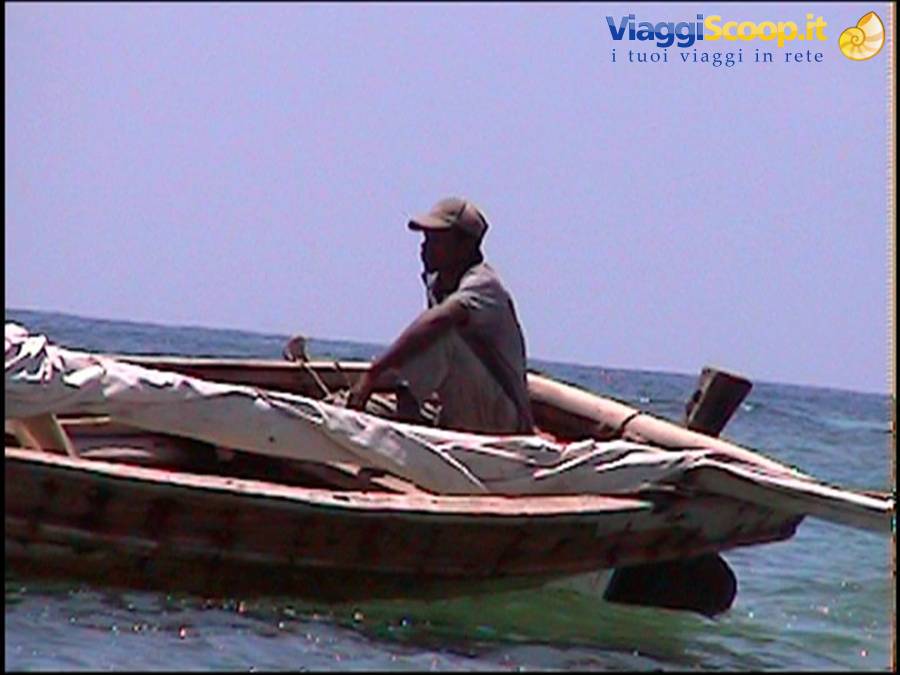
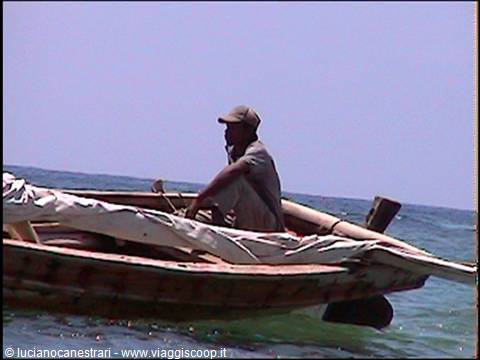
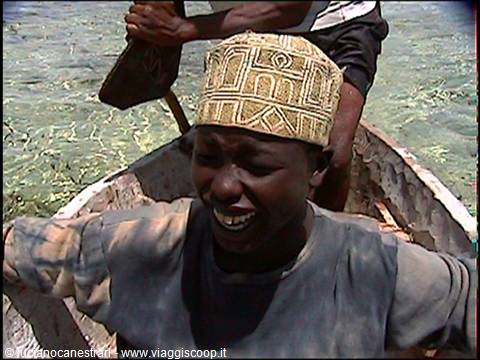
Watamu: fisherman on the dhow
Day 49 Feb 2006
Malindi
The Village offers its guests a daily shuttle service to go to Malindi, and we made use of it right away. On arrival in Malindi, immediately after getting off the minibus we are approached by two local boys who offer to be our guides. We refuse, telling them we wanted to be alone, and at their insistence I am forced to stand firm and tell them to go away... So then one of the two walks off and sits on the ground in a corner with his head in his hands, dejected and almost crying, saying that he is a good boy, that he doesn't steal and that he only wants to keep us company.
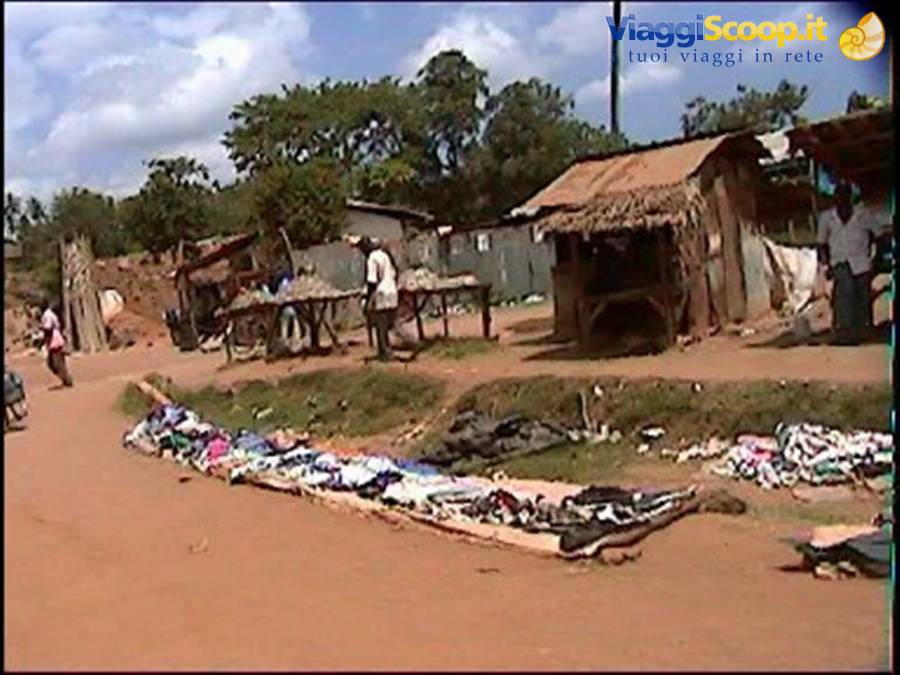
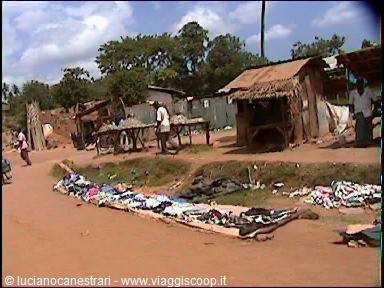
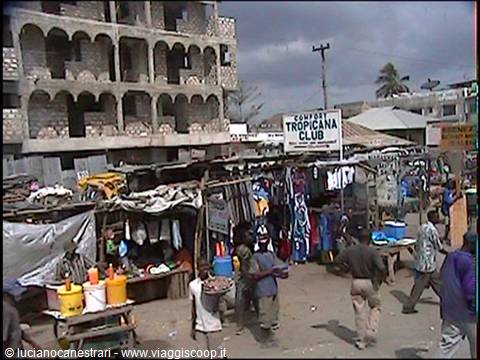
Moved to compassion, we adapt to our new companions and we don't regret it because they take us to places that perhaps on our own we wouldn't have found the courage to visit: little back streets in the outskirts where there was an extremely dignified, poor and kind population, a small local market of typical products where misery was sold or bartered (for example, a woman had only 3 onions and she displayed them laying them on the ground, another displayed 4 miserable courgettes sitting on the corner of the street). We then went to what they call the “porta portese” market, a collection of shacks where they sell local craft items, almost essentially in wood or soapstone.
My wife, who had already discovered that quite a few locals did not turn up their noses at bartering, had fun buying several little statuettes, giving them, besides a few euros, also little objects brought from Rome (small mirrors, combs, toothbrushes, toothpaste and more). They then accompanied us to the seashore, where a group of Kenyan boys was swimming. It was the first time we saw children playing and running. In the end the two improvised escorts took us to an agency that sold excursion packages and we organised, paying very little for it, a 2-day safari for the following day (120 euros each at the Lion Hill's (tented camp) in Tsavo East park).
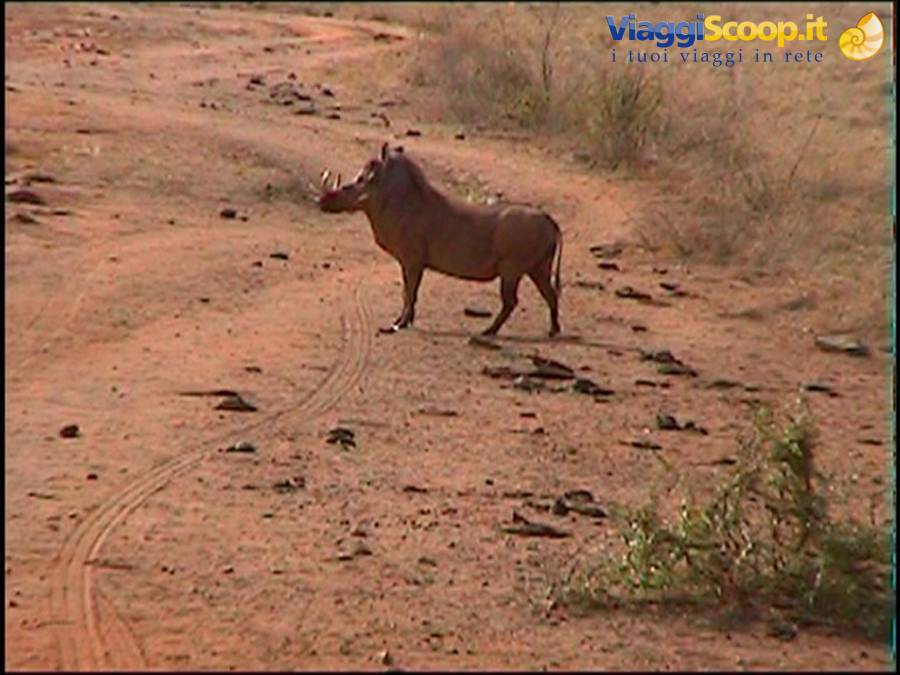
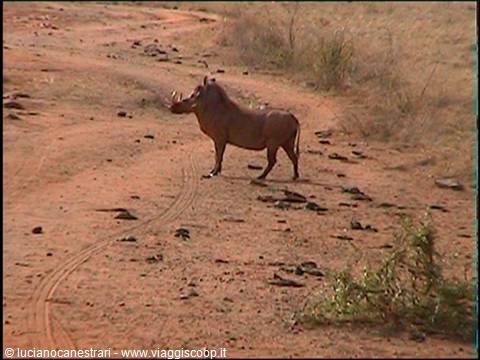
Tsavo East: warthog
Day 510 Feb 2006
Safari to Tsavo East - The Lion Hills tented camp
They come to pick us up at 5:30 in the morning at the entrance of the Village; before letting us get in they ask us to settle the bill (at the agency we had only given a small deposit). In Malindi there are various stops at the Italian villages to be able to pick up the other participants in the Safari – Safari simply means journey. After about two hours of dirt roads we arrive near the entrance of the park (... in the park there are various entrances to pay and, since access by car is possible only by travelling along certain toll roads, there's no escaping it! The animals, on the other hand, are free, they can come in or go out since there is no fencing at all) We stop 20 metres from the entrance to stretch our legs, some to smoke and others to use the “bathrooms”...
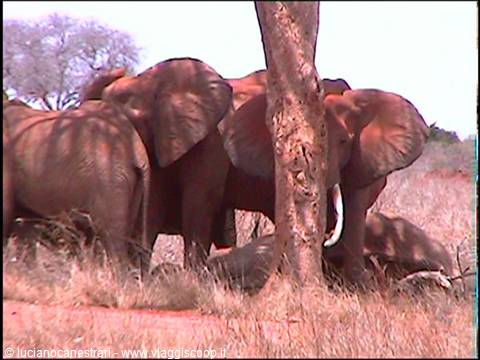
My wife and I, seeing a river flowing in which a pair of Marabou storks stood enthroned, start to approach to capture some images for our video, and we are immediately approached by the Rangers who inform us that, due to the presence of crocodiles, it was dangerous. We finally enter the park and begin filming the animals in the wild, there are a great many of them... The earth in some places is completely red, the very fine dust gets into your clothes and into every corner of the camcorder. The driver/guide (Sammy) is constantly in contact via radio with the other guides and they exchange information about sightings of the “big five”, which are the most coveted prey for our video cameras. There are truly a lot of elephants, giraffes a few less (by the way, giraffe is twige, lion simba, sir buana.....
Hakuna matata means all right..., yes, the local language, Swahili, is the language of cartoons!!!). Inside the park, which is as big as an Italian region, at every crossroads stones are placed with the indication of the various distances and the directions of the next exits. In our car there were, besides me and my wife, a middle-aged couple from Bergamo and three friends from Latina. When lunchtime comes we are separated, the driver takes the couple from Bergamo to the Ndololo tented camp, those from Latina to the Voi Safari Lodge and us to the Lion Hills, the driver Sammy stays with us, so we invite him to our table and offer him a drink (drinks are not included in the price of the stay).
The tent is placed on the ground on a concrete base; inside there are two separate areas, one with two beds protected by mosquito nets and two bedside tables, the other, separated from the sleeping area but inside the tent, is built in concrete and majolica tiles, with three divisions, one for the WC, one for the shower, and finally the washbasin. Also built on a concrete base is the external veranda with a small table and two chairs. After having lunch and a short break, Sammy takes us on a new excursion to “capture” yet more wonderful images. But the Lion King has still not been seen; on the other hand we have filmed ostriches, buffalo (thousands) and cheetahs.
We return to the camp and, after a typical dinner based almost exclusively on vegetables, the owner reminds us that electricity is a luxury and that normally after dinner in every tribe it is customary to gather around a brazier to spend the night, telling each other local legends or traditional stories, so the guests (we were seven people in that camp, my wife and I, three Dutch and two Poles), if they wished, could stay to listen to a Masai warrior who would illustrate the local traditions to us. All of it naturally in English. The following morning, after regrouping the group again, our guide informs us that via the radio other guides had witnessed the attack of some lionesses on a herd of buffalo. Following the directions of the other guides Sammy manages to take us to the place of the hunt but before us there were already another six or seven minibuses.
The lions were devouring the now-dead prey but our view was not the best. Only by zooming in with the camcorder was I able to get a decent view of the meal. The friends from Latina were equipped with digital cameras that allowed them at most a 4x magnification, so they complained about their bad luck. Our guide then tells us not to worry and continues the journey saying that we would come back later, when the other tourists had left the spot; so after about an hour and a half Sammy takes us back to the place, the other tourists were no longer there and so he decides to leave the track (STRICTLY FORBIDDEN!!) and go directly into the savannah, stopping our minibus about 6 metres from two lionesses who continued to devour the remaining carcass. He stays still only for a handful of seconds for a few photos, then immediately goes back onto the dirt track.
The afternoon continues without any more great emotions and after having lunch together in the town of Voi we decide to give Sammy a tip of 5 Euros per couple.
Watamu: giuseppe little man
Day 611 Feb 2006
Excursion to Watamu
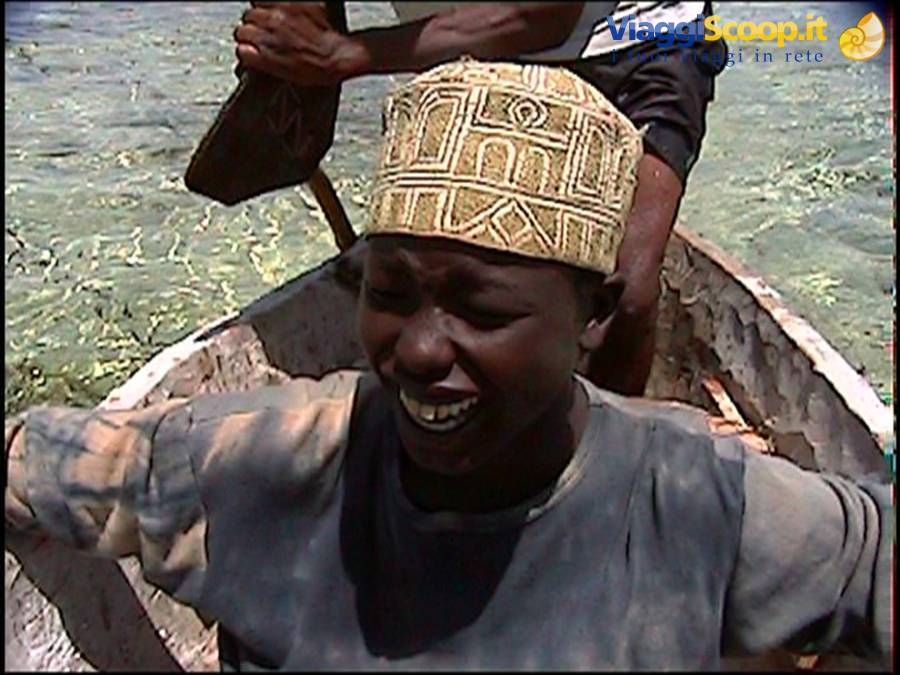
We set off on an excursion to Watamu, a small fishing village famous because it also hosted E. Hemingway, (now instead it hosts villas owned by Briatore, Vecchioni, Ventura and a very large colony of Italians) As soon as we arrive on the white, very white sandy beach, among tall palm trees luxuriant with coconuts, we are approached by a very likeable Kenyan named “Five Hundred, known as Five to his friends” who offers us a trip on his dhow, a typical boat obtained by hollowing out a trunk in an absolutely primitive way. We have ourselves taken along with his dhow as far as the end of the reef and then we swim together, while he dived into the water to show us some puffer fish.
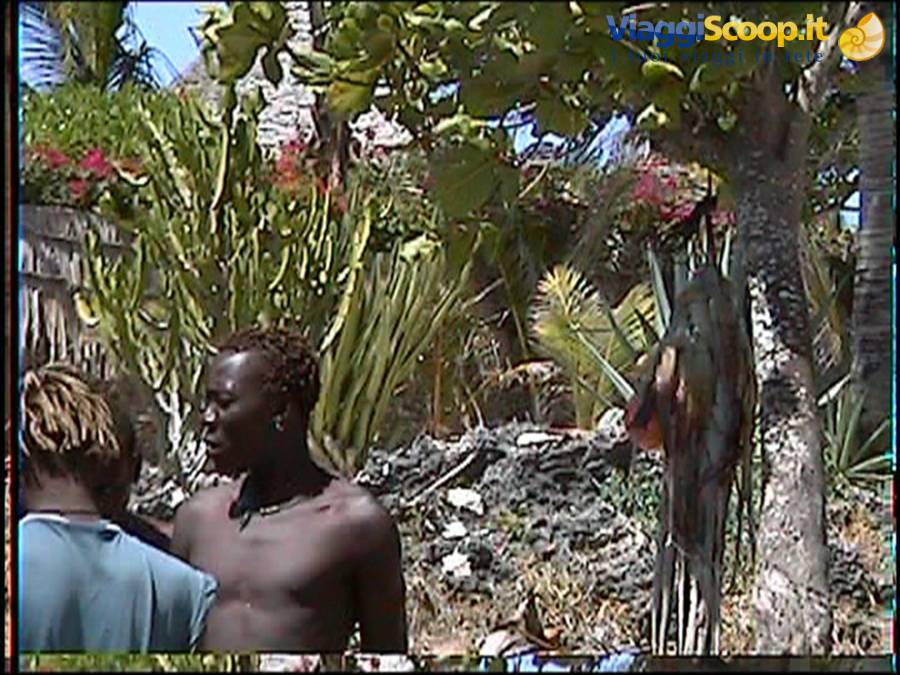
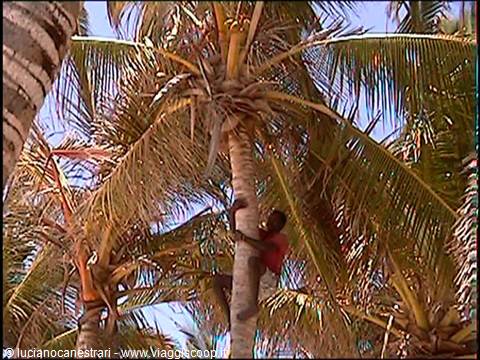
Our driver, named “Giuseppe little man”, expresses himself in almost perfect Italian and tells us that he was adopted by an Italian lady from Bologna named Susy Blady from “turisti per caso”, who paid for his studies in Bologna. Every now and then we notice local boys coming out of the sea, one time with a grouper, another with a lobster, with a basket full of fish for frying or with about ten octopuses. They prepare us grouper and grilled lobster to eat, then they climb up a very tall palm tree to offer us a freshly picked coconut.
Kilifi: fish market dried in the sun
Day 712 Feb 2006
The Malindi Marine Park
They come to pick us up at the Village around 9 o'clock with the tuk tuk (that is, a three-wheeled Ape to which two rear seats for passengers have been added). The vehicle, extremely characteristic, was equipped with a radio with speakers attached with adhesive tape. With the music “blaring” we come into contact for the first time with police corruption, when at a checkpoint our driver “tames” it by passing “something” toward the policeman's outstretched hands. We arrive in Malindi and, having parked the tuk tuk, we are boarded with other tourists, all Italians, onto the boat that will take us to visit the marine park. The sea that day, although calm, did not seem at all very clean to me. We make the first stop for a short swim. Underwater visibility did not exceed 7/8 metres; I saw many sergeant fish, others more fortunate say they saw lobsters.
After the short stop, we set off again coasting along some fishing villages... palm trees, huts and lots of always cheerful people... wonderful images... postcards!!! We arrive at a point about a mile from the coast, the water now is crystal clear with at least 30 metres of visibility, the seabed is almost exclusively sandy, the depth varies between 50 cm and one metre. The boat makes a second stop and they begin to prepare the meal based on King Fish and lobster. While all the tourists were swimming the water level began to drop more and more and some sellers were arriving from the coast on a couple of local boats (dhows) with their load of handcrafted souvenirs. At this point it was inevitable to avoid bargaining and buying a few little objects.
The tide continued to uncover this atoll of white, very white sand and finally, to everyone's satisfaction, they serve us the much-desired meal.
Last note before closing concerns corruption. After completing the boarding formalities, I was handed the ticket on which it said to go to Gate 8; I only manage to find Gate 1 and Gate 2, both very crowded with a queue of at least 20 minutes. I ask a policeman for information, and he tells me to follow him... we enter through a service door and come out exactly as the first in the queue at Gate 1. He asked me for a 2 euro tip, but I was ashamed like a dog... it is not my habit to use tricks to cut in line... I apologise to all the passengers who will have judged me badly.


0 reader comments