A week by the sea between the wonderful coral reef of the Red Sea and a bit of Egyptian culture and archaeology in the desert and in Luxor.
For a more detailed account and all the photos, I refer you to my site:
Day 117 Apr 2005
Flight Cagliari - Rome - Marsa Alam via Malpensa (!?)
Stefania and I chose this trip through the agency BLU VACANZE, which offers an ALL INCLUSIVE deal at the price of 590 euros for 8 days and 7 nights in MARSA ALAM on the RED SEA in EGYPT, with the tour operator EDEN VIAGGI. The real price is quite different (875 euros), adding taxes, fuel, booking fees, the visa for Egypt and the very unlucky compulsory flight for us Sardinians: Cagliari - Rome. I say very unlucky because the flight is the most painful and negative part of this trip. A few days before departure, the agency calls us to warn us that the times have changed: a tragedy for our connections. The same girl from the agency changes the Cagliari - Rome tickets to the morning of 17 April with the 7.00 a.m. flight, the only one left with available seats. The flight to Marsa Alam, however, leaves at 17.30, which means an entire day spent waiting at the airport...
And it's not over! The flight to Egypt in fact first stops over in Milan Malpensa. But how come, from Rome we go up to Milan and then back down to the Red Sea?!? Had we known, we would have taken the Cagliari - Milan directly, no? A paradoxical situation, with the Romans themselves agitated and irritated by this senseless stopover in Malpensa. And we who come from Sardinia and have already waited hour after hour, what are we supposed to say then? The steward's explanations are clear and unmistakable: do you want the 500-euro package? then put up with this flight that goes around picking everyone up! It's precisely because they save on an aircraft that they haggle on the price, otherwise the package would have cost 1,000 euros....
and so enough with the complaints and let's think about this trip: our first stop in Africa! At 20.00 we are still in Milan, where we even get off the plane to let them clean the aircraft, which is really not in optimal condition. 13 hours of travel and we're still in Italy: congratulations! At 20.30 we finally take off for Marsa Alam with our Blu Panorama and after exactly four hours we land in Egypt. It's past one o'clock when we collect our luggage and go through the entry formalities with passport and the form filled out on the plane. We meet our EDEN VIAGGI group assistants, who lead us to the bus, which departs after a bit of waiting, towards our hotel, the BLUE REEF. A little more than half an hour and we arrive at our destination. The welcome cocktail, the check-in, a few quick explanations about what to do (they all speak Italian) and we go to bed at 4 in the morning.
But it's not over yet: they hand us the room keys, the remote control, the orange village bracelet, but once in the room there's an unpleasant smell in the bathroom and we have no hairdryer. Uh oh, I have to go back to reception to ask for it and without having the slightest idea why they don't just put it in the room... In the end there's nothing left but to go to sleep: after all, we've only been up for 22 hours, practically the same amount of time it took us to go to the United States. Except that here we're right on our doorstep!
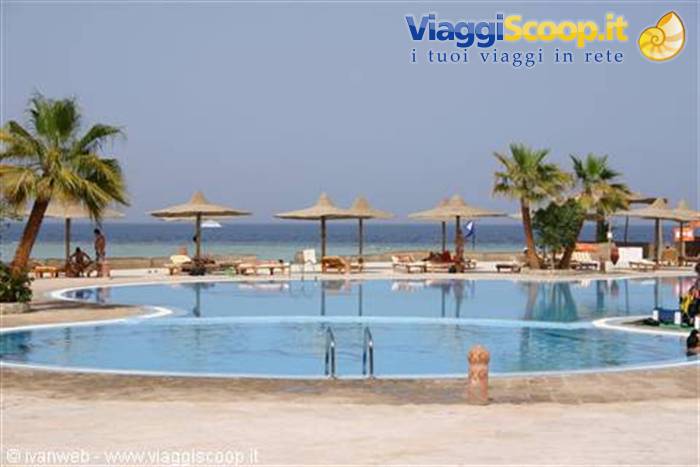
Eden Village Blue Reef
Day 218 Apr 2005
Beach and snorkelling. Guided tour of El Quseir
At 11 we all meet on the beach to get our first sun. The sand isn't great, to be honest, it's a bit pasty, coarse and yellow: typical of the desert I'd say, as we expected. The sea, on the other hand, is spectacular, and I don't waste a second for my first exploration. Joining the group that forms on the shore for the free mini-tour, I follow the guy in charge of the diving with mask and fins towards a guided snorkelling tour of the beauties of the coral reef. It's quite a nice walk to get to the end. Let me start by saying that the Blue Reef doesn't have a jetty, and to get past the reef you have to walk about 200 metres (and it takes no less than ten minutes!) until you reach two red flags.
From here you can leave your booties, very useful to avoid hurting yourself on the corals (I for example have the wetsuit booties and they work just as well), put on mask and fins and dive in to get past, after a few dozen metres, the reef following the rope that indicates the easiest route. The spectacle is guaranteed: the water is crystal clear and the corals exceptional, absolutely intact, uncontaminated and in the most varied colours. The blue coral found at the beginning is the one that gives the hotel its name (Blue Reef, precisely). Unlike the Maldives, however (at least, I'm talking about Bandos where I've been), the water is clearer but colder and the corals are much more beautiful but there is much less fish (the specimens, however, are larger). The schools of fish you'd meet in those parts simply don't exist here.
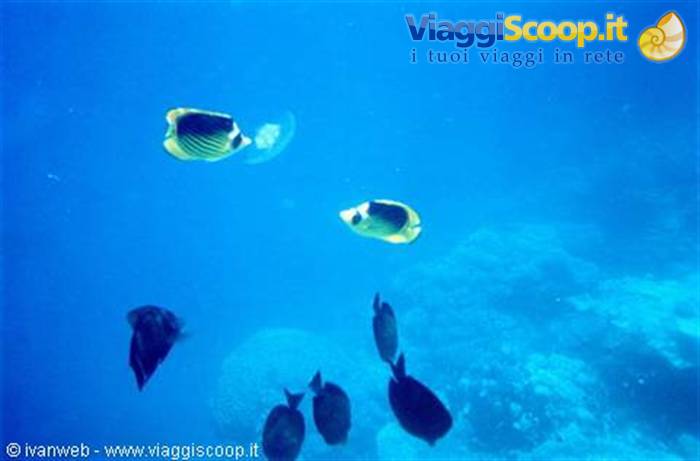
Be that as it may, the underwater world is always a wonder to see and explore! The guide explains a few things to us, among which what not to do is stand on the corals or touch them (especially the one called "fire coral", extremely irritating and sharp). Striking are the pink four-leaf clovers jellyfish, very present in this sea but not at all dangerous. In fact they don't even sting, we calmly take one in our hand (it feels like silicone!). We see many specimens of surgeonfish and parrotfish of considerable size, various trumpetfish, pufferfish, triggerfish and butterflyfish. After about forty minutes we start to get seriously cold, and so we head back to shore, always accompanied by the diving instructor. It's already lunchtime, but before sitting down at the table Ste and I book our afternoon excursion to El Quseir for €20 each.
Lunch is a buffet in the dining room and includes everything: one table for appetisers and salads, another for desserts and fruit, and another long counter for first and second courses. Nothing is missing, certainly not hunger. At 15 sharp we meet at reception to wait for the bus for our trip. We're a good group of people. Departure is on time and we start the excursion driving along the sea on the only paved road that runs along the Red Sea from South to North in this stretch as far as Hurgada. El Quseir is more or less halfway, about 130 km from the latter and 120 km from Marsa Alam. It's an hour and a half of travel. Meanwhile the landscape shows its fundamental characteristics from the first kilometres: rocky desert on one side, blue sea in two dominant shades (light blue and deep blue where the reef ends) on the other. In between, barely a few tourist resorts under construction.
There aren't many hotels operating at the moment, the most famous are surely the Venta Club (just a little further south of ours), the Vera Club and the Kharamana a little further north. They're all on the beach of course and the phenomenon of "third" and "fourth" row that mass tourism has brought to Sharm doesn't exist yet. Marsa Alam is still an unspoilt and fledgling place, but it won't last long. Everywhere you see construction work and building sites at a short distance from each other: many resorts will soon spring up one after another. Of local villages, however, I mean Egyptian houses, there's no sign except near the airport: they are the apartments of those who work in the area, our Egyptian guide named "Amedeo" explains.
He also explains that the Egyptian government does not sell this stretch of land for building homes but only for tourism purposes, which is why there is such a concentration of hotels on the coast. We finally arrive at our destination and have the opportunity to glimpse snatches of Egyptian life in the streets, until we stop near a street teeming with little shops and stalls. The little markets are one of the reasons El Quseir is in fact famous. Amedeo gives us some tips on how not to get badly ripped off. The first of all is the best known: bargain over everything, at least 30-40%. In a few square metres we find concentrated many very beautiful handicrafts and a vast choice of souvenirs you can't resist. Just outside the little shop we see a girl watching us curiously but at the same time very shyly from above a wall of her home, surrounded by brightly coloured towels.
We really are in another world and there is nothing that could resemble our European lifestyle. Amedeo also explains that the veil and the obligation for girls to stay covered is a custom imposed not for their sake but to avoid provoking man's temptation, since their religion forbids sexual relations before marriage. The next stop is a visit to an old phosphate factory, now disused. It looks like a ghost town of the old Wild West. Shacks and dilapidated houses characterise what was a flourishing Italian colony some time ago.
The only exception is the little church that still carries out its religious functions for the few Christians in the area: it's really a case of saying "A cathedral in the desert"! We move on to the little harbour and the beach to drink the characteristic Karkadè beverage while some take the opportunity instead to try "smoking" a characteristic thing from which steam comes out that looks like a candelabra whose name I don't quite understand. Further on we stop at the Mosque, which however we cannot visit from the inside. The excursion ends with a raid on the papyrus shop. First of all we attend a cultural explanation of how these famous Egyptian artefacts are created, so resistant and flexible at the same time, and then we set about calmly choosing the one that best suits our tastes. A likeable guy immediately comes up to me and Ste with the most disparate offers.
After very long negotiations, we take away two papyruses with our name and zodiac sign, one very beautiful painting with a desert sunset on darker brownish paper (it's more valuable and requires exactly twice the work of the normal yellow one), another with the figure of the cat and yet another given as a gift with the key of life, plus various mementos like magnets and lucky scarabs. As a first day of shopping we ruined ourselves.... We return to the Blue Reef for 20.30, just in time for dinner. A walk around the village, well lit and suggestive in its night guise, to enjoy the excellent mango juice served at all hours at the bar, and off to bed.
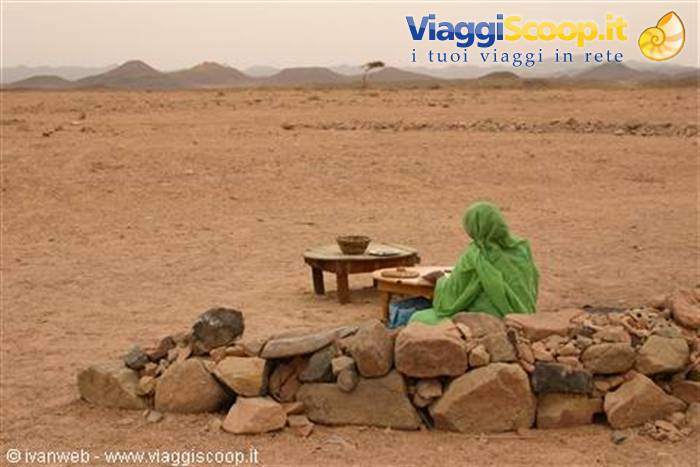
Bedouins in the desert
Day 319 Apr 2005
Eden Bay. Camel ride tour in the desert
At 10 sharp we take the shuttle that runs free of charge from the Blue Reef to Eden Bay, in just ten minutes of travel. This beach is for the exclusive use of the hotel and has completely different characteristics. First of all it's totally deserted, not only because of the fact that there are a mere four tourists from the Eden village but precisely because around it there is no structure or building whatsoever except for the tent camp of two Egyptians who are there to keep an eye on the tourists and try to sell something. Besides, it's the only shaded and sheltered spot because behind the beach there isn't a single tree, only a few sparse low bushes. The sand here too is coarse and the desert rocky.
The panorama of the surrounding "nothing" as far as the horizon is quite impressive, but the main characteristic is the deadly contrast, after 11, between the yellow colour (which becomes blinding white with the very strong reflected sunlight) and the blue of the Red Sea: a stunning sight! Unfortunately the water is cold and choppy and doesn't tempt you to swim today. This should anyway be an excellent spot for snorkelling because the coral reef breaks in the middle of the bay, reaching right up to the shore, which means a much easier and more immediate entry into the water compared to the Blue Reef beach. We leave our towels in the middle of the bay, surely visible from kilometres away since they're the only ones together with those of a likeable Italian couple, also guests of our hotel (it couldn't be otherwise), with whom we have a bit of conversation.
They too have come here to enjoy a bit of tranquillity without entertainment, music and other people. We walk south (to the right of the bay) until we reach the rocks, spotting gigantic crabs that scuttle under the sand as we pass. A very sore point concerns the filth of the hinterland just a few metres behind the beach. From the start of the bushes for several dozen metres there's a sort of uncared-for rubbish dump, apparently inexplicable: where does the rubbish come from if there's nothing around? not from the tourists, at least not only, because there are also big and heavy pieces of rubbish. It reminds me of some Sardinian beaches on the west coast in winter, where sometimes the storms bring rubbish in from Spain. Luckily, at least back home they clean them before the tourist season! And in any case here in the Red Sea there are no storms and the water is very clean.
We leave this mystery behind us and go for a walk instead on the other side of the bay, passing over a rocky stretch and ending up in another little cove, the most beautiful seen so far. In the end we return to our towels to get a bit of well-deserved sun until midday, when the shuttle takes us back to the Blue Reef. Before that though we make a few purchases from the Egyptian's tent-shop: a t-shirt in excellent cotton for only 5 euros can't be passed up. Once back at the hotel, we stay a bit longer on the beach and have lunch at the buffet. At 16 we're at reception ready for the unmissable Camel Ride Tour (cost 40 euros per person). Three equipped off-road vehicles come to pick us up and we begin a fun dash through the rocky desert raising tons of dust and bouncing on the shock absorbers like crazy! The drivers are a bit wild and play at overtaking and showing off.
Beside us, we witness a textbook scene where the driver of the off-roader gets out of the vehicle leaving the steering wheel and running hanging on to the door for a few seconds, under the desperate gaze of the poor stunned tourists! After a few kilometres we're now deep in the desert with no sign of civilisation. We arrive at the starting point of the camel ride, where a large group of dromedaries (with one hump, precisely) waits for us with their owners. They call it a camel ride even though they're actually dromedaries because the Egyptians don't distinguish between the two breeds. In their language there is no secondary term: they're all camels and that's it. So explains our Egyptian guide of today, a very likable guy who goes by the name of Valentino and who speaks Italian very well despite never having been to our country.
Getting on the dromedary is quite comical and when we're all ready we begin our crossing, following a sort of canyon that is wide in places and narrower and taller in others. The landscape is as bare as it is fascinating: finding a tree or a bush that manages to live with this temperature and scarcity of water is an event that almost leaves you open-mouthed. I'm the last in the column (the dromedaries are linked to each other in single file) and I have the chance to take some fun photos of the entire "camel ride", filming everyone ahead of me following the snake-like line. After almost an hour on the back of this splendid animal (which, contrary to what I'd been told, doesn't smell at all and is more comfortable than riding a horse), we arrive at our destination on a plateau with a very wide panorama where it's possible to observe the whole grandeur of the desert.
Here our off-road vehicles pick us up to reach, after a few more adventurous kilometres, the vicinity of a water well. To look at it, it seems just a hole in which, about ten metres deep, you can glimpse the reflection of the water. But here in the middle of the desert this hole is a miracle and the only source of life for the Bedouins. Valentino gives an accurate and long explanation about their nomadic life, retracing its characteristic features and history. I'm struck by the fact that the blessing of water is thanks to the dromedaries: it's they who find it, stopping in the right spots where they "sense" it. Man only has to dig, and if he's lucky 6-7 metres are enough, which become 20-25 in the worst cases. The water found this way is of course undrinkable for us civilised people, but also for the Egyptians themselves.
Only the Bedouins have developed their bodies with adequate antibodies to be able to drink it. And to have proof of this, we move again by off-road vehicle until we reach a real camp of these astonishing inhabitants of the desert. Actually we're talking about a single family: there are just two tents, one of the first wife and one of the second. One of them is preparing bread sitting at a little table of stones. She's very young and very shy, and photographing her is a bit embarrassing: we don't insist too much and just observe how life can exist in this place so harsh and hard. All around, the desert is immense, staggering, so essential and yet indescribable in words. Valentino invites us to drink hot mint tea together with the owner and a small group of local Egyptians. We sit in a semicircle and listen to a bit of history and music.
Coffee is also offered, which apparently has notably aphrodisiac effects for men (jokingly they call it coffee-viagra). We end the evening now at sunset (which however we don't see because it's cloudy, an unusual event in the desert) all dancing together to the strange songs sung by Valentino and played on a traditional instrument by another Egyptian. Such a simple gesture but engaging and moving at the same time: a beautiful and unforgettable experience! During the return to the hotel, now almost dark, I'm struck once again by the way the Egyptians drive. Headlights are used very little, as little as possible: it seems the explanation is that they disturb the view. So, until it's pitch black, they never turn them on but only use the indicators when they meet other vehicles.
They flash the left ones, which are on the inner side of the lane, so that the oncoming vehicle has a physical point of reference on the roadway for the space occupied by the vehicle. I'd never seen anything like it before.
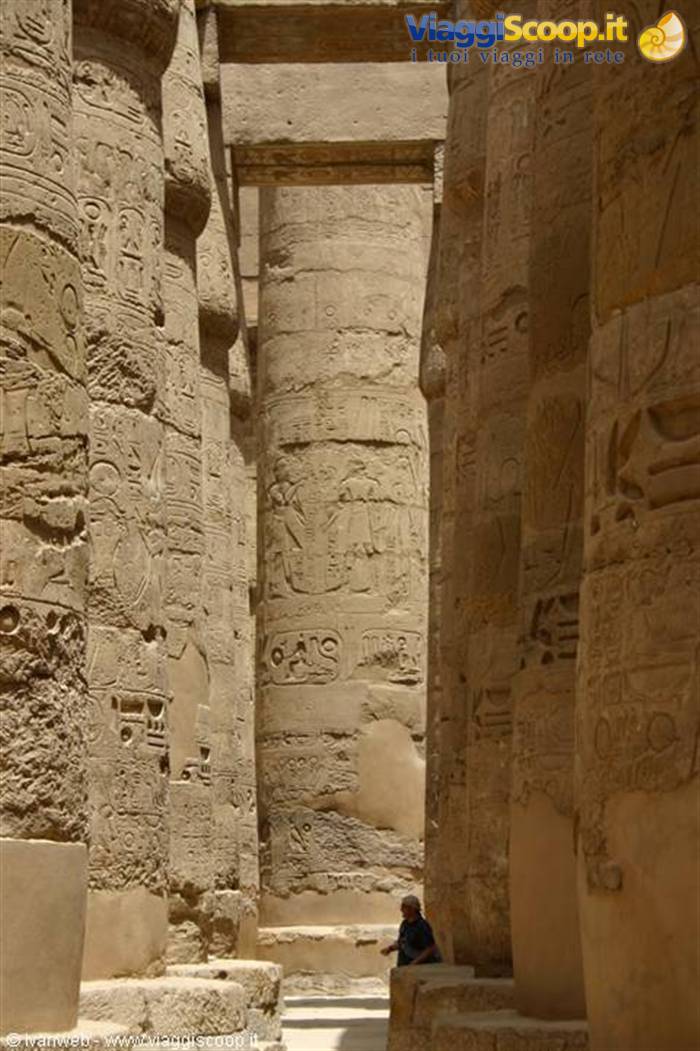
Luxor : temple of Karnak
Day 420 Apr 2005
Sea and snorkelling
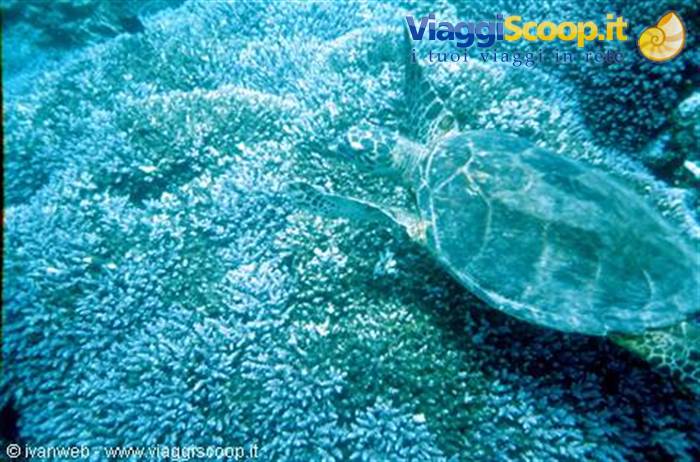
We dedicate today to total relaxation: no trips but exclusively sun, beach, sea, and snorkelling. After breakfast at 8.30, we spend a couple of hours in the pool and go into the water with mask and fins ready to photograph the marvellous underwater world. Bringing the wetsuit booties was a real tip, with which I can calmly walk the whole stretch of sea until I reach the red flags. The water temperature today is decidedly warmer and we can stay swimming for more than an hour. As soon as we get in we immediately notice, with a stroke of luck, a turtle of considerable size, which manoeuvres calmly 6-7 metres below us. We follow it for a few minutes in its elegance: beautiful! Continuing on we meet the various most frequent species of this habitat such as surgeonfish, butterflyfish, oriental snapper, triggerfish, trumpetfish and so on.
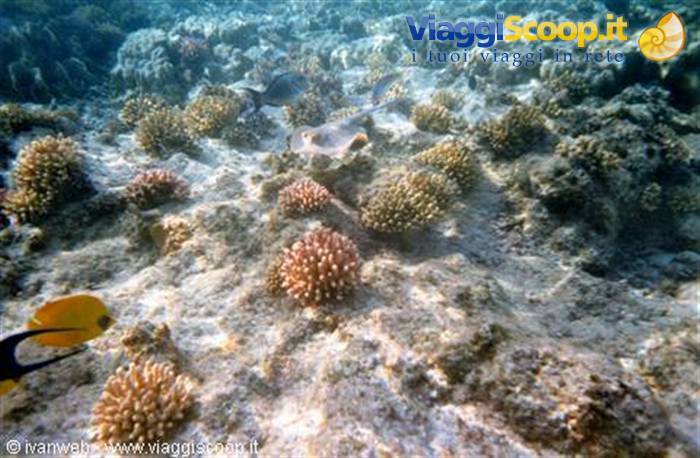
What strikes me instead is the spotted ray, which I didn't know yet. It stays calmly inside the reef, where the depth is about one metre but varies considerably because of pits and veritable caves and tunnels dug into the seabed: a very fascinating and suggestive landscape, just twenty minutes of swimming to the right of the red flags. The corals are also stunning, perfectly intact and with vivid colours. Besides the blue one, the scaly fire coral is very common. A rare and beautiful specimen instead is the green one shaped like seaweed. Once the snorkelling is over we go to eat and then in the afternoon more sun and relaxation in the pool. Here you feel great and it's perhaps the most beautiful spot in the whole village. The bar has vending machines and serves snacks at various times (among which, delicious, crepes made with white chocolate or the classic Nutella).
Beyond the walls of the village you can glimpse an Egyptian on the beach with his dromedaries and a few donkeys, hoping to convince some tourist to take a ride at an exorbitant price. After another memorable snorkelling session, we take a walk along the bay to the next village, also Italian, noting unfortunately once again that, just outside the hotel walls (just outside, I mean a metre), the beach is totally uncared for. Which would be fine for leaving it unspoilt, were it not for the rubbish scattered everywhere.
This seems an incredible paradox since, however much in these places the aim is a policy where the client stays exclusively within the village (also because outside there is practically nothing, neither services nor shops etc.), it's blatantly foolish to think that a tourist won't see or won't notice that a metre outside the hotel paradise is over and the squalor of civilisation's rubbish begins. Is it possible that a hotel really adopts a policy so insensitive as to reason "I'll take care of my beach, the rest is none of my business", even if it's a metre from my walls? I'm not at all criticising the Eden village, because here it's a general point that applies to all the villages.
And this is perhaps the most disappointing side seen of the Red Sea (at least of Marsa Alam), because they've really lost paradise over a banal but fundamental subtlety that is ugly to look at and disturbs quite a lot the souls of any person with a minimum of environmental awareness. So little would be enough to agree and keep the bay clean... I don't want to dwell too much on this subject anyway, also because I'm not aware of the internal policies and also because I'm talking about a situation seen over a few days which I don't know if it lasts all year.
Certainly, I can't deny that seeing these things brings to mind the Maldives, which are on another planet as far as environmental matters go: being the whole island the hotel, you can't find a single paper bag on the ground even if you look for it and if you throw one on purpose, it's a certainty that the next day it won't be there anymore. At the end of the walk, we return to the Eden, have dinner, and pick up the first development of the film taken with the underwater camera. The print quality is excellent but the price of 13 euros is excessive... in any case the photos don't do justice in terms of colour and stillness to the wonders of the coral reef: that's a fact!
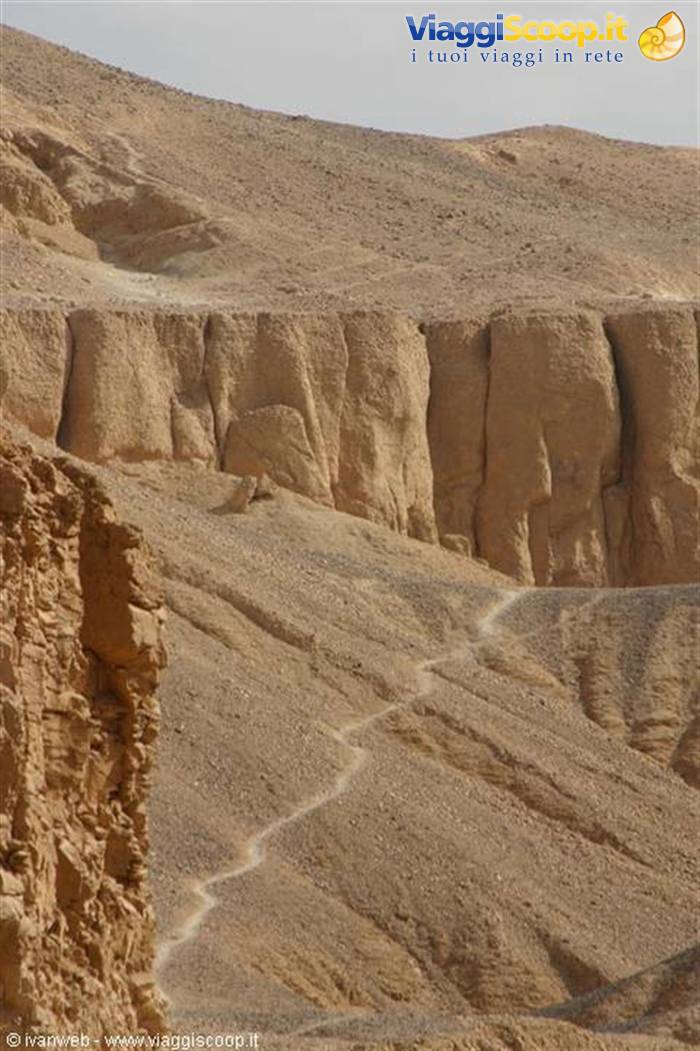
Valley of the Kings
Day 521 Apr 2005
Guided tour to Luxor: Karnak Temple, Colossi of Memnon, Valley of the Kings, Luxor Temple
We set off at 5.30 sharp. We drive along the coastal road northwards to arrive after an hour, as dawn breaks, in El Quseir. Here we gather in an impressive and spectacular way in a gigantic square with dozens and dozens of other buses from all over the area. The purpose is to wait for the police escort which, to cross the roughly 250 kilometres of desert, is absolutely necessary for the most varied safety reasons. After half an hour, the river of buses finally sets off amid the most desperate manoeuvres: some cut across, some overtake for no apparent reason (to go where?). At the exit from El Quseir we find ourselves queued up on the only main road that at this point in Egypt crosses the desert.
At about halfway we all stop at the only service station on this road, and off we go again with more clamorous scenes of buses in fourth and fifth lane and hundreds of people suddenly pouring into a square that seconds earlier was deserted (in the literal sense of the word!). Among other things, it's no small matter to keep firmly in mind which your bus is and its position, so as to find it on the way back... In the middle of the service station an Egyptian child is there with a dromedary ready to have his photo taken for a few coins, while the bar and the little shops are packed with tourists. We set off again after a half-hour break.
I must admit that during the journey the explanation by Amedeo, our guide today (the same one who accompanied us on Monday to El Quseir on the half-day tour), becomes very clear about the definition of "rocky desert", characteristic of the eastern Arabian zone (on the right of the Nile), which is contrasted with that of "sandy desert", which is the classic Sahara with dunes (on the left of the Nile). After several hours, the landscape finally changes and all of a sudden, out of nothing, very green cultivated fields appear with water, palm trees, dense vegetation everywhere: the miracle of the Nile is at hand! It's exciting and fascinating to think that this really is the cradle of civilisation, born thanks to the fertility of this eternal and very long river that continues to give life.
We travel another sixty or so kilometres following the banks of the Nile, crossing local villages and snatches of Egyptian life of all kinds, until we arrive at 11.30 in the much-famed Luxor. Our first visit is the Temple of Karnak, a millennial colossus considered the largest religious temple ever built by man. The entrance is as majestic as the wonders that follow one another before our eyes: the gigantic columns, the obelisk, the statues, all covered with thousands of hieroglyphs that tell the story of a grand people that still today preserves mysteries and history fused together with mythology.
The sore points are the suffocating heat of 40 degrees in the shade (really feeling ill - impossible without a cap or sun umbrella) and the not inconsiderable number of tourists who spoil the magical atmosphere of the place a bit: especially the framing of the photographs!!! Of course you can't ask for too much... to weave our way through the crowd, Amedeo shouts his recognition signal: "Jallakabibi?" (which means: "ready?"), while we reply enthusiastically: "Jalla! Jalla!" (which means: "Let's go!"). Luckily he also has the recognition stick and furthermore he always stations himself in the shaded areas for the explanations, to avoid someone among us collapsing to the ground fainting from the heat... as it happens, someone in our group feels slightly unwell and is forced to sit on a low wall to recover.
Once the visit is over we return to the bus which after a few kilometres stops in a square from where it's possible to admire the Colossi of Memnon, two gigantic statues with a beautiful backdrop of rocky desert that contrasts with the green fields of the Nile. A few ritual photos and we move on to a papyrus shop, where we have about twenty minutes to listen to the explanations and do some shopping. It gets to 14.00 and we go to a nice restaurant for lunch. It's all buffet with no limit on courses, except for drinks which are to be paid for separately and are not included in the tour price. The food is decent, but the cuisine in fact isn't very different from that of the Eden, where indeed there's a greater culinary choice. At 15 sharp we arrive in a small Egyptian village with characteristic colourful (and a bit dilapidated, to tell the truth) buildings on the slopes of the desert.
Here we enter a souvenir shop, where outside the craftsmen work the alabaster vases. Ste and I have already bought quite a lot in the previous days, so we think we'll go outside to wait to avoid the usual Egyptian at our heels trying to sell the impossible with the most varied offers. Nothing could be more wrong, because outside is much worse than inside! The children arrive en masse putting their finger to their mouth in the gesture of giving them something to eat, or alternatively a few euros of alms. How can you remain insensitive in the face of these scenes? Not being able to give money to everyone (giving money seems to me anyway always a questionable attitude in certain respects), we think it's a good idea to opt for our breakfast packets given to us this morning at the hotel.
We certainly don't need them anyway, while they seem to appreciate without hesitating a second this little gesture of ours. Luckily some tourists follow our example (but not all unfortunately), managing to satisfy almost all the children of the surroundings. The next stop is nothing less than the Valley of the Kings, another incredible place surrounded by fascinating millennial stories. On arrival we find ourselves in a square at the foot of the valley, which is even more deserted than the desert itself. The heat has reached its peak, with a boiling wind coming from inland and the sun beating down tremendously without mercy. I'm not surprised not to see a single form of life (except the very annoying flies) across my entire field of vision: not a single tuft of grass! To get near the pharaonic tombs you take a cute little coloured train.
The route is perhaps barely two hundred metres, but done uphill at this temperature would mean arriving exhausted even before starting the visit. Ours, the visit, includes entry to three tombs. There are also others, such as Tutankhamun's, not included in this tour, which can be visited for a fee as an extra. I'd say it's not worth it anyway, unless you're a true devotee of Egyptian history. The tombs in fact are more or less all similar and consist of a gallery dug under the mountain covered with writing and drawings, which lead to the pharaoh's sarcophagus. However much they are in places very damaged, the hieroglyphs are still impressive, even though the whole thing is a bit hard to appreciate because of the queue of people and the stifling heat which, under the mountain, in the enclosed tunnel and without a breath of wind, appears even more unbearable.
Meanwhile Amedeo keeps shouting his ritual "Jallakabibi" but our "Jalla-Jalla" is increasingly muffled and half-hearted! On the way back to the bus they palm off on us along the road something like twenty postcards for one euro (of pitiful quality anyway) and a map of the Nile always at the same price. We have to cross this legendary river by boat to return to our bus, in what promises to be a tragicomic scenario of strong emotional impact. To start with, during the few metres before boarding the vessel, we're surrounded again by children asking for alms, while the older adults approach insistently to sell something at all costs.
... continues on
Turtle
Day 622 Apr 2005
Guided snorkelling in search of the Dugong
After breakfast we head to the diving center, equipped with a duffel bag containing masks, fins and a camera. We've booked the Dugong Tour, that is, a guided snorkeling excursion in search of this distinctive animal that lives in the area and is unfortunately now all alone. From the photos we sense the striking resemblance to the manatee we saw in Florida, and indeed it's the same animal, differing only in its tail fin and a few other small details. The cost of the tour is 20 euros per person. Since the dugong is a completely wild animal, there's no guarantee you'll always see it, but that's a risk more than worth accepting in order to observe it free rather than penned up somewhere, right? There are nine of us in total and we board a minibus (a bit cramped) that takes us, after 10 km north of our village, to the beach of Kharamana and the Vera Club.
Actually, the latter has exclusive use of just one stretch, and uses it exactly as Eden Bay does for Blue Reef: there's a free shuttle that takes guests from the Vera Club to this cove as an alternative to the hotel's main beach. I must admit the beach is nicer than the one at Blue Reef. For one thing, the sand is finer and whiter, and the bay is much larger, leaving space between the umbrellas and sunbeds without giving a feeling of crowding. It's still very busy (unlike Eden Bay, where there's no one!), especially with snorkelers who, like us, surely come in search of the dugong. As for the sea, there's nothing to say: it's beautiful and crystal clear everywhere in this area! Some explanations are given about possible sightings and the route we'll take. The entry is very easy because, just like at Eden Bay, the reef opens up until it reaches the shore.
The water is fairly warm, though every now and then a cold patch comes through depending on the currents. We follow a path parallel to the coast, spotting the distinctive "guitarfish" and a few remoras, along with the usual coral reef fish, then cut across toward the opposite side of the bay, crossing the broad sandy bottom at a depth never exceeding 10 meters, where seagrass grows. This is in fact the dugong's primary food. We keep a few meters of distance from one another to have better visibility, and keep an ear out to hear whether other snorkelers manage to spot it before we do. We reach the far end of the bay where the reef resumes, then turn back again over the sandy bottom. But there's no trace of the dugong. What's more, on this sandy bottom you can barely see anything else, since the fish are concentrated on the coral.
We were unlucky! A shame, because the diving folks saw it both times they went last week with another group. We can't deny we're a bit disappointed, even though all in all we saw another beach and had a nice swim. We head back at 1 pm for lunch and stay at the pool sunbathing. Around 4 pm we go into the sea for another snorkeling session in front of our Blue Reef. The usual long walk toward the red flags, which in the evening, with the high tide, one could also do by swimming more quickly.
Another hour among the wonders of the Red Sea, and we head back to shore, where the water tonight has an absurdly high temperature! It's incredible, it feels like stepping into a hot bath, exactly like at a spa: how could you not stay soaking in this broth? In the evening, though, we're surprised by the cloudy weather, which forces our assistant Cristina to announce the cancellation of the Astro Tour, a desert excursion to see the stars at night. We hope we can at least do it tomorrow.
Spotted ray
Day 723 Apr 2005
An extraordinary event in the desert: rain!
As soon as we wake up, we realize that today doesn't promise anything good. From the balcony of our room the sky is more threatening than ever and heavy dark clouds gather above our heads as we go to breakfast. In no time at all the heavens open up and, combined with the strong wind coming from the desert, it takes on a truly apocalyptic look! Some Egyptian starts shouting: "It's the end of the world! The end of the world has come!" Poor guy must have gotten scared; after all, they really rarely see rain, just as we in Cagliari rarely see snow.
Someone claims it hadn't rained in ten years, so we're literally witnessing an extraordinary event! On the other hand, considering we're on vacation sunbathing in the Red Sea and we know rain all too well back home, it's not exactly great!! We stay stuck in the room for a few hours, and when the rain stops we walk along the beach to see the situation. The very strong wind brings brown clouds and haze, making it feel almost like being in a sandstorm, while the sea has withdrawn tremendously: you can see pools of water for dozens of meters creating an endless drying beach on which some tourists walk, having nothing else to do. Seen this way, it can only bring to mind a pre-tsunami situation that hundreds of thousands of people experienced on December 26, 2004. Fortunately, here we're in the Red Sea and the thought of tragedy only brushes past us for a moment.
Besides, beyond the reef you can see foam and rough sea, which in any case prevent venturing out for a snorkeling session. Even the pool area is a mud pit, though the staff are quickly getting it back in shape by cleaning and drying the sunbeds. There's nothing to do but wait for lunch with a bit of patience. In the meantime we give a generous tip to the Egyptian staff member who looks after our room. Besides cleaning it very well, in fact, every day he leaves amusing and original compositions on the bed like swans and turtles. Today he wrote "Ciao" using the towels, the remote control and a lucky scarab for the dot on the "i." We spend the afternoon at the pool with the sky still cloudy, and around 5 pm, tired of sitting still, we attempt a walk along the bay, curious about the pier we can see in the village just past ours. Actually, it's under construction and not yet usable.
Continuing on and passing a few hotels, we reach another pier: the one at Venta Club. This hotel is much bigger and more spacious than the Eden and frankly seems much better. For one thing, the beach is larger and the umbrellas are wider and better cared for, giving a greater sense of privacy. Moreover, it's totally separated from the pool area, which is much further back, avoiding conflicts of music and activities as sometimes happens at Blue Reef. The pier, then, is a huge convenience. Even though before leaving I thought one could easily do without it, I now recognize that it's fundamental, especially on windy or rough-sea days like today. Once you get beyond the reef, where the water is deep, you skip all the annoying waves that make it impossible to enter on foot as at Eden village.
And as proof, there are in fact some snorkelers going for a swim (always cautiously, because with bad weather and rough sea you don't mess around, but you just stay close to the pier and at least you're sure you can take a dip and get out right away if things worsen). We head back to our hotel after a long walk and have dinner at 7:30 pm (tonight by candlelight, since it's the last day the buffet has prepared something special!) in the hope that at least today we can attempt the astro tour, since the sky is clearing a bit. Unfortunately, though, the cancellation is final: too much humidity, haze and a full moon don't go together. So we drown our disappointment in shopping, buying the last souvenirs from Nino, a very skilled craftsman who on request creates designs of colored sand inside little glass bottles, with surgical precision.
At 10 pm, we go to the amphitheater to watch the animation team's closing show, which has created funny sketches of jokes, dances and music together with the children and guests of the village. It's a special event also for the head of animation, who today ends his career with a truly moving and touching poem. He's changing his life completely: now he's going to be a hotel manager in Sharm (well... he didn't do too badly for himself, it seems!).
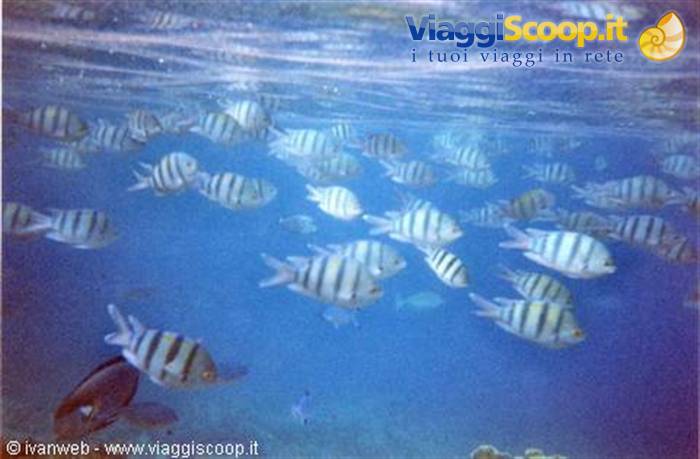
School of striped sergeant fish swimming in blue water near the surface
Day 824 Apr 2005
Feeling unwell with an intestinal infection. Return flight Marsa Alam - Rome via Sharm
I wake up at 7:30 and start the day with very strong stomach cramps. During the morning the pain increases and is such that I can't even stand up because of the nausea. Having to leave tonight at 7 pm then starts to become a nightmare. Before lunch my fever rises to 38 and so we're forced to call the hotel doctor. He's Egyptian but fortunately has an assistant who acts as an interpreter. After various explanations about the pain, he prepares two injections, one of which is extremely painful, to bring my fever down quickly and one for the cramps. He advises me to eat lots of fruit and drink hot tea with lemon. To finish, he gives me three different medicines for nausea, cramps and diarrhea. All for the "modest" sum of 62 euros....
wow, doctors at the village really charge you, huh?! After a couple of hours the fever goes down but the cramps continue unabated without giving me a second's relief. A nice intestinal infection is just what's needed to end a lovely trip in awful fashion. While Ste does all the preparations, at 6:30 pm I'm still bedridden, wondering how I'll survive the return trip, which includes the night at the airport in Rome... at 7 pm we leave the room and go to the restaurant for dinner. Needless to say, I eat practically nothing, just a bit of fruit as the doctor advised. The long waits in the hall for the bus and at the airport once we arrive are devastating with this stomachache and nausea, to the point that I can't stay in any position, least of all standing. It's hard to find the cause, but I don't see any other victims among the departing tourists.
In all likelihood, doing the math, I'd say it's the fault of the salad, probably poorly washed. Even though at the hotel they told us that was a "legend" and all the water is properly disinfected, the fact remains that I got the infection anyway and I was too naive to trust them. A mistake that, given this terrible experience, I will never make again: that's for sure! At 9:30 pm the flight to Rome departs with a stopover in Sharm after 40 minutes. Fortunately, at least they don't make us get off the plane. The stopover in Sharm serves exclusively to board two passengers and to start the vacation for those coming from Italy. They, like us on the way out, made an absurd stopover, getting off first at Marsa Alam to go back up to Sharm.... speechless!
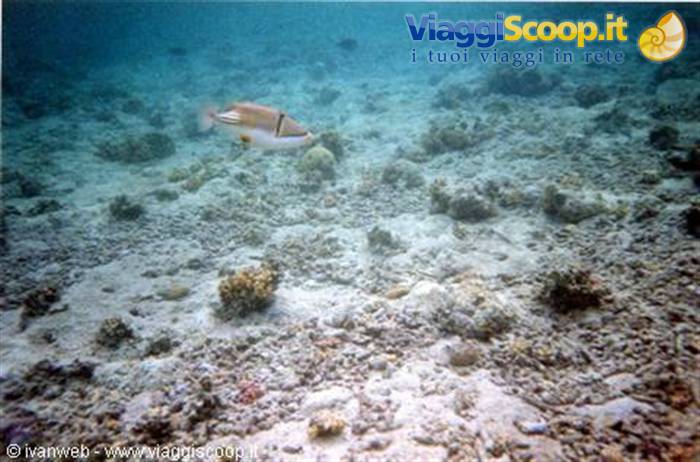
Triggerfish
Day 925 Apr 2005
Flight Rome - Cagliari
We arrive in Rome at 4 in the morning. We take care of the entry formalities, pick up our luggage and look for a spot among the benches to spend the night. More or less around 5, the pain from the very strong stomach cramps passes completely. For me it's paradise, total joy. Without pain everything else fades into the background: the travel delays, the problems I had with the camera, the day lost to bad weather and the one lost to my illness, the long night spent in Rome waiting for the 11 o'clock flight to Cagliari (because the 8 o'clock one - splendid - was canceled! - really lucky on this vacation, I must say). It's really true that health comes before everything! After several hot teas and a few croissants, we finally get home, very worn out. Well... at least I can say I've suffered the so-called "Mal d'Africa," even if it's not exactly what that term means...
Complimenti Ivan, ottimo reportage e ottime foto, come al tuo solito :-)
Sono rimasto colpito anch'io molto positivamente dall'Egitto, una terra magica.... e non ho sofferto di mal di pancia (che secondo me è dovuto al modo in cui i villaggi utilizzano l'aria condizionata) pur mangiando frutta e verdura cruda.
fabio · 26/05/2005
fantastico !!! foto stupende e racconto completissimo !
Grazie Ivan, i tuoi racconti di viaggio ci fanno sempre sognare !
serena.comensoli@libero.it · 19/11/2006
Fantastico ,fantastico come posto , come foto e come racconto
ivanweb · 23/11/2006
Vi ringrazio ragazzi! Dà una grande soddisfazione ricevere i complimenti e spero che i miei racconti vi servano per i futuri viaggi. Mi spiace che la pare di Luxor non sia visibile per intero per problemi di lunghezza max di testo, ma trovate cmq tutto nel mio sito, comprese una valanga di foto in più ad alta risoluzione! A presto, ciao!
monique · 16/03/2008
Fotografie che rendono...soprattutto diverse dalle solite, la geografia umana merita di essere ritratta, davvero belle!


5 reader comments
Complimenti Ivan, ottimo reportage e ottime foto, come al tuo solito :-) Sono rimasto colpito anch'io molto positivamente dall'Egitto, una terra magica.... e non ho sofferto di mal di pancia (che secondo me è dovuto al modo in cui i villaggi utilizzano l'aria condizionata) pur mangiando frutta e verdura cruda.
fantastico !!! foto stupende e racconto completissimo ! Grazie Ivan, i tuoi racconti di viaggio ci fanno sempre sognare !
Fantastico ,fantastico come posto , come foto e come racconto
Vi ringrazio ragazzi! Dà una grande soddisfazione ricevere i complimenti e spero che i miei racconti vi servano per i futuri viaggi. Mi spiace che la pare di Luxor non sia visibile per intero per problemi di lunghezza max di testo, ma trovate cmq tutto nel mio sito, comprese una valanga di foto in più ad alta risoluzione! A presto, ciao!
Fotografie che rendono...soprattutto diverse dalle solite, la geografia umana merita di essere ritratta, davvero belle!