This morning we wake up very early, at 4:15 it's still dark outside. Today we leave for Egypt with the cruise offered by Snaidero and Phone and go (For the first time we make the trip Curti-Rome with our own car...let's hope we don't hit traffic on the GRA. The Windjet flight leaves at 10:45 and arrives four hours later in Luxor, the Egyptian airport is very small (as we imagined) and as happens on all organized trips there are guys outside who escort us onto the motor ship, the Lady Mary. After a small briefing with our guide on board, Claude, we go to our room to rest. The room is very large and cozy, there's an enormous window overlooking the Nile and with the sunset it's fantastic.
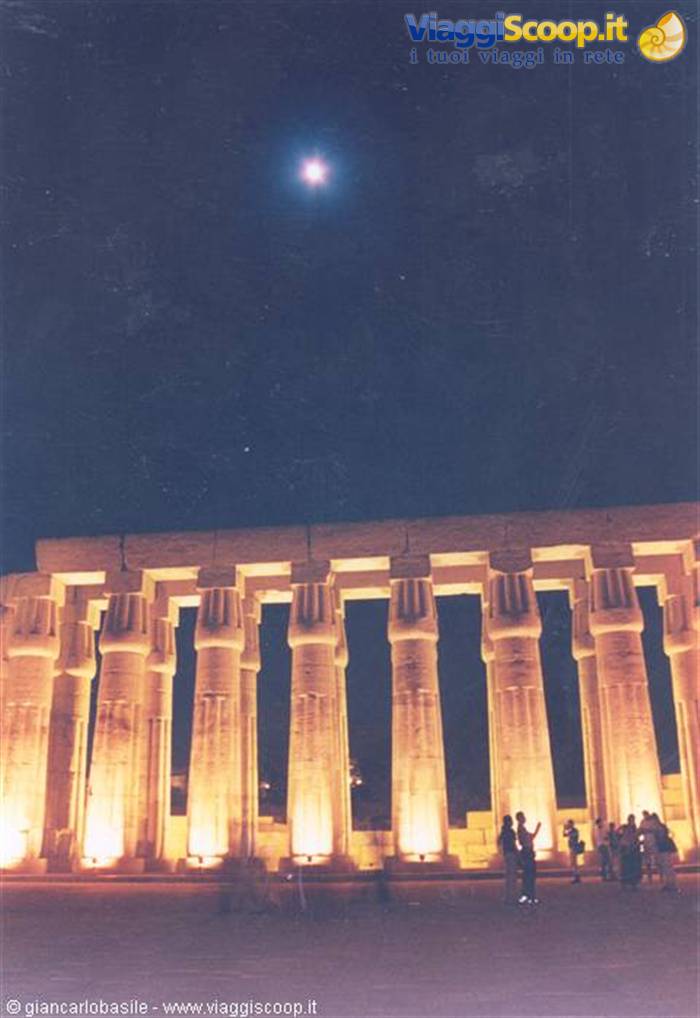
We take a quick tour of the ship, it's very beautiful, it has four decks and there's a bar, restaurant, two little shops, a reading room, a sun deck with an adjacent bar and a small pool; we discover that here in Luxor there are more ships than hotels, about 400, obviously the small berths can't contain them all so they arrange themselves in rows of four ships each and to enter your own ship you often have to pass through the lobbies of the others. Here in Egypt there's the Egyptian pound, also called pound, 1 euro is worth 7.5 pounds...but I must say I never changed a cent...obviously the euro is widely accepted (bring lots of small change). At 17:00 we leave to visit the temple of Luxor, here we make the acquaintance of our guide Tarek (very knowledgeable...but "extremely strict"), it's dark and the temple is lit up, there's a full moon, truly a magical atmosphere.
Apparently here in Luxor there simultaneously exist the largest temple in the world (Karnak) and the smallest, Luxor indeed, the facade is stunning, originally there were two obelisks but one was cut and given to the French in exchange for a clock (we'll see it in Cairo), the obelisk is now on display at place de la concorde in Paris. It's possible to see the avenue of the sphinxes, originally three km long, which connected the temple of Karnak to that of Luxor, and the sanctuary of Alexander the Great where he is depicted together with the god of fertility. After the evocative visit we go on the boat where we begin navigation towards Edfu, we'll arrive late at night.
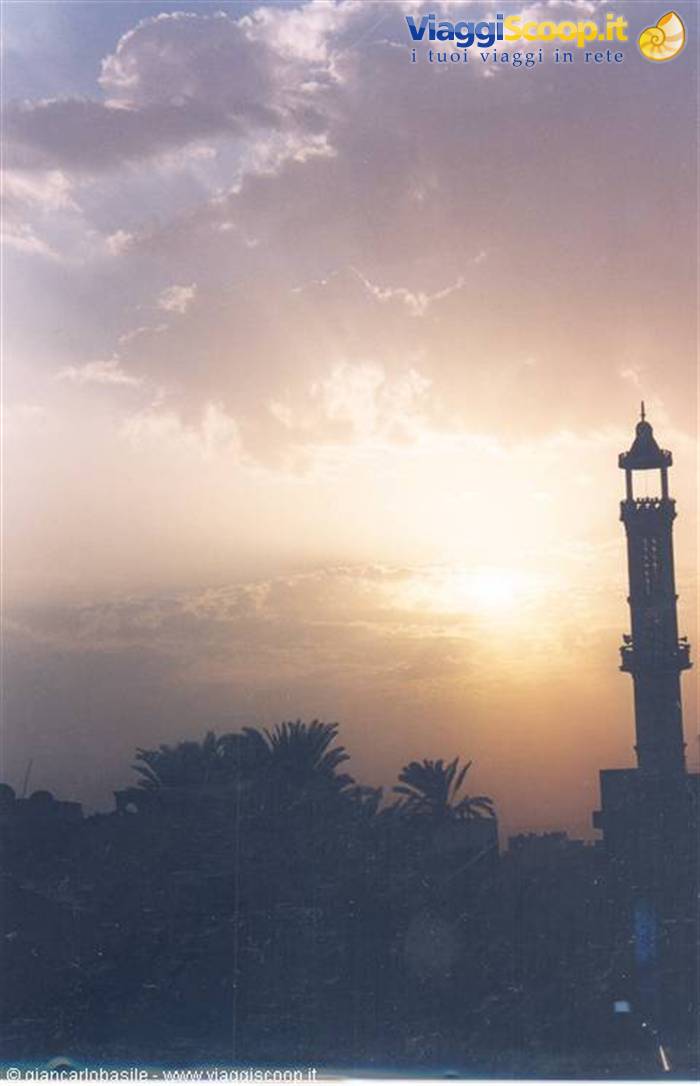
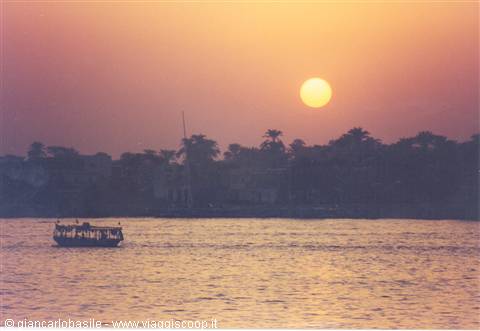
Minaret silhouetted against the low sun, dark palms below
Day 226 Oct 2004
Edfu-Kom Ombo
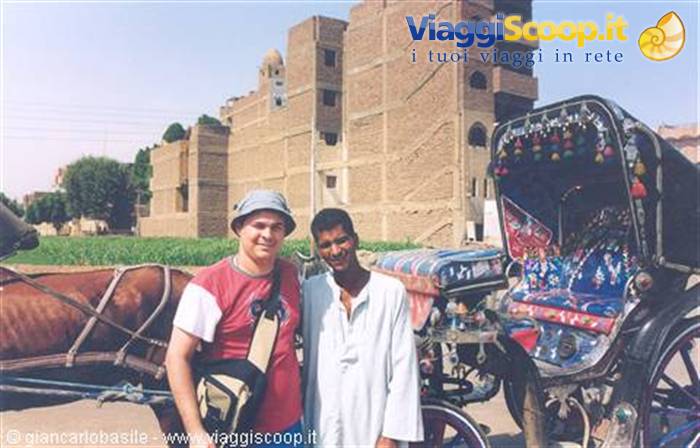
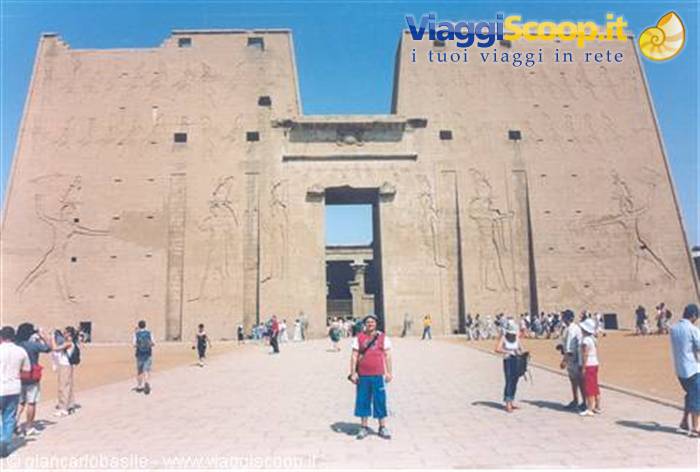
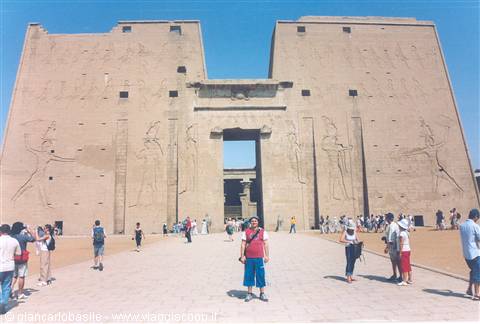
After a hearty breakfast, we're already off the ship where some horse-drawn carriages are waiting to take us to the Temple of Edfu. Along the way, we get the chance to "glimpse" this charming rural town with its inhabitants busy going about their daily chores. The Temple of Edfu, dedicated to the god Horus, is the second largest in the world; it has colossal walls and some fantastic hieroglyphics. Worth seeing is a room where the sky goddess is depicted, in her original colors, with her hands and feet resting on the ground and her body forming the celestial vault. Moreover, in this temple there's a special room; in this place there are hieroglyphics describing the art of preparing essences, an art that the Egyptians (or rather the Nubians) learned very well — today Aswan is the world's foremost city in the preparation of essences.
After visiting this fabulous temple, we spend a few minutes at the little market; of course the merchants invite you, often with a handshake or by calling you friend, to look over their goods... but be careful (especially women) not to cross the white line that marks the entrance to the "shop." We return to the ship and set off again for Kom Ombo; during the navigation you can contemplate the wonderful banks of this river — it's incredible to see lush vegetation along the edges of the Nile and just a few km further on, nothing but desert. The Temple of Kom Ombo is the only one with a double entrance, as it's dedicated to two deities: the crocodile god and the son of Horus (???). The temple stands on a hill very close to the Nile; in the evening, with the lighting, it's a fairy tale.
Inside you can observe many extremely interesting hieroglyphics, such as the first calendar in history and the first surgical instruments in history. Noteworthy is the famous nilometer; this well, using the principle of communicating vessels, allows you to know the level of the Nile. Knowledge of the river's level was of fundamental importance to the Egyptians........based on this, taxes could be assigned....very high or too low waters meant zero taxes (flood or drought), intermediate levels gave increasing taxes.
As usual, we head to the local little market; unfortunately tonight we have a costume party and we need to buy some tunics...the prices they throw at us are 25 euros per tunic.....you've got to be kidding!!!....after a good, lively negotiation I manage to buy three for 5 euros each (receiving the merchant's "congratulations")...ah, the phrase you'll hear most often is: buy this one, the Giuditta model!!!!!. Tonight it's an Arab dinner, I must say it's quite good; alas, I can't eat the felafel (because of favism) but I make do with the very good cous cous. In the end we make friends with the cooks Abdul and Mohammed.
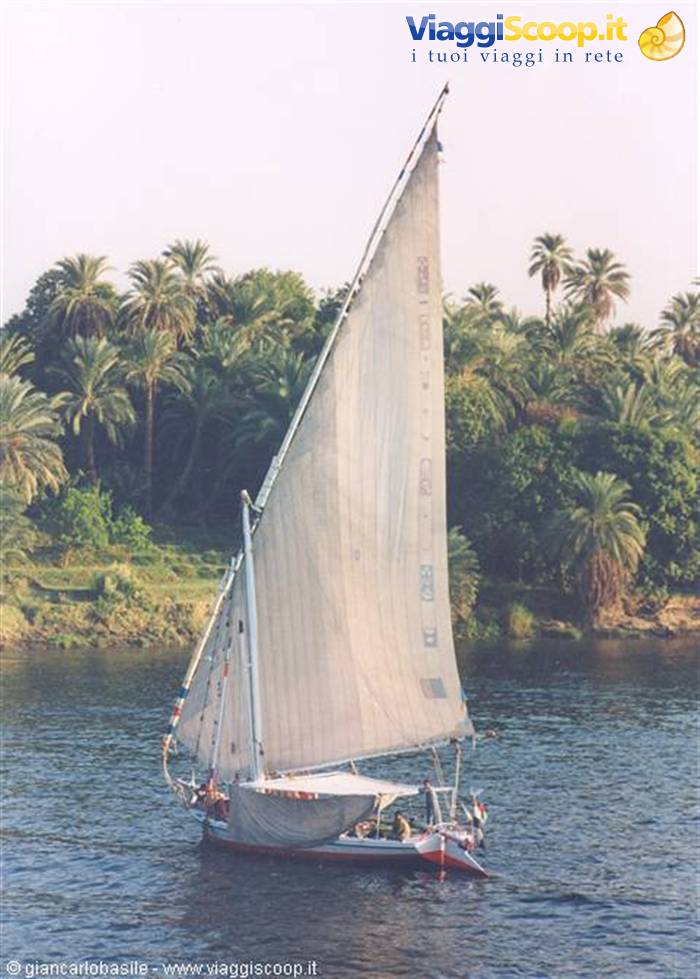
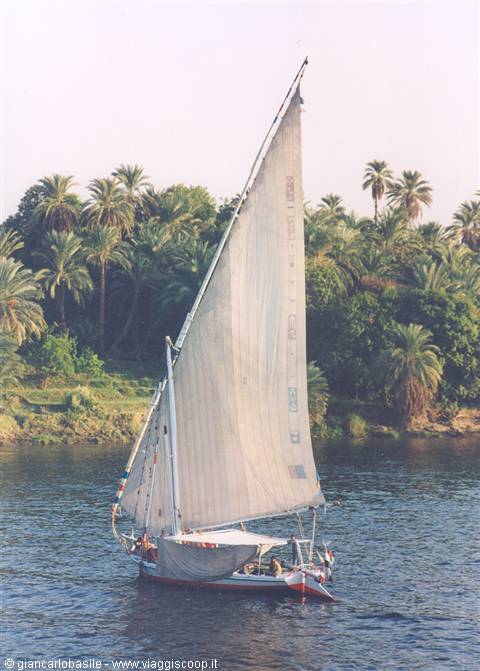
White-sailed felucca on the Nile, palm trees lining the green bank
Day 327 Oct 2004
Kom Ombo-Aswan
This morning the motor ship arrived in Aswan and today a boat trip awaits us to Elephantine Island, called that because it was the center of the ivory trade. You can see the tombs of the nobles carved into the rock and the mausoleum of the Aga Khan. We return by boat and after a quick lunch we set off for the great Aswan Dam; the first stop, however, is the perfume palace (Abu Simbel Perfumes Palace), run entirely by Nubians; here, after a little lesson on how essences are prepared, they have us smell various essences (max 4 because they make you dizzy) and of course they invite you to buy......for anyone interested, they can reproduce any perfume on request.
Afterwards we head to the great Aswan Dam; the creation of this dam made it possible to control the flooding of the Nile and increase cultivable land, but it created an artificial lake (Lake Nasser) that flooded as many as 17 temples, such as those of Abu Simbel and Philae. This very temple is our next stop; we arrive at a small little harbor where we take a motorboat that in five minutes takes us to the island where the Temple of Philae was rebuilt (after recovering the pieces from the bottom of the lake). The temple is beautiful and you can see a room used by Coptic Christians for religious services, with an altar created inside a main hall. Also noteworthy is the Portico of Tiberius, used to welcome the ships that docked at the temple.
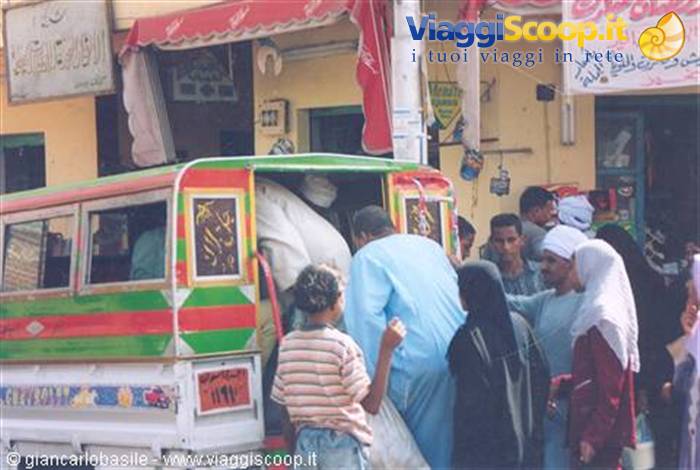
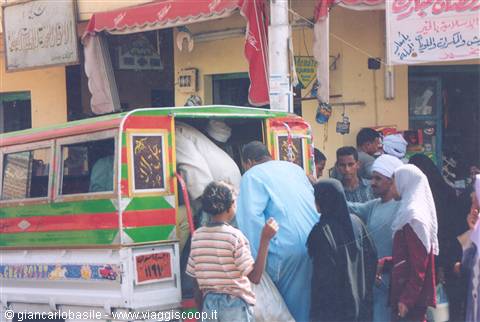
Men boarding a decorated green and red minibus, shops with Arabic signs
Day 428 Oct 2004
Aswan-Abu Simbel-Aswan-Kom Ombo
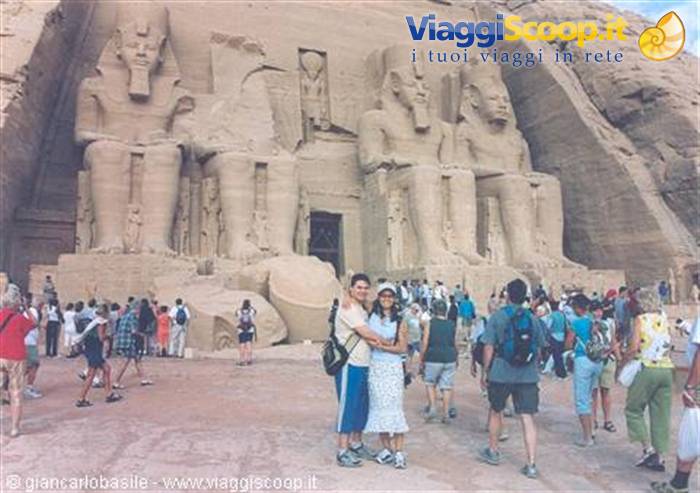
Today is a real grind: wake-up at 2:30 (!!!!!) — just enough time for a coffee — and at 3:15 we leave. The bus going to Abu Simbel is part of a convoy escorted by police that departs at 4:00. Abu Simbel is 200 km from Aswan and only 40 km from Wadi Halfa in Sudan (!!!). After hours of pure desert we arrive at our destination at 6:30; needless to say, the grind is amply rewarded by the beauty of these temples dedicated to Ramses II and his wife Nefertari. The facade is stunning: there are four colossi depicting Ramses seated with his arms crossed (symbol of death) and the false beard straight (symbol of life). Of course there are loads of people and it's already hot at 7:00 — imagine coming at 14:00....forget it, always go very early (this also applies to the Valley of the Kings and Queens).
The interior of the temple is an apotheosis of depictions and hieroglyphics; the most famous are the war chariot and the Battle of Kadesh.....wonderful, a real spectacle (if it weren't for the suffocating heat and sky-high humidity). At the far end there's a small room where Amun-Ra, Ramses II, Horus, and Ptah are depicted in order; these statues, on February 22 and October 22 (one day later than the date of the pharaoh's birth and coronation, a shift due to the reconstruction following the flooding by Lake Nasser), are illuminated by the first rays of the sun. The whole process lasts a total of 12 minutes, and the first ray illuminates Amun-Ra, then Ramses II, and finally Horus..Ptah is never illuminated because he is the deity of darkness... also worth seeing is the Temple of Osiris, the only one in pharaonic history to be dedicated to a woman.
After the visit we return to the boat and begin sailing toward Kom-Ombo.
Tourists in front of the colossal statues of Abu Simbel temple, sunlit sandstone
Day 529 Oct 2004
Kom Ombo-Luxor
After yesterday's slog, today is scheduled as a rest day and it's nice to spend the morning on the deck while watching the Nile flow slowly.
Tourist and driver beside a decorated horse carriage, in front of mud-brick buildings
Day 630 Oct 2004
Luxor
This morning we wake up early (6:15) and head toward the temple of Karnak, this is the largest temple in the world, a real spectacle, its colonnade hall is enormous, we can even make out traces of color on the hieroglyphs (!!!). Also worth seeing are the two obelisks and the sacred lake where the water used for the pharaoh's coronation was drawn. Near the lake there's a low column with a scarab on top, tradition has it that by walking around it counterclockwise you can make a wish... After the temple we set off again for the west bank, welcoming us before the entrance to the valley of the kings and queens are the colossi of Memnon. We make a first stop at the charming temple of Habu and from here we head toward three of the 62 tombs discovered in this valley...the landscape is fantastic, almost lunar.
Here in the valley it's superhumanly hot and it's 11 in the morning and it's October!!!!!!!, anyway the tombs are exceptional, seeing those magnificent hieroglyphs all colored (the colors used are four: black, red, yellow, turquoise) is a real emotion... many are unfinished (the pharaoh died before the work was finished) and you can admire fabulous sketches just as if you were attending a "draw Mickey Mouse" class.
Floodlit colonnade at Luxor Temple by night, tourists under the moon
Day 731 Oct 2004
Luxor-Cairo-Luxor
Included in the cruise price there's also a one-day excursion to Cairo (Gulp!!), so we wake up early (4:30) just for a change and head to the airport where a small turboprop awaits us, taking us to Cairo in an hour. I haven't quite understood whether there are 13 or 17 million people, anyway the difference from the other cities seen so far is obvious...there's abnormal traffic (though nothing compared to Naples'). The first stop is the famous Cairo museum, there's so much stuff that the exhibits seem piled up haphazardly, there are about 36,000 objects (!!!). We see many interesting things like the scribe, the statuette of Khafre, the first Lady, and on the second floor wonder awaits us: the treasure of Tutankhamun. The second floor is practically all dedicated to this pharaoh, there's everything: sarcophagus, jewels, throne, bow, arrows and the very famous funerary mask.
After the museum we suddenly head to the citadel where we admire the fabulous mosque of Mohammed Ali, truly very beautiful, it resembles the blue mosque in Istanbul. After the mosque we head (finally) to the stop that alone is worth the entire trip to Egypt, namely the pyramids at Giza, and even with the annoying smog, it's possible to see the outline of the pyramids already from the mosque's terrace. The Giza pyramid complex is located on a hill right next to the urban center; as soon as we enter, the bus parks in a small square not far away where you can admire them in all their beauty. Khufu, Khafre and Menkaure are the only wonder of antiquity still standing, at least once you have to see this magnificent work of man.
The bus continues its route, stopping us at the foot of the pyramids where you can admire them up close, after which we head to the sphinx, with its body half man half animal (lion), it proudly shows itself with the pyramids as a backdrop. After the sphinx we head to one of the 15 papyrus institutes where they show us how papyrus is worked, and from here we head to the very famous Khan El Khalili market...worth trying, after this super tiring day we return to Luxor, tomorrow we go home.
Tourists before the massive pylon of Edfu Temple, carved hieroglyphs, blue sky




0 reader comments