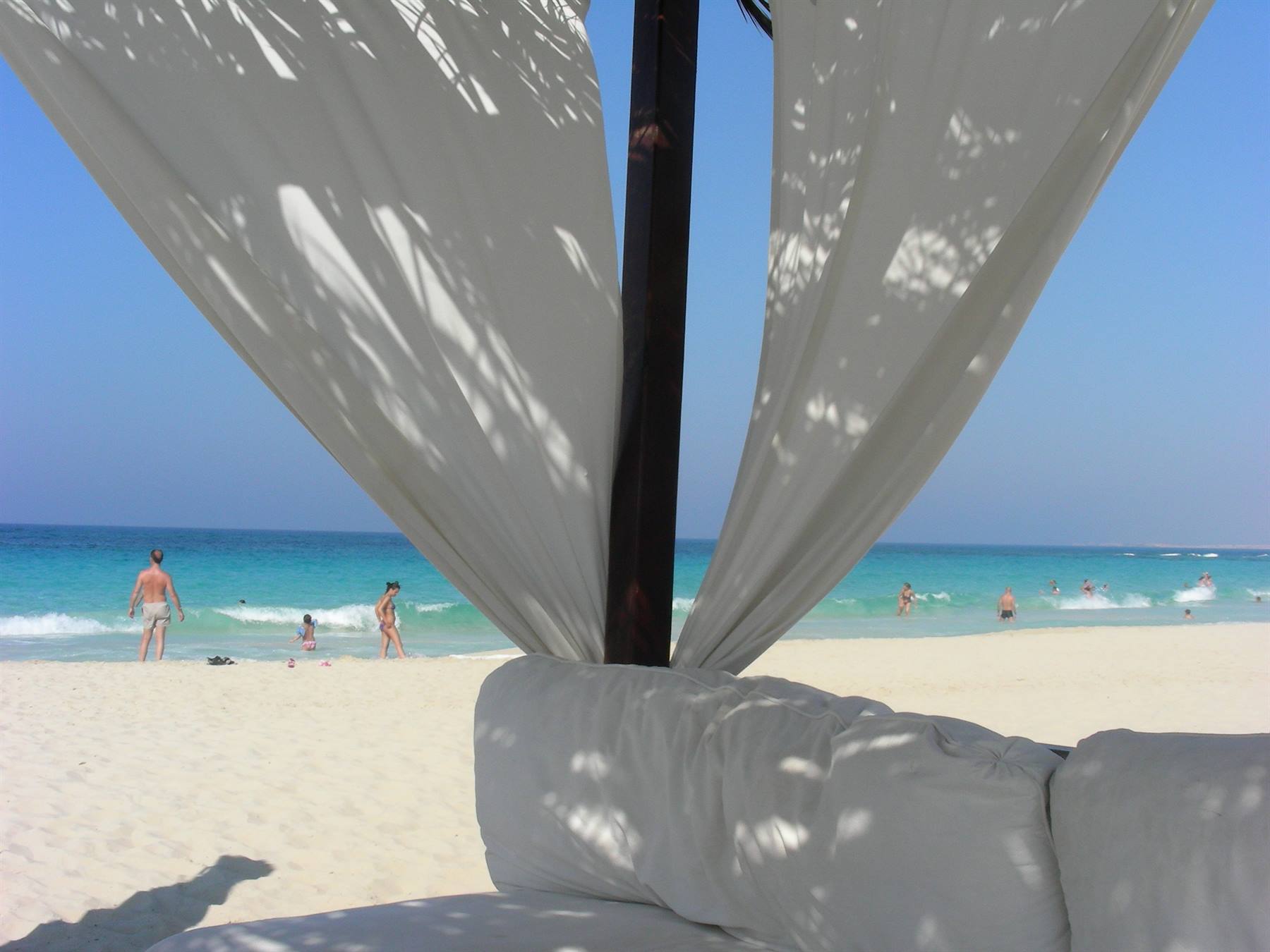
09-07-2010 We leave from Malpensa at 12.00 and arrive at our destination in the late afternoon. By bus we travel about 30 km to reach the Bravo Almaza Beach village. We cross the outskirts of Marsa Matrouh, old houses that sometimes look dilapidated, markets with stalls of every kind. Once out of the city, we travel through an almost deserted area, with a few Bedouin houses scattered here and there. We arrive at the village, very beautiful and right on the sea. Through a lovely garden where the pools are located, we reach the beach, white, long and of very fine sand; the sea, even if a little rough, immediately reveals its Caribbean colours. It really feels like being in the tropics and not on the Mediterranean.
° ° ° ° ° ° ° ° ° ° ° °
In the following days the sea calms down and becomes truly splendid, clear and transparent, with colours shading from blue to green. The beach is enormous, with a few rows of umbrellas, plenty of space for long walks. The village is very well organised with many activities and good entertainment, which will surprise especially in the evening shows, the cuisine is varied and of good quality. After a few days of sea, sun and relaxation, when we start turning red in a slightly worrying way..we decide to make our first excursion: 2 days in Cairo.
Day 112 Jul 2010
CAIRO GIZA
Cairo: we set off early, at 4 in the morning. About 500 km await us to reach Cairo. The minibus is small, just for the five of us, and there are plenty of jolts given the road with its potholes and roughly laid asphalt. When we arrive in Cairo we are greeted by grey weather caused by the smog surrounding the city. We visit Saladin's Citadel, in a dominant position over part of the city, with its 2 mosques, one of them open with porticoes dating back to the 1300s. It's July in Egypt but here the climate is pleasant with a bit of a breeze; below us the blanket of smog envelops the old part of the city. We then go to the Egyptian Museum, an old building with no air conditioning, though only for a little while longer because in a few years it will move to the pyramid area into a new building, since the finds they keep bringing to light no longer fit in the current museum.
We see Tutankhamun's treasure, magnificent in its wealth and in the refinement of the figures. Our guide, Ali, a graduate in Egyptology, explains a few details that distinguish the statues of the pharaohs. Those of the First Kingdom are always standing because at that time the pharaoh was also considered a deity, then in the New Kingdom they are also shown kneeling because he no longer had divine status. The meaning of the beard was different too: if it was straight it meant the pharaoh was still alive, whereas if it was curved the pharaoh was already dead. One hand was usually open and the other closed in a fist, a symbol of peace and power. After the visit to the Museum we have lunch in a barge restaurant along the Nile.
In the afternoon we visit a market in the old part of the city, alleys full of shops and stalls, we are surrounded by vendors offering us everything, above all we are the only tourists... we avoid going too far inside; here there are still water sellers going around the alleys with a small barrel and a single glass from which people drink, in turn; we then get back on the minibus and cross the city of the dead, an area of dilapidated buildings that were once tombs and where people now live, an area full of mosques and minarets, very striking especially when seen as a whole. We reach the hotel in the late afternoon; the hotel is outside the city, near the airport, and so in the evening we are stuck, we don't go out and we watch an Egyptian wedding inside the hotel.
The next day the visit to the Pyramids of Giza awaits us. The city of Giza is now one with Cairo since the buildings are continuous. The pyramids are right up against the houses and appear suddenly, behind the buildings. The pyramid represented the tomb of the pharaoh and his queens in the Old Kingdom (III and IV dynasties) and partly also in the Middle Kingdom (XI and XII dynasties) and had a symbolic meaning, representing the rays of the sun. First we admire them from a panoramic point from which all three can be seen, then we go closer. All around, desert and camels, dirt too, it doesn't feel like being at one of the most important archaeological sites in the world. The pyramid of Cheops is the largest with its 230 metres per side, that of Chephren is the only one that has kept part of its white casing at the tip, and finally the smallest one, that of Mycerinus.
Beside it is the Solar Boat, inside a building. It was discovered in 1954, was dismantled to transport it and then rebuilt in the place where it now stands. 43 metres long, built entirely of wood with the pieces joined only by ropes, it has been preserved surprisingly well; it too had a symbolic meaning, again for the pharaoh's tomb. A little apart from the pyramids, although in photos it looks very close, is the Sphinx, carved out of a spur of rock that echoed its shape. It represents Pharaoh Chephren with the appearance of a feline, a symbol of royalty. We then go to the Papyrus Institute where they show us the working of papyrus and finally to lunch in a restaurant outside the city, set up under a tent. In the afternoon we visit the ancient city of Memphis, founded during the 1st dynasty and very important at the time as a centre of Egypt even though it was not the capital.
Now little remains apart from a few significant statues such as that of Ramses II lying down with the typical double crown of Upper and Lower Egypt, a statue that originally stood in front of the temple. Here there is another sphinx known as the alabaster sphinx although it is actually made of stone and dates back to the 18th dynasty. Then we go to Saqqara, which together with Giza was one of the main necropolises of Memphis; the surrounding area is rich in vegetation, palm groves, since it is rich in water. Here is the step pyramid of Zoser, a pharaoh of the IV dynasty, third millennium before Christ, so it is one of the oldest in Egypt. Beneath the pyramid are various galleries and at the entrance to the site an access colonnade with side niches that represented the passage of the pharaoh's mummy before reaching the tomb.
After this last visit we begin the journey back to Marsa Matrouh, where we arrive in the evening. They have been two intense days, but greatly satisfying, we have seen the archaeological sites and gained an idea of a huge and impressive city like Cairo, where one should certainly return, staying longer to understand more, even though it can't be easy!
THE COLOURS OF THE SEA
Day 216 Jul 2010
AFTERNOON IN MARSA MATROUH
One afternoon we visit the town of Marsa Matrouh, about 30 km from our village. Along the road there are several Bedouin houses. Here the Bedouins have become settled since in this area there is water and they can grow figs and olives. They are recognisable from other Egyptians because they usually wear the keffiyeh. In Arabic Marsa Matrouh means distant port, the town is a holiday resort for Egyptians themselves. In the town there are many hotels considered 4-star but rather squalid by our standards, Alexandria Street, which is the main one, full of stalls selling everything, but here too lots of cheap Chinese goods and few original objects, and the seafront with its promenade. The typical Egyptian holiday consists of getting up late in the morning, staying on the beach until about 7 p.m., but without sunbathing and therefore staying under the umbrella, sitting on simple chairs...
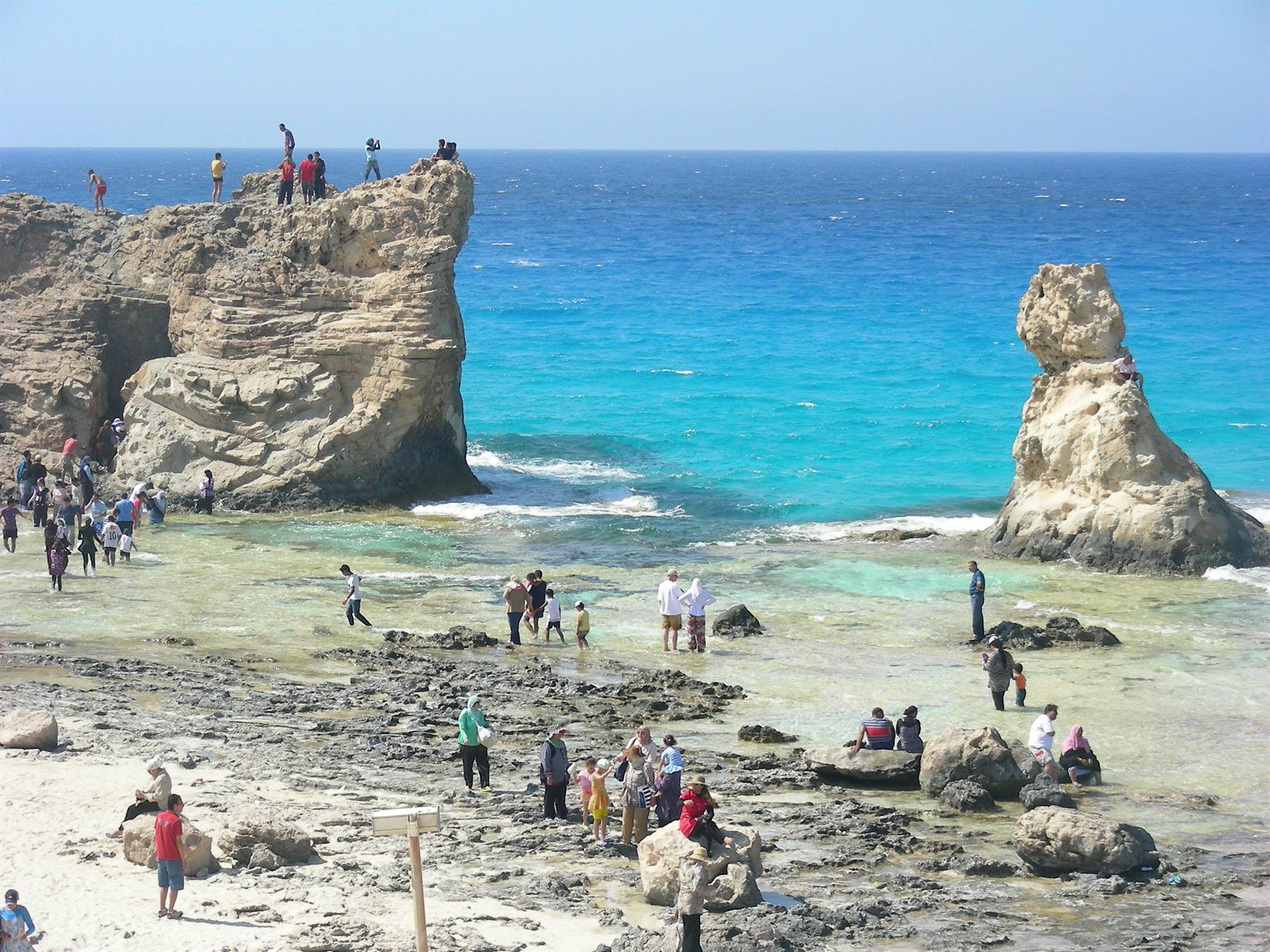
not sun loungers, with only two rows of umbrellas very close together and the rest of the enormous beach free. Here too the sea has lovely colours, though not as beautiful as at our village, but where people swim the water is still and shallow, so a milky blue. The whole coast of Alexandria in Egypt has on the whole a beautiful sea, in fact the construction of residences and villages is in continual ferment, but some parts are close to the Rosetta branch of the Nile, which brings mud. Almaza Beach, where our village is, is truly the best spot, and no wonder, since almaza in Arabic means diamond. We visit the Rommel Museum, set inside a hill right on the harbour; it seems it was dug out by the Romans to store grain, then used by Rommel as his headquarters during the Italo-German advance in World War II. Then we go to Cleopatra's beach with stunning colours.
Legend says that if you enter the cave and bathe in the seawater you grow younger; here Queen Cleopatra used to accompany Mark Antony to bathe when he was in Egypt. Egyptian women must believe it strongly because they go in fully dressed in their burqas, sometimes almost full-body ones, and come out completely soaked but happy. The mosque of Marsa Matrouh cannot be visited since it is not yet a hundred years old and therefore is not considered a monument but only a place of worship. We stroll a bit along the main street, peeking among the stalls, interested not so much in what is for sale as in the people around us.
CLEOPATRA BEACH
Day 319 Jul 2010
SIWA OASIS
Another excursion full of charm is the one to the Siwa Oasis, about 300 km from the village; to reach it you go along the only asphalted road (only since 1985) that crosses the Western Desert or Libyan Desert, since the oasis is only 65 km from the border with Libya. The Oasis extends for over 94,000 sq km, in a depression 20 metres below sea level; 20,000 people live there, Bedouins of Berber origin who preserve ancient traditions such as those concerning women who, while still unmarried, are free to go about with uncovered faces, but once married rarely leave the house, only accompanied by their husband or a man of the family, and wear a full veil in blue and black that leaves only the eyes uncovered. The typical means of transport of the place is the cart, pulled by a donkey; we try it too to cross the town.
There are a great many of them, some pulled by children of 5 or 6, very skilled at manoeuvring the cart and the little donkey. The oasis is rich in crops, olives and date palms; there are lakes and hot spring sources and beyond the greenery... the great sea of sand... We visit the Mountain of the Dead, a necropolis with tombs carved into the mountain and with paintings inside, depicting various deities among them Nut, the goddess of darkness. The tombs were later used by Greeks and Romans, as can be seen from the different paintings; finally during World War II they were used as shelters. From this hill you admire the landscape below with the palm groves, the old town and the desert. We then visit the remains of the ancient city of Shali, built in karshif, a material mixing salt and mud that melts easily, and indeed the city practically melted during the abundant rains of 1926.
What remains, such as the ancient mosque, is nonetheless very fascinating. We then visit a typical Siwan house, built purposely for tourists but which reproduces the typical two-storey dwelling in karshif. Then we take one of the many carts for tourists and go to the Temple of Amun or of the Oracle, where they say Alexander the Great went to consult the oracle about his divine descent. The entrance has a double door, pharaonic and Greek. Carved into the rock are some cartouches dating back to the XXVI dynasty. Last stop before lunch: Cleopatra's Spring, a stone pool containing spring water; it seems it was mentioned by Herodotus as the Spring of the Sun since its water was lukewarm in the morning and then cooled during the day and boiled at midnight. Dozens of local children have fun diving into the clear waters.
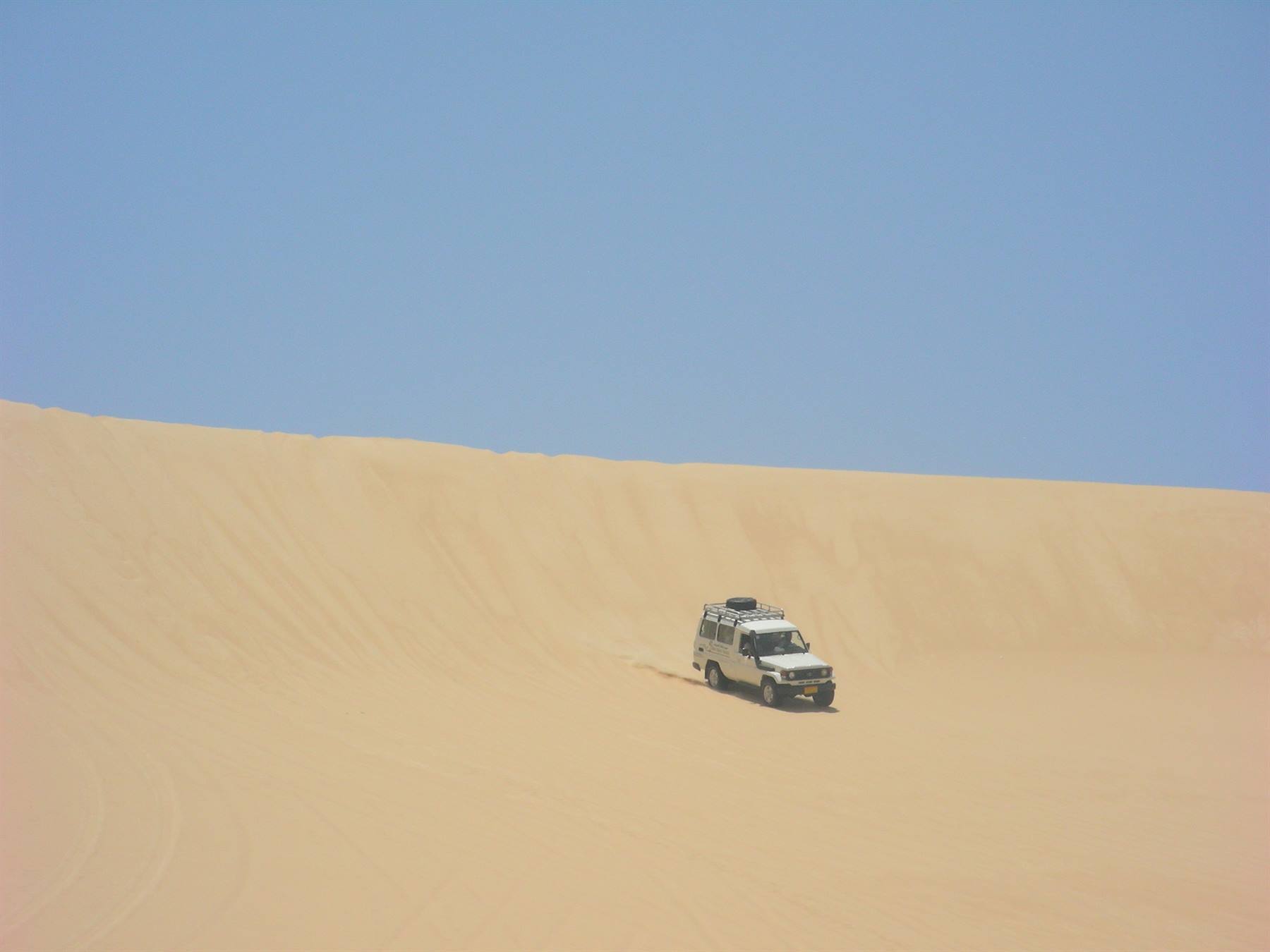
We have lunch in a restaurant inside a tourist complex used by tourists who intend to stay overnight in Siwa. After lunch, under the scorching two-o'clock sun, we go by jeep into the desert surrounding the oasis. The jeep ventures among the dunes and even though the hour is not the best because of the considerable heat, the spectacle of the desert leaves you speechless. After about an hour of dune-bashing, tired, covered in sand but happy, we head back towards our village, where a few more days of relaxation by the sea await us.


0 reader comments