7 June 2007 Thursday: After the visit in Bolivia our luggage has literally risen, and despite the various geometric arrangements we tried in an attempt to cram everything into the Sentra's boot, it refuses to close. We also slightly heightened the bulge of the trunk, but to no avail. Anyway, after various trials we manage to reconcile the luggage with the space and, once the puncture is repaired, we leave Puno, where preparations for the Corpus Domini festival are in full swing. The road runs through valleys dotted with alpaca, we're always around 4,000 metres of altitude. About halfway between Puno and Cusco, a few kilometres before Raqchi, a stop at the restaurant "Filipon", an excellent and very varied buffet. In Raqchi the local Corpus Domini festival is under way: a whole series of local folk groups dance and play in the church square, right at the entrance to the INCA ruins.
The temple of Raqchi was one of the largest in Cusco. We set off again for Cusco, which we reach around 7 in the evening. All the streets of the centre are still blocked for the Corpus Domini procession, one of the main events of Peru's Catholic calendar. After following a labyrinthine series of streets we reach the Piccola Locanda (Hotel Piccola Locanda Cusco, calle Resbalosa 520, Cusco. The inn is well located a few steps from the centre of Cusco, the atmosphere is very pleasant and it has excellent Italian home cooking. 8 June 2007 Friday: For the visit to the museums and archaeological sites of Cusco and surroundings we buy the boleto turistico. We begin with the visit to the Inca museum, then move on to the cathedral, the pre-Columbian museum, the church of Santo Domingo and the Coricancha.
In the afternoon we buy the tickets for the little train to Machu Picchu, previously booked over the Internet. Cusco is a truly interesting city and we gladly lose ourselves among the little streets wedged between the Inca walls, mooching around the craft shops. 9 June Saturday: Today's programme involves the transfer from Cusco to Ollantaytambo, travelling the whole of the Sacred Valley. First stop at the ruins of Saqsaywaman, where it's worth hiring a guide to discover part of the secrets of the stones of the Inca ruins. On the esplanade in front of the ruins the preparations are already under way for the costume festival that re-enacts the battle with Pizarro. Passing then through Q'enqo and Puka Pukara, we reach Pisac. Although the famous market is held on Thursdays and Sundays, the Plaza de Armas is occupied every day by stalls with craft items.
We have lunch in the Plaza de Armas, in the afternoon we set off to visit the ruins of Pisac, where we arrive a bit too late for the kind of route that awaits us. The ruins are in fact scattered over the wall and the ridge of the mountain overlooking Pisac, a complete tour of the ruins probably requires 3 or 4 hours. We have only a couple of hours of light and so we limit ourselves to the reduced route, which nevertheless includes some evocative and somewhat exposed passages. We recover the car after a couple of hours, a bit exhausted from the climb at altitude and the strong wind. We then travel the rest of the Sacred Valley now in darkness. In Ollantaytambo we stay overnight at the Hotel Munay Tika, situated on the road leading to the train station. Dinner quite disappointing at the restaurant Kusiloyuor.
10 June Sunday: Wake-up at 6 for breakfast and to catch the train to Aguas Calientes, the access point to the ruins of Machu Picchu. The English company that runs the railway to Aguas Calientes operates a real legalised scam. It is in fact the most expensive train in the world, about an hour and twenty of train at the price of around 80 USD each! As there's no plausible alternative (the trek on foot finds us a bit out of shape) we let ourselves be "plucked" in this unworthy way (in any case it's worth remembering that tickets can only be bought in Cusco at the central ticket office and at least a day in advance). The seats are numbered, so it's worth trying, at the time of purchase, to ask for seats on the left side of the carriage, which give the best glimpses and views of the river below.
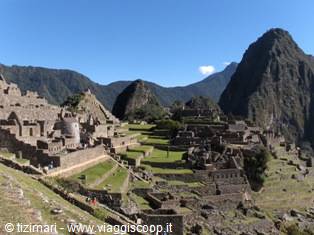
Aguas Calientes is very, very disappointing, almost nothing remains of the original village and everything is built and arranged around the enormous flow of tourists that must pass through every day to reach Machu Picchu. The theft for the visit to Machu Picchu isn't over yet, the minibus for the transfer from Aguas Calientes to the ruins costs 12 USD each, to which you must then add the entrance ticket to the ruins and possibly the cost of the guide. The spectacle is nevertheless majestic, the ruins set on a series of peaks dominating the valleys below leave you breathless, and not only because of the gradients and the slog at altitude. The guided visit lasts about a couple of hours, after which we enjoy the view from various angles. The view from the guard's house is in any case the most fascinating.
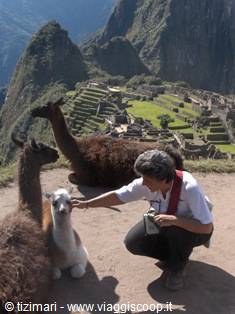
We entertain ourselves with the four-legged gardeners (llamas) that keep the grass in the archaeological area always like an English lawn (could there be some connection with the company running the railway??). The return by minibus to Aguas Calientes is marked by a race between the kids on foot and the minibus. The kids cut across the hairpin bends down through the forest and regularly manage to arrive before the minibuses, in time therefore for a good tip. Journey back with the little train as far as Ollantaytambo. We change restaurant and the restaurant Mayupata turns out to be a pleasant surprise. 11 June Monday: On the way back to Cusco, we visit the salt pans of Maras, an endless expanse of decantation pools, fed by the waters of an underground stream rich in mineral salts.
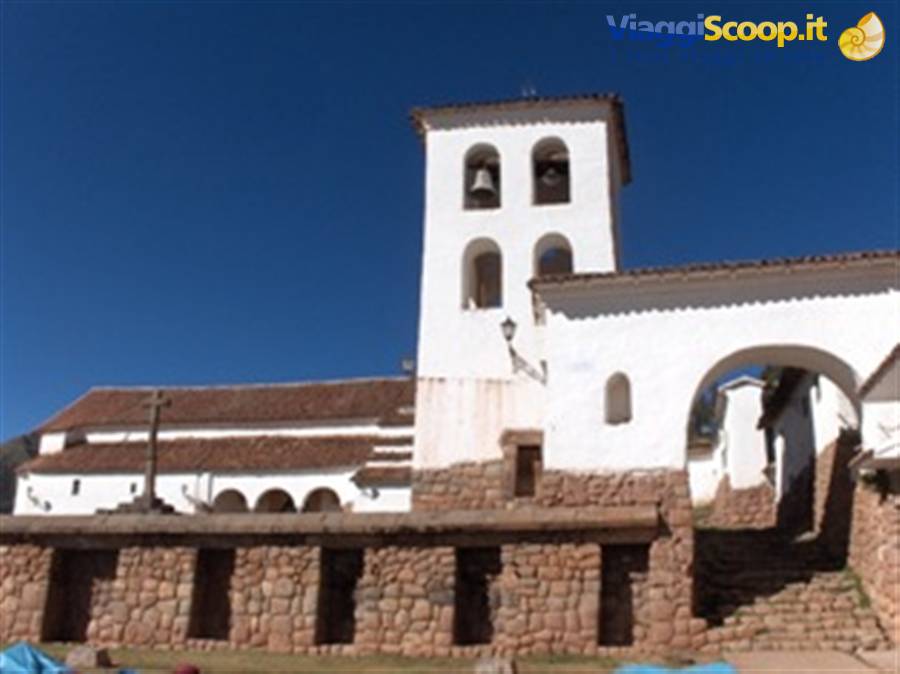
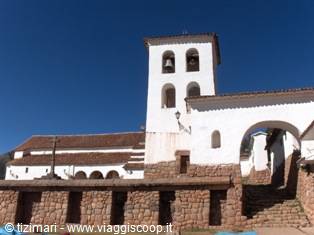
We then go on to Moray to visit the Inca agronomic laboratory, a sort of terraced amphitheatre, in which you can find a different microclimate on each terrace. We then reach Chincero, a typical Andean village, a visit to the colonial church built, as in most cases, on the walls of the Inca temple. Chincero doesn't offer many alternatives for lunch, so we head for the trattoria of the Castro family on the main street. Return to Cusco and dinner at the Piccola Locanda. 12 June Tuesday: Big transfer stage: 900 km crossing the entire Andes range. Everyone was quite doubtful about the possibility of transferring in a day from Cusco to Paracas, about 900 km of roads with at least four passes over 4,000 metres and as many descents into the valleys.
We give it a try! We descend into the Apurimac valley, climb back up to Abancay, descend and climb again, each time about 1,500 or 2,000 metres of gradient. We climb again onto the Huanzu range, descend to Puquio and up again to 4,000 metres in the Pampa Galeras nature park. The landscape is enchanting but the road is prohibitive, an endless series of bends, and despite the sparse traffic we come across no fewer than three vehicles that have gone off the road, a car, a truck and a bus with its whole load of passengers. We're already at sunset when we reach Nazca, at the end therefore of the crossing of the Andes, about 12 hours to cover 700 km, practically without stops. We now have only 200 km of the Panamericana left to reach Paracas, which we reach at 8 p.m. We made it!! 14 hours as planned, very tired!!! Overnight stay and dinner at the Hotel el Mirador - Paracas.
13 June Wednesday: The excursion to the Ballestas islands is scheduled for 8.00 a.m. departing from el Chaco in Paracas. The winter haze reduces visibility to a



0 reader comments