The story
What hasn't already been written about the most famous and spectacular site of the entire South American continent? Novels abound, historical and archaeological studies follow one another, and yet Machu Picchu remains an unknown and secret city. Ninety years have now passed since its discovery, but the famous "Lost City of the Incas" has lost nothing of the aura of mystery surrounding it. After more than two centuries of fruitless searches, on 24 July 1911, the American archaeologist Hiram Bingham, guided by Melchor Arteaga, a local farmer, finally discovered the city of Machu Picchu. In reality the ruins found by Bingham were not those that he and his predecessors had searched for in vain, of the city of Vilcabamba, and so it was an even more sensational discovery, of an Inca city whose existence wasn't even known.
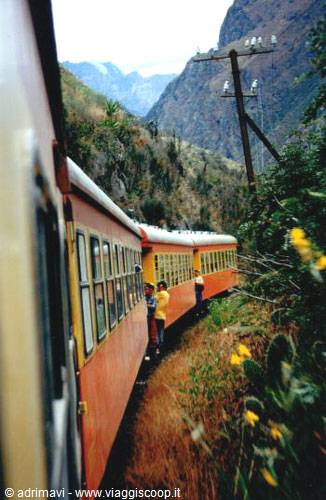
In a short time the ruins would go down in history with the high-sounding name, which they still keep, of "Lost City of the Incas". At the time Bingham couldn't immediately realise the grandeur and state of conservation of the site because of the lush vegetation that largely covered the buildings. The chronicles of that glorious day cite his surprise when, on the spot, he found living there a pair of Indians who lived from farming on the ancient terraces of the Inca city. It's eight in the morning when with the local train we leave the railway station of San Pedro, in Cuzco, heading for Puente Ruinas and not Aguas Calientes, which is the last stop of the tourist trains. The local train, in fact, continues as far as Quillabamba. The Puente station is the one after Aguas, from which it is, precisely, two kilometres away. The train covers the 112 kilometres in about four hours.
Ours is the last convoy of the day. We'll be the last to arrive at the ruins, but also to leave them since the return is scheduled for six in the afternoon. The train leaves the city of Cuzco climbing in zigzags up the steep slopes of the mountain. It moves, time after time, onto dead-end tracks to take the necessary run-up useful for climbing the next ramp. It proceeds in this curious way for at least half an hour, up to the pass called El Arco, north-west of the city. From this moment on, the railway continues in a long and continuous descent to the Urubamba valley. Despite the slow progress of the train, the journey is interesting because of the human contact you have with people. This is in fact the reason that pushed us to prefer the local train.
Unlike the railcar, reserved exclusively for tourists, on the very crowded local train foreigners like us are few and the native people predominate. It's cramped, it's true, in the middle of a rabble of people getting on and off the train continuously and you breathe air made stale by the goods and animals they bring with them. In the corridor of our carriage stand a cage of chickens and, indeed, a goat. Add to that the bags of spices, the onions, the quintals of coca leaves, and whatever else, contained in the ahuayos, the women's rectangular cloths, and it won't be hard to imagine the bedlam.
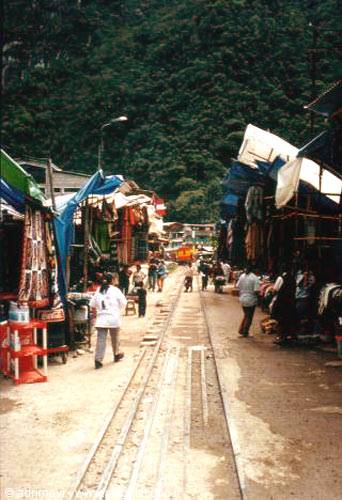
Amid continuous and repeated exchanges of goods, among women busy breastfeeding their child, among men intent on arguing heatedly about who knows what, young people eager and curious to exchange words with outsiders, we arrive at our destination at Puente Ruinas, the stop for Machu Picchu, literally crossing the middle of a market. A minibus waits for the passengers to take them to the ruins. Another eight kilometres up a dirt and dusty road that, turn after turn, climbs up one of the imposing granite rock knolls that mark the landscape, on whose summit stands the city of Machu Picchu. 26 August 2000 is for all of us a sort of 24 July 1911. The emotion is palpable. Only a few minutes separate us from a destination long yearned for. Here it is! Machu Picchu appears suddenly, in all its grandeur, after yet another hairpin bend.
The sensations, indescribable, are the same as those felt in other marvellous places like the Giza plateau, Petra and the Taj Mahal. For a few minutes you remain as if lost, almost hypnotised, and breathless. Machu Picchu is just as you imagine it. Exactly like the documentaries and the photos in magazines and catalogues, it's astonishing! It's 12:30, so we cross the ruins to head immediately to the entrance kiosk for the climb to Huayna Picchu, "young peak" in the Quechua language. From 13:00 onwards, in fact, the climb to the mountain rising right behind the ruins is no longer allowed. You must sign a register, a kind of self-declaration with which the management of the archaeological site is relieved of all responsibility in case of accidents. It's a measure made necessary despite the most dangerous and exposed passages being equipped with ropes and ladders cut into the ground.
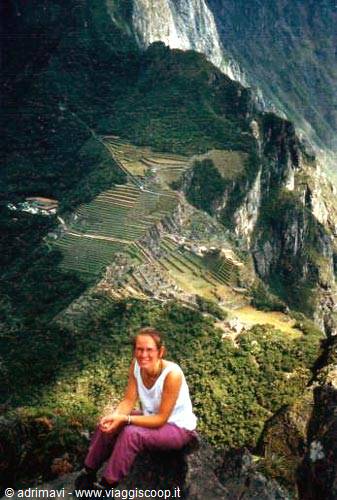
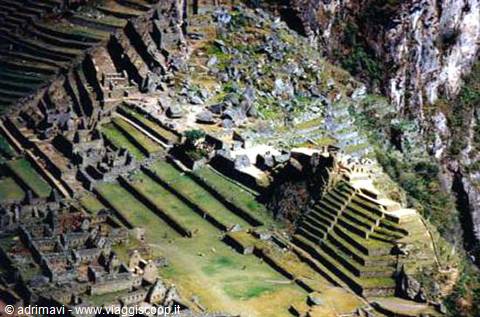
The ascent is, then, demanding and takes about an hour. Once at the top, an unforgettable panorama more than amply repays the effort made. The view over the Urubamba valley is splendid and the view from above of Machu Picchu is superb. The wide, 360° horizon splendidly conveys the idea of the incredible surrounding environment and the vertiginous position of the city. On the way back we begin the visit of the ruins, starting from the Sacred Rock, the large monolith, shaped like a feline, that you come across right after the Huayna Picchu path. Meanwhile most of the tourists have already left for Cuzco. We can enjoy the place almost in complete solitude. We cross the city passing now through its squares and temples, now through the long stairways, now through the doors and dwellings.
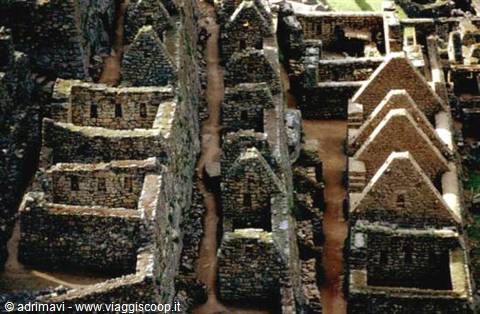
Arrived at the Intihuatana we linger a few minutes as it's the most important and famous point of the ruins, which didn't serve to indicate the time, but rather the period of the year. It's the only one left because the Spanish destroyed them all, considering them blasphemous. The Hut of the Guardian of the Funerary Rock is one of the few restored buildings, complete with a straw roof that was the original covering of the buildings. It's one of the mysteries of the Incas: why did they, who were so good at working and treating stone, build the roofs of their dwellings with simple straw? It's one of the first things that strikes the visitor at Machu Picchu: the total absence of the roofs of the houses since straw is clearly perishable. From here we admire, for the last time, the sublime view of the "Lost City of the Incas".
At Puente Ruinas sitting on the platform, waiting for the train to Cuzco. Each of us is absorbed in gathering in the drawer of our own memories, to carry them with us for a lifetime, the indelible images of one of the most fantastic places in the world, for the marvellous blend of the natural environment and the monumental architectural one. The information gathered about Machu Picchu is approximate. Hypotheses are consumed. Why did the Incas build such a large city, in such an inhospitable place? The only fair consideration is that it will remain difficult to write the history of Machu Picchu, since the Incas didn't know writing, so, even today, it continues to be a secret place. For us it's good that it is and always remains so: inexplicable and obscure. In the end, this too is the wonder of Machu Picchu, the mystery it jealously keeps about itself
The journey's photographs
9 photographs · click to open them full screen




0 reader comments