The story
I leave Tierra del Fuego, boarding the ferry that daily links the Isla Grande with the southernmost part of the American continent. Thirty minutes of crossing, over the Strait of Magellan, and I am in Patagonia. From Punta Delgada, a long transfer now awaits us as far as Puerto Natales, but at least the kilometres to be covered are entirely paved. Along the way, my thoughts wander… Who knows, I wonder, whether I will find those same adventurous lands that I have so often pictured to myself, reading books about these territories, in which I sensed nature as absolute mistress. Around me unique landscapes opened up when, on my sofa at home, I closed my eyes to better imagine what I had just read about the magical and wild lands of Patagonia.
The accounts of the travels of the first explorers, together with the reports of the climbs of the great mountaineers, made me love these extreme lands from boyhood. Even without ever having seen or lived them, it was a bit as if I had always known them, but now Patagonia is in front of me, below me, around me. I can finally explore it, savour it, discover it. We make a first stop at the Estancia San Gregorio, right on the road. What was once a vast and glorious ranch is now largely abandoned and looks like a ghost town. An atmosphere added to by the wrecks of the ships stranded on the beach: these are the Amedeo, famous for being the ship that brought the first Salesian fathers to these parts, and the Ambassador, which also ended up ingloriously on the northern shore of the historic Strait of Magellan.
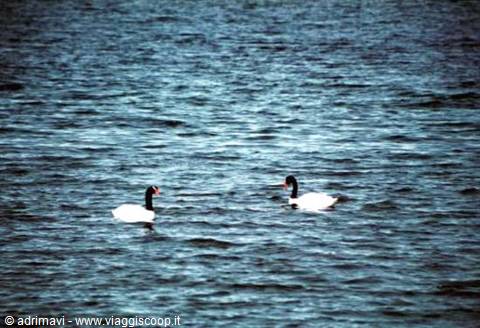
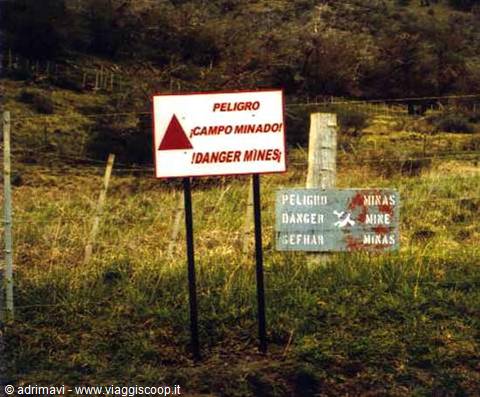
We reach Puerto Natales in the last light of day, in time to witness a spectacular sunset over the Seno Ultima Esperanza, our minds already projected to tomorrow, to the Parque Nacional Torres del Paine, one of the main attractions of all Patagonia. In the morning, after a glance at the black-necked swans characteristic of the region, we head for the Guarderia Laguna Azul, the northernmost entrance to the park. The sky is grey and gloomy, it's raining and there's a bit of fog. I can only trust in one of the many sudden weather changes that characterise Patagonia. The road becomes dirt again, just outside Puerto Natales. A short stop at the Cueva del Milodon and we continue straight on to Cerro Castillo. We travel a stretch of road fenced on both sides by barbed wire, on which threatening signs are posted: recalling old hostilities between Chile and Argentina.
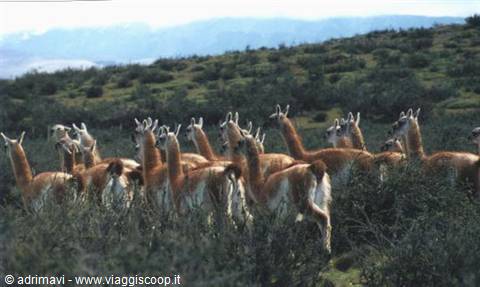
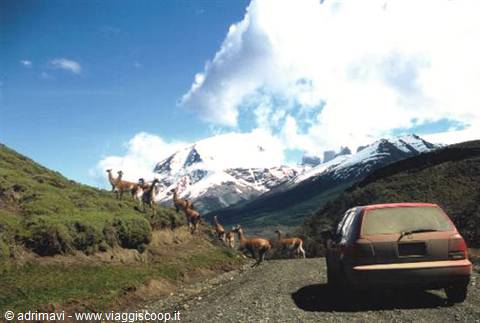
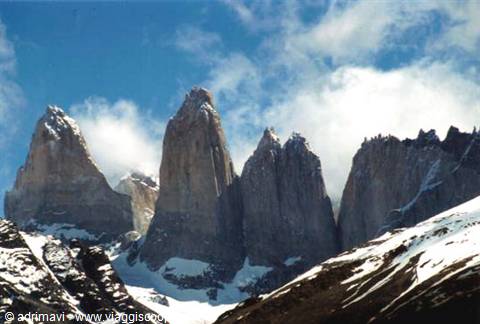
My arms stiffen and I slow down at the thought of possibly ending up off-road for any reason. Meanwhile the weather improves and we find ourselves in the park without even realising it. About fifty guanaco, startled by our arrival, run off, literally cutting across our path, giving us a welcome to the Paine. At the Laguna Azul we wait more than an hour in the hope that the wind will sweep away the last cloud banks that linger right over the Torres del Paine. The day is decidedly clearing. The wind blows ever stronger and consequently frees the sky of clouds, so we wait to be able to capture the three granitic and renowned towers mirrored in the clear waters of the lagoon. In vain! The only result is to be suddenly drenched by a veritable bucket of water, lifted by the impetuous wind.
We will be rewarded at the viewpoint of the great waterfall of the Rio Paine, and it hardly matters if here the three peaks are not mirrored in any lake. The view is, in any case, superb. At the Guarderia Laguna Amarga we give a lift to Francisca, a young girl from Santiago de Chile who works in the park during the summer season. As often happens in these circumstances, the conversation turns to obtaining information about each other's countries. There's no need to speak English; Francisca makes herself understood by speaking Spanish slowly. The landscape is fairytale-like. Within the frame of the imposing Paine massif, the road seems to open up suspended above an enchanted kingdom, with spectacular and sudden ups and downs, among lakes of various colours, now silver and green, now azure and blue.
In certain stretches the road acts as a natural bridge from one shore to the other and you almost feel like plunging with the car into the water and then re-emerging on the opposite bank. The green is of a thousand shades, all brilliant. It feels like being in the garden of Eden. The stops are continuous. You simply can't help stopping, to capture the various panoramas. Francisca gets out too, even though she must be used to it. I refrain from asking her why. …One never tires of observing landscapes that are authentic works of creation. Towards the end of the afternoon we reach the posada Rio Serrano, whose hall looks like a tea room from another era, a pseudo-aristocratic setting that contrasts with the simple rooms heated by wood stoves. After dinner we go to watch the sunset over Lake Pehoe.
The road, now as the shadows of night draw near, is crossed by nimble, agile capybara, the hares of Patagonia. In front of the Paine mountain range, delicately tinged with pink that stands out sculpted against the sky like a formidable fortress crowned with towers, pinnacles and monstrous horns, I am left speechless. The cold turns biting and forces us back inside. Before going to bed, however, we stock up on wood to feed the stove during the night, and we linger talking with the manager. Comfortably seated around the fireplace that warms and pleasantly scents the room, with no television or radio, far from the world, amid nature, alone with ourselves and our conversations, I feel serene as on few other occasions in my life. The next day is dedicated to Lake Grey. After covering about twenty kilometres we reach the luxurious hotel where bookings for the excursion are made.
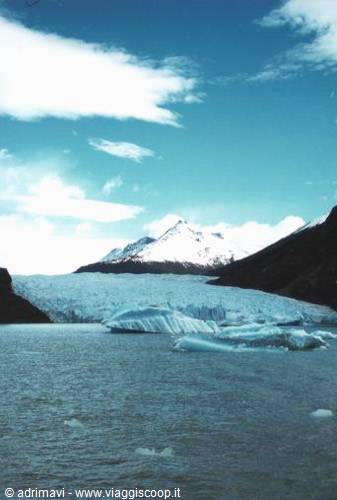
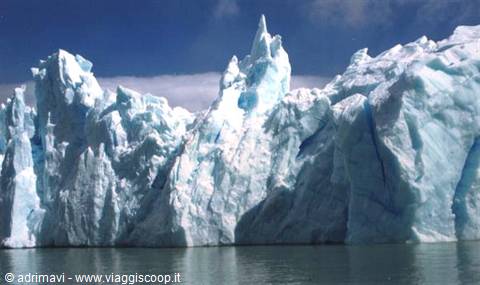
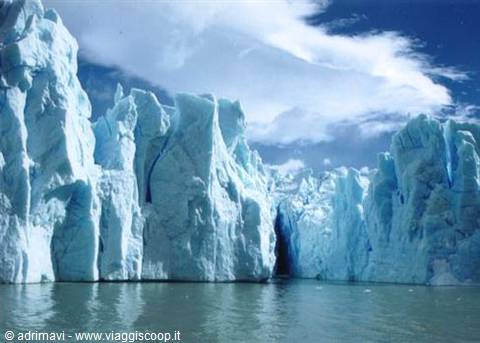
From here we already glimpse some icebergs that have broken off from the glacier of the same name, which the wind pushes as far as the shore. It is precisely these small icebergs that prevent the boat that will take us to the glacier front from approaching, so the transfer from the shore to the hull is made by a small dinghy. As we go up the lake we encounter no icebergs; they are all concentrated in the immediate vicinity of the glacier or the shore. When the engines are turned off, we go out on deck and find ourselves before the entire front of the glacier and the nunatak, the small rocky islet that divides it and for which the Grey glacier is famous. The height of the ice front is not great, but precisely for this reason we manage to approach almost to graze it.
So close, you cannot help but be crossed by continual surges of adrenaline, even if the observation of the pinnacles, the crevasses and the countless colours is more than enough to distract. An hour passes when the ship resumes its return journey, yet it seems only five minutes have gone by, such was the enchantment. Everyone is offered pisco sour with ice, ice naturally gathered from the cold waters of the lake. Along the road that runs beside Lake Sarmiento we stop to pay a last tribute to the Paine, a kind of farewell. It is sad to part from that incredible jumble of vertiginous peaks that now fade into the background like so many knives driven into the clouds. The wind suddenly drops. I interpret this as a sign, a reply to my reverent greeting. I find the moment to turn my back on the mountains and get back into the car. No one speaks.
I believe that, like me, Mavi and Ila have known the place where they would gladly spend the rest of their lives.
The journey's photographs
13 photographs · click to open them full screen





0 reader comments