Andrea, Dionigi, Paolo · @ritornoalparallelozero · Treviso
How
Travel diary
The story · 4 days
Day 114 Aug 2005
Manaus
After leaving Bogotá our next destination was Manaus, a big metropolis in the middle of the Amazon rainforest. Due to the lack of a direct flight we had to head first to São Paulo and from there take another flight to go back up to Manaus: an absurd route that cost us almost a day of flying. Finally arrived at our destination, as soon as we got off the plane we were hit by a humid heat that seeped into our bones; as if that weren't enough, as soon as we came out of customs we were also mobbed by a billion tour operators offering us exciting adventures in the jungle. After dodging a few of them we were captured by Sandro, a tiny Brazilian who spoke Italian and who, like a good salesman, kept incessantly proposing a ton of alternatives for visiting the jungle.
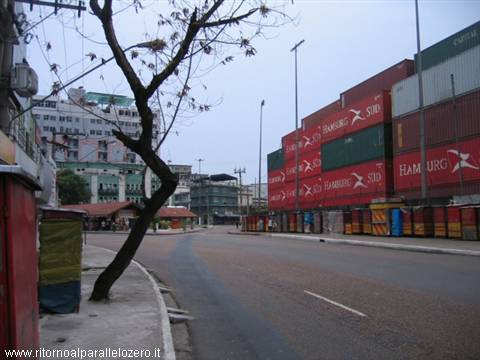
In the end, still in the company of our new friend, we had him escort us into the city and more precisely to a hotel that naturally Sandro knew well, with the promise of meeting at his office the following day. We can define Manaus as a veritable cathedral in the jungle, since after it, to find another city worthy of the name, you had to reach Belém on the coast. We were in one of the largest industrial centers in all of Brazil, which sprang up along the banks of the Amazon River, a port city par excellence where the major multinationals have their headquarters. It was already late afternoon and so, having unpacked our bags, we went to drink something at the first bar around the corner. Given the now late hour we thought we'd bring forward the meeting with Sandro to that same day so as to have the whole of Sunday free.
No sooner had we entered Sandro's dilapidated office than we were already immersed in photographs, geographic maps and letters of recommendation that satisfied tourists had written for our friend. The negotiations were tough first of all because the time at our disposal was short; secondly, no less importantly, because the money at our disposal was truly limited. The final agreement included a three-day tour in an area of the Amazon rainforest unknown to tourists for a total cost of sixty dollars per person per day: a seemingly exorbitant price but one that, compared with the offers of the other tour operators, seemed truly advantageous. At the end of our bargaining, Fernando arrived at the office, a young associate of Sandro, who asked us if we wanted to spend Saturday evening with him at a party that would be held just outside the city.
We didn't need to be asked twice and accepted the proposal: after a quick shower we were already on the street heading to the party. We reached the destination by bus; the party wasn't in a specific venue but spread out over a large open-air space where a famous band from Manaus was playing the most classic of sambas live. The party was crowded with people and the particularly fun atmosphere kept us there until morning, which is why the following day we woke up in the middle of the afternoon. Once out to get something to eat, it felt like being in a ghost town: not a person, not an open venue, not even a car, just a few rats crossing the street. In a desolate atmosphere, after a long search, we came across some street vendors of skewers who, for a pittance, let us fill our bellies.
Back at our hotel it was time to prepare our backpack for the following day: we hadn't been allowed to bring our bags because they were too big, so we gathered everything essential for our survival into a single small backpack.
Water supplies
Day 215 Aug 2005
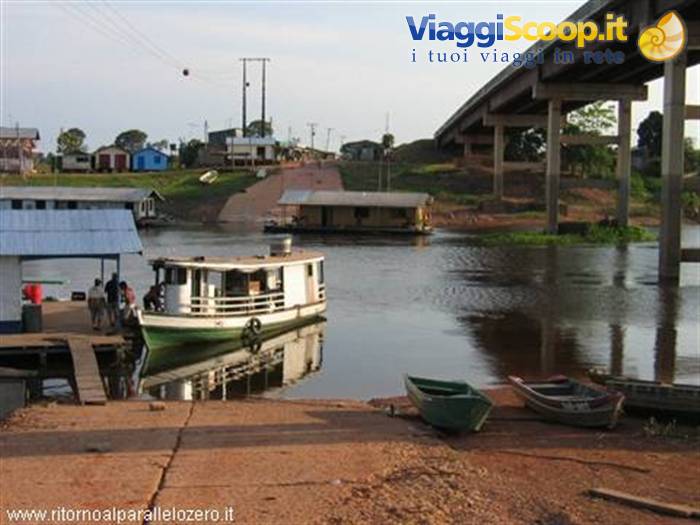
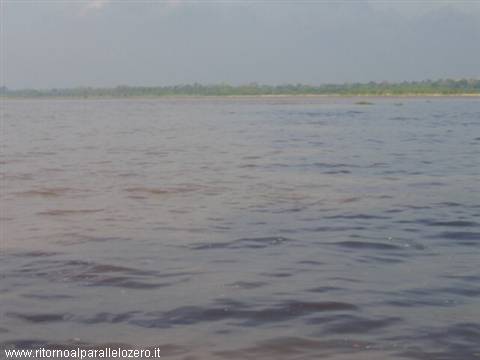
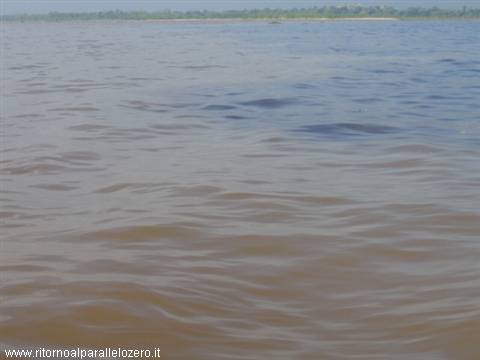
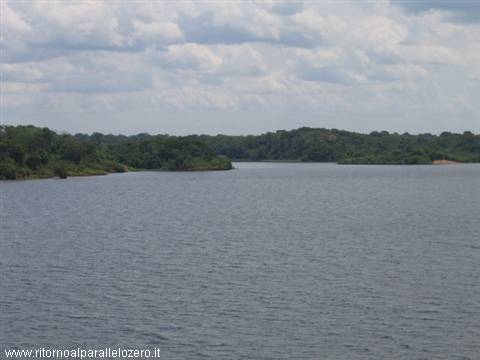
In the morning, after a hearty breakfast, we met Marcelo, who would be our guide for the next three days. Having immediately hit it off with the likeable Marcelo, we headed to the second port of Manaus to board a small motorboat that took us across the great Amazon River. Midway we paused to admire the meeting of the two rivers; this is the Rio Negro and the Rio Branco which, joining precisely in this part of the Amazon, keep their waters distinct, so different in temperature, acidity, height, density and above all (since it's the only thing noticeable to the human eye) color. After the usual ritual photos we continued navigating and reached the other bank, where, having boarded a van, we traveled part of the Trans-Amazonian Highway until we reached an enormous bridge.
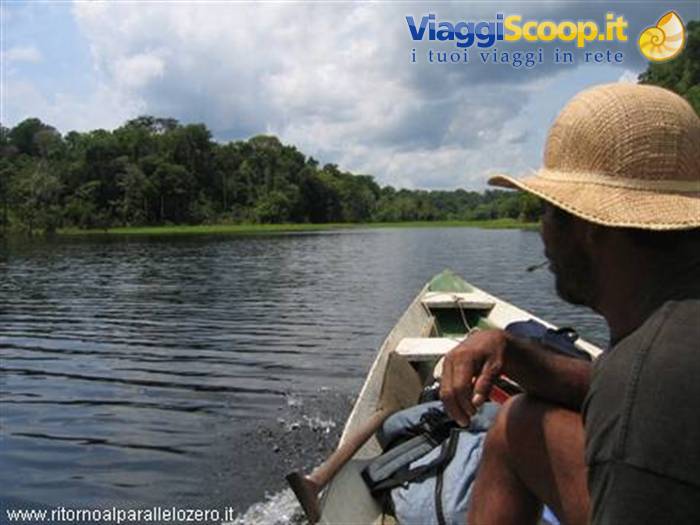
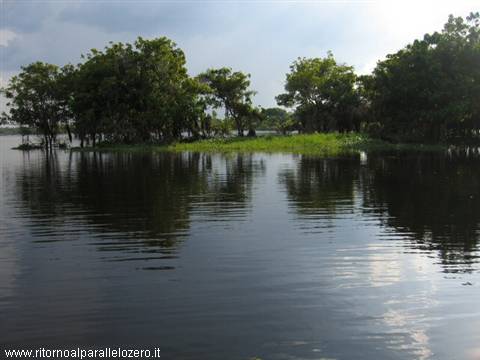
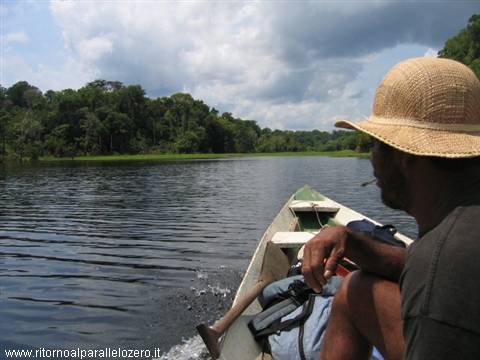
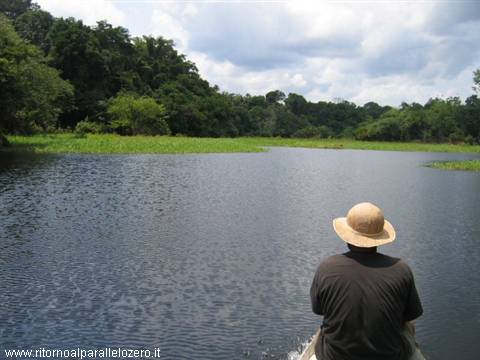
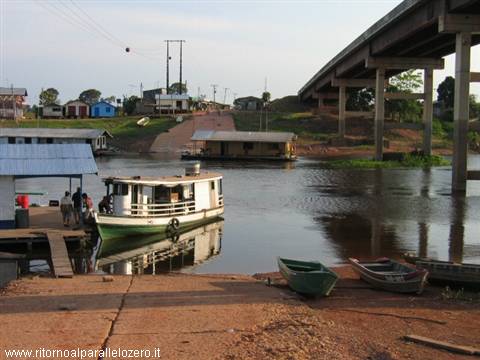
There another much smaller boat was waiting for us, little more than a dugout canoe, equipped with a tiny long-tail motor, ideal for making its way through the treacherous waters of varying depth. Having stowed our gear in the small canoe, we proceeded with the current until the first stop: a floating house that, besides providing hammocks for spending the night, was also the last supply point for food and water. After a stop of about half an hour we embarked on a long journey of more than two hours, gliding ever deeper into the heart of the forest and sighting for the first time in our lives the pink dolphins that, together with the gray ones, make up the only species of river dolphin.
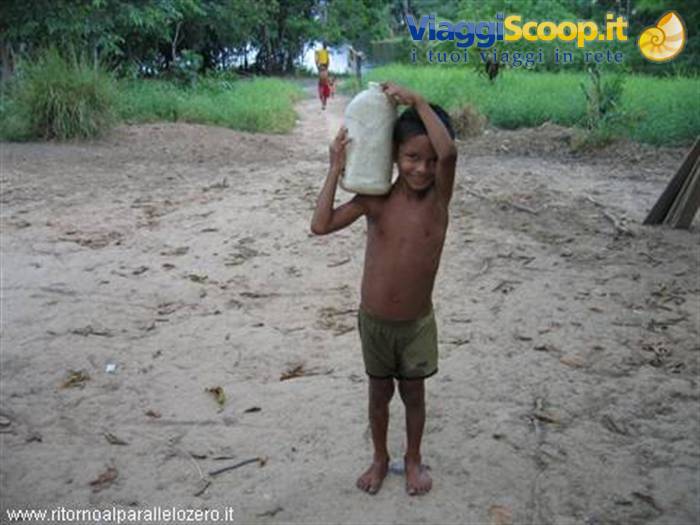
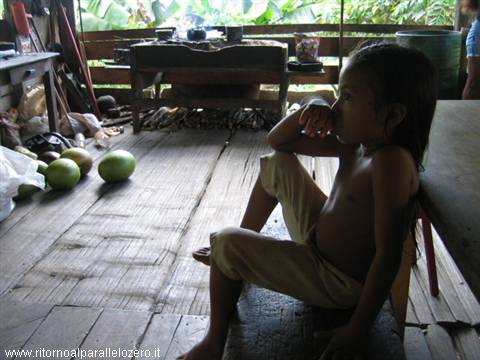
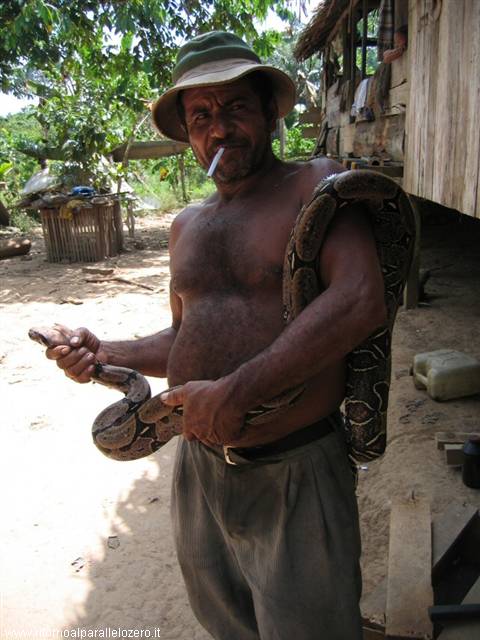
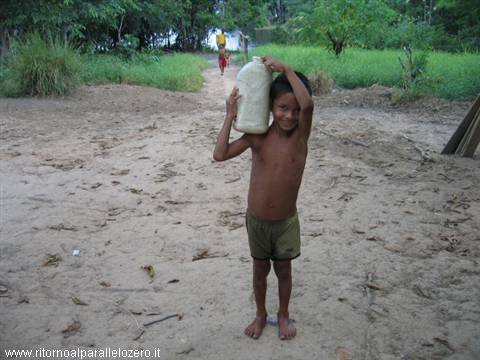
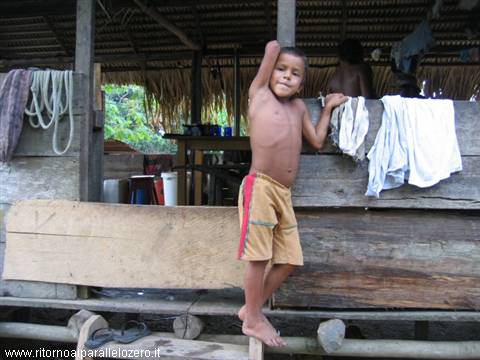
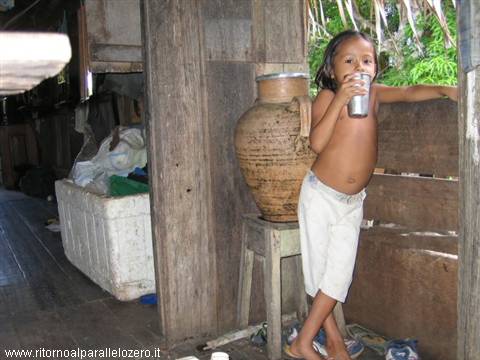
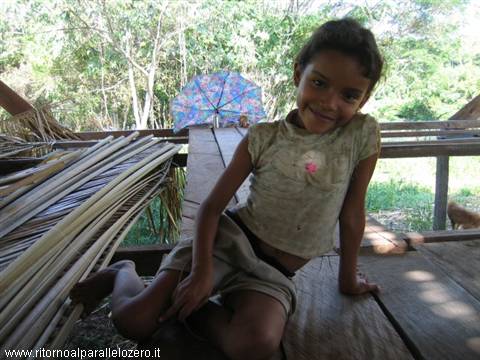
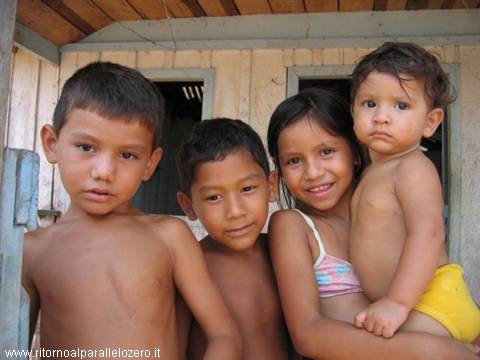
Accompanied for a stretch of the journey by these new friends, we finally reached the house of our second guide: Luis, a native who lived with his extended family (very extended) in a hut of wood and straw built in a small natural inlet of the river we were navigating. Luis, whom we later nicknamed wolf man because of his rough manners and the thick hair that sprouted all over his body, would be the guide of the guide, given his immense experience gained in a life spent in the jungle. After the customary welcomes and having met the countless kids who lived there, we were invited to lunch to taste some immense big fish caught in the river itself and cooked on a kind of grill supported by large stones (the only way of cooking available to the family).
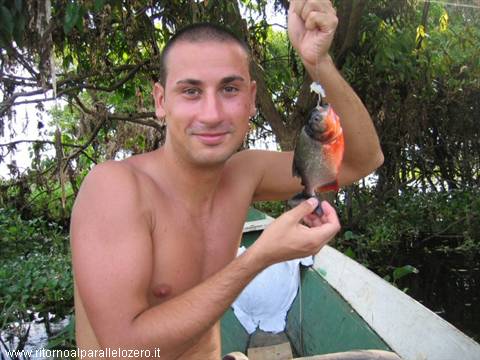
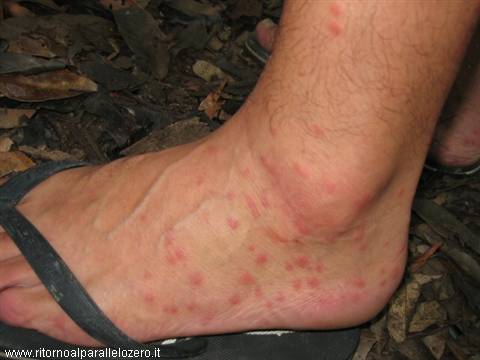
Right after lunch we were allotted about an hour in which we were supposed to take a nap, something that turned out to be impossible because of the children who, like flies, kept buzzing menacingly around us. Having escaped the clutches of the children, we boarded the small canoe again, loading along with us some bamboo rods with a fishing line attached: our mission was to provide our dinner by going to catch the notorious piranhas. Mission accomplished, since in a short time we managed to gather more than a dozen. Having turned the canoe around, we headed toward the meeting point of three rivers, one of the deepest spots where it was again possible to witness the spectacle offered by the pink dolphins. The sun was setting, the light was fading and the dreaded mosquitoes were lying in wait, which, in the environment we were in, went perfectly with our bare ankles.
Back at the wolf man's house we again spent time with the little kids while the women prepared dinner: our evening wouldn't end there, a nighttime hunt for the jacaré awaited us (the name by which the numerous crocodiles that populate the river's lagoons are identified). And so it was, with the wolf man seated at the bow armed with a very long harpoon, we set off gliding through the darkness in hunt of the unfortunate alligator. The technique for catching these living fossils is very simple: you just have to be very quiet and with a flashlight illuminate the surface of the water until you see little red dots appear; those little red dots are the eyes of the prey which, almost hypnotized by the light, doesn't even try to flee.
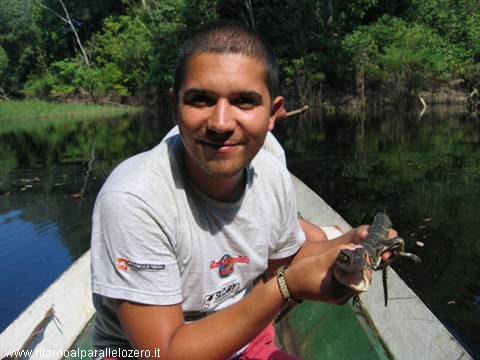
Unfortunately for us and fortunately for the alligators, the evening wasn't fruitful, only a baby alligator that the wolf man caught with his bare hands and promptly released. Dead tired and gripped by mosquitoes, we headed back home to set up the hammocks in complete darkness and take a well-deserved nap.
Led by the wolf man
Day 316 Aug 2005
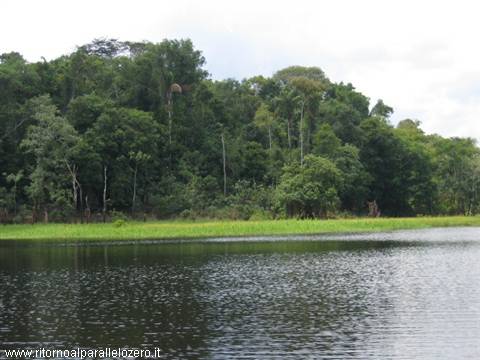
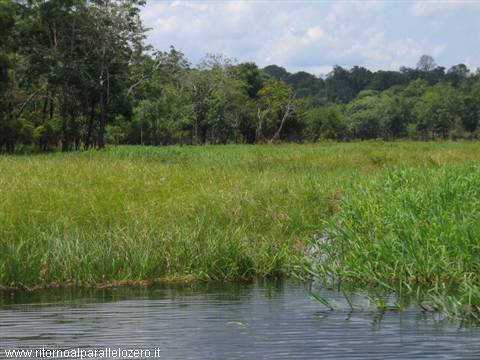
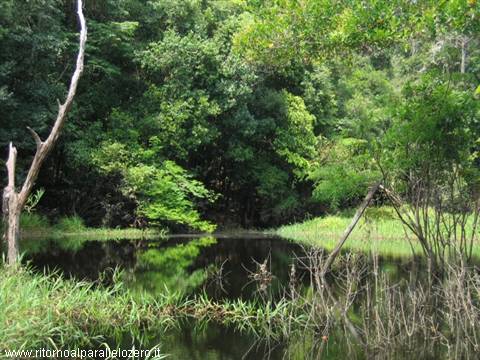
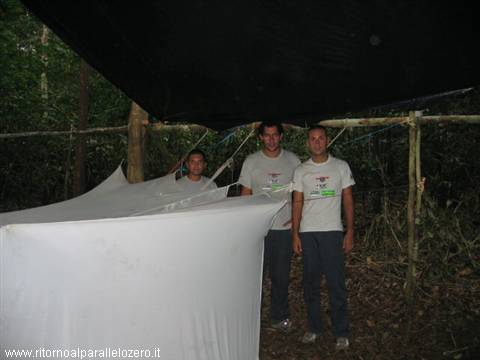
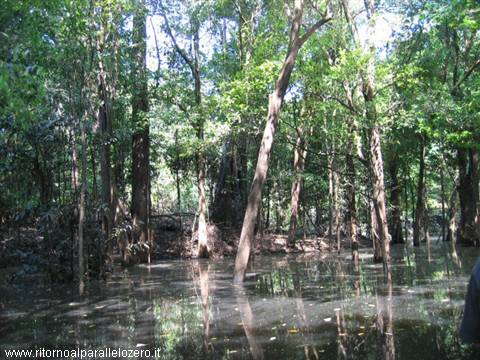
The following morning we were woken at five by the children going to school and, after breakfast, we climbed back into the canoe to venture even deeper into the heart of the Amazon rainforest where we would spend the next night. The route proved to be very tortuous and difficult, passing through very shallow waters, broken trunks, sharp grasses and a wild forest repeatedly cut down by the wolf man with his machete. Having reached our destination, the construction of the camp began: using some special barks our guides made sturdy ropes with which we tied some poles together to build a roof under which to spend the night.
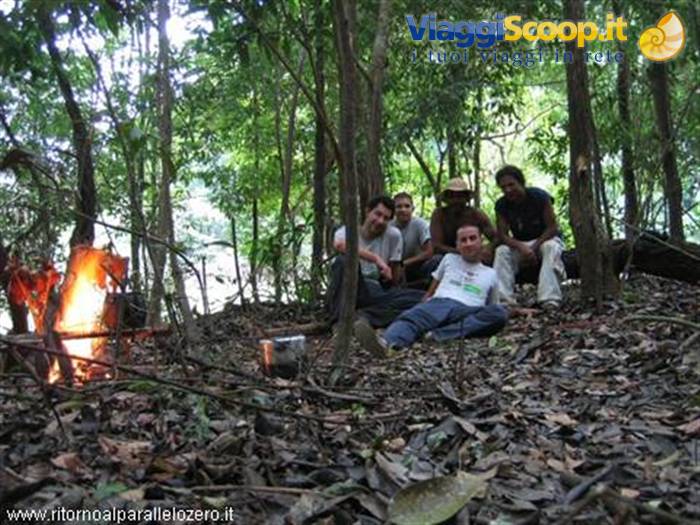
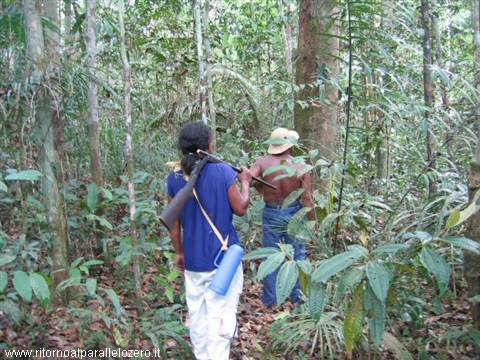
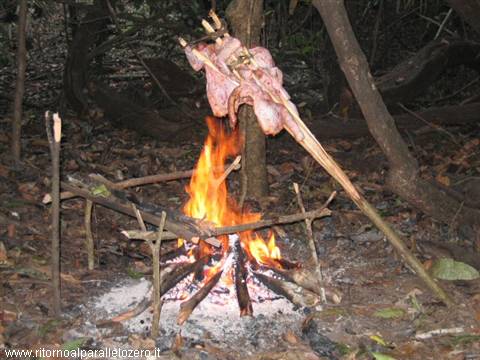
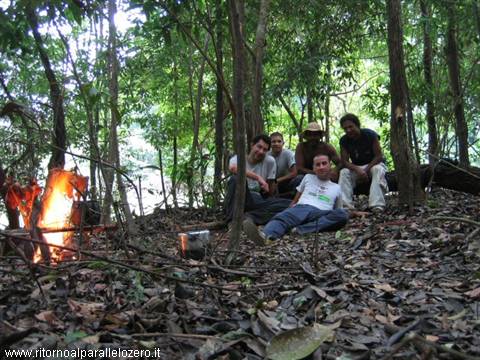
Once the camp preparation was finished, we all set off together for an excursion into the dense jungle in the hope of being able to admire some wild animal: there was talk of anacondas, jaguars and sloths, besides the countless and colorful species of birds that were supposed to crowd the forest. In reality we saw none of all this, apart from the presence of a few toucans and giant macaws in the treetops. One thing was certain, the forest was impenetrable and if it hadn't been for the wolf man's skillful machete we wouldn't have moved a single step. Back at base camp because we were caught by a hint of rain, we lit the fire to prepare dinner based on rice, manioc flour and a chicken skillfully skewered on a stick and naturally browned over the open flame.
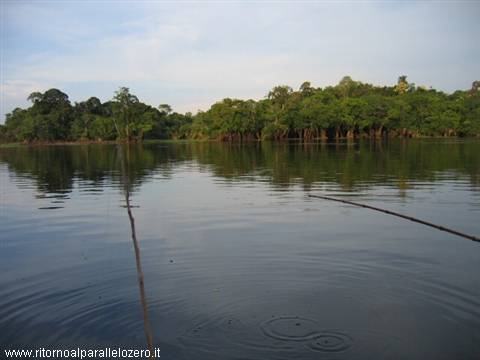
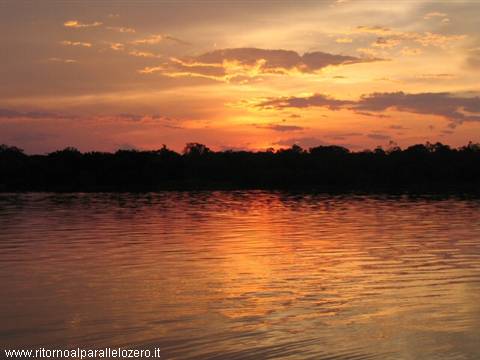
Having eaten dinner at five in the afternoon, the day held no other activities until two the following morning, when the wolf man would once again lead us to hunt jacaré. So we spent nine hours lying in our hammocks, also wrapped in a useless mosquito net, waiting for two in the morning. This hunting expedition turned out to be even less fruitful than the previous one in terms of catches but more exciting for the landscapes and for the full moon reflected in the dark waters of the river.
Group photo
Day 417 Aug 2005
The following morning, having taken down the camp, we were still aboard our canoe to venture into a dead branch of the river where, according to our guide, it would be particularly easy to spot wild animals. This time too nothing came of it, apart from the usual very noisy parrots fluttering among the tree fronds; it was time to return to the wolf man's house since in our attempt to spot animals we had lost more time than expected. On the way back we stopped to visit a school that gathered all the children from the surroundings and, after a few ritual photos, we resumed our journey. We didn't even have time to have lunch and properly say goodbye to the whole family, since by five in the afternoon of that same day we were already supposed to be back at the port of Manaus.
Having dismissed the wolf man, we got back on the boat and, with the engine at full throttle, we set course for the return. Maybe it was because of the excessive haste with which our guide was steering the canoe, but the fact is that right in the middle of the immense river the engine began to act up and shortly afterwards it died, forcing us to a forced stop to repair the damage and set off again faster than before. The repair, unfortunately, was only temporary and, when we reached the same floating house where we had resupplied on the way there, we transferred to a new boat in the company of other tourists, leaving our canoe moored there.
After an hour of slowly going back upstream against the current we reached the docking point, the usual bridge where it had all begun, and from there, having taken a van, we reached the great Amazon River, which we crossed until we reached the port of Manaus. Having thanked and dismissed our guide Marcelo, we returned to the hotel to take a shower and tend to the countless wounds inflicted on us by the killer mosquitoes. The following day we took a little stroll around the city, in its main market this time crowded with people. We didn't do much else because we were still recovering from the beating of three days spent in the wild jungle. The next day it was already time to leave the Amazon for São Paulo, to begin our exploration of the Brazilian coast.







0 reader comments