The story
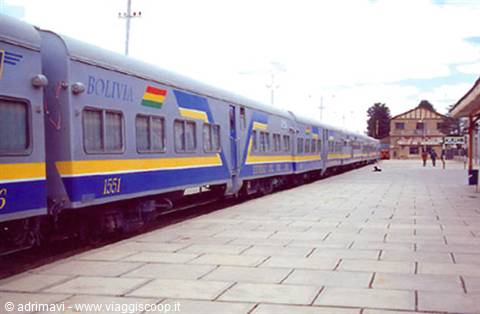
A long day awaits us. La Paz is no less than 761 kilometres from Uyuni, 229 of which we'll cover by bus while the remaining 532 by train. At Oruro our train is already waiting on the platform, it's the famous "Expreso del Sur". It links Bolivia with Argentina once a week, precisely on Fridays, arriving in Buenos Aires three days later. The service on board is impeccable, it feels like being in Switzerland and not in South America. The second-class carriages have comfortable reclining seats on which you can stretch out, sleep, watch television. Passengers are also offered sweets and drinks. Every half hour, the train staff pass through to dust the carriages.
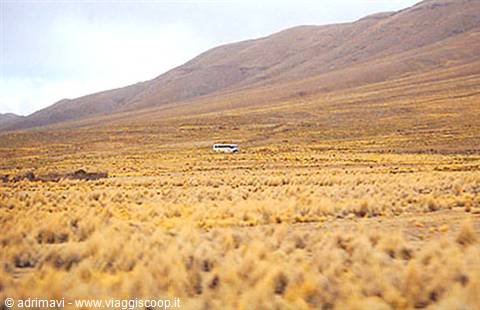
In fact, despite a double closure, one made of the window glass and the other of an iron shutter, the train is continually invaded by the sand that the strong winds of the altiplano stir up, making it filter into the carriages, where even breathing becomes difficult. The convoy from Oruro to Uyuni makes no stops, and it couldn't be otherwise. In that grandiose depression 800 km long and wide, steadily above 3,500 metres, which is the Altiplano, life is hard. The "puna" with the typical tola bushes (tufts of yellowish grass) is a terrain of clods and stones continually swept by wind and frost. We arrive at Uyuni at 21:30, after six hours and twenty minutes. Waiting for us is Ibert, our guide for the next four days.
Having left the station, loaded the backpacks onto the off-road vehicle, we set off for the Hotel del Sal, located right in the middle of the Salar. The Salar at night is a spectacle! As we travel over the white, flat surface we're literally left speechless by the poignant beauty. It feels like we've entered, through who knows which door, an unreal world. "Am I dreaming or awake? Is it all real?", are the questions anyone asks themselves when they arrive in this place at night. Here real images are transfigured into dreams and fairy tales and reality dissolves into visual metaphors. There's also a myriad of stars that overturns the idea we all have of the dark night that instils fear, together with the trail of light left by the Milky Way that crosses from one side to the other, like a rainbow, the whole sky. And stars are also those you see on the horizon.
They're so low that you don't even need to raise your head to contemplate them. You just have to look ahead. It seems you could reach them, but instead they always remain there on the horizon, in the sky and not on the ground. Stars everywhere, above, in front, behind, beside… we're as if wrapped in a reassuring cloak of lights. Everything is so unearthly that we seem like astronauts conquering the universe, and not tourists. We feel an unusual emotion, that of feeling like aliens on Earth. After thirty minutes of road, in which Ibert orientates himself by following the stars, we reach the hotel del Sal. We're the only tourists!
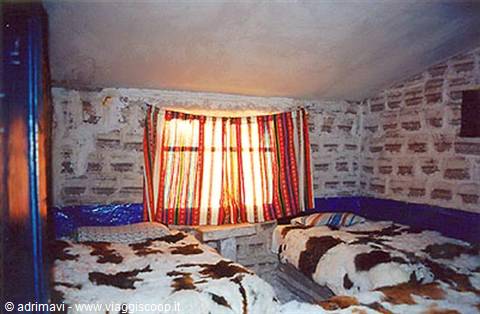
At the first light of the new day we get up so as not to miss the spectacle of the sunrise. In twenty minutes, the Salar continuously changes colour, going from blue to light blue, from pink to orange, from yellow to white. As the first ray of sun appears on the horizon our shadows stretch immeasurably over the surface. After witnessing the dawn, we go back into the hotel to have breakfast. - The Hotel del Sal belongs to that particular category of strange and curious hotels. In fact, it's entirely built of salt bricks, besides being, as already said, in an utterly original position. The charm it exerts is indisputable. Don't count, however, on hot water, you'll be lucky if you find cold water, in the basins. There is light, in the sense that there are lamps with electrical wires, but the starting motor at certain temperatures almost never works. So lighting remains a utopia.
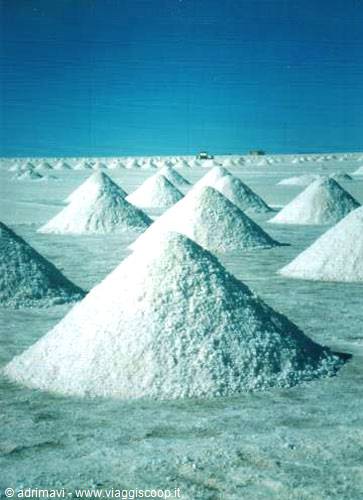
There's no heating. To all this add a night spent sleepless because of the cold. And yet the Hotel del Sal, this hotel built in the middle of nowhere and quite spartan, … and yet it's enchanting! - After breakfast, the day begins, which we'll spend entirely in the Salar de Uyuni; a unique itinerary in one of the most fantastic natural spectacles that can be admired. We start by visiting the small village of Colchani which Bolivians consider, not by chance, the end of the world. The observation is apt. You have to see it to believe it. Here, in practice, every family is a cooperative and annually 20,000 tonnes are produced of what, according to an estimate, is the content of 10 billion tonnes of salt in the Salar. We continue towards the area called Bloques de Sal where the men of Colchani gather the salt, armed with pickaxe and shovel.
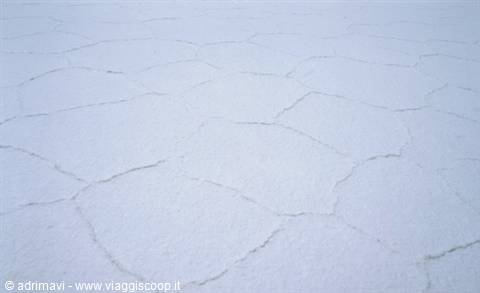
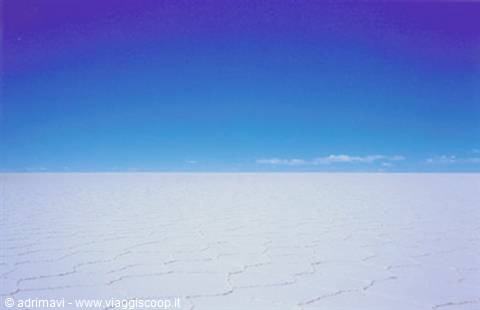
Along the way we see some salinares heading to their workplace by bicycle. To protect themselves from the glare of the sun on the salt they all wear glasses mounted with thick, dark lenses, while to beat the cold they wear balaclavas. From here more than eighty kilometres separate us from the Isla del Pescado. During the journey Ibert tells us some curiosities. So we learn that the Salar is the highest (3,650 m) and largest salt desert in the world; it covers an area of 10,000 sq km (like Basilicata). The looming mass of the Tunupa volcano, 5,400 metres high, the only landmark in the Salar, indicates that we're still in the northern part. Soon though we find ourselves in the centre and then, as far as the eye can see, we'll see nothing more. Only the blinding white of the surface contrasting with the blue of the sky. The blue and the white are perfectly divided by the horizon line.
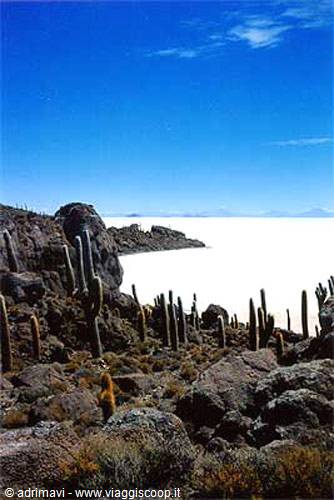
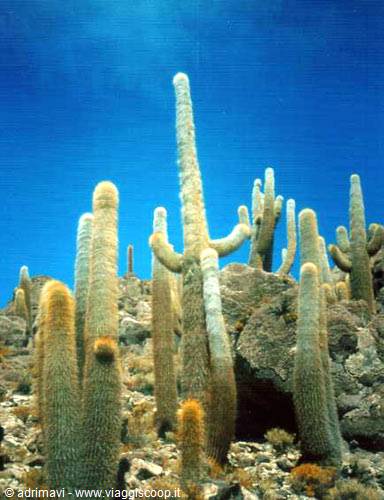
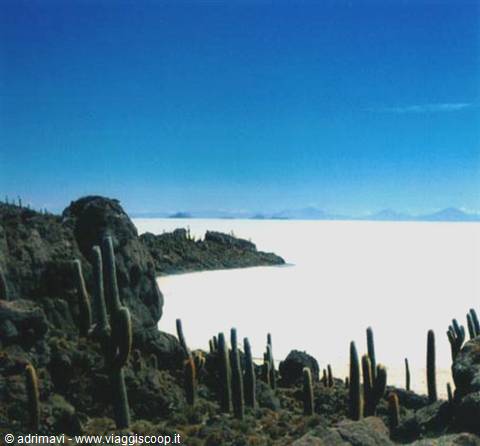
After a while, a mirage appears. A dark spot can be made out on the horizon, suddenly breaking the line of contrast between the white and the blue, but it's not a mirage, rather the Isla del Pescado. When, about fifteen kilometres away, the well-defined shape appears you understand the meaning of the curious name given to it. It resembles, in fact, a fish. It's the most stunning place in the Salar. You can properly call it an island not only because it's an outcrop of land, but a real coral island, which today emerges, like an atoll, from the unusual expanse of salt, a real reminiscence of what the Salar was in a distant geological era: an enormous inland sea. A forest of giant cacti covers the island. The tallest reach twelve metres in height. Most appear as simple columns, but there's no lack of those shaped like a candelabra.
Don't lean on them, though, because they're entirely covered in long spines. We go around the island on foot, taking an hour, after which we climb to the top, making our way along a path among the cacti. Along the way we admire beautiful views of the Salar. The yellow, green and grey colours of the island contrast with the white of the salt and the blue of the sky. From the summit, having overcome a height difference of fifty metres, we see in the distance a dark dot moving. It's nothing other than an off-road vehicle. After a two-hour stop we leave the island and the Salar heading for the village of San Juan. We travel with our heads turned backward to see one last time, from the windows of our off-road vehicle, the immense white expanse of salt.
Anyone who visits the Salar will be dazzled by the blinding light and the incomparable landscape. It's one of those few places in the world, still unspoilt, where you can admire one of the most fantastic spectacles of nature.
The journey's photographs
12 photographs · click to open them full screen



0 reader comments