The story
At the "Parque Nacional los Glaciares" we all expect to see a kind of miniature "Antarctica", a landscape of towering glaciers and great icebergs. Although the size of both is far smaller than those of Antarctica, the resemblance will be palpable and the name "little Antarctica" is very apt indeed, especially for those who decide to make the crossing of the Hielo Patagónico Sur. We will content ourselves with admiring the more touristy Glaciers Park, which is in any case able to satisfy even the most demanding travellers.
El Calafate is the starting base for all excursions to the "Parque Nacional Los Glaciares". An overcast sky and a fine but relentless rain compromise the walking excursion on the most famous and best-known glacier in all of Patagonia, namely the Perito Moreno. The Moreno's fame is due to the fact that it is the only glacier on earth in an advancing phase and to the height of its front, which reaches eighty metres above the water's surface of the lake. So we allow ourselves a day of relaxation, back and forth along avenida del Libertador General Josè de San Martin, the main artery of El Calafate. We go in and out of the shops lining the street. Batik, T-shirts, fleeces, but above all calafate liqueur and jam, the blueberry-like fruit from which the town takes its name. As we wander up and down, the delicious aromas of asado keep us constant company.
The smell of meat on the grill makes our mouths water and, although it's only 6 p.m., we're already savouring the taste of dinner.
As usual, our days are numbered, we can no longer afford changes of plan. Tomorrow, indifferent to the weather conditions, we will carry out the planned excursions. We're lucky! The sun shines high in the sky when we leave El Calafate at 07.00 for Puerto Bandera, where we will board for the cruise on Lake Argentino. Most of the excursionists settle inside the catamaran. We stay on deck, indifferent to the strong, icy wind that makes us realise that if we're not in Antarctica, beyond the edges of the world, we are nonetheless in Patagonia, at the edge of the world. At the bow, wrapped up in my jacket, bobble hat pulled well down over my ears and the relentless drip running from my nose, I scan the horizon of the immense lake. I want to be the first to spot an iceberg.
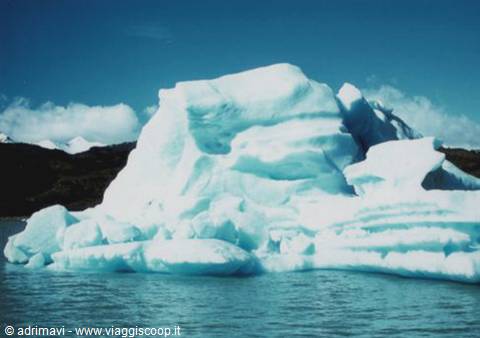
When I'm just about to give up and sit beside Mavi and Ila, crouched out of the wind beneath the walls of the wheelhouse, I glimpse a little white dot floating in the distance, at the end of the brazo norte of the lake. Five minutes later that dot becomes a clearly defined iceberg. The captain announces over the microphone the sighting of a témpanos, as icebergs are called here, and the deck is overrun by the other tourists. As I photograph up close the gigantic block of ice ten metres high and as many wide, I wonder whether it will ever come to rest on the opposite shore, as sometimes happens when icebergs are so large. As we draw near the glacier fronts we will see many témpanos appear, mostly small and only a few large.
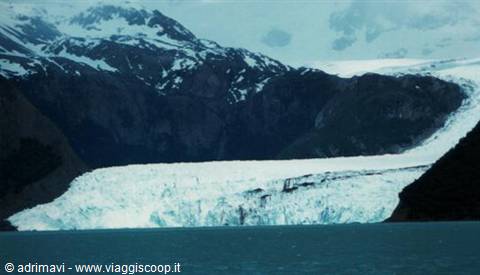
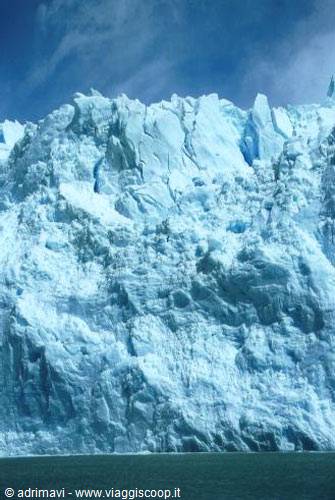
Over the course of the excursion we will visit the front of three glaciers, in order Spegazzini, Onelli and Upsala; the first and the last, in particular, are veritable rivers of ice flowing down into the lake from the valleys of the cordillera. The Seco glacier, the first we glimpse, stands out because, unlike the others, it does not reach the water. After an hour of sailing the Spegazzini glacier appears. From afar it resembles an enormous white serpent winding down from the mountain to plunge into the waters of the lake. During our reconnaissance we witness the spectacular calving of a pinnacle of ice. The noise is catastrophic, the consequences fortunately not, but even so the boat will rock for a few minutes. We reach the Onelli glacier after a short walk of about twenty minutes through a wood of lenga trees.
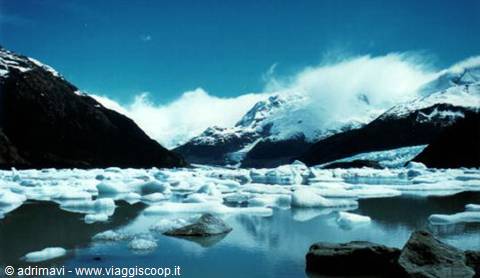
Here it is the lagoon, more than the glacier front, that attracts attention. The little lagoon is thawing. In front of bahia Onelli, far from towns and villages, isolated, sitting on a rock, I spend a good hour aware of the uniqueness of the situation. In this place where life seems to flow as in remote times I savour this wild beauty. There is a great silence. I am drawn to the landscape that only now can I fully savour in all its grandeur. Space and silence are peculiar, almost unreal. Finally we reach the Upsala glacier, a field of floating ice made up of many icebergs, small and large. What we are seeing is of such grandeur, beauty and magnificence that my pen is incapable of describing it. I really feel as if I am in some polar sea or other. The catamaran keeps bumping against little ice obstacles, with more or less deafening noises that sometimes instil fear.
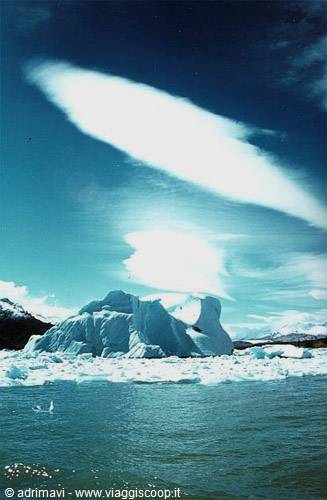
Some témpanos seem to sail, driven by the wind and the currents, others are completely still. All of them, without distinction, have bizarre shapes and cold colours. The massive presence of blocks of ice prevents us from reaching the glacier front, despite the boat's vain attempts to advance. Upsala is the largest of the peripheral glaciers of the Hielo Patagónico. It measures 60 km in length and 12 km in width, while the front is 4 km. The fine day begins to spoil; we thus get to appreciate the clouds so frequent in Patagonia, the so-called "Contessa dei venti", that is an overlapping of lenticular clouds
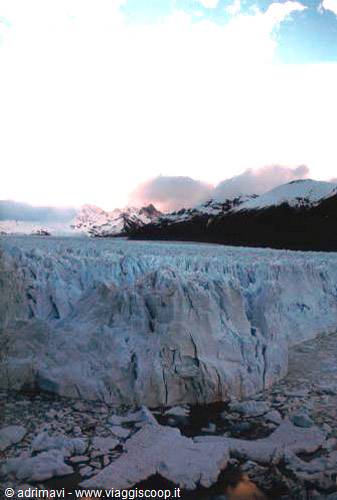
Back at Puerto Bandera, making the most of the hours of daylight, since the sun sets at 21.40, we immediately get into the car to reach, after 70 kilometres of dirt road, the brazo Rico of Lake Argentino, where the Perito Moreno is located. We arrive at dusk and, given the late hour, the walkways on which the visit is made are completely empty and free of tourists. In this setting the glacier keeps intact the intrinsic enchantment of wild nature. The glacier rumbles continuously, it seems alive. The effect is due to the continuous collapses, internal and external, of the blocks of ice which, as they fall, produce spectacular splashes. The noises marry perfectly with the dreams, of hopes and adventures, that the spires of the glacier convey, seemingly harsh and desolate but harmonious when compared with the environment and the surrounding landscape, which ooze magic.
In this primordial space, I feel for the first time a truly free spirit.
Back in the car, on the road home, I see myself reflected in the window. My face is unkempt, my beard thick, my eyes tired from the long day, but bright for the natural beauties contemplated. I stare at the alambrado, the wire fence present everywhere on Patagonian land, and for once I see neither yellow tufts nor sheep huddled against miserable bushes. My eyes are still full of the blinding white of the long day spent among the ice of the "Parque Nacional los Glaciares": a place where the spirit feeds on the grandeur of the landscape, freedom becomes immense ice and the wind shakes the soul…
The journey's photographs
10 photographs · click to open them full screen



0 reader comments