The story
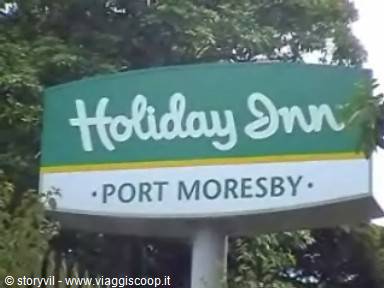
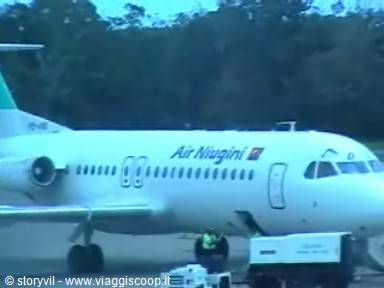
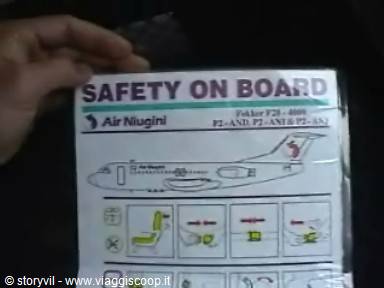
Papua New Guinea For the first time I fly on a Fokker 100; the Dutch factory went bankrupt some time ago, let's hope they still supply the spare parts. I land after seeing a stunning sea with corals, at Port Moresby. The usual heat hits me as soon as I leave the airport. Inside, the air conditioning doesn't let you gauge what the climate is like outside. I get on a minibus that takes me all the way to the Holiday Inn. I chose this hotel to have a certain peace of mind since I'm on my own, and because it's the first time in my life I've come to these parts. More than one person told me this is a dangerous place, but as usual it then turns out to be quite the opposite. The only thing is that here there's a chance of catching malaria, and I didn't take Lariam as I always do when I go to Africa.
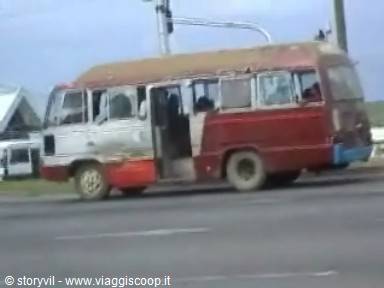
A big, splendid butterfly flies over the large leaves of the plants in the hotel garden, and I take the chance to film it, but so close that I've switched on macro. I even almost brushed it with my fingers. A nice swim in the pool and then to my room on the third floor, where I discover that among the welcome gadgets there's a toothbrush with toothpaste, a needle and thread with buttons for sewing, and even a cloth for cleaning shoes and brown cream to polish them. Very good. Here the mobile phone doesn't get a signal; strange, I have international roaming and in nearby Australia, in Cairns, it works; one can see that TIM hasn't struck agreements with the local telecom. On the road pass extremely beat-up buses crammed with people going everywhere; I'm white, one of the few to be seen around.
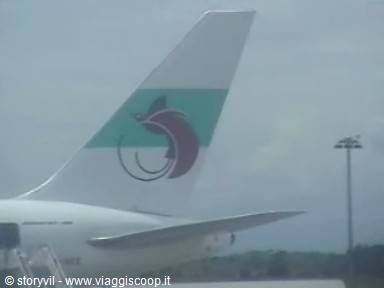
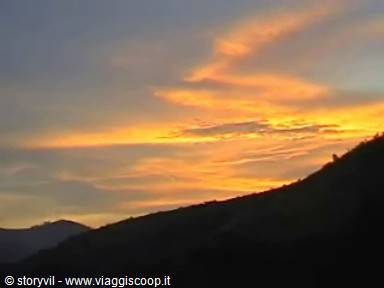
From the terrace of my room I see lots of tropical green on the adjoining hill and a beautiful sunset, which I don't fail to film. Papua New Guinea is famous for its headhunters; on this island there's also a very famous volcano. The archipelago consists of this big island cut in two by a border, on the other side of which is the Indonesian Irian Jaya, and of three other large islands and a multitude of small ones. The more remote towns are linked by Air Niugini planes, since not all towns are connected by roads. If you want, you can organise boat trips here for excellent diving, but it costs an arm and a leg to do it, perhaps because few do it in such an exclusive place, with everything included on board for a week; certainly, in good company, it would be an experience worth having, with a sea so warm and full of corals.
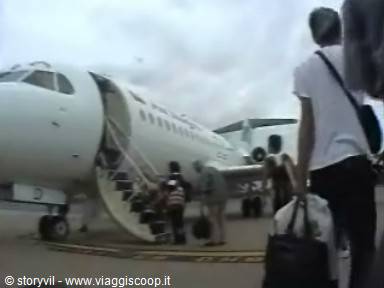
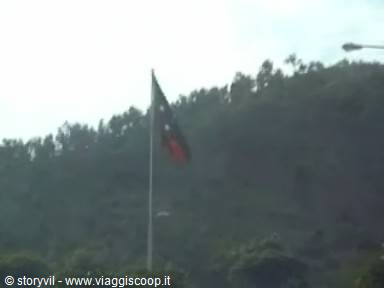
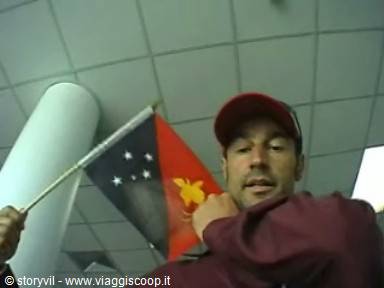
A local language is spoken here but everyone understands English; evidently they teach it at school. Many foreign companies are present; mining companies do business with the local government. I have myself taken to the new Port Moresby airport, and along the road I see a gigantic Papua flag, but it isn't waving, there's no wind; what a pity, I wanted to take a photo. So I buy a little one at the airport. Here there are many Japanese in transit; they come from Osaka and Tokyo and continue to Australia with Air Niugini, which costs less than Japan Airlines even though you make a stop in Papua; who knows, maybe someone takes the chance to visit this country. I take off again on the Fokker 100 and I get three seconds of panic: I can't find my wallet.
In three seconds I thought about where I might have left it: at the hotel? on the bus? at the airport? In fact it was at the bottom of my pocket. Thank goodness; how would I have managed otherwise? I take off after the fright and see again the splendid coral reef. Bye bye
The journey's photographs
15 photographs · click to open them full screen

0 reader comments