Uluru, Kata Tjuta, Kings Canyon, Mereenie Loop Road, Alice Springs
When
25 Jun 2008 – 28 Jun 2008 4 days · trip of 2008
Who
ALBERTO GREGORI · @macgreg · CASTIGLIONE D'ADDA
How
Travel diary
The story · 4 days
Day 125 Jun 2008
Day 11, Sydney - Ayers Rock
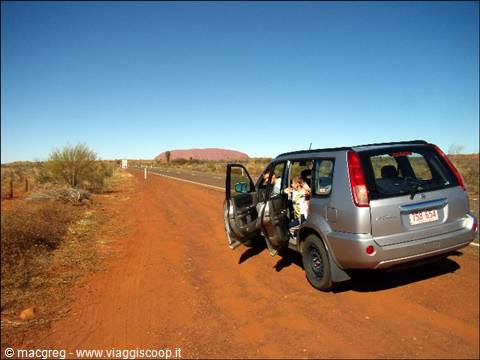
We leave Sydney with the Qantas flight (€150) that takes us to the Red Center, where literally another Australia begins. We pick up the 4x4 at the Avis desk (€315 for 3 days, booking on vroomvroomvroom.au) that will lead us to discover this immense, harsh and isolated territory, but with places of breathtaking, inimitable beauty.
One of the first doubts when planning a trip to this endless Country is whether or not to include the Red Center, where the famous Uluru is located, commonly translated as Ayers Rock.
The doubts arise from the fact that this choice involves a decided surcharge, compared to the average of normal costs, and an almost obligatory route in building an itinerary: two additional flights (Qantas monopoly, therefore the most expensive), expensive resorts, expensive car rental, in short, an economic effort to find yourself in front of a mountain…whose image is so famous that you'd almost think: but who's making me do it??
My advice?? DO IT!!!! And don't call Uluru a mountain….the reason, though, you only understand after you've seen it.
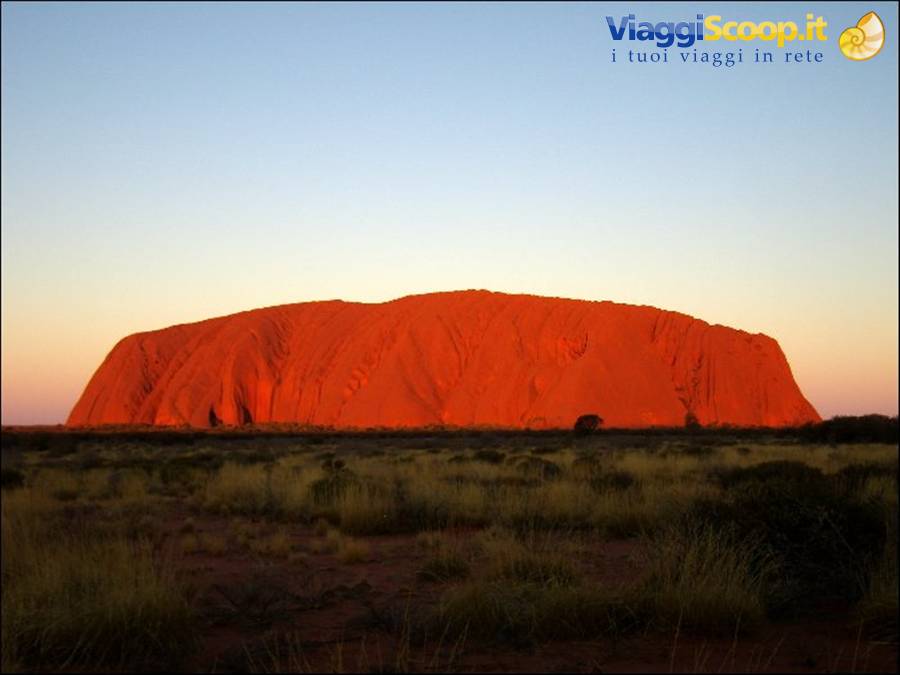
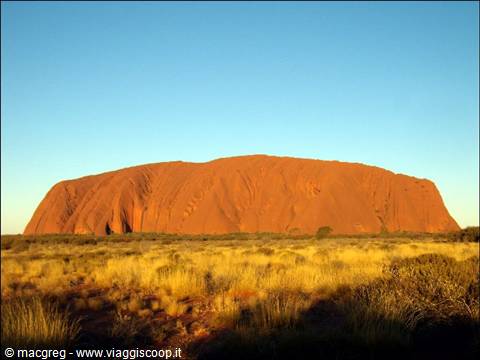
The first emotion Uluru arouses is ADRENALINE: just being in its presence makes your heart beat, lets you daydream, it feels like you've arrived at a precise destination, at a point of reference, at a symbol not only of Australia but of the entire planet. An unmissable destination for anyone who considers themselves vaguely a traveller.
The second feeling you get as you approach is RESPECT. The wish of the Anangu, the Aboriginal tribe that has always lived in these lands, is to teach the simple tourist to appreciate the place beyond the simple visit, to know their traditions, their respect for nature, for a plant, for an insect, for a pool of water considered sacred, since only thanks to water have they managed to survive in such an inhospitable place.
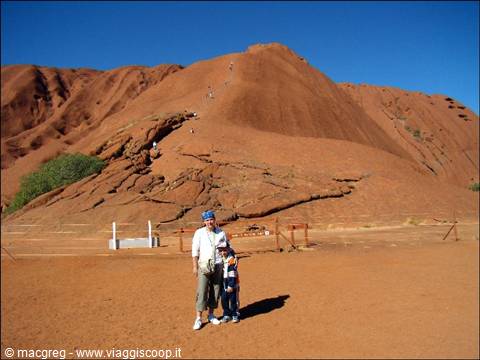
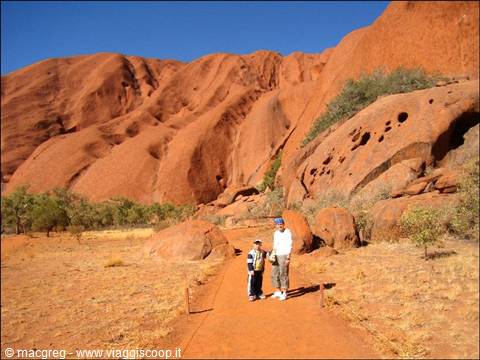
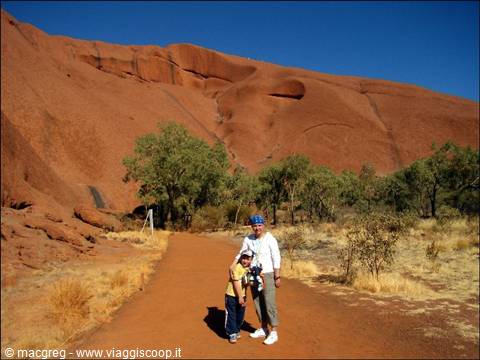
The Anangu ask tourists not to climb their sacred symbol, but they don't forbid it. It's up to the visitor to decide what the best thing to do is. Certainly the most exciting views are not offered by the climb, but by the path that circles the base, passing through spectacular canyons, vertiginous walls smoothed by wind and water, impressive holes carved by time, caves painted with rock paintings that symbolise and bear witness to the existence of the Aborigines for millennia.
The third emotion Uluru offers is AMAZEMENT, in admiring such a monolith rising out of nowhere from the flat surrounding landscape, it seems placed not by chance but by someone's will. Savouring the silence and the sound of the wind walking slowly around the base, where you find yourself as if by magic far from the rest of the tourists, from the bustle of cars and buses. It's here that you breathe the true essence of Uluru.
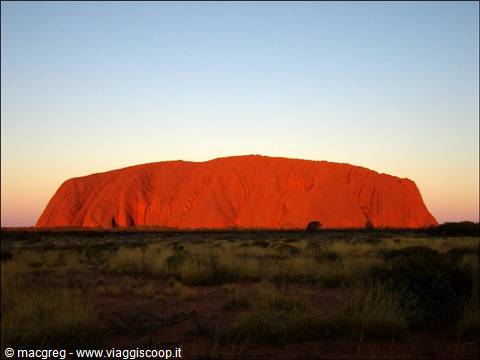
The fourth and last emotion Uluru gives is MAGIC: it's the one offered by the unforgettable sunset that quickly descends on the Red Center, which almost confuses and gives the eyes and the spirit enchanted moments, raising a doubt; perhaps this place really is magical as many say.
In a few minutes Uluru offers its best, transforming as if by prodigy, giving the impression of becoming something alive, passing through an incredible, unique, indescribable range of colours, as if a fluorescent light bulb lit up inside it, and then slowly going out in the intense darkness of the desert, where a starry sky never seen before suddenly lights up, with stars so bright they give the impression of being on another planet.
In the days before, I liked telling my son a made-up little story, to increase his desire and curiosity, since at his age he certainly couldn't appreciate emotions that are aroused in an adult: I told him that many years ago, when the Aborigines had become slaves of the conquerors, one day they arrived in front of Uluru and told them that this mountain was sacred, and that if in the evening it turned red, the mountain's protective spirit would kill them. That evening, once they had witnessed the mountain's transformation, the conquerors got scared and fled and the Aborigines returned free. Even today, if the mountain turns red, the good spirit watches over whoever has shown respect to the mountain.
After seeing Uluru, I'm starting to believe that this made-up story holds a small grain of truth, and that Uluru's good spirit has watched over us in our wandering around Australia, giving us strong emotions.
Practical information:
Ayers Rock airport is about 30 km from Uluru, and represents the most convenient base for visiting the whole area. The only company that serves the airport is Qantas. Alternatively, it's possible to fly to Alice Springs and do a 4-day car tour (a 4x4 is almost indispensable) that touches the various main attractions of the area.
5 kilometres from the airport is the only area where you can stay: there are 4 different resorts, which have all the services, built at a suitable distance from Uluru. Even the cheapest is offered at an excessive price, the smallest room with private bathroom at the Outback Resort costs €124 room only, and is truly modest. Alternatively there are dormitories and a campsite.
Dinner is also expensive: you can do it under the stars by buying the meat and cooking it yourself on the barbecues, but the price, which includes a buffet of vegetables, is decidedly excessive. It's worth spending a little more and dining at a typically Australian buffet in the restaurants of the various resorts (about aud 48, children free).
Entry to the Uluru park, which also includes the visit to the Olgas, costs aud 25 (€15) and lasts 3 days, children free.
At Ayers Rock petrol is also expensive, over 2 dollars against the dollar and a half of Western Australia…
Climate: from June to August winter descends on the Red Center, but perhaps it's the best season for the visit. Night-time temperatures are harsh, but after dawn a heavy sweatshirt is enough to withstand the morning cold (even 2-4 degrees), which quickly rises already by 9 o'clock to reach 18-22 degrees. The days are clear, the sky blue, and the annoying flies are almost absent.
Once winter is over the temperatures rise progressively until they easily exceed 40 degrees, it becomes impossible to walk the various trails during the day, also because of the flies which become very annoying.
Sunset 2
Day 226 Jun 2008
Day 12, Ayers Rock - Kings Canyon
Luck is with us on this trip, and so instead of the budget room booked at the Outback Resort we were offered a standard one (a big difference in price) at no extra charge. Quick breakfast in the room and off we go….to discover another wonder of the Red Center…
the Olgas mountains, or rather, the Kata Tjuta National Park
It's early morning, the air is more than crisp, but I thought worse…and besides you don't feel the cold, you're too spellbound by the colours of the Outback, by its endless spaces and by the silences that reign supreme.
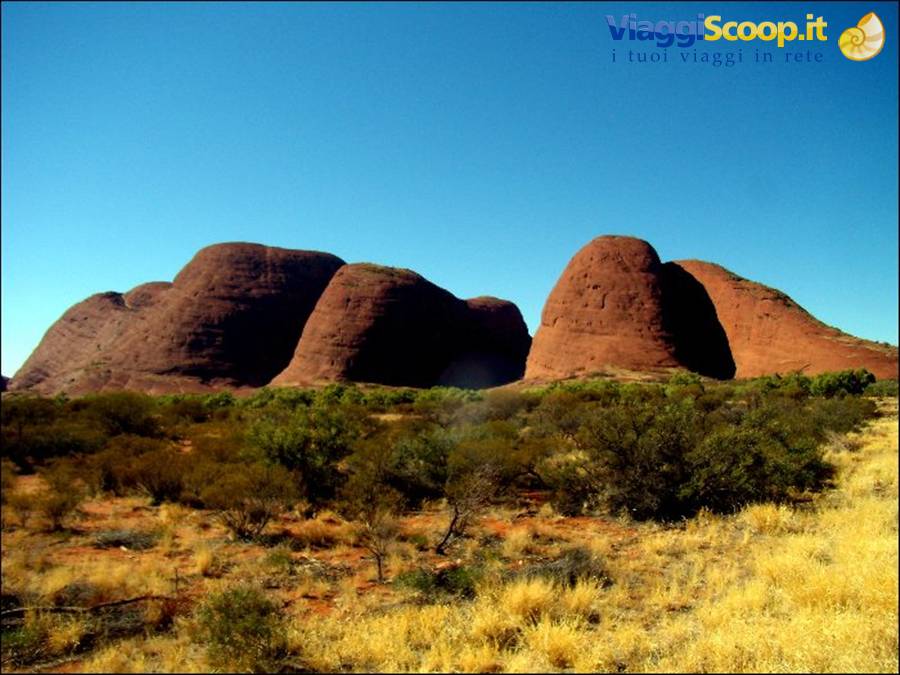
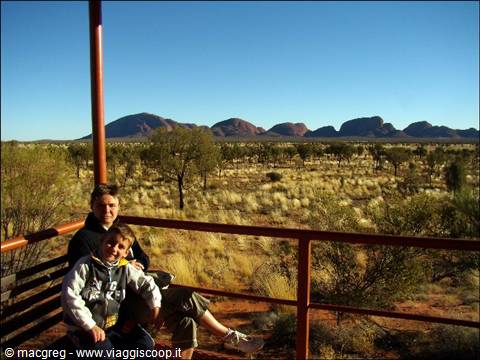
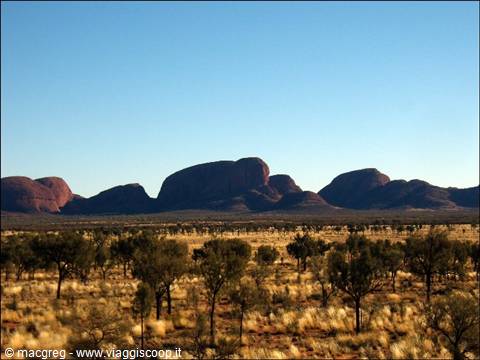
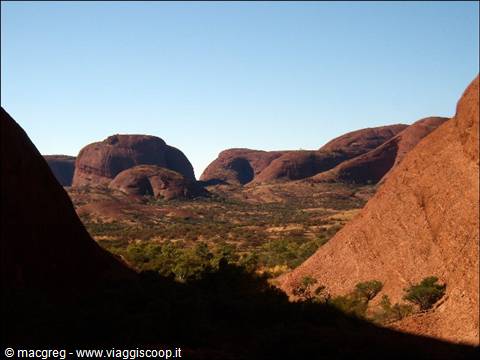
We're approaching the Olgas quickly, with our 4*4….as you get closer they change shape and colour, they become more and more spectacular and mysterious. A turnoff on the right signals a viewpoint, Dune Viewing, which you reach with a short 5-minute walk, along a raised path through the scrub of the bush. For us sand and insignificant vegetation, but for the Aborigines a sacred environment to respect. We find ourselves on a slightly elevated platform in front of the Olgas, which impose themselves with a unique and indisputable beauty. The environment recalls the endless African savannahs, with that dry and almost yellowish vegetation and those endless views.
Kata Tjuta means "many heads", and indeed the term conveys the idea of these extravagant rock formations.
We continue by car to the end of the road, or rather, to the end of the road marked on the maps, because here where the asphalt ends begins an endless dirt road that leads to Western Australia…but that's more the stuff of prepared adventurers!
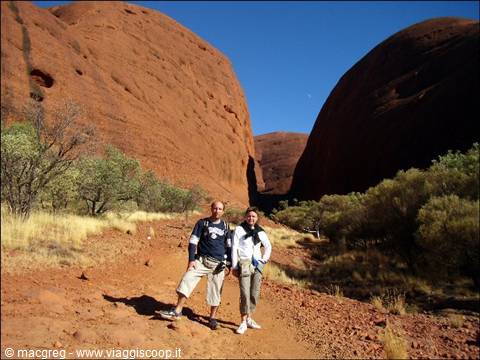
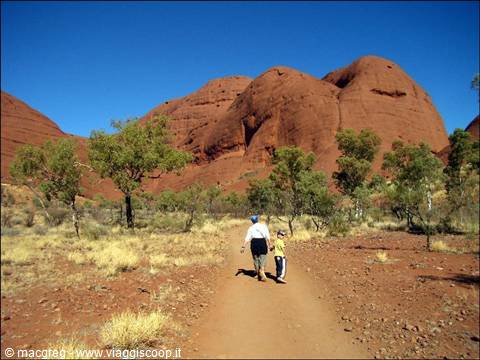
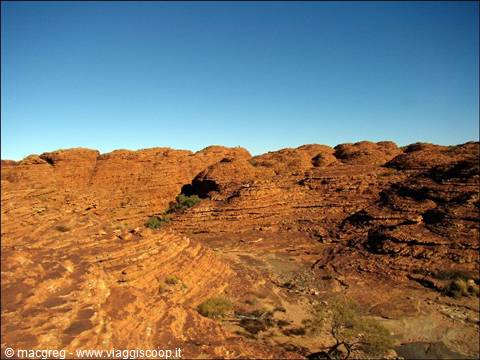
We leave the car in the car park and continue on foot to the start of the Valley of the Winds Walk, a 7km circuit that wedges itself among the rock domes. The sign indicates 3 hours of walking….and they will be 3 unforgettable hours, among lunar scenery made of rocks the colour of blazing red, which contrast unequalled with a deep blue sky. Breathtaking climbs up to mountain passes where the view is stolen by the intense beauty of the place, made even more fascinating by the complete solitude in which you're immersed.
Three hours out of the world, or maybe….three hours inside the most fascinating and unreachable world that exists.
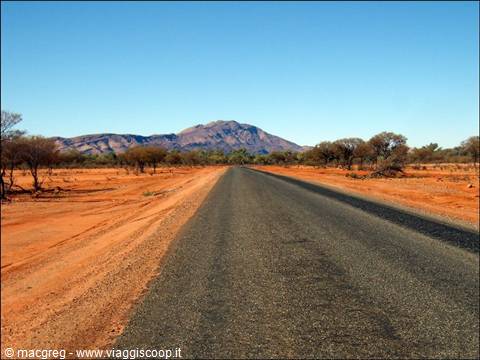
It's time to set off again, we leave Uluru for good to travel a road that loses itself in the middle of the red desert in the heart of Australia. The road is absolutely solitary and for over 200 kilometres it doesn't even pass through a single settlement. Just a few cars and a few campers, encounters so rare that when you cross paths you give a wave of greeting. Oh, I forgot…and a camel that slowly crossed the road in front of us….
A little over two hours and we arrive at the Kings Canyon Resort (€133, room only, asiarooms), in a fantastic position, immersed in the nothingness of the boundless Red Center. A short path that starts from the resort leads to a panoramic platform that lets you admire a suggestive sunset over the red mountains that dominate the background. We go back for the buffet dinner at the resort's Carmichael's restaurant (€30).
Kata Tjuta
Day 327 Jun 2008
Day 13, Kings Canyon - Alice Springs
Hard to say which place I liked most in Australia among the many wonders seen, but if I really had to choose one, I'd probably say….Kings Canyon.
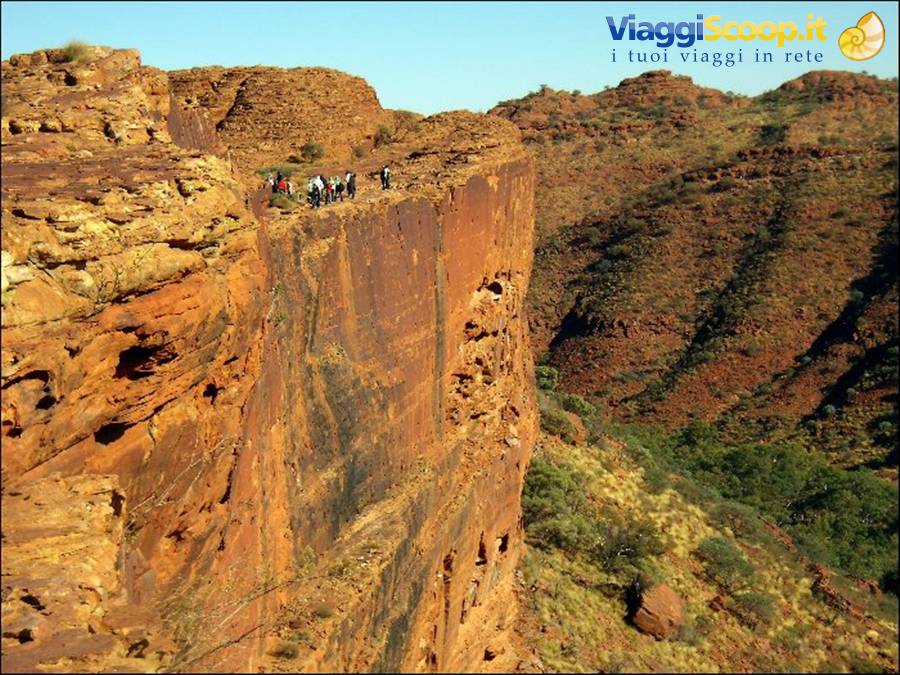
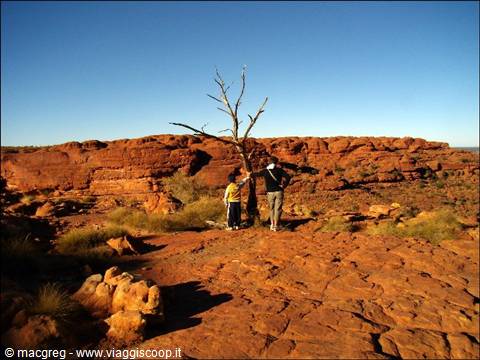
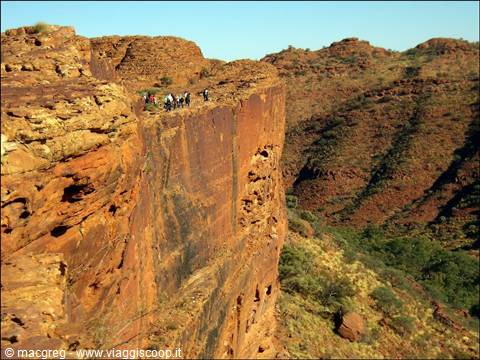
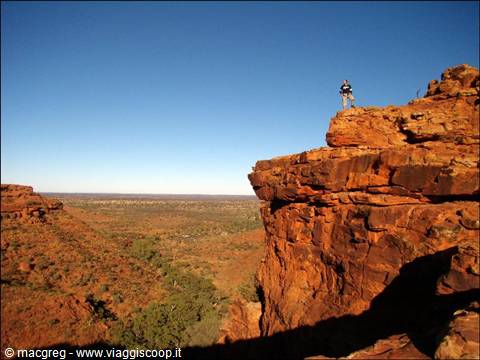
If the Kata Tjuta route is spectacular, this one at Kings Canyon is simply indescribable. It's 7 kilometres to be lived intensely, to be covered in about 3 hours (including the numerous stops to take photos).
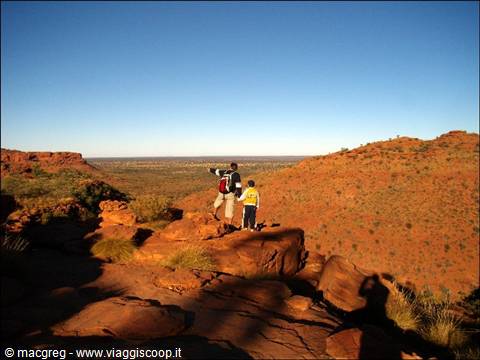
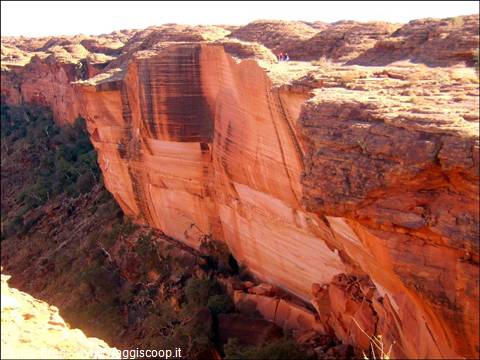
Ready, go, the first stretch breaks your legs and takes your breath away, a steep climb that leads to the edge of the canyon…better to do it at the beginning anyway, in the cool with all your strength. Once you reach the top, there are no more climbs, but the route continues on a false flat with some ups and downs, until the final descent. The route is a progression of spectacular scenery, which first dominates the vast surrounding plain, and then goes into the true canyon, among amazing precipices, breathtakingly steep walls, red rocks and domes smoothed by the wind, ending in a very green oasis, called the Valley of Eden, which miraculously springs up in this truly hostile environment.
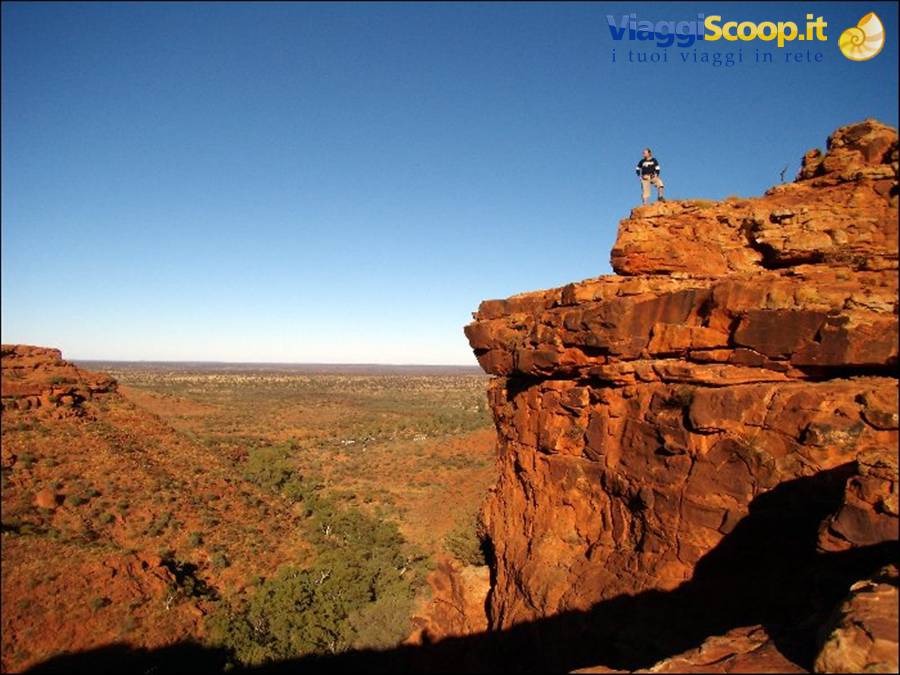
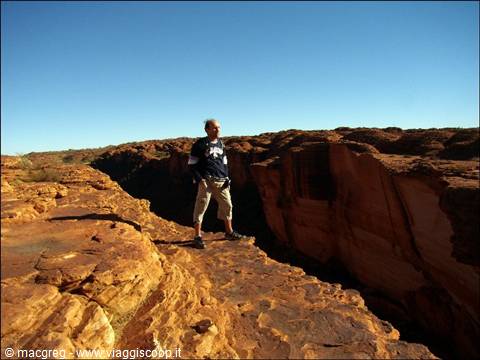
The route runs largely near the edge of the canyon, on both sides, and a minimum of attention is needed because the whole place has no barriers. You can therefore approach the chasms up to the last centimetre.
I can assure you of one thing…I don't suffer from vertigo, but when you get close to the edge, your head starts spinning and your heart beats very fast!!!!
Once on the opposite side, you go back up with a steep wooden staircase carved into the rocks; the colours and reflections become unbelievable, almost fake. The route finally loses itself among thousands of ancient rock formations, as if it were a city of stone, before descending back to the car park.
An unforgettable day and incredible photos.
While planning the trip to Australia, I was several times puzzled by the period chosen, June, in the middle of the Australian winter. But after experiencing the Red Center, its thrilling trekking routes, and also many places in Western Australia, I have to say that perhaps this season is ideal for many of the places visited. I can't even imagine walking these trails during the summer season, between mind-boggling heat and the very annoying flies. In these days of late June, in the morning until 9 it's rather cold, but towards midday the temperature approaches and exceeds 20 degrees, ideal. Already during the hottest moments of the day, a few sparse flies start to bother you…there are very few and small, but truly persistent. We had brought some rather heavy jackets and we brought them back without even using them.
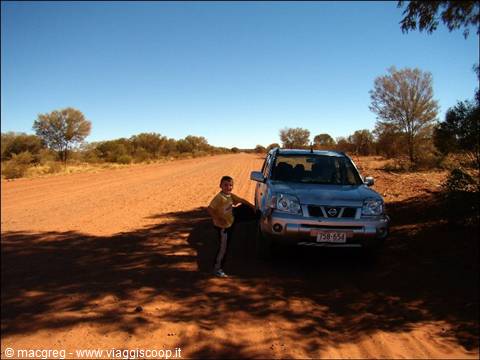
Once the trekking in Kings Canyon is finished, we set off again towards Alice Springs and having rented a 4x4 we venture onto the Mereenie Loop Road (buy the permit at Kings Canyon, about 2 dollars) a completely dirt road that crosses some spectacular points of the Red Center. We took about 3 hours to cover the dirt stretch, we crossed 4 cars….the road is quite demanding, also because, given the length, you need to keep a speed of at least 80 kmh, but the potholes and stones constantly demand your attention at the wheel and don't allow distractions. To get to Alice Springs there are two options: the first is to go through the town of Hermannsburgh, but the road is rather monotonous. The advice is to take the only junction before this town, and head north towards Glen Helen.
Now much of this route has been paved, but above all it crosses the breathtaking landscapes of the West Macdonnell, a harsh mountain range where you can visit some spectacular gorges with short detours from the main road, such as Standley and Simpson's Gap. In the end it takes almost 5 hours to cover the entire distance.
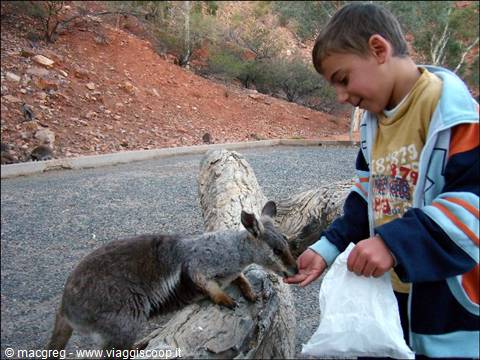
In Alice Springs we stay at the Heavitree Gap Outback (€55, booking direct), which has a not insignificant particularity: towards sunset, a group of small and rare black wallabies come down from the mountain and reach the cottages to look for something to eat directly from people's hands. The reception is stocked with feed suitable for their diet.
Kings Canyon
Day 428 Jun 2008
Day 14, Alice Springs - Darwin
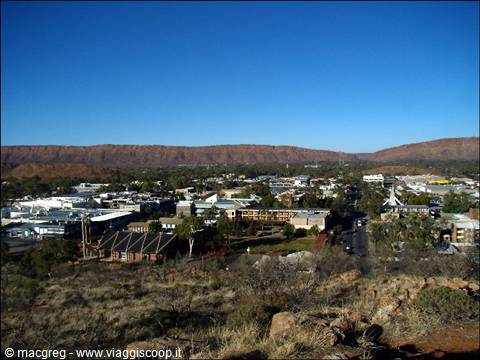
We spend the morning visiting the center of Alice Springs. The mall is very nice, you stroll along a quiet pedestrian street full of artisan shops and galleries displaying Aboriginal artworks and typical products of the Red Center (very expensive)…the strange thing is that there isn't a single Aboriginal person selling their own works…they're all white!!
Time's up, we leave the splendid Red Center behind; in just three days we've seen so many natural wonders that it feels like we've been here much longer.
We return the car at the Avis desk, where we're unjustly charged 200 dollars for dropping it off in another city, something that at the time of booking was indicated as included.
After various arguments, there's nothing left to do but sort it out upon our return (and I only sorted it out now, after two months!!!).
The flight to Darwin awaits us (Qantas, € 145), which in just an hour and a half will take us to a completely different territory, both in terms of landscape and climate.


0 reader comments