Perth, Margaret River, Wanpole, Cervantes, Kalbarri, Coral Bay, Ningaloo, Karijini, Broome, Purnululu, Kakadu, Uluru, Kings Canyon · Western Australia e Northern Territory
When
28 Oct 2012 – 25 Nov 2012 29 days · trip of 2012
Who
Cip Civectitis Civetta · @tizimari · Sâo Tomé
How
Travel diary
The story · 3 days
10,800 km, 1660 litres of petrol. Maximum temperature 48 degrees Celsius. Top five: Purnululu Bungle Bungle - Echidna Gorge, Kings Canyon, Ningaloo Marine Park - Turquoise Bay, Karinjini NP, Wanpole NP - Valley of Giants.
Sunday 28 October
Departure from Milan Malpensa with an Emirates flight (1100 eur each) via Dubai. Stopover in Dubai and overnight stay at the Metropolitan Hotel (900 AED) for the double.
Monday 29 October
Flight from Dubai to Perth. Arrival in Perth at 2 in the morning on 30/10. By taxi we reach the Ibis Hotel, not far from the airport. The automatic porter service is in operation; we enter the code received by email to collect the room keys. Very basic rooms, but for one night it'll do.
Tuesday 30 October
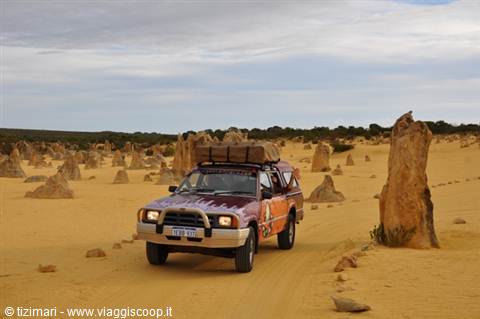
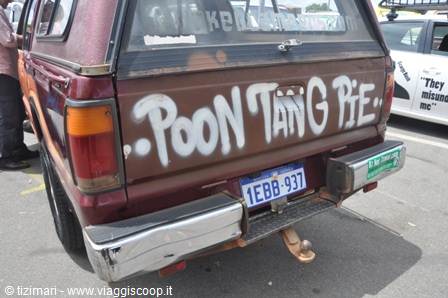
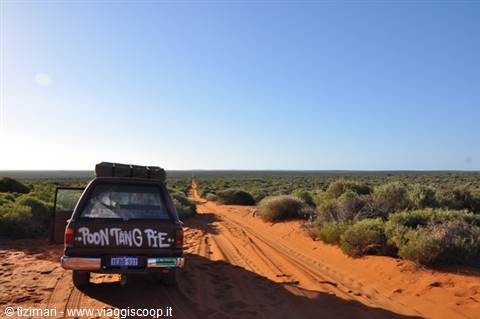
Perth – Perth We collect the car, from Wicked Campers, a very colourful Mazda 4x4 with some pornographic writing in wicked style on the back. The car has more than 500,000 km and we're immediately assailed by the doubt "will we manage to cover the roughly 10,000 km planned with this old banger?". Another surprise: the air conditioning doesn't work; the employee calls a mechanic who pretends to check the fault and in the end the verdict is that it can't be repaired. What to do? Change car? There are no other 4x4s available; change company and we'd lose the whole deposit, and there's no guarantee of finding another off-road vehicle available straight away. So we set off with our old banger. Moral: be very careful about the quality of the cars offered by Wicked Campers and keep your fingers crossed that the old banger manages to get through this latest effort too.
By now it's lunchtime, so we head to Freemantle for lunch at "Little Creatures", a brewery still in operation with a part set aside as a restaurant, in an excellent position on the harbour. The temperature is pleasant but a cool wind is blowing, so after 4 or 5 attempts to find the right table (too much sun, too much wind, no view), we find the table that suits us all, with a good balance between temperature, view and closeness to the kitchen. A plate of fish and chips and the inevitable beer brewed on site. A walk in the centre of Fremantle, where we buy the holiday pass (40 Australian dollars) that allows entry to all the parks of Western Australia. Dinner in a Vietnamese restaurant in the centre of Perth. Overnight stay at the "Governor Robinson Backpackers" in central Perth.
Wednesday 31 October
Perth – Margaret River 311 km After doing some shopping to complete our camping equipment, we leave Perth heading south; we'll save a visit to the city for our return. On the motorway heading south, speed limit 110 km/h, we immediately realise that our old banger is also very noisy, and its range extremely limited (about 300 km). In the north we'll have to travel always with reserve cans of petrol. At Australind we leave the motorway and take the tourist route along the coastal road. After Bunbury, lunch stop at Vasse Felix. A restaurant inside the winery of the same name, with delicious and spectacular courses. The bill was spectacular too, but it was worth it. We reach Margaret River, where we settle in at the Margaret River Resort, not bad and great value for money. There's still time for a walk in the little town; it's 17.30 and everything is already closed.
This is our first encounter with the monastic hours of Western Australia.
Thursday 1 November
Margaret River – Walpole 364 km A day dedicated to the caves and forests of the south-west. First stop, a visit to Mammoth Cave; we collect the recorders and headphones with the explanations for the unaccompanied visit. At Jewel Cave the visit is guided. This cave is much more spectacular than the previous one, with incredible cascades of stalactites and stalagmites of different shapes and colours. We continue towards Augusta, and Cape Leeuwin, the south-westernmost point of Western Australia, where the Southern Ocean and the Indian Ocean meet. We reach the Warren NP, home to gigantic eucalyptus trees. Among the tallest is the Bicentennial Tree, which you can climb via iron pegs driven into the trunk. You go up to 68 metres high, precariously balanced on the iron spurs, with no safety system; better not to suffer from vertigo.
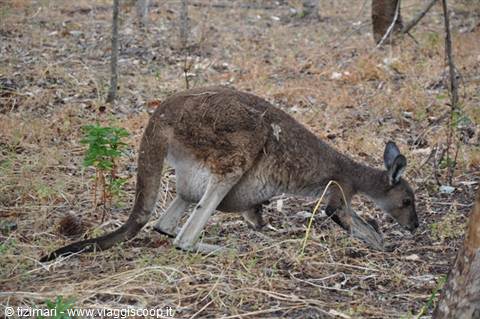
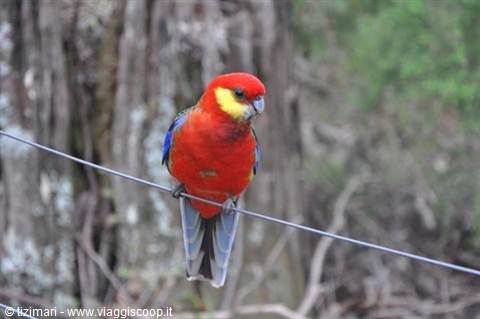
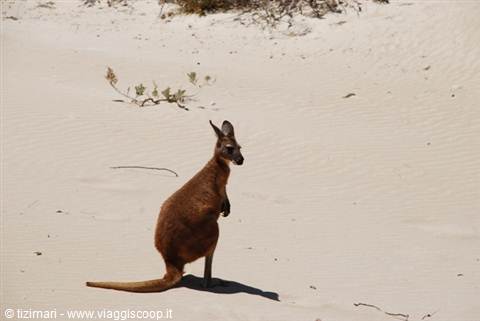
The other famous giant is the Gloucester Tree, located in the nature park of the same name. Here you climb to more than 70 metres with a spectacular view over the surrounding forest. The park is very rich in birds, including many multicoloured parrots. Today our first encounters with kangaroos, in the green pastures of the south-western wineries. Overnight stay in a chalet at the Coalmine Beach Caravan Park. Dinner in Walpole at a restaurant with Filipino cuisine.
Friday 2 November
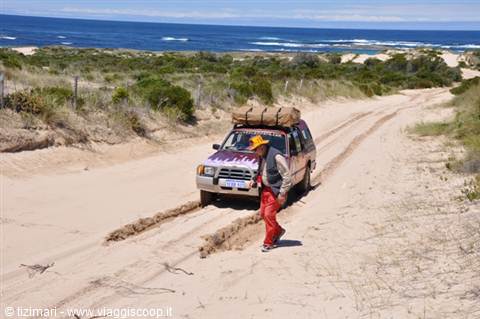
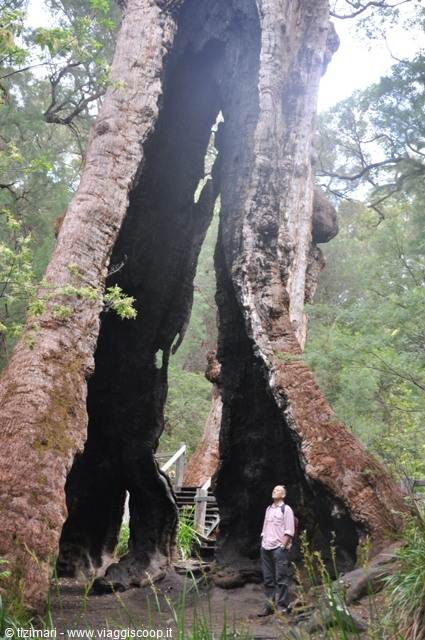
Walpole – Mandurah -448 km A day dedicated to the Walpole-Nornalup NP. Early in the morning we drive the Valley of the Giants Road, which crosses a centuries-old eucalyptus forest where the action of fire has created spectacular fissures and clearings. We then continue towards the Tree Top Walk, a metal walkway suspended 60 metres high over the forest canopy. We continue towards Peaceful Bay; we take a sandy track that descends towards the ocean, a wild beach packed with little white shells. Climbing back up towards the tarmac, our first bogging down, resolved anyway after a few attempts to climb the slope without needing to lower the tyre pressure. Stop at Conspicuous Cliffs, where from the top of the cliff we spot the first whales. The beaches of this area are truly very wild.
We then head back north, passing through Bridgetown, Donnybrook and Bunbury, picnic in a rest area and then camp a few km before Mandurah. First experience with the rooftop tent. Dinner at the tavern near Mandurah.
Saturday 3 November
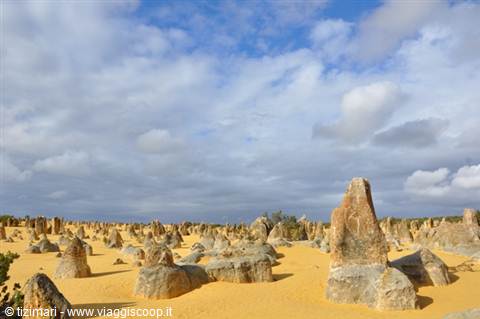
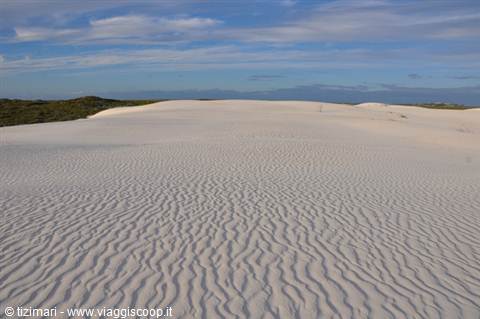
Mandurah – Cervantes 342 km We cross Perth again and head north. The weather forecast says it's getting worse. The sky changes continually. Storms with downpours. We reach Yanchep NP. First encounter with the Koalas, sleeping peacefully hanging from the tree branches under an insistent drizzle. Picnic at Yanchep among pink cockatoos. We set off again towards the Pinnacles in the Nambung N.P. A few km before the Pinnacles a row of very white sand dunes lines the national road. This is sand from the coral reef carried here by the wind. The landscape is breathtaking. The Pinnacles offers a lunar landscape with a spread of pinnacles emerging from the yellow sands of the desert. We cross the area on foot and then drive the itinerary in the last light of sunset. Dinner at the Country Club with an exceptional seafood dish and an excellent local beer. Night at the Pinnacles Camping in Cervantes.
Sunday 4 November
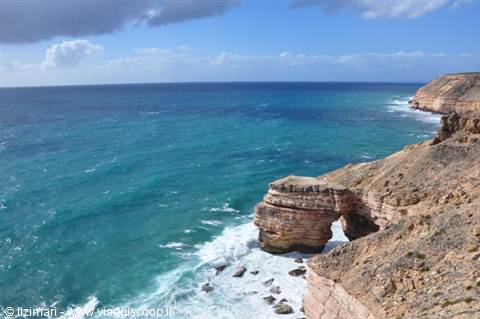
Cervantes – Kalbarri 437 km A spectacular breakfast at the Seashell café in the Cervantes campsite, with a series of homemade sweets and cakes; we continue towards Geraldton, where we have lunch at Topolini's; we continue towards Kalbarri, passing a lagoon with completely pink water, a phenomenon caused by microalgae. Visit to the cliffs of the Kalbarri nature park, where we spot several whales. We camp at the Kalbarri campsite and have dinner at the Upstairs restaurant.
Monday 5 November
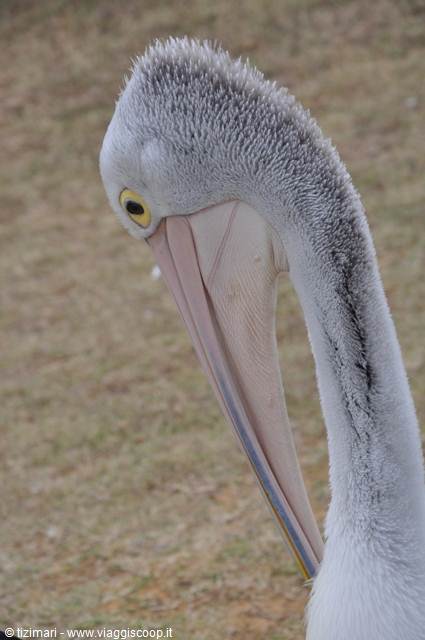
Kalbarri to Monkey Mia - 568 km Breakfast at the Gorge café, again with not bad cakes, while waiting for the pelican feeding time. Every morning in the area near the harbour a group of pelicans is fed. Mari volunteers and is immediately targeted by the pelican, which approaches with a threatening air, claiming the fish it's due. After a bit of a scuffle the pelican wins and happily swallows the fish. We continue the visit to the inland area of Kalbarri.
Day 16 Nov 2012
Lunch at the Billabong roadhouse. We continue toward Shark Bay. Dinner in Denham at the Old Pearl, a restaurant built in the traditional way with compressed shell blocks. Fish and seafood dish a bit below expectations. Overnight stay at Monkey Mia Dolphins Village, ready to wait for the dolphins' visit the following morning.
Tuesday, November 6
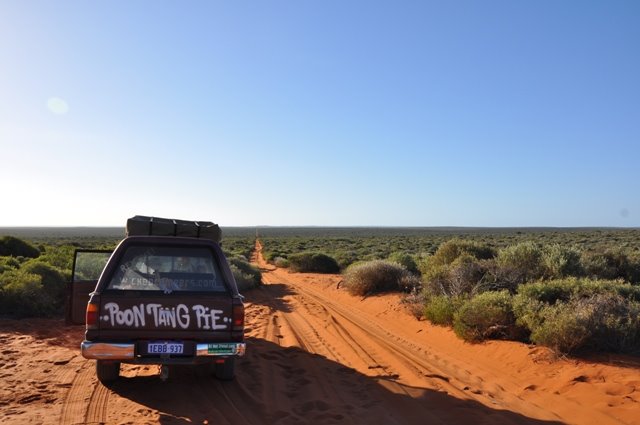
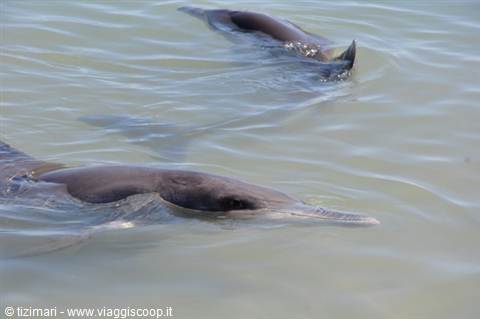
Monkey Mia to Monkey Mia – 198 km Every morning some dolphins come to visit the beach at Monkey Mia, where you can admire them up close and feed them a few fish. This morning only one dolphin. We set off to visit F. Peron National Park. At the park entrance there's a tire deflation/inflation station. To tackle the sandy tracks that lead to Point Peron, you have to reduce tire pressure, to avoid getting bogged down and damaging the track excessively. About 60 km of sandy track with some stretches over treacherous salt layers that could give way under the weight of vehicles lead to Cape Peron. The landscape is enchanting, a dense vegetation of bushes springs from the red sands of this area. Once at the cape, the white sand of the beach fades into ochre tones only to blaze into the red of the surrounding earth. We spot a dugong and the silhouettes of some rays in the crystal-clear water.
On the beach a colony of cormorants. Picnic on South Gregory beach, passing by Big Lagoon on the way back toward Denham and again to Monkey Mia.
Wednesday, November 7
Monkey Mia to Coral Bay - 643 km Back on the beach at Monkey Mia for the appointment with the dolphins. This morning there are as many as 5 of them swimming in 20 cm of water, observing up close the tourists lined up along the beach. This time Mari manages to come forward as a volunteer to give one of the fish to feed the dolphins. This time the operation is much simpler than the experience with the pelicans. Even the pelicans that play a supporting role while waiting for the dolphins' arrival never miss the morning appointment. Breakfast at Monkey Mia and back on the road, ever further north. Setting off from Shark Bay, a stop at Shell Beach, an immense beach of white shells. A brief lunch stop at Carnarvon and north again, we cross the Tropic of Capricorn before reaching Coral Bay in the first shadows of the evening.
Dinner at the only restaurant still open and the night at the hostel in Coral Bay.
Thursday, November 8
Coral Bay to Ningaloo Marine Park Mesa Camp – 239 km Coral Bay is little more than a small village that lives on tourism, thanks to the spectacular bay with its white-sand beaches and the coral reef located less than 100 meters from the shore. Breakfast on the beach surrounded by seagulls waiting for some scraps. In the morning, a boat excursion with a glass bottom over the coral reef. Snorkeling on the reef; as soon as I entered the water (not very warm) a small shark passed right beneath me, but it calmly went on its way. The area is rich in multicolored fish. Return by boat to Coral Bay. Lunch and off again toward the northern tip of Ningaloo NP. Roads in Australia are generally in excellent condition; the long straights tempt you to speed up, but with a 4x4 you must never overdo it.
After about an hour of driving we in fact find a 4x4 like ours overturned, the two boys in a state of shock and the girl motionless on the ground with a back injury. Probably a moment of falling asleep in the hot afternoon hours, a run off the road, the attempt to get the car back on track, the inevitable rollover. We give first aid while waiting for the ambulance to arrive, which has to come from Exmouth more than 100 km away. We continue on, refuel in Exmouth so we can camp on the wild coast of Ningaloo Marine Park. We reach the Mesa bush camp almost at sunset. We pitch the tents, have dinner under the stars less than 100 meters from a wild and endless coast. During the night a strong wind from the sea makes it almost impossible to sleep.
Friday, November 9
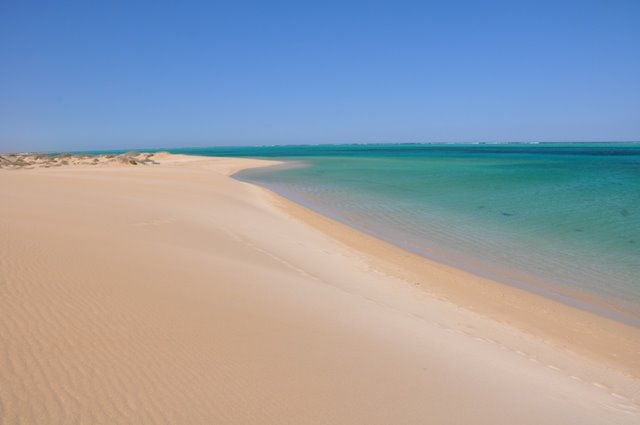
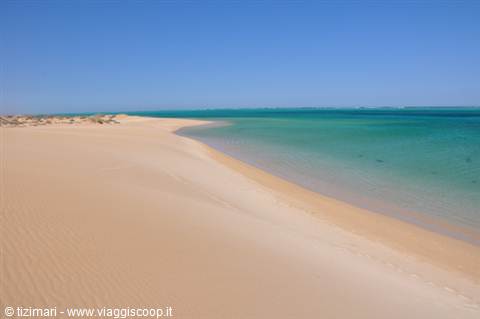
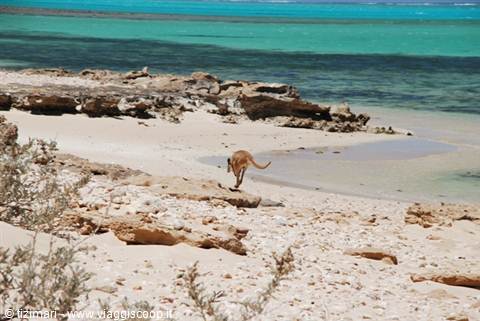
Ningaloo Marine Park Mesa Camp – Nanutarra – 356 km We continue our visit to the Ningaloo Marine Park, reaching Turquoise Bay, one of the most fantastic places on this stretch of coast. An immense, snow-white beach with a bay enclosed by the reef with an opening that connects it to the open ocean. With the changing tides, treacherous currents form, either incoming or outgoing. You mustn't miss the exit point, or the current can drag you into the open ocean. The colors are fantastic and dazzling: a white beach, a sea in turquoise tones, an outside temperature around 40 degrees, inviting you to swim. After cooling off we continue to Varanus Beach, where a group of kangaroos shelters from the sun in the shade of the rocks right at the water's edge. This coast offers over 300 km of wild beaches. We return toward Exmouth for lunch and continue in the direction of Karijini N.P.
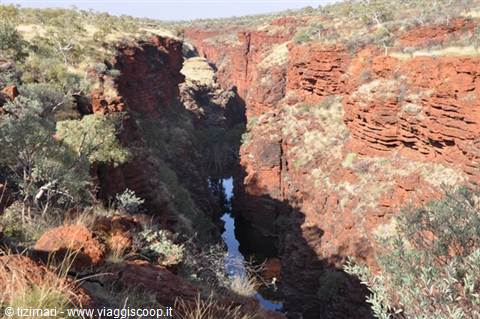
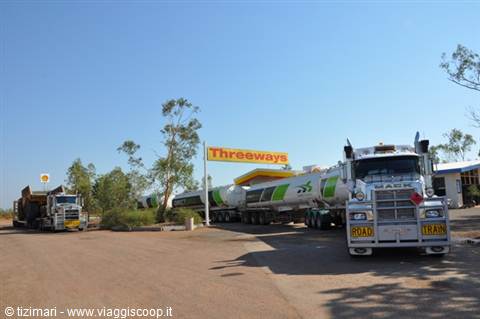
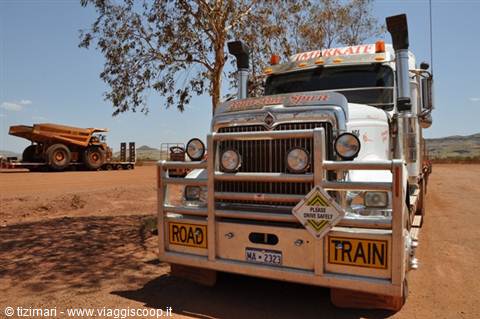
to shorten tomorrow's transfer leg a bit. We stop at sunset at the Nanutarra Roadhouse. In all the roadhouses of Western Australia you can find accommodations for the night, restaurant and campground. They're an excellent solution for a break during the long transfer legs. Saturday, November 10 Nanutarra to Karijini National Park – 458 km We enter one of Australia's mining areas; the roads are worn by road trains, endless trucks that can have up to 4 trailers and reach 50 meters in length. We reach Karijini NP and camp at the ecolodge campground. A short 20-minute walk with a steep descent into the gorges of Joffre Gorge and the pools of water below. The landscape is very striking and swimming at the bottom of this gorge with walls over 100 meters above you is a unique experience.
In the area the first enormous red-earth termite mounds appear, along with the white and black silhouettes of ghost gum trees.
Sunday, November 11
Karijini National Park to Pardoo – 581 km We continue our visit to Karijini N.P. A first visit to Oxer Lookout, where 4 very deep canyons with red and white walls converge; at the bottom of the canyons are various pools of cool water. We then continue on the red track to reach Knox Lookout and Joffre Gorge, from the east side, where you enjoy a magnificent view over the amphitheater of the waterfall and the long natural pool below. Continuing east we reach Dales Gorge; a walk of about 20 minutes leads to the waterfall and Fern Pool. It's Sunday and the natural pool is quite busy with workers from the local mines. A refreshing swim in the pool with a hydromassage under the waterfall, and we climb back up the canyon to reach the car and continue toward Broome.
It's the early afternoon and the outside temperature is around 50 degrees; this is considered the hottest area in Australia and you can feel it! At sunset we reach the Pardoo Roadhouse, where we settle in for the night.
Ningaloo NP
Day 212 Nov 2012
Monday, November 12
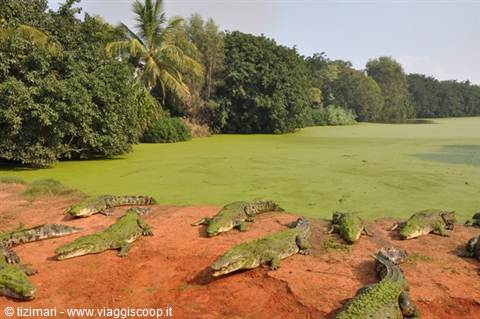
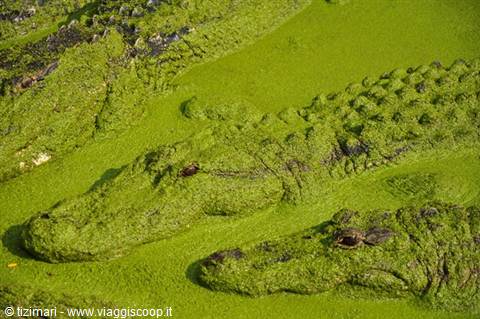
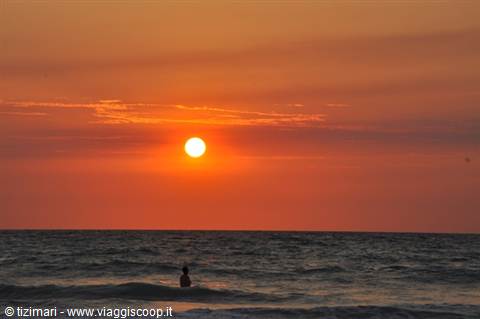
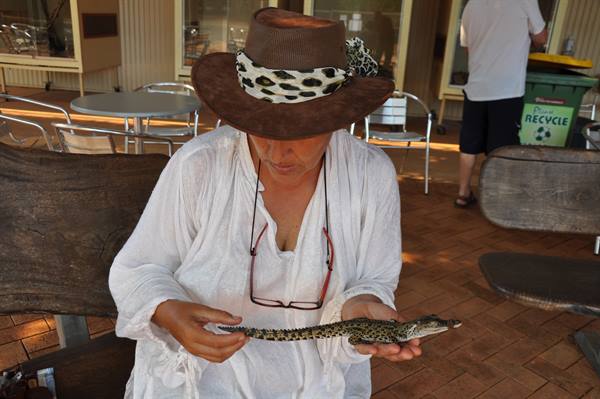
Pardoo to Broome – 524 km We set off again toward Broome, crossing the desolate Great Sandy Desert; a few kilometers before Broome we visit the crocodile park at the time of the daily feeding; there are various specimens of freshwater and saltwater crocodiles. The saltwater crocodiles that live in the mangrove areas and rivers of the Kimberley are gigantic and extremely dangerous; some specimens in the park reach 5 meters, but there is talk of specimens over eight meters that have been captured in the wild. We then reach Broome and settle into the campground at Cable Beach. We arrive at the beach for a sunset that's truly red, like a postcard. Cable Beach is an immense beach of white sand that at low tide appears even more enormous. For dinner, a fabulous seafood dish at a restaurant on Cable Beach.
Tuesday, November 13
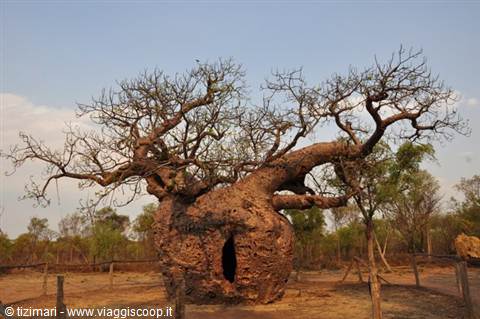
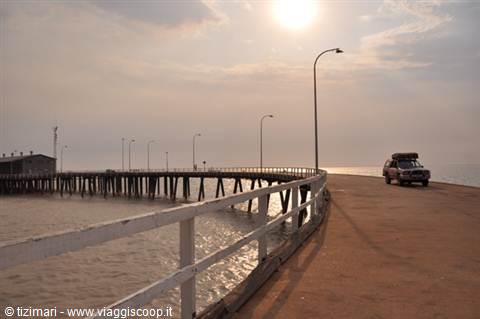
Broome to Derby (Birdwood Downs Station) – 269 km Early in the morning, a swim in the warm waters of the Indian Ocean, breakfast at a restaurant on the beach, a visit to the cultured pearl exhibition in the Broome area, an Aboriginal art gallery, and then grocery shopping at the supermarket to prepare for crossing the Kimberley, a region still extremely wild, considered Australia's last frontier. We reach Derby, a visit to the famous Boab Prison Tree, an enormous baobab used as a rest stop during the transport of prisoners from the Derby prison. A quick stop on the jetty from which you can admire the impressive tides. The tide is rising and the sea takes on the whitish-gray color of the local earth; a storm approaching from the sky gives the whole scene a very striking look. We take the legendary Gibb River Road; after only 3 km we visit the Mowanjum Aboriginal cooperative.
The artists of this community are inspired by their Wandjina spirit. Their artistic expression turns into fascinating canvases. Unfortunately the prices are extremely high, almost unaffordable. We continue about ten km on the Gibb River Road and then head in for the night at Birdwood Downs Station, a farm that provides a space to pitch tents. We'll discover the next morning the secret behind the name of this station.
Wednesday, November 14
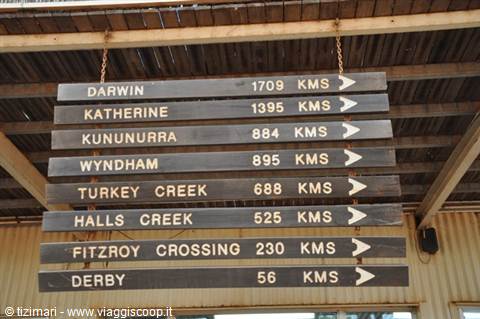
Derby - Birdwood Downs Station to Halls Creek – 605 km Waking up at Birdwood Station is spectacular; we're surrounded by flocks of white cockatoos and pink cockatoos performing a concert of screeches as they fly from tree to tree around the tent. As soon as we leave the tent all hell breaks loose: the cockatoos fly over us with a deafening noise, and a group of horses from the station comes over, curious. Impossible to keep sleeping; it's 5 in the morning. Truly impressive and unforgettable. Breakfast at the camp and off we go on the Gibb River Road. The first 100 km of this legendary Kimberley road are partly paved. After about 120 km, we take the turnoff to the right toward Windjana Gorge NP and Tunnel Creek. These two nature parks are part of the Devonian Reef; it seems that about 350 million years ago these were the edges of the continent.
Windjana Gorge is a gorge set between two barriers of irregular rock rising about 100 meters. We continue toward Tunnel Creek, an underground tunnel of about 750 meters with some pools sometimes inhabited by crocodiles; we go through the first part of the tunnel up to the first water pools. We continue on the dirt track of Leonard Road and about thirty km before reaching the Great Northern Highway, we try to save a cow trapped in a mud pool; we have to tie its horns and drag it with the car to pull it out of the mud that's holding it trapped. Operation successful, but the cow, probably exhausted from its long stay in the mud, can't get back up; after several attempts we leave it hoping the cool of the night will let it recover and get back on its feet. The doubt will remain with us. Once in Fitzroy Crossing, we visit the Aboriginal art cooperative.
Interesting but not on a par with the Mowanjum one seen the day before. We arrive in Halls Creek in the dark, set up at the campground, take a dip in the pool after 3 days of terrible heat, and then have dinner at the Kimberley Inn restaurant.
Thursday, November 15
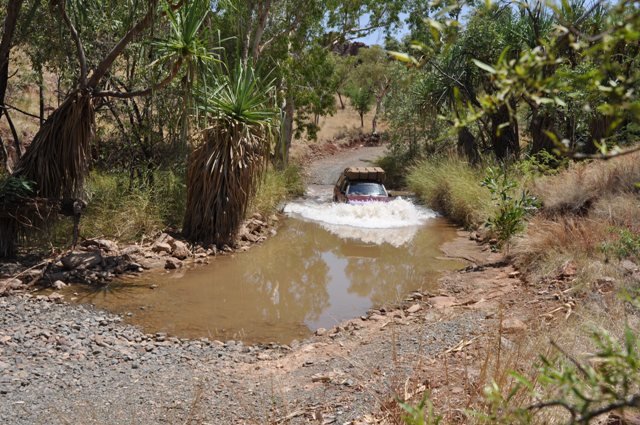
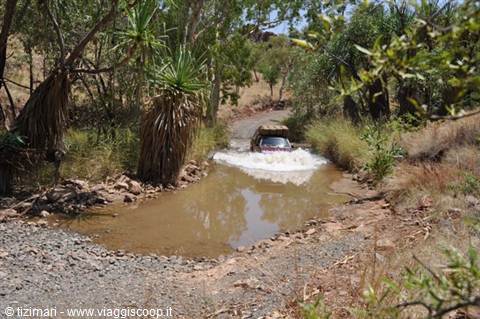
Halls Creek to Purnululu Bungle Bungle National Park – 222 km Breakfast at the Kimberley Inn, then we get information at the Visitor Centre about the road conditions to Purnululu Bungle Bungle National Park. With a 4x4 there shouldn't be problems traveling the 53 km of track that lead from the HWY to the park entrance. We shop at the Halls Creek supermarket and set off; we'll spend the night in Purnululu Bungle Bungle NP. After 108 km from Halls Creek, we find the turnoff to the right for Purnululu NP. The first km of road aren't in bad condition, just some stretches of corrugated road that put our Mazda to the test. After about twenty km, the first river ford with about 80 cm of water. The most demanding ford is at km 36, where you have to cross about fifty meters of river with a muddy bottom and almost a meter of water, but we make it through; we'll see on the way back.
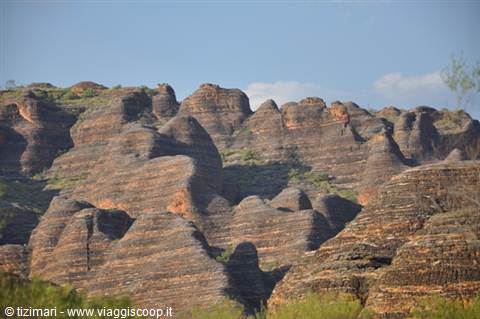
Then follow 3 other less demanding fords and at km 53 we reach the visitor centre at the park entrance. Since it's now out of tourist season, the visitor centre is closed, so we use the honesty box to register and pay for camping, a system we had already found in Norway, but which would be unthinkable in Italy. We continue through an incredible landscape and reach the famous "domes" at Piccaninny Gorge. The rock formations surrounding us originated about 360 million years ago, and the erosive phenomena of air and wind gave rise to these incredible beehive formations with red, black and white stripes. We're alone in the middle of a fairy-tale landscape. We walk the 2 km up Cathedral Gorge and reach an enormous natural amphitheater, among rock walls rising over 100 meters above us, indescribable.
We return toward the park entrance and settle in for the night at the Walardi campsite; just before reaching the camp, our first encounter with a dingo, the Australian wild dog. We're the only guests in the camping area, some storms in the distance and above us an infinity of stars; here the darkness is the most absolute. We're hundreds of km from the nearest electric light.
Friday, November 16
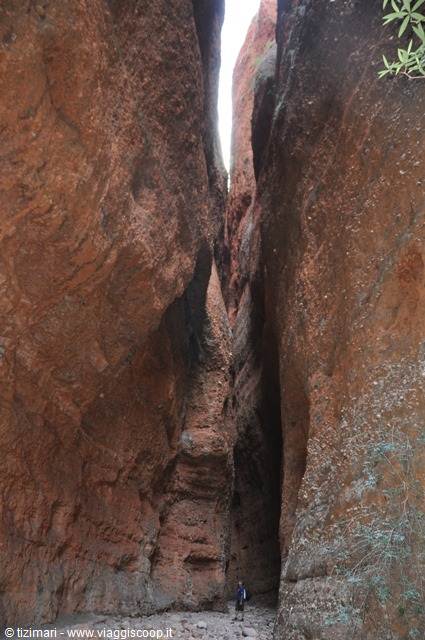
Purnululu Bungle Bungle National Park to Kununurra – 371 km During the night the dingoes prowled around the camp howling. We set off to visit Echidna Chasm in Purnululu National Park. An impressive gorge with walls over 200 meters high and only a few meters wide. The area is truly very striking. We take the track again in terrible condition to leave the park, and face the various fords again. This time in the deepest ford the distributor gets wet and after a few sputters the engine stops with the car still in the middle of the ford. We somehow manage to restart it and reach the road again, but we have to stop and let everything dry out. Half an hour's stop and off we go again. No problems in the following fords and we reach the asphalt again. We visit the Aboriginal art center of Warmun with interesting works, but always with exorbitant prices.
We reach Kununurra where we camp for the night at the campground in the town center, a bit too noisy (not recommended). Dinner at the adjacent restaurant.
Treacherous ford on the Purnululu track
Day 317 Nov 2012
Saturday, November 17, 2012
Kununurra to Kakadu NP – 752 km A big transfer leg to reach Kakadu National Park. After Kununurra we leave Western Australia to enter the Northern Territory. We reach Katherine, the hometown of Cadel Evans, world cycling champion. Lunch at the golf club and off again toward Pine Creek, an old mining town. Refueling and refreshment at the Lazy Lizard Tavern before taking the junction toward Kakadu. We reach the park entrance at Mary River after 5 PM and everything is already closed; we consult the list of campgrounds and decide to head to the Gungurul campsite, a bush camp in an extremely wild environment, surrounded by bats and with a threatening sky with lightning in the distance. Despite the wind and threatening sky, the night passes peacefully and the awakening is accompanied by birdsong, but also by the invasion of terrible, persistent flies.
Sunday, November 18, 2012
Kakadu – Kakadu Cooinda – 313 km We reach the Kakadu Cooinda Lodge where we pay the park entrance fee and gather information for the visits. We start with a visit to the Warradjan Aboriginal Cultural Centre near the Cooinda Lodge, where you can get lots of information about Aboriginal culture. We then reach the Anbangbang rock art site. We continue our visit to the park, passing by some billabongs (water pools where animals gather, especially birds), thus reaching the Ubirr site (rock paintings), where the most famous rock paintings of northern Australia are located. We return toward Jabiru, a stop for an ice cream at the Jabiru Golf Club, where to enter we're forced to sign up as club members. You never know, it might always come in handy. We return toward the Kakadu Cooinda Lodge and stop at Yellow Water, unfortunately too late for the afternoon boat trip.
So we settle for a walk on the boardwalk that runs along the river. A saltwater crocodile puts on a show, jumping as it tries to hunt some herons at the river's edges. Dinner at Kakadu Cooinda under one of the first downpours that herald the approaching cyclone season. A good part of the roads in this area become impassable in this period, being completely flooded, and you risk being isolated, surrounded by voracious saltwater crocodiles; luckily that's not our case. A humid night at the Cooinda Lodge campground, but at least the temperature drops a bit, giving us some relief after several days of scorching temperatures.
Monday, November 19
Kakadu Cooinda to Renner Springs – 817 km A night of rain in Kakadu NP; in the morning we take down the still-damp tents, breakfast at the Gagudju resort and return toward Pine Creek and Katherine. Two big transfer legs await us to reach the red heart of Australia. 100 km south of Katherine, a pleasant 3 km detour to the Bitter Springs, thermal springs with crystal-clear water at 34 degrees. A relaxing swim in the company of a few monitor lizards (here it seems there are no crocodiles) is just what's needed to break up the long journey toward Alice Springs. To swim in these springs you have to pay attention to the direction of the current, which can sometimes be strong enough to make swimming upstream difficult; you therefore have to let yourself be carried to the next exit point.
160 km further south, another short detour to the historic Daly Waters pub, a singular place in the Australian outback, where all travelers leave a little memento that gets hung on the pub's walls; you can find truly anything, from banknotes to flip-flops to bras, license plates and other car parts. We leave our little memento too. We continue south and stop shortly before sunset at Renner Springs, a cattle watering point. Camping and dinner at the Renner Springs Roadhouse. Shortly before reaching the roadhouse we hit a flock of parakeets head-on; about twenty of them remain between the bumper and the radiator of our 4x4. A shame, but it was impossible to avoid them.
Tuesday, November 20
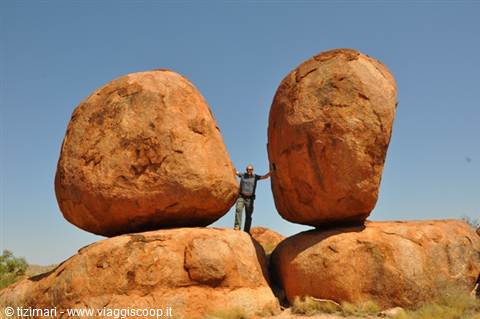
Renner Springs to Ellery Creek 799 km Second big transfer leg in the Australian outback; the only diversion in the monotony of the desert are the isolated and very characteristic roadhouses and the impressive road trains (up to 50 meters long) that supply these remote places. In the middle of the desert we reach Karlu Karlu (Devils Marbles), a series of rounded boulders in unstable balance that give the landscape an unusual panorama. A refueling stop at Barrow Creek and then at the Red Centre Farm, where vineyards are grown in the middle of the desert and a not-bad Cabernet Shiraz is produced, along with a mango ice cream that contrasts with the almost 50 degrees of temperature surrounding us. Before reaching Alice Springs we cross the Tropic of Capricorn again. Lunch in Alice Springs, provisions for camping in the MacDonnell Hills and at Kings Canyon.
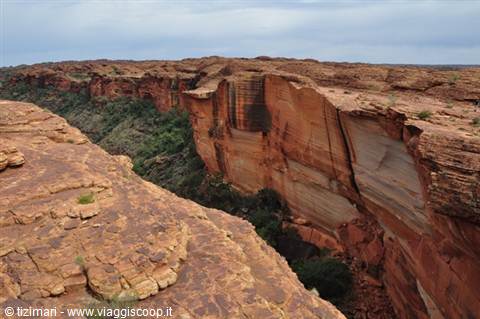
At the Alice Springs tourist office we also arrange the permit to cross Aboriginal territories. We thus reach Ellery Creek, where we camp near the waterhole in the canyon. Night sky observation with a telescope thanks to our French astronomer friends, eclipse chasers. Wednesday, November 21 Ellery Creek to Kings Canyon 320 km Today about 300 km of track await us to reach Kings Canyon. First stop at the ochre pits, from which the Aborigines extracted and still extract the ochres used for traditional paintings. The tones range from ochre to violet to white. We then reach Ormiston Gorge, a walk and a swim in the cool water pool inside the gorge, a true blessing in this desert area scorched by high temperatures. We continue on Larapinta Road, passing alongside enormous craters caused by meteorite falls.
Wild horses and camels are the rare encounters on this red track that cuts through the heart of Australia to reach the Kings Canyon area, which we reach by now at sunset. Dinner and the night at the Kings Canyon campground.
0 reader comments