The story
Greenland is still a distant destination, to be understood not as distance, but in the sense of different and strange… far from our society and from the landscapes we're used to. The great north begins at 66°33' of latitude (the Arctic Circle) and ends at 90°, the North Pole; that at least is how it's marked on the maps, but in reality it's a place without borders that summons the sphere of the imagination to mythical expeditions and that today offers the traveller exciting adventures, in areas little frequented by tourism.
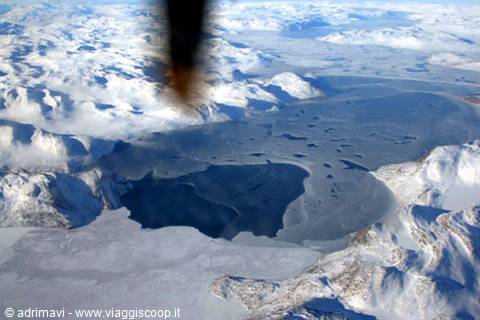
Greenland. Ilulissat. Winter. Early March. Four days to spend at 69°23'40'' of northern latitude, a good 280 kilometres beyond the "Arctic Circle", in a forgotten corner of the planet. Aboard a Dash-7, the twin-propeller plane that connects Kangerlussuaq to Ilulissat, eyes glued to the windows for all 45 minutes of the flight, indifferent to the deafening noise of the twin-engine, Greenland appears for what it is: "a frozen world". On the right, in the direction of travel, the ice cap, an immense white expanse that fades into the distance; right below, the ice floe, which still covers the stretch of sea closest to the shore, broken here and there, signs of the arrival of the fine season; on the left the open sea, free of the pack, where enormous islands of ice, the icebergs, float.
The fascination Greenland exerts is enclosed here: the ice, the landscapes and the extreme weather conditions. In this scrap of town at the edge of the universe, in winter, you arrive only by plane, …and not always. Ilulissat, even before being a well-defined physical place (69° of latitude and 51° of longitude), is a place that, depending on your point of view, is sublime and merciless, excessive and limited, fortunate and apocalyptic. A small town lost among the Greenlandic ice, where people live their drab life with dignity and a marked sense of community. The dark, freezing, bleak winter yearly claims its victims.
The scourge of alcoholism first and foremost and, then, suicides, which spread more and more until they become the leading cause of death among the young, struck by depression for lack of light and distraction, oppressed by the narrow confines within which their existence unfolds, frustrated by the impossible environmental reality. That's why on 13 January, every year, the small community seems to awaken to new life, when the sun returns to peep out after the long Arctic night (2 months of total darkness). There is joy and celebration on the hill of Sermermiut. What for us is an anomalous oddity is, especially for the young, a sad condition of life. If you don't give in to alcohol, you make love. Ilulissat teems with children and nurseries.
Ilulissat, "the city of icebergs", (in the Inuit language) lives alongside the ice with a community of nearly 6,000 dogs, so numerous that they outnumber the town's 4,700 inhabitants. They are the Eskimo, a pure breed, since it's not possible to bring any dog into Greenland, precisely to preserve this species, strong enough to withstand the rigours of the climate and to endure long fasts. Of vital importance to the town's economy, they serve to pull the sleds in the winter period, in particular to go hunting. Sled dogs are part of the landscape. You hear them barking and howling continually. They live tied to ropes about six metres long and their living space is a miserable patch of earth. Only the puppies and the pregnant females are allowed to roam freely around the town.
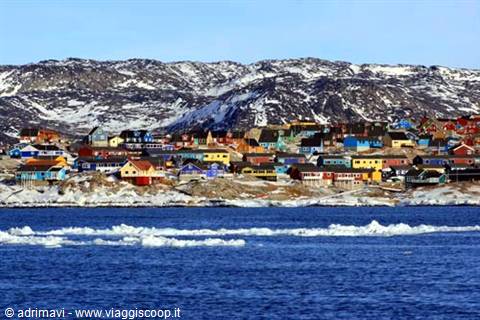
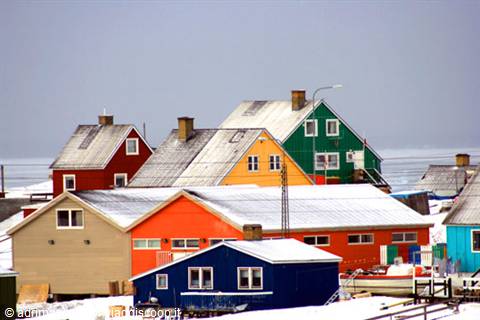
The old dogs, by now useless, are deliberately left, without a collar, so that they become easy prey for the municipal dog-catchers who shoot them down with rifles. The houses are all in bright colours: blue, sky-blue, red, orange, yellow, green; this to alleviate the long nights and the gloomy days of bad weather. The streets are a continual up and down and end at the edges of the town. The only asphalted one, outside the town limits, is the one leading to the airport. The road surface frozen all day makes them dangerous not only for pedestrians (mind how you walk); but for the cars themselves; many are the dented vehicles that skid because of the slipperiness. There is a single industry and it's at the port. It's Royal Greenland, which processes prawns and other kinds of fish, giving work to most of the population. The port is semi-frozen and there are boats still locked in the ice.
To be counted among the most remote towns on the planet, Ilulissat is worth visiting not only for the supreme art form of its icebergs, which dominate the bay in front of it, but for its unusual way of life, or also, simply, because it makes you think So then the point is this: an idyllic place or a baleful one? What place does Ilulissat occupy in the global village? Is it about to open up to the world or is it exactly the opposite? Each will have their own personal answer. That of Silver, whose real name is Silverio Scivoli, ex-Corvi, the "legendary" sixties group, owner of the Tourist Nature agency, together with his son Crhistian, a charismatic figure — he gave his answer some time ago, …he has lived there now for thirty very long years.
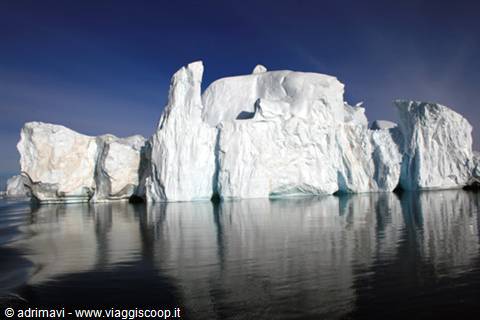
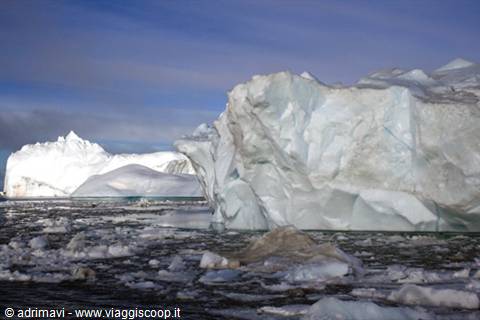
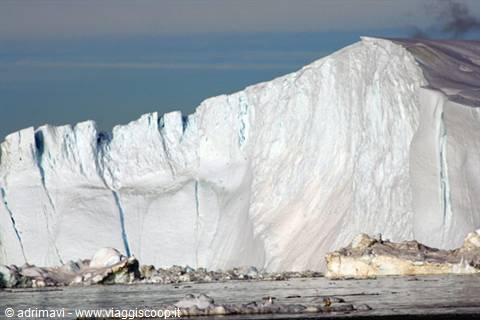
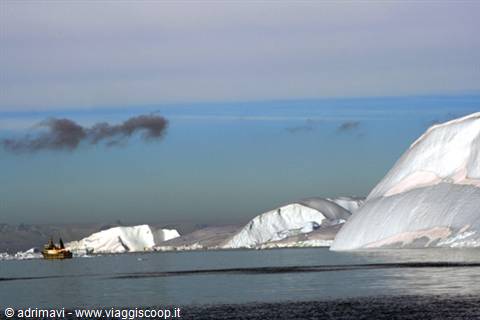
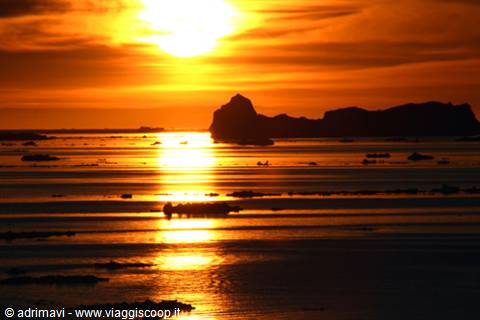
The bay in front of the town is the famous one of Disko; the melting pack is the sign of nature's reawakening and the now imminent arrival of spring, but above all the sea is no longer imprisoned by the ice and this means that it's possible to make the boat trip to Iluminaq. To get there you must of course pass through that arm of sea which hundreds and hundreds of icebergs, broken off from the ice cap, reach after descending for about 30 km the Kangia Icefjord, the fjord of Ilulissat. When the front of the Sermeq Kujalleq glacier, which boasts the greatest iceberg production of the whole northern hemisphere, comes into contact with the sea water, the warmer temperature of the sea causes blocks of ice to break off, giving rise to monolithic icebergs. A paradox of nature: water is a substance that in its solid state weighs less than in its liquid state, which is why icebergs float.
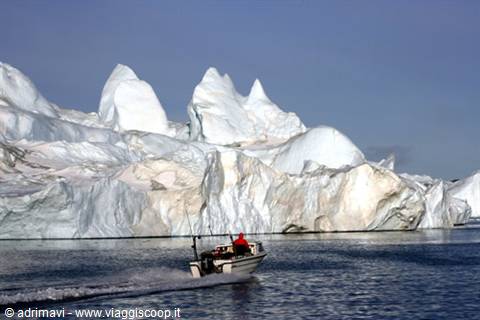
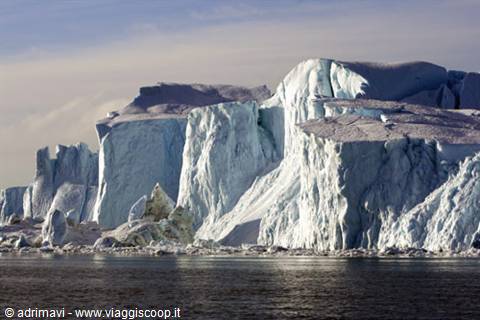
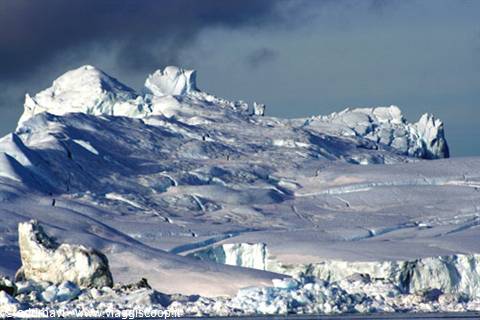
Once in the open sea the currents push them south…, and it was precisely from here that the iceberg set off which, south of Newfoundland, on the night between 14 and 15 April 1912, sank the Titanic. These icebergs of extravagant dimensions and shapes, all together, form the strangest and most marvellous of open-air museums, made up of thousands of monuments of ice: obelisks, boulders, columns, peaks, pinnacles. Each iceberg is in itself a unique work. Here, for a moment, the ice age still seems a reality. You cannot imagine the size they reach; a hundred metres high and more, a kilometre long and more. The waves of the sea crash against them like breakers against the rocks. We pass close by them, almost grazing them; I wonder whether it's dangerous, since beneath the emerging part lies hidden a mass seven times greater than the visible one.
Sinister thoughts assail me when we see in the distance a block of ice collapse into the water, breaking what until then had been the only sound: the creaking of our boat. I understand, at last, why the Inuit have almost a hundred different words to define ice, made up as it is of a myriad of streaks and infinite colours: white, grey, blue, indigo, azure, pale blue, turquoise, light green, plum, lilac, pink. The ice floe (the pack) is still particularly solid and thick near the coast, so much so that the boat cannot advance and so one is forced to pass further out to sea. In the course of the
The journey's photographs
16 photographs · click to open them full screen



1 reader comments
un viaggio insolito e fantastico... foto bellissime!!!!!