The story
A trip to Yemen, even today, means living adventures that lie between past and present. The journey begins already on the plane. The Yemenia airbus is empty and the few passengers on board are all Muslims. After five and a half hours of flight the captain announces to fasten seat belts because the landing is beginning. At this point the women who throughout the flight have been in jeans and t-shirt cover themselves from head to foot, leaving only their eyes visible. It's dawn, we haven't yet left the airport, but we immediately come into contact with that world we have come to seek when we see a group of people kneeling repeatedly in a corner on whose wall a mosque is drawn, indicating the direction of Mecca… they are the faithful praying to Allah. Having taken a taxi to the Sinbad Hotel, along the way what captures our attention is people's clothing.
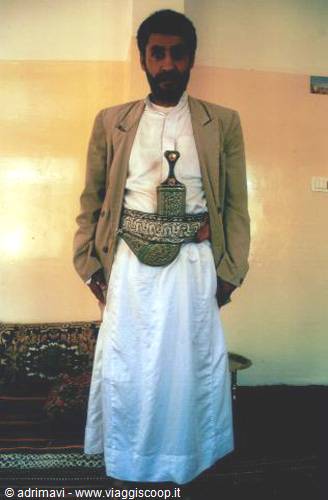
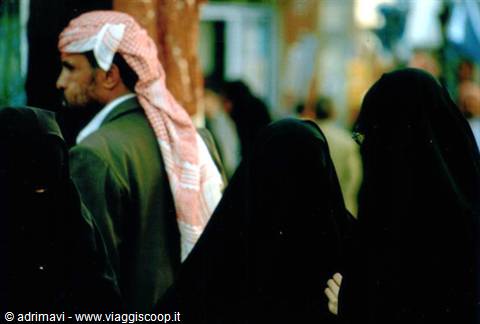
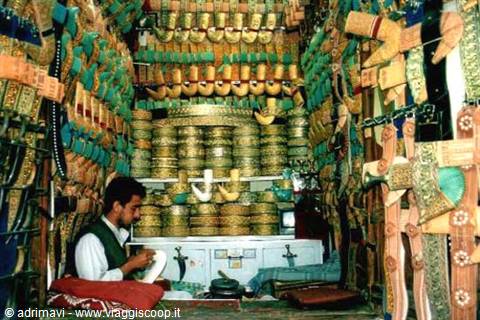
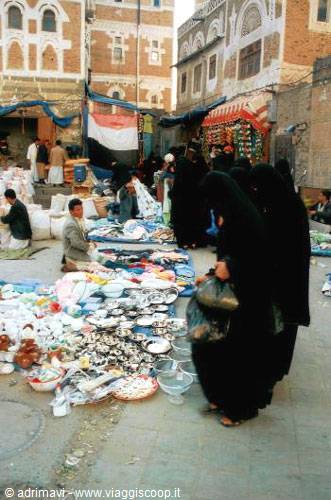
The men wear a tunic, usually white, called a kandoura or more simply a skirt. Few wear trousers, but all wear jackets resembling those worn back home on feast days in the sixties. On their heads, like a kind of turban but often just resting on their shoulders, they wear the ghutra, the white, black- or red-checked headscarf. Finally, at the waist they have a lavishly embroidered belt used to tuck in the jambiya, the unsettling curved dagger that all Yemenis always carry. Because of the long black cloak they wear, the abaya, that is what we Westerners call the full veil, the women seem like sinister presences, but they have a proud bearing as well as gaze, when it is possible to see it since the eyes are not always uncovered. Many, in fact, wear the burqa, a piece of cloth that covers the whole face. From the hotel you enjoy a beautiful view over Old Sana'a.
The soft light of the first rays of the sun strikes the tallest buildings of the old city. It feels like admiring a painting: the hotel is the gallery, the window frame is the picture frame and Old Sana'a is the subject. Capturing it a few times is a must. We are eager to immerse ourselves in the Suq al-Milh, the market made up of forty small suqs. We walk along Az-Zubayri Street, cross the bridge over the Sa'ila river, completely dried up, and find ourselves at the foot of imposing walls which we follow as far as Bab al-Yemen. Here, sitting next to their wares, not too far from one another, we meet some strange hawkers. They are about ten sellers of miswak, chewing sticks, which metaphorically we can call the Yemeni toothbrushes. They apparently contain fluoride and antibacterial agents, as well as refreshing essences.
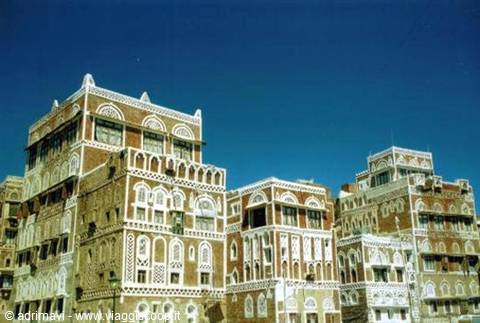
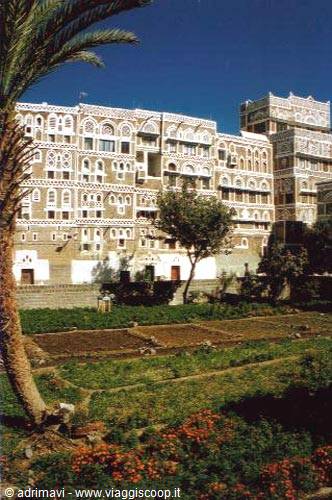
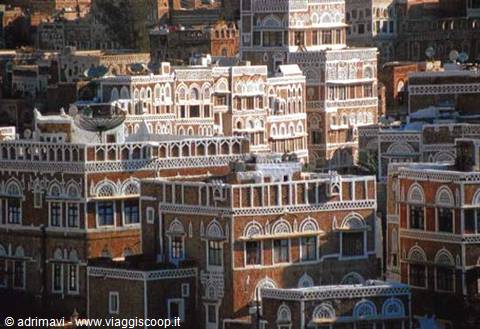
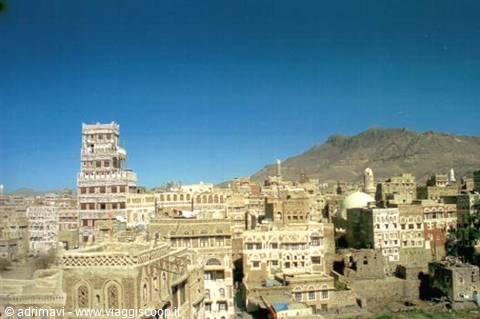
We stop at a currency exchange office, where we lose quite a lot of time counting the enormous quantity of hundred-rial notes exchanged for a meagre sum of dollars. Having passed Bab al-Yemen, the main entrance gate of old Sana'a, we have immediate confirmation that reality far exceeds the expectations we had formed about this city, truly without equal in the world. Beyond the gate, inside the walls, is the Yemen of times past. A phrase by Nino Gorio read before departing comes to mind: "Old Sana'a bursts into the third millennium by skipping the second entirely." Old Sana'a has indeed remained just as the travellers of old saw it; immediately you breathe an exotic and fairytale atmosphere thanks to the impressive throng of people and the characteristic tower houses, the tall clay-coloured buildings decorated in white.
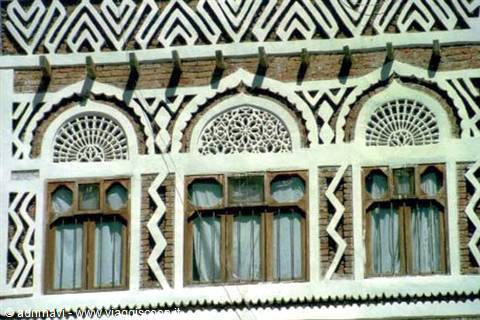
Besides the height of the buildings constructed with mud bricks, it is the fanciful ornaments plastered with gypsum that astonish a Westerner's eye. The manzar, the attics found on the roofs of the buildings, thanks to the white decorations recall the lace of grandmothers' doilies. The windows, once of alabaster, are today of glass, painted in various colours whose vivacity you appreciate walking at night, when the light inside the houses illuminates them in a thousand colours. In the two and a half days we stay in Sana'a, we do nothing but delve into this labyrinth of narrow streets where it's easy to get disoriented but impossible to get lost. The air is heavy with smells depending on the suq you're in: hides, silver, vegetables, cereals, ceramics, clothes, spices, qat… The last is the one that most intrigues us. Twigs of qat leaves are scattered everywhere.
The highly sought-after leaves of this tree are rich in ephedrine, which is a stimulant, which is why qat is the national drug that Yemenis are accustomed to chewing for hours on end. If Sana'a is chock-full of little shops, Old Sana'a is overflowing with them: two metres by three, at most, and all raised slightly from the ground, with the shopkeepers surrounded by the merchandise, sitting on top of the merchandise, seemingly more intent, it would appear, on chewing qat than on selling. Before getting out of the walls we ask a young man, who had meanwhile begun to follow us to offer himself as a guide, what those yellowish-white stones we saw being sold here and there were. They weren't stones, but an aromatic resin, and precisely the famous myrrh.
In the late afternoon at sunset the buildings of Old Sana'a gradually take on the colour of bronze, while the white decorations seem to shine with their own light. After a delicious dinner at the Palestine restaurant we return to the hotel. Late at night, at 04.00 in the morning, a din wakes us and reminds us that we are in this incredible city. Causing this racket are the muezzins singing the adhan (the call to prayer) which spreads from the tops of the minarets, through the loudspeakers. We find ourselves in Sana'a in the middle of Ramadan, the month in which Muslims fast from dawn to sunset. The next day, Friday, is a holiday and the shops are closed, even those of Old Sana'a. Now, with so few people, we can wander freely and better appreciate the buildings of the old city, discovering fascinating hidden corners such as the gardens and vegetable plots.
We wander all morning and realise that one could wander endlessly through old Sana'a almost never taking the same street. We are enraptured, bewitched by this sort of medieval enclave, when an old man breaks the spell and brings us back to reality, telling us off because we are eating potato croquettes, something by the way permitted here to non-believers. In Saudi Arabia we would have been immediately arrested. "Ramadan…!". We try to justify ourselves to the old man, but he doesn't want to hear our excuses and continues on his way cursing in Arabic. After the incident we pay more attention so as not to offend the people whose guests we are. Tired of wandering we make a stop at the Golden Daar Tourist Hotel. From the top of its seven floors we watch the sunset after having waited for it for more than an hour sitting on the sofas of the mafraj drinking something.
When evening comes, the muezzins from the mosque loudspeakers announce the end of the fast, greeted, as every evening, with the start of the feast (of Eid al-Fitr) and the city suddenly fills with life. A coming and going of people rushes to eat every kind of dish in the kiosks and restaurants. In the street actual makeshift banquets are set up, stormed by the people who stuff themselves with everything. We collect the luggage left in the care of the hotel reception and, having taken a taxi, we set off for the airport…the journey is over.
The journey's photographs
11 photographs · click to open them full screen


0 reader comments