The story
Arrived in Anatolia (the Asian part of the country) by Turkish ship that had left from Ancona, we disembarked at Çeşme, a port town facing the Greek island of Chios. Once the customs formalities were completed with my Fiat Punto and in the company of a friend, I began the long itinerary, heading inland as far as Sardis. This city was famous in antiquity for its King Croesus; today it preserves some imposing remains of the royal palace, visible even from the road, and, a little further on, along a stream once sacred, the bases of the columns of a temple. Continuing south along a hilly road we reach the imposing remains of Ephesus, perhaps the greatest archaeological excavation of the classical world, certainly very evocative, with amphitheatres, gymnasiums, temples and libraries. The sacred way, slightly uphill, is still paved, and the remains of palazzi and temples overlook it.
Continuing south we climb a hill where we find the remains of another ancient city, Priene. The excavations are nothing compared with what we saw at Ephesus, but their position on a height makes them very special. Yet archaeological remains are not always comparable to the fame of the city they testify to: such is the case of Miletus, a little further south, which offers us above all an amphitheatre set in the countryside, near which some sheep graze, heedless of history. Our first intense day, entirely devoted to the Hellenic poleis of Asia Minor, brings us in the evening to the splendid temple of Didyma. Whether it is fascinating because among those seen it is the best preserved, or because seeing it in the evening the lights make it particularly interesting, I will never know, but it is certainly a pleasure for the eye and a plunge into history.
Since we must fill ourselves not only with culture but also with food, we do so in a nice but expensive restaurant that offers fish and a view of the temple. We still have the strength to go on and stop to sleep in a very nice guest house inside a wooded area on the road to Miletus. It was a bit late and perhaps the rooms were full, but the landlord gave us a room nonetheless that was presumably his daughter's, woken late in the evening to make room for us!! The next day we headed for Bodrum, a truly beautiful city resting in a gulf and dominated by a promontory on which there is an interesting castle. After strolling along the elegant seafront and seeing the typical boats moored, we climbed the hill to visit the castle.
Seen from afar it is beautiful; from inside it is even more so, not only for the fine museum areas that take us back to the time of the Knights of Rhodes, for the courtyards and the gardens, but also for the fine views over the gulf that can be enjoyed from here. After this plunge into the Middle Ages we return to Greek classicism, stopping inland at Aphrodisias and its excavations. This city in the Hellenistic age was the cradle of sculpture, as some remains still decently preserved demonstrate. We continue to Pamukkale, famous for its splendid white limestone pools full of blue water. The effect is that of a snow-covered hill that we climb, not without difficulty, barefoot, right to the top. On the hill, behind the famous pools, are the ruins of another historic city, Hierapolis.
Back down in the valley and having taken the car again, we had to "flee" pursued by swarms of hotel touts, the first real nuisances of this journey — but they will not be the last. Our "flight" stops at Kurkuteli, where we sleep in a truly squalid little hotel, I would say "scary", especially as regards hygiene. The following morning we stop a short distance away, turning off into a nature park within which are the ruins of Termessos, whose inhabitants long maintained their independence, even getting the better of Alexander the Great. To reach them you must leave the car in a car park and continue on foot for about 50 minutes along a mountain path. At the summit we are rewarded by the unusual spectacle of the remains of a city once impregnable and above all by its amphitheatre. We retrace the path back, pick up the car and continue to the largest city of the area.
Antalya is big, modern, touristy, with grand avenues, fast food, but also the remains of ancient minarets and mosques; we had almost forgotten, amid all this Hellenism, that here we are in Islamic land. A fine public park faces the seafront, where we walk before resuming our itinerary. Next stop the archaeological area of Perge, where an unbearable heat awaits us but also an immense expanse of remains of palazzi, temples and agoras. What is left of two cylindrical towers introduces us to this journey through history, so much so that we can say Perge really pleased us. A few kilometres east and here we are at another archaeological marvel, the great amphitheatre of Aspendos, still excellently preserved and still used for performances.
We continue east to stop at Side, where the remains of a Hellenic theatre precede the port area where the typical large boats that we had already seen at Bodrum are moored. From here we set off for Anamur; up to the city of Alanya the road is good, but afterwards a difficult and impervious road awaits us. Although as the crow flies there are about eighty kilometres, we will have to face a narrow, up-and-down road full of hairpin bends brushing precipices on the coast, heavily used especially by heavy traffic. Driving here really makes you sweat, and the pleasure of crossing banana plantations does not ease our laborious driving. We finally reach Anamur, so tired and hungry that at the first open-air kiosk we stop to have dinner and sleep. The owners of the kiosk are very kind but try to cheat us in every way — and they succeed too.
The following morning we observe a few steps from the kiosk a medieval fortress half-surrounded by water that we had already glimpsed the evening before, then we continue east. Along the road we pass the medieval fortress of Kelesi, then, skirting the Mediterranean, we decide to stop for a few minutes; it is hot and I take the chance for a swim in a hollow between two rocks. A long transfer awaits us and, moreover, there is an unbearable heat, but fortunately there is air conditioning on full blast and a modern motorway that begins at Mersin and ends at Gaziantep. Before taking the motorway we stop at Silifke to change some money; coming off at Gaziantep one enters another world — we have left the Anatolian peninsula behind and we are in Mesopotamia.
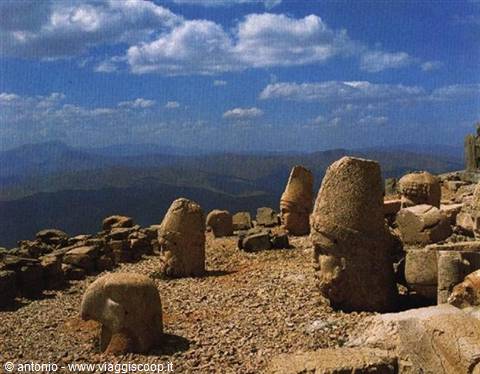
After a chance overnight stop, the following morning we reach the great Atatürk Dam on the Euphrates, viewable from a panoramic terrace, then we head for Nemrut Dağı, a high, bare mountain where there is a cyclopean monument depicting what remains of seated figures — they are the sovereigns of a small state of the classical era. To get here you must climb a mountain road, then park and continue on foot up a steep staircase. When you arrive at the monument you wonder how these enormous sculptures could have been brought up here. The road towards Diyarbakır breaks off abruptly before the banks of the Euphrates; we load our car onto a ferry where numerous locals loaded with goods, crammed trucks and bicycles find place with us. On the other side of the river we are in Turkish Kurdistan (see "Journey in Kurdistan").
On the return from Kurdistan we will continue along the Turkish roads with "Journey in Turkey - Part Two").
The journey's photographs
1 photographs · click to open them full screen
0 reader comments