The story
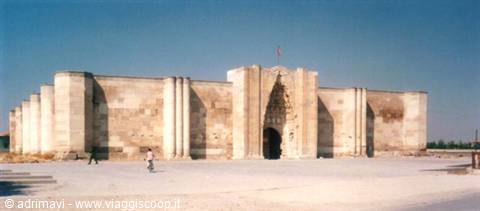
We cross the central Anatolian plateau, the heart of Turkey, covered with expanses of wheat fields bordered by long, tall rows of poplars. Travelling along secondary roads, we will discover sleepy towns, far from westernisation, where we will fully appreciate Islamic culture. In the manner of the caravans of times past, we too stop at the caravanserais to break the long hours of travel. The caravanserais were the rest stops of merchants and travellers, a sort of service station of the time. Today many are abandoned, others have been restored and, of them all, the most beautiful is certainly the one at "Sultanhani", which you will come across 95 kilometres after the city of Konya. When we stop, even in places we consider isolated, swarms of children appear from nowhere to ask us for small gifts, especially pens and notebooks.
We manage to satisfy them thanks to the supplies we had conveniently prepared on the basis of information received from previous travellers. In the small villages we are amazed to see men who, meeting, greet each other by shaking hands, like us, and then holding it until the discussion is over, or to see two young boys walking hand in hand, like a couple of lovers. One should not be surprised by this behaviour: in Turkey it is a sign of great friendship and respect. And the women? Here and there we come across groups of ladies not only with the chador, the veil they wear on their heads, but also with their faces covered. We are surprised because we did not think we would meet any in the now westernised Turkey.
In Konya, city of the whirling dervishes, we encounter Islamic spirituality by visiting the Mausoleum of Mevlana, unmistakable because of the sumptuous and towering emerald-green dome. Mevlana, the greatest mystical poet of Islam, buried here, makes the place an important pilgrimage destination. Barefoot and with the girls respectfully covering their heads, we mix among the pilgrims and pay homage to the poet Mevlana too, accompanied by devotional music and in the strictest silence. Not to be missed, in the visit to the Mausoleum, is the adjoining room where you can admire the miniature depictions of the many Qurans kept there in special display cases: fine, elegant and of precious artistic workmanship, they are authentic masterpieces.
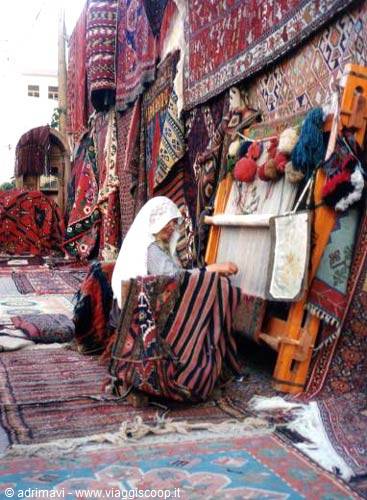
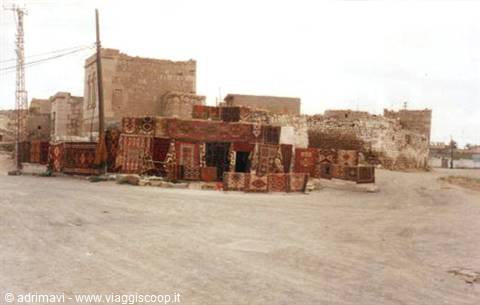
It will be a great regret not to manage to see the dervish monks performing their mystical whirling dance, famous throughout the world, which symbolises the desire to detach oneself from the ground and free oneself into the air, up to the sky. The dervishes perform the ritual only on the days when Mevlana is commemorated, so we have to settle for merely hearing the beautiful melodies intoned during the dances. Huge or small, in bright or soft tones, simple or decorated, for prayer or for domestic use, of silk, wool, cotton or kilim… "carpets" are the undisputed protagonists of Turkish daily life, especially in Konya. In every direction you see nothing but shops and warehouses in which men, women and, unfortunately, also many children are busy at the loom, working the carpets. Unmissable, then, during the bargaining, is the apple-flavoured tea offered to all potential buyers.
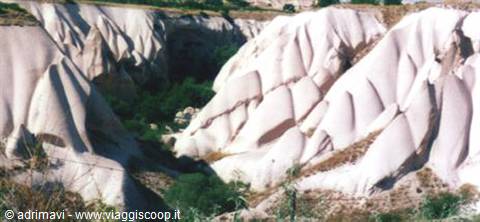
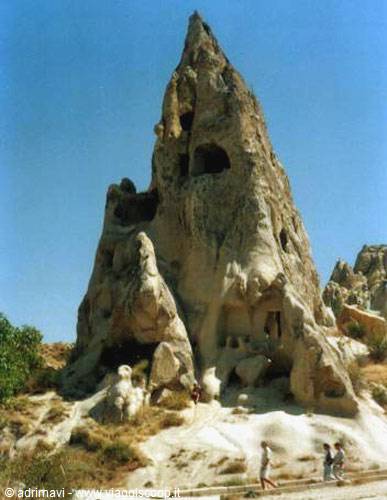
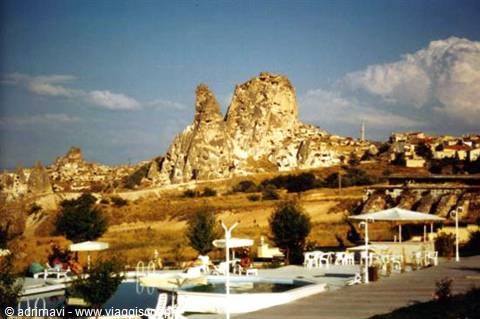
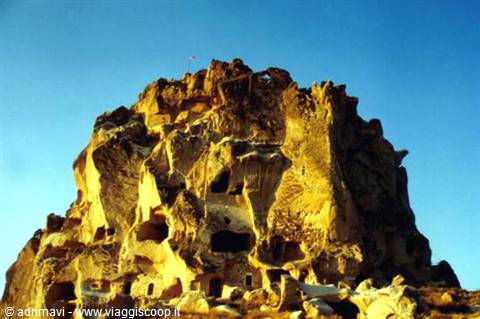
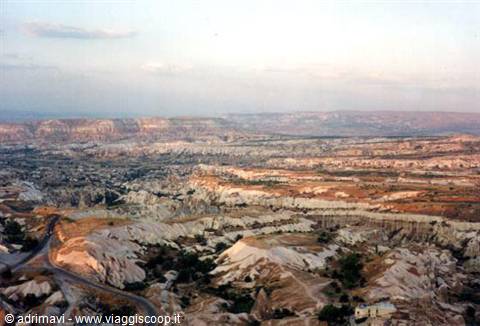
The next day we leave Konya and our journey continues towards the legendary Cappadocia, that area around the city of Urgup that offers a fairy-tale and surreal landscape, unique in the world, generated millions of years ago by violent eruptions that covered the entire plateau with lava, ash and mud. Later, this material petrified unevenly. It was shaped by the combined action of winds and rains that eroded it, creating astonishing canyons, ravines, pinnacles, cones, etc., etc. All crowned by unimaginable underground cities (Derinkuyu), rock churches (Goreme) and fortresses (Ortahisar and Uchisar). The base of our excursions will be a hotel, at the foot of the fortress of Uchisar, a construction literally immersed in nature, so much so that it blends with the surrounding environment. On the day of our arrival we witness, from the top of the "Fortress of Uchisar", the daily rite of sunset.
The setting sun cloaks the whole region in a golden and pinkish light. It would be unforgivable to miss this wonderful spectacle. The next day, our tour begins from the isolated valley of Ihlara where a gigantic crack in the ground forms a deep canyon which, to tell the truth, we visit to shelter from the scorching heat, drawn more by the shade of its high walls than by its beauty. Speaking of the weather, it may seem incredible, but during the two days of our stay in Cappadocia, on the first we suffered the heat, on the second, perhaps, we would be exaggerating to say we felt cold; in any case, the temperature dropped to 15°C, precisely, by a good 20°C. After the valley of Ihlara it is the turn of a fascinating visit to the underground city of "Yeralti Sehri", in Derinkuyu, which is only one of the many that exist in the area.
These cities, whose streets are genuine tunnels, to give an idea, on the model of mine tunnels, had grain stores, stables, bedrooms, kitchens, water and air conduits, as can still be seen and easily visited thanks also to excellent lighting. They have been perfectly preserved and it could not have been otherwise given their hidden existence. They were used by Christians in the 7th century to escape persecution, but their origins are much older. By taking refuge in these hidden cities, the Christians thus avoided the iconoclastic conflict with Byzantium. The underground city of "Yeralti Sehri" in Derinkuyu is unimaginable! How many could think of a city, no less than eight floors deep, carved into the bowels of the earth, more than a thousand years ago? Before returning to the hotel, for a longed-for swim in the pool, we go to the rock fortress of Ortahisar.
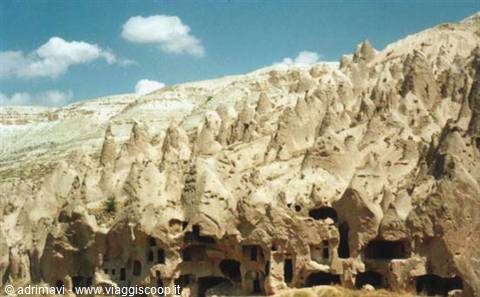
Climbing up, through the various holes in the rock, you can admire fabulous views even before the spectacular panorama enjoyed from the top, on which the Turkish flag still flies as it once did. The next day we get up early in the morning to admire, this time, the sunrise from the belvedere of the "Valley of the Fairy Chimneys", the most incredible place in all of Cappadocia, a confused and chaotic jumble of cone-shaped rocks and pinnacles, a myriad of stone obelisks. The Valley opens right on the side of the road, between Cavusin and Zelve, and it really seems you have ended up in a fairy tale, so enchanted is the place. During the day we will also see Zelve, whose dwellings carved into the rock blend so harmoniously with the landscape as to make it one of those rare areas in the world where man's work seems at one with nature.
Outside the archaeological site of Zelve, in the surroundings of the village it is easy to see some of these dwellings, rightly called troglodyte, still inhabited today. Near Cavusin, then, you come across rocks that would look like gigantic meringues were it not for the lack of cream. We finally reach the "Goreme Open-Air Museum", a monastic complex of rock churches and chapels dating back to the 10th and 13th centuries, that is, in the full Byzantine and Seljuk period. The frescoes preserved inside are splendid. Here too, as before, who would ever have said that inside these large conical rocks there were unsuspected and astonishing rock churches hidden? In Goreme there are even restaurants carved into the rock, exclusively reserved for tourists.
The journey's photographs
10 photographs · click to open them full screen

0 reader comments