The story
We end up in Doha in the middle of the Iraqi crisis. The Americans have set up their headquarters since 6 March at the As Sayliyah base, near Doha. The capital of Qatar plays an important role on the political chessboard of this delicate area, the Persian Gulf. Qatar, in fact, is certainly not a tourist destination. Given its modest size it hasn't much to offer the traveller. Without fear of being contradicted, it's among the least sought-after tourist destinations in the world. The country only began issuing tourist visas from 1989 onwards, and only recently has the hereditary absolute monarchy in power decided to open up to tourism, but to elite tourism. Qatar promotes international-level events in golf, tennis and motorcycling, and recently the national football team met Milan in a friendly match. Despite everything, Qatar remains a country not geared to tourism.
Somewhat by chance we find ourselves in Doha to capture, as far as possible, the characteristic features of this society of the Arabian peninsula, only slightly more liberal than Saudi Arabia, but certainly more backward than Bahrain, Kuwait and the Emirates.
During the not-so-simple customs formalities we're separated; the men on one side and the women on the other. Cece and I, just as much as Mavi and Ila, are thoroughly searched. They confiscate a bottle of wine from me, but at last we get out of the airport. An unexpected and annoying wind blows, an ominous foretaste of the winds of war to come. Four days later the new Gulf War will break out.
On the square outside we hire a taxi for a couple of hours. The driver doesn't understand English well, so I hand him the sheet with the itinerary jotted down (in English) on the plane: Corniche, Qatar National Museum, Tower O'Clock, Big Mosque, Al-Sadd Plaza, Shebestan Palace Restaurant, Doha Sheraton Hotel, Aljazeera T.V. Now he seems to understand and we set off.
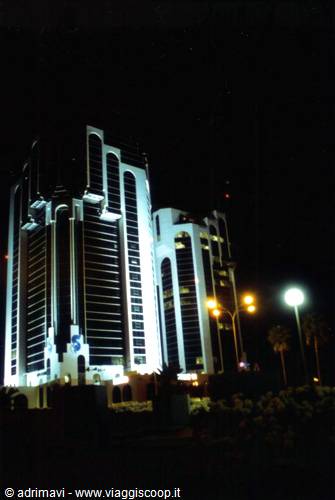
Almost at once we turn onto the road that runs the whole length of the Corniche, a crescent-shaped bay where, in the darkness of the night, the lights of the luxurious hotels lining it glitter. We momentarily leave the seafront to head for the Qatar National Museum, not to visit the precious collections it holds — also because, given the hour, it's closed — but to observe the building that until 1949 was the residence of Sheikh Abdullah Bin Mohamed. We continue towards the city centre, heading for the Tower O'Clock, the Big Mosque and Al-Sadd Plaza. At this point our driver first orders us and then forbids us to get out. We ask him: « Why, no possible? » We insist, assuring him we simply want to take a stroll and snap a few photos. « No possible! No possible! » keeps being his answer.
Until, after our incessant requests for an explanation, he loses his temper and threatens to leave us there. Having stopped the taxi at the roadside, he explains that the area is rough at night and, moreover, with the times as they are, Western tourists aren't very well regarded by the population. We don't know what to think. Qatar, from the point of view of social welfare, is one of the safest in the world. For example, education and healthcare are free, housing costs little or nothing, there's no shortage of work. All this thanks to oil. The citizens, moreover, have grown accustomed to Western foreigners in recent years. Could it then be precisely because of the war? According to what the newspapers write, the people of Qatar don't agree with their government's choice to side with the Americans.
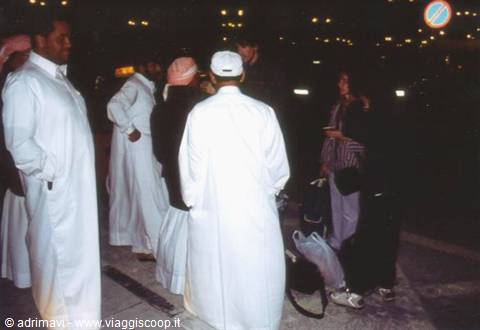
We're tempted to ask the taxi driver his opinion, then we hold back so as not to create further tension. The impression, though, is that in the capital of Qatar the conflict already seems to have broken out, and here more than elsewhere the war is experienced as a clash between West and Islam, even though the Americans strive in every way to make clear that it's a war against the Iraqi leader, Saddam Hussein, and not against his people. Looking around, you're struck by the men's clothing: they all still dress in the traditional way, that is, wearing a tunic reaching to the feet, strictly white, with the kafiyyeh on their heads, the typical Arab headscarf (red and white, black and white or completely white), and the 'iqal, the black cord used to fasten it to the head. On the streets, what strikes you even more is the absolute absence of women.
We're in one of the most conservative Arab countries. The condition of women is, by Western standards, anachronistic. Suffice it to say that only in the last elections held in 1999 did women vote for the first time — an exceptional event, so much so that the circumstance met with the disapproval of the neighbouring Arab countries. At yet another No possible, no possible! we give up, without having understood why we were prevented from getting out. We continue our night tour and this time it's only bad luck that stops us seeing the Shebestan Palace Restaurant, since it's closed. The restaurant, in the heart of the city, is famous not only for its cuisine but for its Persian-style architecture, with interiors straight out of the Arabian Nights, so much so that it has become a tourist attraction, like the Doha Sheraton Hotel.
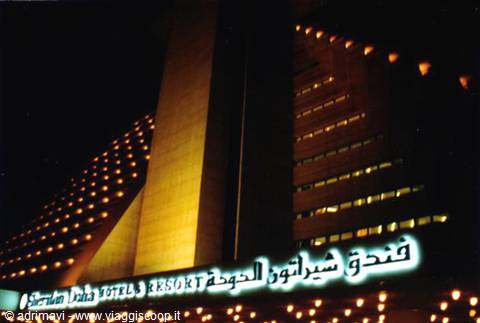
In the city you glimpse enormous portraits of the head of state, the Emir Sheikh Hamad bin Khalifa Al-Thani, a feature of all the countries of this geographical area, where the figure of the sovereign appears everywhere. Before reaching the Doha Sheraton we take the Corniche again, at the end of which the famous hotel stands. It stands out from afar for its spectacular pyramid-shaped architecture. The hotel offers a wide range of luxury services, from the fitness centre to tennis and squash courts, and various restaurants and cafés. The entrance and the lobby are enormous; there's a fountain and real palm trees. Two lifts, entirely of glass, go up and down continuously. The floor is white, immaculate marble, or otherwise covered with large carpets. A night in a suite costs as much as the whole holiday we've just spent in Sri Lanka.
To finish our round there remains only the visit to Aljazeera T.V., nicknamed the Arab CNN. Once again the taxi driver starts cursing, in English, « No possible. No possible. Danger!. Danger! » According to him the broadcaster, which became famous for airing the images of Osama Bin Laden after 11 September, is a target at risk of attacks. He explains that he's afraid, he has a family, and for all these reasons he refuses to take us. Now the impression we had a little earlier becomes reality: in Qatar the conflict, seen as an opposition between the Western world and the Arab world, has metaphorically already broken out. Back at the airport we decide to go, still, as far as the McDonald's, which is no more than three hundred metres away. We discover that the "McArabia" burger really exists, but, above all, inside we see three women completely covered in the typical black Islamic mantle.
The contrast of their rigorous dark clothing clashes with the gaudy colours of the place. Their behaviour almost embarrasses us; to me it feels as if I'm desecrating their customs and habits. We realise how different our society is from theirs.
It's time to go back. We check in, they give me back the bottle of wine confiscated on the way out... in six hours we'll be in Milan.
The journey's photographs
5 photographs · click to open them full screen

0 reader comments