Tripscoop›Middle East›PALESTINIAN TERRITORY, OCCUPIED›Between Guns and Barbed Wire (Before the Wall)
PALESTINIAN TERRITORY, OCCUPIED · Middle East
The story
After an unsuccessful attempt to obtain a visa for Syria in Amman, we decide to head for Jerusalem; we'll leave Damascus for another occasion! We reach the Allenby Bridge, from where we will enter the West Bank to reach Jericho and Ramallah. At the border post with Israel the checks are tight, the cars are searched inside, upside down; we enter the West Bank, so much barbed wire, and then it really feels like changing world: half-destroyed houses, roads that end in an abyss without warning, skeletons of cars and trucks here and there. Ramallah is a garrisoned city; we glimpse in the distance the building that houses the Palestinian government, and all around life goes on in the typical chaos of Arab souks.
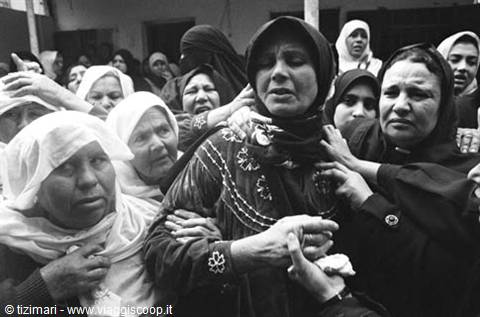
The suffering of this people can be felt on every street corner, the anger is felt on your skin, it seems impossible to be able to live in a situation of this kind, and yet most of the children around us have never seen anything but weapons and war. They play among the remains of an armoured vehicle or a burnt-out car. After the First World War the Ottoman Empire disappears, defeated. The League of Nations divides the military and political control of the Middle East between Britain and France. Palestine is under the British mandate.
Meanwhile the "Zionist" project develops, a movement and an organisation among Jews from all over the world, but mostly from central-eastern Europe (Germany, Poland, Russia) which, for various inspirations — the flight from the grave persecutions of the late 1800s (pogroms), the utopia of a form of communist society and economy (the kibbutzim), the stimulus of colonialist economic groups (interested in controlling the Suez Canal and oil) and finally a religious component that aspires to return to the Promised Land — promotes Jewish migration to Palestine and sets the goal of founding a Jewish national state. For almost 30 years the British government pursued a policy oscillating between favouring immigration and banning it when it came to dampening the hostility of the surrounding Arab nations, especially the oil countries.
From the lands that the Zionists bought at a high price from the old Ottoman landowners (almost always resident far away, in Damascus or Baghdad), the Palestinian inhabitants were driven out. Already in 1920, 1926, 1936 there were clashes and riots, not so much for religious reasons as for economic and social causes. During the Second World War, Nazi persecution, the Holocaust and the refusal of Western countries to take on the Jewish refugees forced hundreds of thousands of them to take refuge in Palestine. The situation became increasingly difficult to control. The British government renounced the protectorate. The United Nations decided to divide Palestine into two states, one Jewish and one Palestinian. Jewish terrorists killed the Swedish diplomat Folke Bernadotte, appointed by the UN as mediator.
The surrounding Arab countries rejected the partition and went to war against the State of Israel, self-proclaimed on 14 May 1948. A year later, at the end of the war, Israel had enlarged its territory. Jordan controlled part of Palestine and of Jerusalem (the West Bank and East Jerusalem). Egypt controlled the "Gaza Strip" along the Mediterranean coast. In June 1967, while an international press campaign had presented to Europe and America an Israel threatened with extermination, Israel exploited the situation and, thanks to its enormous air and technological superiority, attacked the Arab states and carried out a second invasion of Sinai, indeed continued the war even after the Arab states had accepted the truce, going on to occupy the entire eastern line of the Suez Canal, the fertile West Bank and the strategic Syrian Golan Heights.
And immediately a "Second Jewish colonisation" began and at the same time the exodus of the Palestinians, forced for the second time in twenty years to abandon everything to the Israelis. The "Six-Day War", far from being defensive, turned out to have been conceived solely as the first stage of the Zionist expansion plan. The "lightning war" was immediately followed by the creation of agricultural-military defence posts. On a large scale, oil exploitation in Sinai began, the international character of Jerusalem was ignored, and finally the Labour minister announced that: "the current borders are non-negotiable". For how much longer??
The journey's photographs
3 photographs · click to open them full screen

0 reader comments