The story
I arrived in Jordan on a one-day excursion from Taba (Egypt), where I was staying for a week. I was with a friend and other people took part in the trip. We reached the country by the Red Sea, crossing the Gulf of Aqaba, here really very narrow (about ten km), from Taba to the little harbour of a large tourist village on the Jordanian shore. The little harbour lies south of Aqaba and is charming, surrounded by new-generation tourist facilities such as residences, a welcome centre and luxury shops. Here we are welcomed by a local guide and board a bus, setting off for Petra. The road passes through Aqaba, Jordan's only port, located right opposite the Israeli city of Eilat, from which it is separated by the short Arava plain.
From a distance Aqaba and Eilat look like a single urban centre, and only as you get closer do you realise that between them there's an empty space, a no man's land that inexorably separates them. Seen from the bus windows, Aqaba doesn't look particularly interesting; the guide moreover tells us that the buildings are all recent. We take the desert highway that we meet right up against the city. It's the Wadi Rum desert: harsh mountains totally devoid of vegetation but rich in polychrome shades in which pink predominates, standing out on the horizon. These mountains hold the sand at their feet, carried here by the wind from the Arabian desert. Wadi Rum is the desert where Lawrence of Arabia operated, but to find the spectacular corners shown in the film with Omar Sharif we'd have to go deep inside; instead we skirt it, heading further north.
Our destination is Petra; before reaching it we stop to admire the Valley of Moses, which with its steep stone mountains appears inaccessible and inhospitable. On a mountain shaped like camel humps stands out a tiny, very white structure: it's Aaron's tomb. The remains of Moses's brother were brought up here from Mount Sinai by a local sultan. Near Petra there's a little town in whose valley some vegetation comes to the surface; we stop at a souvenir shop where we're offered hot tea. We then arrive at the archaeological area of Petra, the ancient capital of the Nabataeans, a pre-Roman people who came here from Saudi Arabia. The Nabataeans built their city in a place difficult to access, protected by harsh mountains and separated from the rest of the world by a very narrow canyon, the Siq.
The city had considerable urban development, it imported architectural styles from Egypt and Greece, blending them with their own Arab traditions, and it used cutting-edge water-supply techniques. Petra's peculiarity is that the buildings were not erected from scratch from the foundations but were created directly in the rocks that surrounded the canyon and the surrounding valleys. In practice they were nothing but rock dwellings, but they were given beautiful and mighty facades by carving the rocks of the mountains with fine decorations, columns and capitals. Precisely because these palaces and temples were carved directly out of the mountain, many of them have survived to this day. The Nabataeans were also excellent engineers and managed to solve the water-supply problem by taking advantage of the impermeability of these mountains.
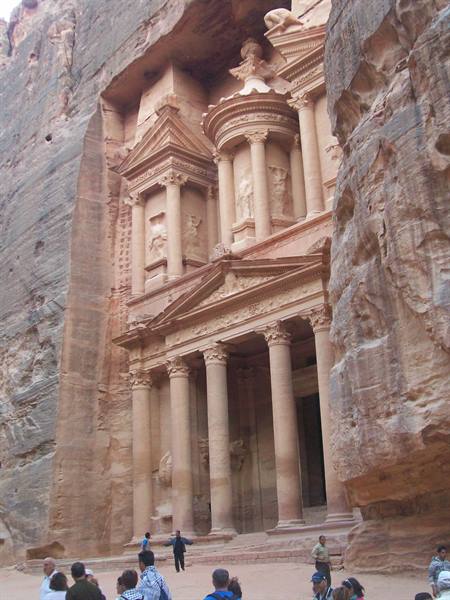
They surrounded the city with numerous cisterns that held the water from the rare but abundant rains and then distributed it in the urban centre through a truly cutting-edge system of channels. We make our way through the long, narrow canyon that winds between the pink rocks streaked with numerous polychrome concretions like a painter's palette. The sun rarely manages to break into the canyon, but when it does it enhances the colours of these stones, which change shade according to the light they receive. The canyon is constantly crossed by horse- and camel-drawn carriages carrying tourists led by Bedouins wrapped in their distinctive headgear. At the end of the canyon the spectacular sight of the Treasury of the Pharaohs opens before our eyes, the most famous and best-preserved monument of Petra. Seeing it, it seems the canyon walls open up to frame it like a curtain in a theatre.
And when you reach the clearing the Treasury faces onto, it's so beautiful it seems unreal, also because in fact everything carved in the rock has been there as a set for thousands of years. The columns don't have to support anything, and the pediments too, interrupted by a niche where, according to tradition, the treasure was kept, don't hold up any roof. The interior, on the other hand, is disappointing: practically a cave that, like the other buildings, was first a tomb and then a dwelling. From here the city extends for kilometres and kilometres; we choose one of the routes that takes us into a valley on whose mountains the remains of numerous palaces are clearly visible, though they lack the definition and perfection of the Treasury of the Pharaohs. Here too is Petra's Roman part, with the remains of the Temple and a modest amphitheatre.
We have lunch in this area at a buffet restaurant, then take the road back to the bus parking area. The route is quite long, almost 8 km there and back, but really pleasant; in every corner Petra has something to offer. The guide explains that these rock dwellings were inhabited by the Bedouins until a few years ago and that the Jordanian government had considerable difficulty in moving the population to a nearby village built for them. Back on the bus, we return to the little harbour south of Aqaba, where we board the ferry that in less than an hour takes us to Taba in Egypt. A few notes: Petra is very beautiful; alone it's worth the trip to Jordan. The visit involves about four hours on foot, but those who don't feel up to it can cover the whole route or part of it by horse, dromedary or donkey.
The first stretch on horseback from the entrance to the start of the canyon is included in the ticket price but a compulsory three-euro tip is required. The following stretches are paid and not cheap, though you can haggle. In Jordanian shops haggling is essential and the price suggested by the trader is generally more than double what you'll manage to get.
The journey's photographs
2 photographs · click to open them full screen

0 reader comments