The story
Carved out of a magnificent landscape, hidden as it is among the cliffs in which it is sculpted, the mythical Petra, the pearl of the Nabataeans, has kept all its charm intact through the centuries. Its wonderful treasures remained unknown for entire eras. Until 1812 nothing was known of the existence of the city and its monuments. The local Bedouin jealously guarded the ruins, which they used as stores and warehouses for their merchandise. The legendary "rose-red city" was discovered by the young Swiss traveller Johann Ludwig Burckhardt, thanks to his tenacity. Travelling between Damascus and Cairo he heard the local people speak of the existence of an extraordinary city hidden among the mountains. His explorer's nature led him to look for it, but only his tenacity, his conversion to the Islamic faith and his knowledge of Arabic allowed him to blend in easily with the local population.
All this, however, was still not enough. He had to devise a ruse to be accompanied to the site, and so he passed himself off as a Muslim pilgrim who had to sacrifice a goat for a vow made to Aaron. He therefore hired a guide and had himself escorted there.
Thanks to its long isolation, Petra still preserves many of its monuments, despite the centuries, the wear of time, earthquakes and sandstorms. Petra lives on, yesterday a destination for pilgrims and merchants, today for hordes of tourists. The caravans, setting out from Oman with their precious cargoes carried on the backs of camels, took three long and gruelling months to reach the city of Petra, after overcoming a thousand difficulties such as the bandits of Yemen or the hellish, sun-scorched sand dunes of Saudi Arabia. For the traveller of those times, Petra must have been like the beckoning call of a distant comet, and its sudden appearance in the middle of the desert had something mystical about it.
After two thousand years, Petra still exerts an equally irresistible pull and charm, but the journey to reach it, however unusual it may be, is attended by quite different perils from those of the caravan drivers of old.
We will reach Petra in two days. We leave from Malpensa and in about four hours we arrive in Sharm el Sheik. The next day we take a bus along the Sinai coastal road to Nuweiba, and there we set sail for Aqaba, in Jordan. After completing the customs formalities, at the port exit we are set upon by a swarm of taxi drivers and literally shoved right and left so as to be bundled into one taxi rather than another. The intervention of the customs police is not only timely but decisive, and they seat us in the oldest man's taxi. It will be the only annoyance caused to us by the kind and cordial Jordanian people. Arriving in the city of Aqaba we rent a car and set off immediately for Petra, even though it is already dark. When we arrive, most of the places are already closed. On the main street, a kebab street vendor is still turning his mutton on the grill.
Proud that two tourists might eat his food, he invites us to sit on two big stones at the edge of the pavement and lays the table for us, complete with tablecloth, on an upturned crate. Besides eating two tasty kebabs each, we get to make friends with Mohamed, from Amman.
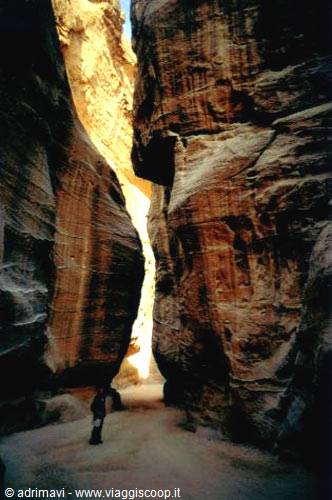
What indescribable relief the travellers must have felt when they reached Petra. After paying the toll for entry to the city, the high walls of a fantastic canyon called the Siq, the main access route to Petra, formed a cool oasis of shade. The channels cut into the walls carried running water with which one could refresh oneself and drink. In November the sun sets at 16:30 and rises at 06:30, so the hours of daylight must be used to the full. Early in the morning, even in the mild Jordanian autumn, it is cold in the Siq. The aqueduct channels, here and there destroyed, are still clearly visible. The walls rise to 200 metres high and narrow to 5 metres at their tightest point.
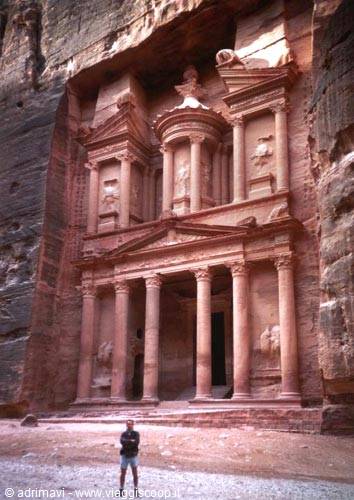
Just when you begin to wonder whether the Siq will ever end – the canyon is a full 2,000 metres long, but I recommend walking it – the unmistakable outline of Petra's most important and beautiful monument, the Treasury (Khazneh), appears at the bottom of the narrow gorge. As with all the monuments of Petra, carved into the rock, the most fascinating element is the 40-metre-high facade. The merchants' caravans arrived in long Indian files. In an instant they passed from the solitude of the Siq to the crowded square in front of the khazneh where the city market was held; the clamour of the people and the smells of spices and burnt food must have hung in the air. Such a bustle of tourists was what we expected too, but we find nothing of the sort. Perhaps it is the early hour, perhaps the season, but the Treasury and the whole of Petra seem to be ours alone.
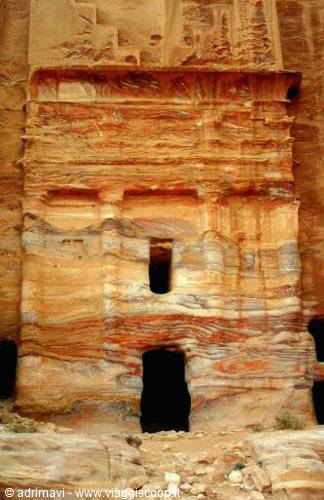
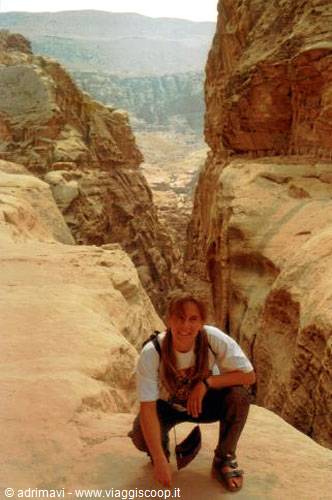
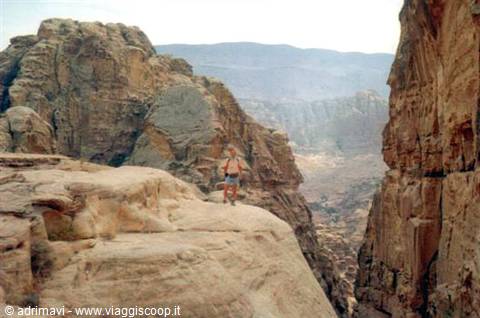
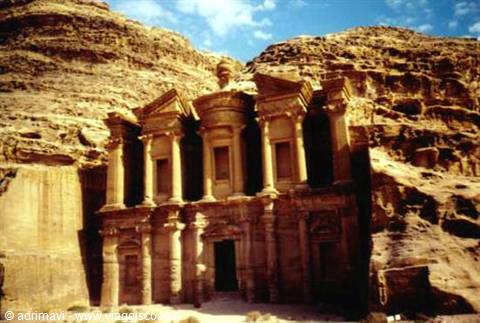
Walking among the cliffs and ruins you understand why three-day tickets are sold: Petra is enormous. To this day, 800 monuments have been catalogued and the archaeologists' work is still not finished. For those with only one day at their disposal, I recommend climbing at least one of the many heights that make up the city, not so much for the tombs – the most beautiful are in the lower part – as for the panoramas you can admire during the walk. The paths are spectacular and the more difficult passages are made easier by steps cut into the rock. Petra is beautiful. Don't rack your brains reading up on which tombs are most worthy; instead put away the guidebooks and simply prepare to walk. There is, however, one monument that must not be missed: the Monastery. It is as impressive and sumptuous as the Treasury, but unlike the Treasury this one must, so to speak, be earned.
The climb (starting from Qasr al Bint) takes at least 45 minutes and a height gain of about two hundred metres. The Monastery is even larger than the Treasury, being 50 metres wide and 45 high. From here, a short walk leads to a magnificent viewpoint over the Wadi Araba, a full 1,500 metres below, mostly in Israeli territory.
To visit Petra at dawn means seeing the Bedouin preparing for a new day's work. In 1985, when it was declared a World Heritage Site, the Bedouin left the city at the request of the Jordanian government, on the agreement that they could work inside Petra as labourers for archaeologists, as sellers, or continue to graze their goats in the surrounding countryside. The only prohibition was that they must not stay overnight in the site. So every morning the Bedouin still pitch their black goat-hair tents, some to sell cans of Coca-Cola or Pepsi, others handicrafts such as sand bottles in different colours, terracottas or old coins. These are the ones who have benefited most from state aid, but there are still those faithful to the nomadic Bedouin spirit who love to camp in the open and graze their flocks, few in truth. The army guards turn a blind eye and let these last holdouts live.
You will meet them along the less-trodden paths of the city, far from the main attractions, such as Sharif. I wish you the encounter with one of them. Many Sharifs roam Petra. Men bound to their origins and who love their land. They will not offer themselves as guides; rather, you will have to press them to take you on, and in the end it will be even harder to reward them.
The journey's photographs
9 photographs · click to open them full screen


0 reader comments