WIND OF JORDAN (short account) For a long time I had wanted to visit Jordan, but various considerations had always made me give up. And yet, thanks to a last-minute offer, here I am: on a hot August morning, the voice of the muezzin wakes me in Amman, the "white city". The first emotions come during the journey towards the north-east of the country; suddenly, like mirages, the desert castles appear before us: the silence is broken by the hissing of a strong, steady wind. The next morning we set off for the north, towards the border with Syria and Israel. We stop at Umm Qays, a mountain village that holds the ruins of the ancient city of Gadara. From the acropolis you savour a vast panorama: on the left the Sea of Galilee, ahead the border with Syria and the Golan Heights, with the territories occupied by Israel.
A knot of emotion catches in my throat; we are in the land where Jesus Christ lived: nearby is the town of Nazareth, over there the Jordan Valley; here in front of us the miracle of the division of the loaves and fishes took place, and right here, at Gadara, Jesus helped the demoniacs. The simplicity of the village, with its little white houses among fig and olive trees, creates a haunting atmosphere, and it is very easy to imagine a figure wrapped in linen cloths who, in his sandals, treads these ancient stones.
Then quickly on towards the south, to visit fortified castles, built either by Saladin's Muslims or by the Crusader knights, to dominate and plunder the caravan routes heading for Mecca, as well as the Christian pilgrimages towards Jerusalem; among the old walls, the tunnels, the broad staircases of the ancient strongholds perched on the rocks, you can almost hear echoes of bloody battles. And then Jerash, the "Pompeii of the East", with its stunning oval plaza and the Colonnaded Street; on a small rise, the temple dedicated to Artemis, whose columns shine golden in the late-afternoon light and seem to defy, with their miraculously intact Corinthian capitals, the action of the wind, the ever-present wind. The next day, a long journey towards the south, towards Petra. First stop, Mount Nebo, the mountain from which Moses contemplated the Promised Land.
The place strikes us at once for its silence and its simplicity; from the top of the hill, on the natural terrace cooled by the wind, you enjoy a splendid view over the Jordan Valley and the Dead Sea; facing us, Jericho, Bethlehem and Jerusalem. Now we travel the legendary King's Highway, which follows the route of the biblical exodus of the Jews from Egypt. We pass along the winding road, then Mahdi, our Jordanian guide, prepares us for a clever twist, inviting us to close our eyes and open them again at his signal. A spectacular, lunar canyon suddenly opens before our eyes: admiring the breathtaking panorama over desolate plains, once again we realise how important the presence/absence of water and wind is for Jordan. Then the King's Highway opens onto broader, gentler valleys and landscapes, as far as the valley of Petra, the city of the Nabataeans.
The following morning, here we are at the entrance to the siq, which almost secretly leads into the heart of the city; it's from here that Mahdi works his masterpiece: entering the winding little path, he lets us savour the silences, the endless variations of light and colour, the different atmospheres you breathe, the thousand details that, usually, in the rush to reach the Treasury, go unnoticed by most tourists. Mahdi invites us to follow a relaxed pace, to notice patiently and attentively the contrasts between light and shadow, the shifts in colour, to touch the sandstone, so pleasant to the touch. Petra shway shway (slowly, gently), then. Now the rocks of the siq draw closer and seem almost to close over it: it's the moment of another piece of magic.
Mahdi invites us to hold hands and walk with our eyes closed: after a few moments, in the blinding midday light, before us, towering, the Treasury. And then other temples, little temples, tombs dotted along the sandstone walls; mountains that seem to melt in the warm sun, slowly dissolving the architectural elements that decorate them; blends of colour that seem produced by the harmonious action of a combining wind. Then we climb towards the Monastery, to let our gaze roam over the peaks of the surrounding mountains and admire canyons and deep valleys. And it's Mahdi's moment, the mystic. He gets five minutes of perfect silence from us, during which we listen to the voice of the wind whispering and shouting, by turns, obscure messages. We retrace our steps, heedless of the effort, reliving the emotions we have felt.
We are grateful to Mahdi for the moments he offered us with kindness and attentive participation. An old Bedouin, sitting on the sand, intones an ancient song for us, accompanying himself on his traditional single-stringed "rababa". Mahdi tells of the simple, dignified life of these people, their sense of freedom, honour and hospitality... then he translates the Bedouin song for us: "It is the sun that is our strength, it is the moon that is our beauty, it is the desert that is our wealth. Black tent, but white heart. The colour of our blood is the same as the sand; of the scent of our coffee only rock remains" The next day we are travelling towards the "vast, echoing and divine" Wadi Rum.
In old off-road vehicles we venture into a landscape that's hard to describe: gigantic towers, enormous sandstone monoliths with a granite base, that seem to appear from the sand by magic; in the shade of a large acacia a child rests with his flock of goats... We take the road north again, towards Amman. I look at the city at sunset with new eyes: maybe it's the strange light of the moment, maybe it's the awareness that we have little time left to spend in this country, but now I feel I understand much more about the Jordanian land and its people. As we take our leave, with nostalgia, from Amman, the city wraps us in one last embrace, with its immense expanse of houses and little homes in white limestone, piled one on top of another. A large military plane flies low over the sky, reminding us that winds of war blow very close to us; not here, though, where a gentle wind lifts a kite.
This is the last image we carry with us of a country that, among all the other Arab countries, stands out for the kindness, warmth, sensitivity and dignity of its people; a foreign country, considered by many to be risky, in which we recognised a friendly country.
The wind from the north and the west, that carries memories of times past and harsh messages from neighbouring countries, at once distant. The tireless wind, that shapes and reshapes the hidden cities, among the mysterious stones of the south. The wind laden with suggestions, that whispers words of mystery on the tops of mountains and canyons of shifting colours. The helping wind, that caresses the skin scorched by the sun, in the desert of flour-fine sandstone.
The sweet and gentle wind of the white city, that lifts high, at sunset, the children's kites, messengers of peace.
Day 14 Aug 2004
Here I am, a week after my return from a tour of Jordan + a stay in Marsa Alam, trying to put on (virtual) paper the impressions, the emotions, the suggestions that make a destination chosen almost by chance a truly special journey (Mahdi and Vittoriano, Thank you!). Almost by chance in fact the choice fell on this destination: for some time Mauro and I had wanted to visit Jordan, but considerations of various kinds expressed by those close to us had always made us desist. This time, however, thanks to a rather convenient Turisanda offer, we decided to leave.
1st day-Wednesday 4 August - ITALY/AMMAN Departure from Milan Malpensa (terminal 2) with a Livingston charter flight to Marka airport in Amman. Scheduled departure time 2.20 pm; the plane is however more than two hours late. We're not complaining: we're in the crucial August period. We arrive at the small airport for charter flights around 9.30 pm. Most of the travellers will continue for the stay in the Red Sea; only about fifty people get off at Amman. We are welcomed by Vittoriano, Turisanda representative in Amman (in a few minutes all the formalities are completed) and Mahdi, our Jordanian guide. We look around, trying to understand who will be part of the Jordan tour group (38 people): some will then continue to Syria, others will do a mixed Jordan/Syria tour.
Long wait on the bus: one of our travel companions hasn't found his suitcase on arrival (it will be discovered that it was never loaded in Milan). Around midnight we arrive at the first hotel intended for part of the group (Radisson hotel - 5 stars - luxurious), then we are accompanied to the second hotel (Golden Tulip - 4 stars - less showy, but comfortable).
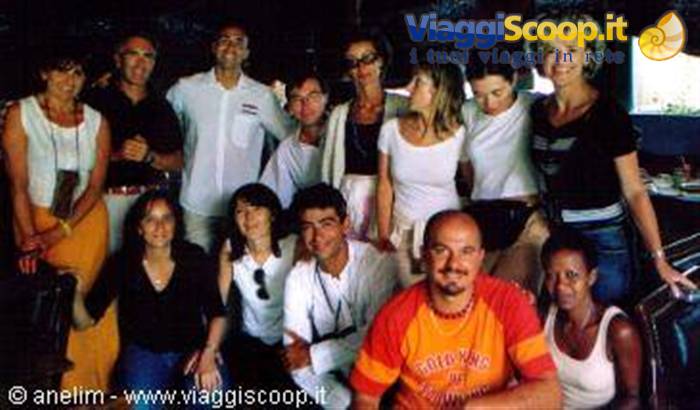
golden tulip group
Day 25 Aug 2004
2nd day-Thursday 5 August - AMMAN /DESERT CASTLES (100 km) At 8.30 am departure by bus for the North East of the country, on the borders with Iraq. Mahdi, our guide, studied at the University of Perugia and knows Italy very well. For our first day together he chose to wear a t-shirt with the map of Jordan: it will serve to help us orient ourselves in our first movements. We immediately realise that he will not be the usual guide-cicerone: Mahdi is not only very prepared, but he never misses an opportunity to try to bring us closer to his country, pointing out even the smallest details to us. First approach with the city of Amman: the "white city" is modern, clean, served by good roads (traffic flows fast). Passing through the more "poor" neighbourhoods, Mahdi points out the presence of many Egyptians, who make up the country's workforce.
The most strenuous jobs are left to immigrants by Jordanians who, equipped with a high average level of education, prefer public employment or more remunerative professions (many Jordanians work in Saudi Arabia). Jordan does not have many natural resources (potash, phosphates) and invests a lot in education. Jordan's school level is very high and the government policy invests much of its resources in this sector. Schools are present even in the most remote centres and those who tackle their studies with good results can access the best state universities.
After several km in an arid and monotonous landscape (the signs with directions for Baghdad and Iraq make a certain impression), during which our guide tells us about the partition of these lands by the victors of the Second World War, we arrive at our first destination: Qasr al-Kharanah, an ancient square-plan caravanserai, in the middle of the desolate desert plain. It is a tall and massive stone construction, decorated with the characteristic frieze with bricks laid diagonally: the rooms on the lower floor were used as stables for the caravan drivers' animals; in the centre of the large courtyard a basin collected the rainwater. The rooms on the upper floor are well preserved and retain medallions and "dog-tooth" friezes.
From the platform at the top you enjoy a vast panorama over the territories of the neighbouring countries (Iraq and Saudi Arabia), the silence is broken by the whistling of a strong and constant wind. The Qusair (diminutive of Qasr = castle) Amra, is our second destination: declared a UNESCO world heritage site, it is a small hunting castle, a small palace that reserves unexpected surprises for us inside. Outside, a well 40 metres deep and a noria (a mechanism for drawing water) bear witness to the need for a lot of water for the hammam (calidarium, tepidarium and frigidarium) of this hunting lodge, which the Umayyad caliph Al Walid (who interpreted Islamic precepts with ease) had built around 710.
What makes this construction an unusual little pearl are the decorations of the rooms: forbidden frescoes of dancers and women bathing, scenes of hunting and daily life, which survived the destructions of the iconoclasts; intimate alcoves with decorations of gazelles and bunches of grapes, in which the gallant encounters of the not exactly orthodox caliph took place. A curiosity: in the blackened ceiling of one of these rooms, someone believes they can make out the image of the face of Jesus Christ. A few more km and we arrive at Qasr al Azraq, an ancient Nabataean fortress and, in 1917, the headquarters of Lawrence of Arabia. It is a stronghold with mighty walls, built in black basalt (lava pebbles bear witness to the presence of small volcanoes in the area in distant eras) near an oasis once rich in water (canalisation works now bring the precious liquid to Amman).
Originally the construction, which is entered through a door with very heavy stone panels and which includes towers, stables and a small mosque in the centre of the courtyard, was much larger, but most of the structures collapsed during an earthquake in 1927. The journey was not very tiring: the temperatures are mitigated by the dry climate and the omnipresent wind. After dinner, therefore, first evening outing: Vittoriano accompanies us who, although having been in Jordan for a very short time, guides us confidently through the fearsome city traffic and the busy streets adjacent to the hotel, in the (local) shopping area of Gebel al Hussein.
golden tulip group
Day 36 Aug 2004
3rd day- Friday 6 August - AMMAN/ GADARA/AJLUN/JERASH In the morning departure for the North, towards the border with Syria and Israel. Along the way we encounter many Palestinian settlements. Golda Meir defined Israel as "a land without a people for a people without a land", but, given the number (18) and density of these Palestinian camps set up in Jordan in 1948 and 1967, one understands that that land was not exactly without a people. We arrive at Umm Qays, a mountain village (380 m above sea level) that houses the ruins of the ancient city of Gadara, the "new Athens", one of the most important cities of the Decapolis (in Jordanian territory the other cities were Philadelphia-Amman, Gerasa and Pella), the league that united ten city-states that depended directly on the Roman proconsul Pompey.
After walking along the Roman cardo, we reach the acropolis and suddenly, before us, a vast panorama opens up: on the left the Sea of Galilee (Lake Tiberias), ahead the Golan Heights, with the territories occupied by Israel (a plateau that Israel hesitates to return to Syria because it draws a third of its water needs from it) and the border with Syria. A knot of emotion catches in my throat; we are in the land where Jesus Christ lived: nearby is the town of Nazareth, over there the Jordan valley, with the lake near whose shores, according to the Gospel, the Nazarene spoke to his followers; here before us the miracle of the division of the loaves and fishes was accomplished and right here, at Gadara, Jesus cast out the demons that had taken possession of some inhabitants of the city.
The simplicity of the village, with its little white houses among fig and olive trees, more than the majesty of the ruins of the Roman city, creates a suggestive atmosphere, and it is very easy to imagine a figure wrapped in linen cloths who, with his sandals, treads these ancient stones. We visit the ruins of Gadara: the decumanus (the road that crosses the city from West to East) which, unusually, is larger than the cardo (from North to South), the well-preserved theatre (Mahdi is sorry because it has not yet been cleaned of papers and cans, annoying traces of a performance the previous evening), the baths.
We go back on the coach and return south towards Ajlun, where the Arab fortified castle of Qala'at ar-Rabad is located, perched on the top of a hill (1000 m above sea level) dominating the entire surrounding area, which is considered one of the best examples of Arab military architecture. The Castle of Ajlun, built by Saladin in the 12th century to dominate the caravan routes heading to Mecca, towards the South, as well as the Christian pilgrimages towards Jerusalem, resisted the invasion of the Crusaders. Today is Friday, a feast day for Muslims, and the site is visited by many local tourists: Ajlun is a cool holiday resort rich in greenery. The castle is majestic, full of towers, galleries, staircases and spacious rooms; from the terrace of the central tower you enjoy a splendid 360° panorama over the fertile Jordan valley.
The words of a song by Fabrizio De André accompany us on our approach to the next destination.
"King Charles was returning from the war his land welcomes him, crowning him with laurel. In the sun of the warm spring the armour of the victorious Lord flashes. The blood of the Prince and of the Moor redden the crest with identical colour but more than the body's wounds Charles feels the longings of love....."
Charles Martel returns from the battle of Poitiers (F. De André - P. Villaggio)
Mahdi shows more and more that he is an exquisite, intelligent and very special person. His knowledge of Italy never ceases to surprise us and his words make us understand and make us see with new eyes the country that is hosting us. We thus arrive at Jerash, ancient Gerasa, one of the best-preserved cities of the Roman Empire. After lunch, accompanied by an excellent khobz, a delicious Arab bread fresh from the oven, we find ourselves under the triumphal arch built in honour of the visit of the emperor Hadrian, flanking a hippodrome, ready for the visit to the "Pompeii of the East".
Having passed through the south-Philadelphia gate of the city walls (which extend for 3.5 km) we are welcomed by the stupendous oval plaza (90 x 80 m), surrounded by 56 columns with Ionic capitals; for some scholars it was a forum, a place designated for commerce, for others a sacred area (témenos) in front of the temple of Zeus. From here begins the Street of Columns, the very long cardo (800 m) still equipped with the original paving, on whose sides are massed remains of columns, magnificent capitals, friezes of temple pediments.... The site is very popular, also because in July the very important International Festival of Gerasa takes place in the city, commissioned by Queen Noor, wife of King Hussein, in 1981.
The ancient street is travelled by local tourists, by women covered from head to toe, accompanying their numerous children; our gazes and theirs meet, in the attempt to understand something more about our respective habits and cultures... We watch an impromptu ballet by some children on a school trip, who try their hand at a typical Jordanian dance on the balustrade of the Nymphaeum, accompanied by the rhythmic clapping of our hands and those of their parents. The great nymphaeum, a monumental fountain rich in marbles and stuccoes, bears witness to the presence in the area of much water, water that flowed around and was transported through canalisations. This morning Mahdi wore a t-shirt with the image of the temple dedicated to Artemis, and here we are in front of this building, the most important of Gerasa.
The temple, dedicated to the patron goddess of the city, stands on a small hill, and with its columns seems to support the sky above. The columns shine golden in the late afternoon light
golden tulip group
Day 47 Aug 2004
Day 4 - Saturday, August 7 - AMMAN/ MOUNT NEBO/ MADABA/KERAK/PETRA (260 km) Today a long journey awaits us toward the South, heading for Petra. First stop, Mount Nebo (710 m), at the highest point of a small mountain range. It was from the top of this mount that Moses, at 120 years of age, contemplated the Promised Land, which he and his generation were forbidden to enter. "... From the steppes of Moab, Moses went up Mount Nebo, and God showed him all the land: all Naphtali, all the land of Judah as far as the Western Sea, the Negev, the district of the valley of Jericho. God said to him: - this is the land I swore to Abraham, to Isaac and to Jacob.
I have let you see it with your eyes, but you shall not enter it..." (Deuteronomy) His tomb was never found, but the Christians of nearby Madaba built here, on Gebel Musa, in the 4th century, a basilica to commemorate the figure of the prophet. The place strikes us immediately for its silence and its simplicity. At the entrance of the avenue leading to the Basilica of the Memorials, a monument commemorates the visit of John Paul II in 2000. It is here that Michele Piccirillo carries out his work, a Franciscan friar, scholar, archaeologist and expert on mosaics, who accompanied the Pope on his visit to the Middle East. From the top of the hill one enjoys a splendid view over the Jordan Valley and the Dead Sea, facing Jericho, Bethlehem and Jerusalem. We enter the Byzantine stone basilica and immediately notice the extraordinary mosaic.
Hunting scenes with lions, zebras, panthers, bears, ostriches, spotted dromedaries, elephants: we are before a unique artistic work, which is also an important historical document on the local flora and fauna of the time and on the activities of the inhabitants of the area. The monks of the basilica managed to save the mosaic from iconoclastic fury, covering it with a layer of sand and placing over it another mosaic, with geometric motifs, which is now hung on the walls of the church. Only in 1976, thanks also to the work of Father Piccirillo, did the ancient mosaics reappear in their intact beauty.
It is hot inside the basilica (the roof is made of asbestos and the friars have long been waiting for help for a new covering) and we go out again onto the natural terrace refreshed by the wind, on which stands a bronze monument representing the staff of Moses, wrapped in the coils of a cobra. After stopping at a handicraft center (ceramics and beautiful mosaics) where disadvantaged young people also work, we head toward Madaba, the city of mosaics. Here, in the Orthodox church of St. George, we admire the exceptional mosaic map (560 AD) of Palestine. Originally the mosaic measured 15.7 x 5.6 m. and was made up of about five million stone tiles (not ceramic).
The Map of the Holy Land (including in the North between the Phoenician Tyre and Sidon and in the South Egypt; between the Mediterranean to the West and the desert to the East) is clearly legible: one can recognize the Jordan, the Dead Sea (with the fish of the river turning back because of the high salinity and merchants transporting salt on boats), cities such as Jerusalem, Neapolis (Nablus), Gaza, Kerak, Jericho.... We return to the bus and travel along the legendary King's Highway, with its 5000 years of history, which follows the route of the biblical exodus from Egypt of the Hebrews and which was one of the most important communication routes of the Middle East.
Lulled by fascinating music we travel on the winding road, then Mahdi prepares us for a clever twist, inviting us to close our eyes and reopen them at his signal: a spectacular gorge 1000 meters deep now suddenly opens before our eyes, it is the Wadi Mujib, with its impressive lunar landscape. Admiring the great canyon, with its breathtaking panoramas over desolate lands, once again we realize the importance of the presence/absence of water and wind for Jordan. Mahdi has us listen to music by Battiato: once again he has hit the mark.
"I will bring you above all silence and patience. We will travel together the roads that lead to the essence." F. Battiato, La cura
We then continue, climbing up sinuous and steep hairpin bends, to Kerak (950 m.), where the ancient Crusader fortress stands, built at the order of Baldwin, king of Jerusalem, in 1132, on the order of Pope Urban II. The stronghold stands in a privileged position, from which it dominates the entire valley; Kerak enriched itself with the taxes it collected from the caravaneers and pilgrims heading to Mecca. Considered impregnable, it became one of the strongholds of the Crusader kingdom of Jerusalem; it was besieged several times by the Arabs and fell into the hands of Yusuf ibn Ayyub Salah al-Din (Saladin), in 1188. The name of Kerak is linked to that of Reynald of Chatillon, martyr for the Christians, demon for the Muslims; a knight-brigand who extorted pilgrims between Damascus and Mecca.
He was killed by the hand of Saladin who, despite the epithet of "fierce" by which he is known, was in reality a gentle prince (it is said that, while besieging Kerak, he was informed of a wedding feast being celebrated in the castle; Saladin ordered his artillerymen not to strike the tower where the newlyweds were lodged). A moat separates the stronghold from the ancient city, the walls are imposing, even if they bear witness to a certain hastiness in execution; inside, a labyrinth of corridors, secret passages, halls with uninterrupted plays of light and shadow. We continue along the King's Highway, which now opens onto broader and gentler valleys and landscapes, and we finally arrive in the valley of Petra, the city of the Nabataeans.
We are staying at the Golden Tulip King's Way, one of the most recent 4-star hotels, which is located 4 km from the entrance to the city of Petra, on the main road north of the village of Wadi Musa, near the spring made to gush forth by the staff of Moses, because of which the prophet will be condemned not to enter the Promised Land. "And Moses lifted up his hand, and struck the rock with his staff and water came out abundantly" (Numbers, 20, 9)
golden tulip group
Day 58 Aug 2004
Day 5 – Sunday, August 8 – PETRA "Petra is the most beautiful place on earth. Not because of its ruins, but because of the colors of its rocks, all red and black with green and blue streaks, almost like little corrugations, and because of the shapes of its stones and spires, and because of its fantastic gorge, through which spring water flows and which is just wide enough for a camel to pass through. I have read an endless series of descriptions of it, but these absolutely fail to give any idea of it, and I am sure that not even I am capable of doing so. So you will never know what Petra is really like, unless you come here in person. Only images in a childhood dream sometimes appear so immense and silent." from T.E. LAWRENCE (Lawrence of Arabia), The Seven Pillars of Wisdom
And so we have reached the climax of our journey: Petra! The emotions this mythical city offers cannot be adequately translated into words, and the images imprinted on memory pile up in disorder, as if the mind refused to bring order to the impressions and suggestions registered. I will dwell as little as possible on describing the wonders of Petra, but I will try not to let slip the sensations I felt. At around 8:30 we leave the hotel to reach the entrance of the site. Mahdi points out the mountains that close the horizon: on the summit of the highest mountain, Mount Hor or Gebel Haroun, a white spot marks the cenotaph of Aaron, the brother of Moses, who died for having yielded to the idolatrous demands to worship the golden calf.
We enter the archaeological site and walk along a dusty road, accompanied by the requests of the drivers of horses, mules and dromedaries who, for a few dinars, would like to lighten our journey. But we are prepared to face a tiring day and to savor every moment. (One piece of advice: the carriages are really to be avoided; they have no shock absorbers and they turn the journey into an ordeal). And, after a few steps, we begin to encounter the first structures. The hidden city of the Nabataeans rises in an area of 9 sq km, situated on a plateau at about 900 meters of altitude, surrounded by high sandstone mountains, with sheer walls rising another 300 meters. The Edomites, enemies of the Israelites, were the first inhabitants, later driven out, in 500 BC, by the Nabataeans, nomadic Bedouins from the Arabian peninsula, who erected their capital in this place.
Strategically located at the crossroads of ancient trade routes (the famous incense route), Petra was crowded with merchants who brought their goods there from Damascus and Arabia, from the Mediterranean and from Egypt. Thanks to this strategic position, the Nabataeans were thus able to grow rich, controlling the merchants' routes, charging high duties for the passage of caravans and providing resources and supplies to men and animals for the continuation of their journey. Rock was not a problem for this population, so much so that their principal deity, Dushara, was symbolized by stone blocks and obelisks scattered even today in the siq and somewhat everywhere in the city.
In 63 BC the Romans tried to seize the city by launching a sudden assault, but they succeeded in their intent only in 106 AD, when Petra became part, it seems without putting up resistance, of the Roman province of Arabia. Although the Nabataean dynasty had by then died out, the local population coexisted with the Roman one for over a century. It was then absorbed by the Byzantine Empire, and, from the rise of the Muslims – except for the brief stay of the Crusaders who raised fortified guard posts on two nearby peaks – history is silent on the fate of Petra, until 1812, when an Anglo-Swiss traveler, J.L. Burckhardt, heard talk of an ancient city squeezed between impenetrable mountains and decided to go and look for it.
He knew how to speak Arabic and so, under the name of Sheik Ibrahim and disguised as a Muslim merchant, he recounted that he had made a vow to Allah to sacrifice a goat to the prophet Aaron, at his tomb on top of Gebel Haroun. With such a story he convinced two inhabitants of the area to guide him through the siq, the narrow dark gorge with sheer walls, in some points little more than a meter wide, which winds for almost a kilometer and a half between towering blocks of decorated and carved red sandstone. Suddenly, from the darkness of the siq emerged the first and most sensational monument of the city: the Khazneh, the Treasury. There Burckhardt sketched the building on his ample garments, then made a brief visit around the city and, as darkness fell, sacrificed the goat at the foot of the temple of Aaron.
Burckhardt's diaries on the discovery of Petra became public only five years after his death, in 1822, causing a great stir especially in England. Today Petra is a world heritage site of humanity, safeguarded by UNESCO. We are finally at the entrance of the siq, the winding path sloping gently downward, about 1 km and a half long, created by erosion and natural upheavals (the Jordan valley is part of the great African tectonic trench, called the Rift Valley) between two sheer rock walls up to 200 meters high, which almost secretly leads into the interior of the city.
Today one no longer smells the intense perfume of incense, of cinnamon, of myrrh, which forced merchants to sniff the smelly beards of billy goats to free themselves from the dizziness caused by the aromas of the spices; at most one notices the sharp trail left by mules and horses that sometimes travel along the gully (although it is now forbidden to travel through the siq on donkey-back, some local boys still manage to evade the rules). In the siq the waters of Wadi Musa were channeled in winter, but, following some accidents (in 1974 twenty-four French and Spanish tourists were swept away by a torrent of rainwater) appropriate modifications have been made.
And it is from here that Mahdi performs his masterpiece: entering the siq he lets us savor the silences, the infinite variations of light and colors, the different atmospheres one breathes, the thousand details that, usually, in the anxiety to reach the Treasury, are entirely unnoticed and neglected by the majority of tourists. Mahdi invites us to follow a relaxed rhythm, to notice with patience and attention the contrasts between light and shadow, the changes of color ranging from white to pink, to orange, to red, to light blue, to blue, to indigo, to sky blue, to purple, to touch the sandstone, most pleasant to the touch. Petra shway shway (slowly, gently), then.
We thus manage to notice the skill with which the Nabataeans, through conduits carved into the rock, channeled the precious water to the city, the ancient paving, the small temples dedicated to the stone deity, the first rock-cut tombs; we discover the graffiti, the traces left by man over the centuries: on a wall an erosion that seems natural reveals itself instead to be a large bas-relief, representing a caravaneer leading his dromedaries to drink! As the minutes pass the rocks, rich in ferrous minerals, become more and more colored with a deep ochre, which contrasts marvelously with the intense blue of the sky, above. And up there, with a little imagination, it is easy to imagine a Nabataean soldier checking the movements in the siq. Now the rocks of the siq draw closer and seem almost to close over it: it is the moment of another magic.
Mahdi invites us to hold hands and proceed with our eyes closed; excitedly we advance, noticing (even with our eyelids lowered) the sudden variation of light, and the passage from the silence that enveloped us to a sudden animation.
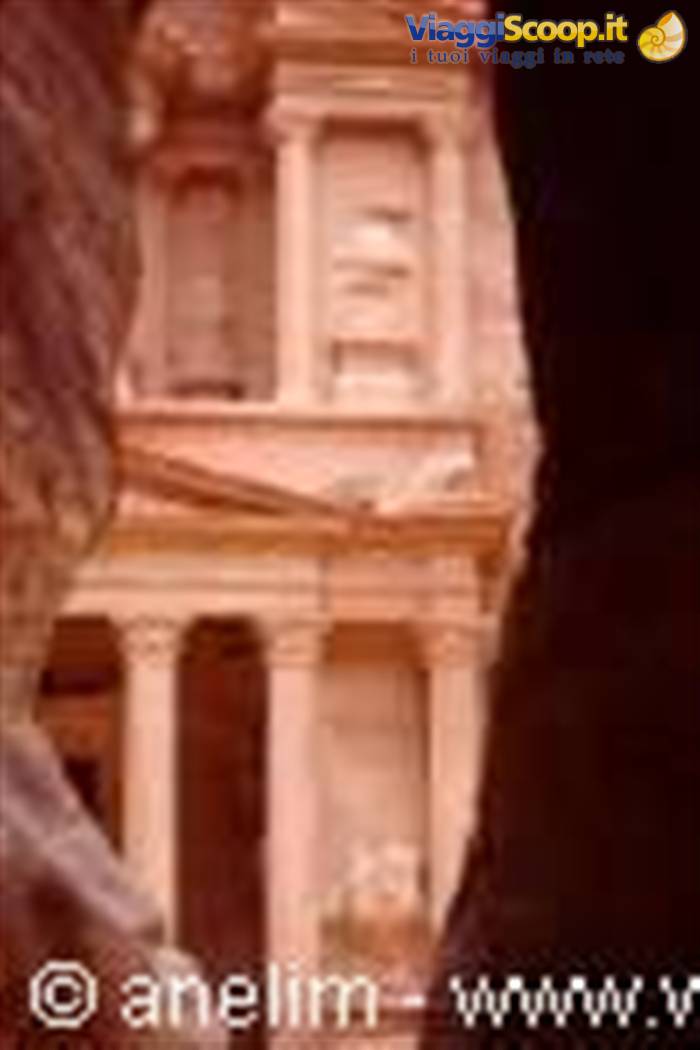
The Treasury facade carved in pink rock at Petra seen from the Siq
Day 68 Aug 2004
(continued)
A few more moments and we open our eyes: in the blinding light of noon, before us, imposing, the Khasné Firaun, the Treasury of the pharaoh. The stupendous facade is entirely carved into the rock for 43 meters in height and 30 in width. According to some theories it served as a royal tomb, but the very recent discovery of a series of tombs at the foot of the Khasné makes the hypothesis more probable that it may be a temple (the current level of the square should be a few meters higher than the original paving). It was called "Treasury" because of an old Bedouin legend according to which the treasures of the ancient city were hidden in the urn on the summit of the monument (which was, for a long time, the target of rifle shots by the locals).
In the square in front (témenos?) numerous tourists, mules, dromedaries, men with the characteristic white and red checkered headdress of the Bedouins. Guarding the entrance to the Treasury, a sentinel in official Jordanian uniform. After climbing a few steps we look inside. A completely empty room appears to us, perfectly squared and cut into the rock, up to about fifteen meters in height. On the ceiling, to the typical streaks of natural colors, has been added the black of the smoke due to the bivouacs of the Bedouins, who used these monuments as dwellings and shelters for animals. Probably only the priests had access here who, taking advantage of the acoustics of the room that amplified their voices (another trick of Mahdi), managed to influence the inhabitants of the city.
We then enter on the right into the Nabataean city, to discover the other treasures: everywhere natural niches, temples, small temples and tombs carved into the rock punctuate the sandstone walls; mountains that seem to liquefy in the hot sun, slowly dissolving the architectural elements that decorate them; mixtures of colors that seem produced by the harmonious action of a combining wind. The area of the necropolis is dotted with caves carved into the rock with incredible streaks of natural colors. A girl with deep black eyes beckons to me from a circular opening in a wall: she looks like an image inside a beautiful and very colorful frame. The child shows some colored pebbles she has collected and offers them to me for a few dinars.
But, previously, Mahdi had asked us not to buy the colored stones, to avoid a rapid degradation of the natural environment, and had asked us, above all, not to offer coins to children in order to safeguard their dignity. The girl, disappointed by my refusal, first tries to give me the stones, then, resigned, accompanies me for a stretch of the road. After admiring the Theater, originally Nabataean, then enlarged and used by the Romans, which holds 3,000 seats, and the tall structures of unknown function on a rise opposite, we rest and eat lunch in the restaurant adjacent to the small archaeological museum. Mahdi proposes an excursion to the Monastery, which will allow us to have a panoramic view of the area.
We therefore prepare to climb the more than 800 stone steps that lead to the Deir, or Monastery, accompanied by the music of reed pipes and the offers of rides on mule-back by Bedouin boys. A demanding hour-long climb through fantastic scenery awaits us. In the shaded stretches, under makeshift tents, Bedouin women in finely embroidered dresses invite us with dignity, discretion and without the slightest insistence, to look at the trinkets for sale on an improvised stall. We finally arrive at the top of the mountain where, after a last bend, there appears to us at 1200 meters of altitude and almost protected by the embrace of the summit of Gebel el-Deir, the imposing facade of the Monastery (it measures 45 m x 50).
A brief stop inside a cave equipped to welcome those who climb to the summit: we admire the Bedouin silver jewelry (these are objects from the foundation, voluto by Queen Noor, for the protection of craftsmanship) that are displayed here and, on comfortable carpets, we refresh ourselves with mint tea. Then once again we continue to climb until we arrive right at the top, to range with our gaze over the peaks of the surrounding mountains and admire canyons and deep valleys. And it is Mahdi's moment, the mystic. He obtains from us five minutes of perfect silence, during which we listen to the voice of the wind whispering and shouting obscure messages.
Earth by Gibran Kahlil Gibran
"With force and power the earth emerges from the earth, then earth moves upon earth with dignity and pride; and the earth raises from the earth palaces for kings, and high towers and squared temples for all, and weaves bizarre myths, severe laws and subtle dogmas. When all this is done, the earth is tired of the work of the earth, and from its light and darkness creates gray shadows, and sleepy fantasies, and fascinating dreams. The sleep of the earth then seduces the heavy eyelids of the earth, which close over all things in a deep and quiet sleep. And the earth calls to the earth, and says: "Look, I am a womb and I am a tomb; womb and tomb I shall be forever, yes, even when there are no more stars, and until the suns turn into death ashes."
We retrace our steps, then descending along the path that is now almost in shadow, stopping every now and then to keep the purchase promises we had made on the way up. We retrace the morning's route, without paying attention to the fatigue from the kilometers covered (13), reliving the emotions experienced. We are grateful to Mahdi for the moments he offered us with kindness and attentive participation. And it is precisely after the experience of this day that our vacation party transforms into a group bound by ties of friendship and affinity of feelings.
The Treasury facade carved in pink rock at Petra seen from the Siq
Day 79 Aug 2004
Day 6 – Monday, August 9 – PETRA /BEIDA/WADI RUM/DISEH This morning we head to Beida, "little Petra". It rises about 4 km north of Petra, at 1000 m of altitude; it is a destination little touched by mass tourism, but, thanks to its contained dimensions, it has its own surprising charm. Before arriving we notice, on the left, the village built by the Jordanian government to convince the local population to abandon the dwellings carved into the crevices of Petra. Most of the families live on the little that tourism, now much reduced, can offer them.
Mahdi announces that our visit to Beida will be enlivened by the company of many children; at our unexpected arrival, but very welcome, the little square in front of the entrance to the archaeological site quickly comes to life; a guard, however, despite the insistences of Mahdi who is clearly much loved by the local people, prevents the little ones from following us (some of them, however, further on, will peek out among the rocks). The sandstone walls of little Petra too are split by a deep and narrow crevice, the Siq-el-Barid, a passage little more than two meters wide.
After this narrow pass a small valley appears, and here are the testimonies of the ancient past: a temple with a staircase that invites you to enter and with triclinia that invite you to rest; another temple with four columns with Nabataean capitals (with eagles), with the rock that seems to want to engulf it again within itself; a cave, accessed by a staircase carved into the stone, with a barrel-vaulted room painted with vine shoots, symbol of fortune and abundance. Everywhere one notices steep staircases leading up toward cisterns: here the Nabataeans had devised a bold system of channeling, exploiting natural cavities, digging innumerable small channels, building wells for collecting water...
In Beida the caravan merchants, after the dryness of the desert, could stop and pitch their tents, refresh themselves and their animals; here the spices were sorted, before setting off again for Petra. An old Bedouin, sitting on the sand, intones an ancient song for us, accompanying himself with his traditional single-stringed "rababa". On the way out of the site the Bedouin women greet us, hoping for a purchase from us: we buy some decorated face masks with shells and little mirrors. And meanwhile, the children surround our guide. On the bus Mahdi tells of the simple and dignified life of these people, their sense of freedom, of honor and of hospitality, tells how his little friends keep him informed of their progress at school... then he translates the Bedouin song for us:
"The sun is our strength, the moon is our beauty, the desert is our wealth. Black tent, but white heart. The color of our blood is the same as the sand; of the perfume of our coffee only rock remains"
Naturally, I cannot hold back my tears. Accompanied by images of unreal hills and evocative music, we approach the "vast, echoing and divine" Wadi Rum (as Sir T.H. Lawrence described it), a marvelous geological complex of sandstone and granite mountains, with extraordinary shapes and colors. On our left the famous "Seven Pillars of Wisdom" extolled by the usual Lawrence; right here El Orens, as the Arabs called him, used to camp to discuss the plans of the revolt against the Turks. We stop shortly afterward in the Bedouin village of Diseh, inside the valley, where we have lunch. We taste local specialties based on chickpeas, yogurt, couscous, eggplant... then we throw ourselves into typical dances, accompanied by the music of waiters turned into drum players. And then out again, where old off-road vehicles await us for an excursion into the desert.
Some of us, to create a Lawrence of Arabia-type atmosphere and protect themselves from the desert dust, do not hesitate to wrap themselves in white or checkered keffiyahs. Our jeep sets off at the head, and immediately we plunge into this landscape difficult to describe: gigantic towers, enormous sandstone monoliths with granite bases, which seem to appear from the sand by magic; under the shade of a large acacia a child rests with his flock of goats... We get down to observe, on an enormous boulder at the edge of a desert plain, mysterious writings carved into the stone. They probably indicated to the nomads the presence of water: nearby, in fact, is a spring (now channeled), attributed to Lawrence, but, in reality, much older. Again our driver plunges along tracks hidden in the sand; through landscapes that evoke ancient raids and slow caravans in search of a little water.
The ochre slowly turns to pink, then deep orange, almost red. We get down passing alongside piles of sand now dark red; Mahdi gives me a pebble from which "the desert earth" is obtained, once used by women as a natural blush. We approach a mountain in which we notice a large fissure: the presence of a small ficus benjamina tree and other shrubs indicates the certain presence of water. We venture inside the narrow canyon and immediately Mahdi points out extraordinary graffiti and rock drawings: a woman giving birth (standing, in the manner of the ancient Bedouins), men, animals, footprints (which indicate the possibility of stopping) and, right at the far end, cisterns for water.
Another off-road round and finally a mandatory stop in front of a beautiful and scenic pile of bright orange sand, resting against a stone wall, which seems placed there on purpose to enchant those who venture into this desert. We then return to Petra with these images in our eyes and accept Mahdi's proposal to relax in a hammam (Turkish bath). We booked the hammam a little late, and, as a group, we enter the calidarium, where we suddenly find ourselves immersed in a dense and very hot cloud of water vapor. We breathe with a little difficulty and begin to rid ourselves of the toxins and fatigue accumulated. Then a passage into the tepidarium where each of us is first literally scrubbed with a horsehair glove, then soaped with olive-oil foam and finally rinsed with beneficial and refreshing "basins" of water.
Finally stretched out on marble tables we are oiled and pleasantly massaged; other basins of fresh water on our heads and then off, into the next room, wrapped in towels, to savor a restorative mint tea. The experience, very pleasant in truth, also reserved for us a moment of embarrassment due to the electricity going out, which however was immediately remedied with more suggestive little candle flames. We do not manage to plan a nighttime excursion into the desert to witness, lying on mats, the natural spectacle of the stars, but it doesn't matter: tonight Mahdi and Vittoriano are with us and in their company we spend the evening pleasantly.
The Treasury facade carved in pink rock at Petra seen from the Siq
Day 810 Aug 2004
Day 7 – Tuesday, August 10 – PETRA/DEAD SEA/AMMAN (320 km) We take the road again toward the North, toward Amman. The road begins little by little to descend; a brief stop to eat figs and plums bought locally, during which we admire a quiet and verdant valley on the border with Israel, and then, after several km, we arrive at the sign indicating altitude 0 above sea level. From here on we descend further, entering the depression of the Dead Sea, announced by the first salt flats. The Bahar Lot or Sea of Lot is about 400 m below sea level, has an extension of about 1000 sq km, is 65 km long, 16 wide (6 km at the narrowest point), up to 400 m deep. Here stood Sodom and Gomorrah, here Lot's wife was turned into a statue of salt for having turned to look at the destruction of the cities.
The Dead Sea is, in reality, a very large salt lake; it owes its name to the fact that, because of the very high salt concentration (three times higher than average), there is no form of life in its waters. It is formed by the river Jordan, which enters it in the North and exits it in the South. It has no other tributaries and unfortunately the level of its waters drops more and more every year, because of the notable evaporation due to the high temperatures of the area and the increasingly massive water withdrawals from the Jordan. It constitutes a natural border with Israel (or rather, with the occupied Palestinian territories) and indeed, on the other shore of the lake, though veiled by a little haze, we see the hills of Moab, behind which are Jerusalem and Jericho.
On the shores, characterized by white salt concretions, spa establishments are springing up that exploit the therapeutic virtues of the waters and muds. On the road there are some checkpoints: simple checks that are resolved in a few seconds. We stop at a bathing establishment where we will also have lunch. It is very hot compared to the rest of the country, so we go down to the beach immediately, curious to try the peculiarities of these waters. Taking a bath in the Dead Sea is a truly curious experience: one floats, in fact, in any position. It is very difficult to swim, the water supports you in such a way that it is as if one were lying on a mattress; one turns with difficulty, it is impossible to try to immerse oneself completely. Taking a look around it is funny to see how we are all behaving: we let ourselves be carried away into an excess of pure and simple fun.
Then we overdo it: we spread our bodies with the mud collected from the bottom, hoping to obtain, in a few minutes, the miraculous effects of an unusual treatment for our body. The temperature is high, the water is very warm, the salt burns on the skin: we cradle ourselves in the water with the impression of being immersed in a primordial broth. Later, after an abundant shower, since by now we no longer even try to maintain a decorous attitude, we let ourselves be involved in unrestrained descents on the helical toboggan of the pool. Toward evening, after a stop (by popular demand) at a company producing beauty products based on Dead Sea salt and mud, we return to Amman. A last surprise awaits us: instead of the Golden Tulip, though pleasant, we will spend the last night at the Regency (a luxurious 5-star hotel full of stuccoes and golden mirrors, frequented by rich Arabs).
Pulling back the heavy damask curtains of the delightful room furnished in Empire style (WOW!), I look with new eyes at the city at sunset: it may be the strange light of the moment, it may be the awareness that we have little time left to spend in this country, but now it seems to me that I understand much more about the Jordanian land and its people. After having consumed (a little intimidated) an exquisite dinner, we decide to rely on Vittoriano (Vitto, you're unique!) to grant ourselves one last evening in the white city. A few steps from the hotel, we reach an area much frequented by young people, couples and families, strolling or sitting outside the many bars of the area. An inviting music, coming from a terrace on the street, makes us decide in the choice of a venue on the first floor of a building.
We climb some stairs and arrive in a large crowded room: at the tables, pleasantly entertained by a local singer truly well prepared, women, men, even children, sip drinks and smoke narghile. We find a place in a corner: we are the only tourists, many glances rest with feigned nonchalance on us. We are no different and, with barely concealed curiosity, we try to understand the customs of the place from the attitudes. Many are the veiled girls, but just as many are not, and, watching a girl in jeans, but with her head covered by a black veil, who lets loose, to the rhythm of an oriental pop melody, in a sinuous and involving dance, we understand that clothing (veil yes/no) is a free subjective choice.
With the music as an accomplice, we let ourselves be absorbed by the particular atmosphere: we pass to one another a cup of coffee flavored with cardamom, symbol of friendship and hospitality, we participate in the cheerfulness of the evening, we even smoke apple tobacco from the little pipe of a narghile (Antonio and Mauro overdo it and during the night they are tossed about by nightmares, the fruit of unconscious feelings of guilt).
The Treasury facade carved in pink rock at Petra seen from the Siq
Day 911 Aug 2004
Day 8 – Wednesday, August 11 – AMMAN/MARSA ALAM Given the nighttime revelries, we get up more calmly this morning: we have an appointment with Fatma, Chiara, Monica, Antonio and Francesca at 9:30. By taxi (3 dinars) we reach the lower city, for shopping in the souq of Amman, which, contrary to other Arab cities, is nothing but a collection of shops (predominantly non-touristy) along the sides of the streets, near the Roman theater. Precisely this non-touristy atmosphere is what we like about the place: we are among the very few foreigners who wander among fabric shops, perfumeries, pastry shops, tailors' shops, spice stalls, Iraqi women former housewives who spread on the ground little cloths of shoddy merchandise and packets of banknotes, with the effigy of Saddam, by now without any value.
Toward noon, with bags from which peek the spouts of dallah coffee pots in copper and brass and narghile pipes... we return to the hotel. Lunch at the Tawaheen Al-Hawa Restaurant (a must-try!), where, under a Bedouin-like tent, we appreciate a tasty typical cuisine. And then the last excursion to take our leave, with nostalgia, from the city of Amman. Once the city, the ancient Philadelphia, was built on seven hills (jebel), now it occupies about twenty and has almost a million and a half inhabitants (a third of the inhabitants of the whole of Jordan). It is a city that has developed fairly recently (since 1920), but that still preserves the traces of its ancient history. In the upper area the Citadel, from which one has a stupendous panoramic view of what, not wrongly, is known as the white city.
From every height we are embraced by an immense expanse of houses and little houses in white limestone, piled one on top of another; on a hill, towering very high, an enormous Jordanian flag; opposite, on Jebel Amman, a beautiful mosque with a geometric white/black facade. We wander among the remains of the Temple of Hercules, with its three beautiful columns standing out against the blue sky, we visit the Umayyad castle, with its madrasa (Quranic school) decorated with dog-tooth friezes, we observe the great cistern carved into the rock, while the call of the imam to the late afternoon prayer (recorded on disc, but still evocative) sends the name of Allah from one mosque to another. Among the white houses of the poor area of Amman stands out the green of a large park: here is the residence of the current sovereign, King Abdullah II, son of the beloved King Hussein.
A large military plane flies over the sky at low altitude, reminding us that winds of war blow very close to us; not here, however, where a gentle wind holds a kite aloft. In the nearby Archaeological Museum we admire finds dating back to the Neolithic, the Iron Age, the Nabataean period, the Hellenistic, Roman, Byzantine and finally Arab ages. Notable are the precious Qumran scrolls, found on the Dead Sea, which will reserve surprises for those who, in the future, dedicate themselves to their study. We then descend to the Lower City, where the monumental Greek-Roman Theater stands, which could hold 5000 people. Then a brief visit to the Folklore Museum and the Museum of Popular Traditions, located on the sides of the Theater itself: we are amazed before the beauty of Bedouin jewelry, patiently embroidered clothes, carpets, chiseled daggers, furniture inlaid with mother-of-pearl.
A phone call warns that the plane will be at the airport at the established time: there is no more time. We quickly retrace by bus the streets of the souq, in which this morning we had strolled calmly; we glimpse the Mosque in pink and white stone of Hussein, we pass through the new residential districts with dozens of beautiful and spacious villas, all built and faced with the elegant exposed limestone extracted from the south of Jordan. The last image of Jordan is an image of well-being, of order, of cleanliness, the hope of a better future for a country that, among all the other Arab countries, stands out for the kindness, cordiality, sensitivity, dignity of its people. I omit the farewells to Mahdi and Vittoriano, who made this journey a special experience (we'll meet again guys!).
Notes remain with them bearing our thoughts, which someone perhaps will collect, to demonstrate how, in a foreign country, by many considered at risk, we found a friendly country.
Wind of Jordan
The wind coming from the North and the West, which brings memories of times past and harsh messages from neighboring countries, at the same time distant.
The tireless wind, which shapes and reshapes the hidden cities, among the mysterious stones of the South.
The wind laden with suggestions, which whispers words of mystery on the summit of mountains and canyons of changing colors.
The helpful wind, which caresses the skin scorched by the sun, in the desert of flour-like sandstones.
The sweet and gentle wind of the white city, which holds aloft, at sunset, the kites of children, messengers of peace.
The Treasury facade carved in pink rock at Petra seen from the Siq

0 reader comments