The story
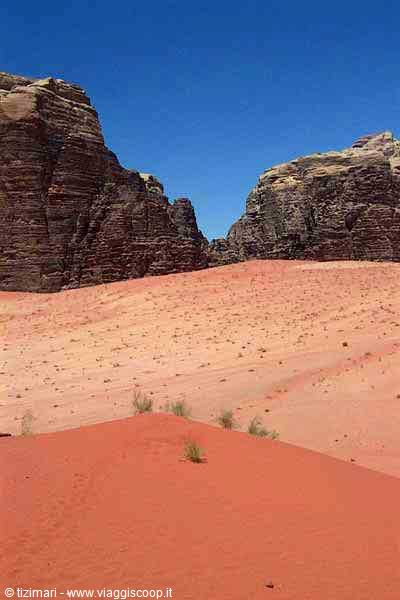
Wadi Rum: among these dunes we spent the turn of the century: 31/12/1999 - 01/01/2000. After contacting a Bedouin who drove us in a 4x4 deep into the desert, we had ourselves dropped off with our luggage. Watching the 4x4 drive away, our thought was 'Let's hope he comes back to pick us up!!'. Having pitched the tent at the foot of a wall of red rock, we savoured the clarity of the desert sky. A slightly different way to enter the new century!
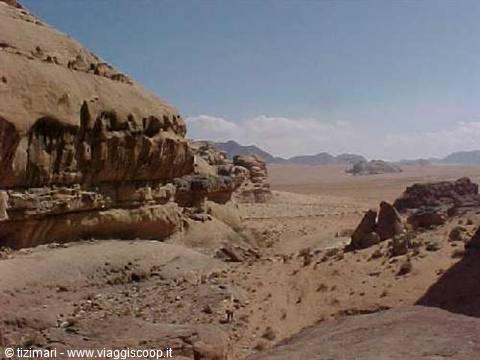
Described as 'immense, echoing, divine' by the writer T.E. Lawrence, Wadi Rum is the largest desert in Jordan. Among dunes, tongues of scorched earth and stretches of sand you find the springs of Lawrence of Arabia and the mountain of the seven pillars of wisdom.
Every desert, any desert, is spectacular in itself. Wadi Rum is the most majestic and vast in Jordan, though not the only one, famous for the narratives of T.E. Lawrence. It offers the classic image of the desert, made up of stretches of reddish sand with jabal (hills) of sandstone rising suddenly from the valley floor. But it also offers suggestive attractions such as Jebel Khazali, the springs of Lawrence of Arabia and the mountain of the seven pillars of wisdom. In this boundless environment there are also canyons and very high mountains with peaks of pure granite up to 1750 metres, demanding climbs for the most adventurous and expert climbers. Here is the second highest mountain in Jordan, Jabal Rum.
It's not hard to come across, on the horizon of the desert landscape, Jordanian Bedouins with their low black tents and camels, even though most have moved to the towns. Options for exploring Wadi Rum include four-wheel-drive vehicles and camel caravans. The 'truly devoted', of course, maintain that to discover the immense soul of Wadi Rum you have to walk it, sleeping in a tent.
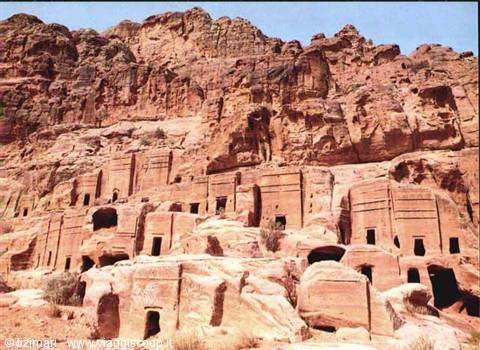
Petra: a city built by the Nabataeans of Petra, in southern Jordan, it was one of the terminals of the ancient spice route, and reached its greatest splendour under Philhellenus (84 - 56 BC). In 64 AD Pompey attacked the Nabataeans, managing to subdue them and make the whole territory a Roman province in 106 AD. Numerous places of worship, tombs and dwellings, carved into the rock. The architectural style appears influenced by the Hellenistic, Egyptian and Persian-Assyrian ones. After walking through the Siq, a narrow gorge (in some points no more than two metres wide), a striking view appears of the majestic facade of the 'Alkhazneh' tomb, the Treasury.
The journey's photographs
5 photographs · click to open them full screen


0 reader comments