The story
A brief stop in East Jerusalem, which alone deserves a whole travel itinerary, because this place, which according to the United Nations should be administered by the international community, has in fact been annexed by Israel since 1967; joining it to the other part of the city, Israel proclaimed it the capital of the country. In turn, the Palestinian National Authority considers East Jerusalem its own territory occupied by Israel and has self-proclaimed the city the capital of Palestine. In short, a real puzzle that's hard to solve, with three opposing positions. And yet in Jerusalem four communities have been tolerated for centuries, having divided the old city into as many quarters: Jews, Muslims, Christians and Armenians (in fact they too are Christians).
After all, Jerusalem is a Holy city for the world's three major monotheistic religions: here was King Solomon's Temple, cradle of Judaism; here Jesus was crucified; here, according to Muslim tradition, Muhammad ascended to heaven. My travel companion and I arrive in East Jerusalem on a one-day excursion that started from Taba in Egypt. The bus we travelled on together with numerous Italians crossed southern Israel, stopped at the Dead Sea (see the Israel itinerary), crossed the West Bank (see the Palestinian occupied territories itinerary) and has reached all the way here. The border with the West Bank is right up against East Jerusalem but customs formalities are limited and the frontier is like a motorway toll booth.
You climb onto the plateau that hosts the city and make the first stop on the Mount of Olives, little more than a hill from which you enjoy a complete panorama of the old city. We get off the bus to reach a particularly favourable viewpoint: the square walls enclose the old city, over which the golden dome of the Mosque and the Esplanade of the Mosques stand out. From here it's clear how a few dozen metres separate the quarters of the four communities; the famous Wailing Wall so dear to the Jews rests against one of the four walls of the Esplanade of the Mosques, and the Stations of the Cross unfold inside the Arab souk. A few steps from us is the place where Jesus taught the Lord's Prayer to his disciples; below us, on a flank of the hill, perhaps the most important Jewish cemetery in the world.
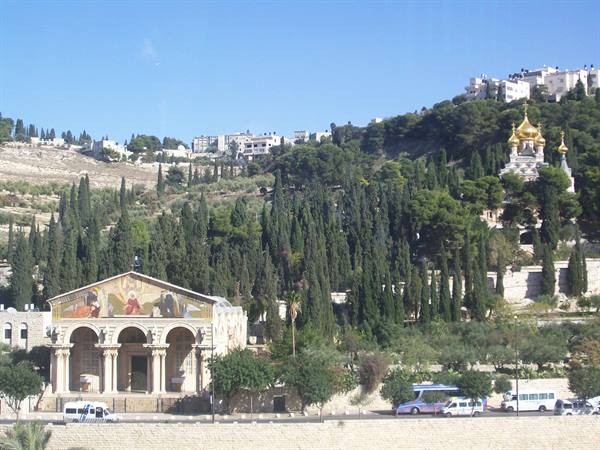
We go down from the Mount of Olives to its lower slopes, where the Garden of Gethsemane lies. It was here that Jesus suffered Judas's betrayal and his capture by the Romans. On this spot there are still some olive trees, some of them millennia old, others planted in the last century, such as the one Pope Paul VI planted here. Beside the garden is the Church of the Nations, named thus because it was built with contributions from numerous Catholic countries. Inside is preserved the rock on which Jesus prayed before his capture. I felt moved in this church, where I was able to have a moment of recollection. From here we re-board the bus in front of what should be the Tomb of Mary, I say "should" because Ephesus in Turkey also claims to have one. We go to a restaurant where we have a buffet lunch, then by bus again we reach the old city.
To enter the old town you have to pass under a metal detector; it doesn't bother me much and it protects me against terrorist attacks. Here you see the first Orthodox Jews with their black clothes and wide-brimmed hats; they make up about 20% of the Israeli population and most live in Jerusalem. Before us opens the large square that hosts the Wailing Wall; it's the only wall left standing of King Solomon's Temple and it rests against the hill that hosts the Esplanade of the Mosques. For centuries Jews have come before the wall and placed notes with prayers addressed to God in its crevices. I do the same, but to enter I have to wear the classic Jewish skullcap, made of paper, which is provided to me at the entrance to the prayer area. Then we enter the Muslim souk, which unfolds in very crowded, narrow alleys lined with little shops selling every kind of merchandise.
It's in these alleys that the Via Dolorosa winds with its various Stations of the Cross, little more than sketches marked by plaques on the facades of shops and ancient houses. It's impossible to pray in this din or to seek a moment of recollection while a merchant tries to foist his goods on you. But just go up a few steps and the noise magically disappears; in a few metres we leave behind the vociferous crowd and enter the quiet of the Christian quarter, where we reach the Basilica of the Holy Sepulchre. The church faces onto a little square, its facade squeezed between ancient houses where the single entrance door opens. The interior is large and holds the places of Jesus's passion. We're lucky because the queue to visit the Holy Sepulchre isn't very long; in less than an hour we manage to enter the edicule that houses Jesus's empty tomb.
Not far from the edicule, in another wing of the church, a short flight of stairs leads up to Golgotha, the place where Jesus's crucifixion took place. Between the Holy Sepulchre and Golgotha is the stone on which Jesus's lifeless body was laid to be wrapped in the shroud. Unfortunately, unlike what had happened at Gethsemane, here there's a hubbub and it's impossible to find the right recollection; a pity, because the place would certainly have deserved it. This is in fact not only the land of Calvary but also one of the few places in the world where the entire Christian community is recognised, and indeed it's managed jointly by Catholics, Greek Orthodox, Copts, Armenians and Syriac Christians. From the Holy Sepulchre we descend by a different route from the Via Dolorosa and reach the Jaffa Gate, leaving through the walls.
Here our bus awaits us, and with it we leave East Jerusalem, re-entering the West Bank (see the Palestinian occupied territories itinerary). Having crossed the West Bank we'll re-enter Israel (see the Israel itinerary) and from there to Taba in Egypt.
The journey's photographs
2 photographs · click to open them full screen

0 reader comments