The story
I arrived in Israel on an excursion from Taba in Egypt, where I was on holiday for a week. The trip was made with a friend and numerous other Italians. We crossed the border between Egypt and Israel on foot and after numerous checks we entered the country. We were welcomed by a young Israeli guide and a practically new tourist coach. It was the first light of dawn when we began driving along the roads of Israel; Eilat, the city that is the country's only narrow outlet to the Red Sea, was presumably still asleep. Eilat lies right opposite Jordan's Aqaba, from which it is separated by the short Arava valley. Aqaba is very close, it seems you could touch it; from here it looks like a district of Eilat. Heading north, the city soon gives way to the Negev desert with its bare mountains of pink stone.
Every so often we come across a kibbutz, small clusters of farmers' houses living in community, interpreting communist discipline to the letter. The road descends into the deepest depression on Earth to reach the Dead Sea. Near it the guide points out the mountain of Masada, on whose summit there is a small plateau where one of the many tragic events that mark Jewish history took place: the mass suicide of the Zealots who had taken refuge here to avoid being captured by the Roman soldiers. The sacrifice of these men, who took their own lives rather than surrender to the enemy, is deeply felt by today's Jews too, and soldiers of the Israeli army swear their oath at Masada. After Masada the road runs along the Dead Sea, actually a lake with a high salt content fed to the north by the course of the river Jordan and which is slowly drying up through evaporation.
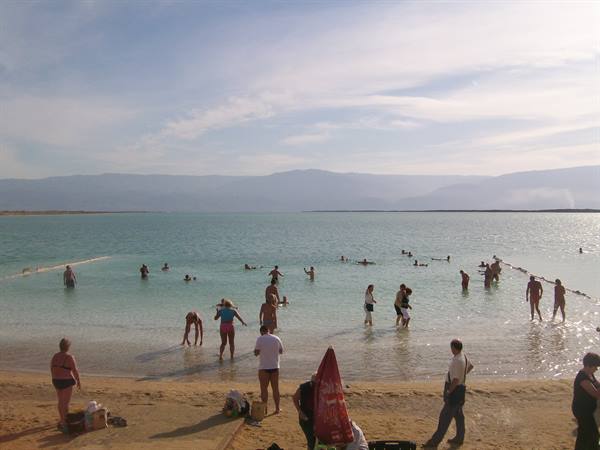
Here it's always very hot, it hardly ever rains, and we're 400 metres below the level of the Mediterranean. Half a century ago the Dead Sea was much bigger; now not only has the level dropped considerably but the basin has split, forming two distinct bodies of water, the southern and the northern. It's on the shores of the southern one that we stop at a bathing establishment. The little beach is reddish, the sea is a colour very close to turquoise and patches of salt come to the surface. The outside and water temperature is ideal for immersing ourselves in this lake completely devoid of fish. The sensation is unusual: even without swimming you float, supported by the salinity of these waters. When you return to the beach, though, you feel as if you're covered in an oily substance, but a quick shower is enough to get rid of the feeling.
Near the beach there's a very well-stocked shop of the famous Dead Sea salts, which also offers the free use of showers and changing rooms. We go back to the bus and continue northwards along the Northern Dead Sea. On the opposite shore to where we are, the profile of Jordan's peaks can be seen, while our road is squeezed between the lake and harsh rocky mountains whose colours range between pink and ochre. The sun reflecting on the Dead Sea makes the scene almost unreal. As we follow the lake we leave Israel and enter the West Bank, one of the two theoretically Palestinian parts but in fact under Israeli military control (the other part is the Gaza Strip). There are no borders between Israel and the West Bank in this area because there are no significant Palestinian settlements here; the wall is further north.
We enter the West Bank without even noticing (for this part of the trip see the Palestinian occupied territories itinerary). From the West Bank we'll then enter East Jerusalem, the part of Jerusalem that according to the international community should be administered by the UN and which instead has been annexed by Israel since 1967. Moreover, both Israel and the Palestinian National Authority have unilaterally proclaimed Jerusalem their capital (Israel the whole city, Palestine only East Jerusalem). For this reason we'll dedicate a separate itinerary to Jerusalem. On the way back from Jerusalem, after crossing the West Bank again, we re-entered Israel retracing the road we'd come by. After a short stop at the bathing establishment on the Southern Dead Sea where we'd also stopped that morning, we continued south as far as the border near Eilat that separates Israel from Egypt.
Leaving the country, the checks turned out to be less meticulous than on the way in; having got off the bus, we quickly crossed the border on foot as far as the Egyptian Taba. A few notes: swimming in the Dead Sea is an experience not to be missed if you're passing through these parts. There are no customs formalities nor checks between Israel and the West Bank in this part of the country. At the Israeli border it's better to ask not to have your passport stamped, and to do so it's enough to fill in a form where your entry stamp will be placed. Obviously this form must be kept together with your passport until you leave the country. This is necessary because otherwise, with an Israeli stamp in your passport, you'll be denied access to numerous countries of Islamic faith that do not recognise the State of Israel.
The journey's photographs
2 photographs · click to open them full screen

0 reader comments