The story
This tour is part of a wider journey, which also included Ireland (Eire), made with my Fiat Tipo. Having reached the island on the Calais (France)-Dover ferry I headed straight to Windsor to admire the Royal Castle, a Wax Museum rebuilt inside an old Victorian station that recreates Queen Victoria's visit to the town, and, as a surprise, a characteristic military parade complete with Royal Guards and Scottish kilt-wearing bagpipers. From here to Oxford to visit some of the main colleges and the lively streets of the centre, filled with students. Transfer north and, passing through Bradford, an overnight stay at Haworth. This characteristic village lies among the Yorkshire heather moors so often described in the famous tales of the Brontë sisters, who were born here; their father was the village curate and the Parsonage has been turned into a memorial museum.
With a walk of a few hours I climbed the hill of "Wuthering Heights", recalling the love story between Heathcliff and Cathy. On returning to the village, among the winding, characteristic stone streets, there was a festival with storytellers and street artists, and it was possible to visit the wool museum. Transfer and overnight stay in York at a very functional youth hostel. The following morning, a visit to the city in memory of the Wars of the Roses between York and Lancaster; the fortress is interesting, the Victorian museum is nice, the Viking one much less so, as it's practically a ride. In the afternoon a brief stop in a park near Middlesbrough, where there are mementoes of the world circumnavigator Captain Cook, who was born here, though the nicest thing to see was the squirrels. In the evening, an overnight stay in Carlisle.
The following morning, having left England for Scotland and reached Edinburgh, a beautiful city rich in history with its Castle dominating it and preserving some good museum displays. From the Esplanade square you go down the High Street lined with old buildings, many of which house exhibitions created inside shops (I saw the Museum of Childhood). At the end of the street is Holyroodhouse Palace and, nearby, the district famous for the story of that dog that returned every day to its master's grave, with church, cemetery and monument to the poor animal. From a distance I saw the National Monument set on a hill in neoclassical style. In the evening, an overnight stay in Perth.
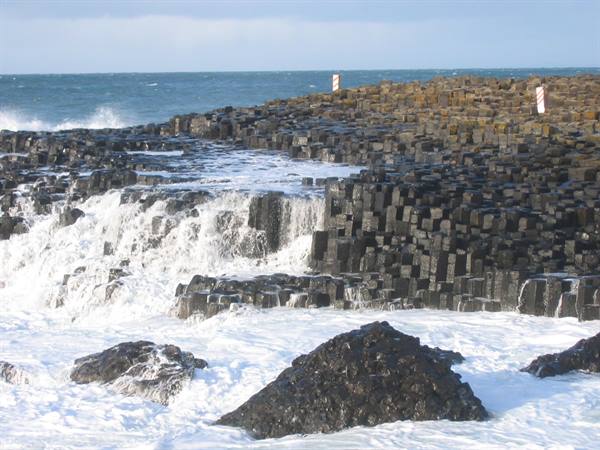
The following morning even further north to Inverness, then Loch Ness (famous for its monster, but the nicest thing to see is Urquhart Castle), Fort William dominated by the bare Ben Nevis, passing along some characteristic fjords, and slept at Stranraer. Of that day the most beautiful thing was observing the Highland landscape in a sparsely inhabited area. The following morning a ferry to Larne in Northern Ireland and from here to the Giant's Causeway, characteristic hexagonal basalt columns that lap the sea creating a natural pavement. Nearby I followed a cliff-edge path over the sea cut into a reddish limestone mountain. Passing through Portrush and Belfast I entered Eire at Newry (see the tour of EIRE). From EIRE I returned to Great Britain, precisely on the Rosslare Harbour-Pembroke (Wales) ferry.
Bypassing Cardiff I returned to England, and passing through the elegant ups-and-downs streets of the spa city of Bath I reached the megalithic circle of Stonehenge. From here to Winchester, which preserves a beautiful Cathedral and, inside the Great Hall, what is said to be the Round Table of King Arthur's Knights. Afternoon in Portsmouth to visit the Naval Museum, in whose docks are the Victory of Admiral Nelson and the Mary Rose of Henry VIII, raised not long ago from the seabed. Overnight stay in London at Wimbledon, where I left the car in a service-area car park on the ring road. The first day in the capital I went to Hyde Park (the Serpentine lake, the Peter Pan monument) and Kensington Gardens as far as the Royal Palace of the same name, overlooked by a circular pond with swans.
A walk through the museum area around the Royal Albert Hall and the Albert Memorial, then by Tube to Trafalgar Square with its fountains and the Nelson Monument. From here, following White Hall lined with important government buildings and celebratory monuments, I could admire the Horse Guards and visit the secret place from which Churchill ran the war. After the famous Downing Street where the Prime Minister resides, the street takes the name of Parliament as it leads into the square of the same name overlooked by the turreted Houses of Parliament with the tower known as Big Ben, St Margaret's Church, a small garden with monuments to illustrious figures and one side of Westminster Abbey. Inside, the Abbey is stupendous; it preserves numerous mementoes of British history, royal tombs, epitaphs of actors, poets, inventors and the place where the coronation of Kings takes place.
Beside the church is the great cloister with other mementoes and famous tombs. Back at Trafalgar Square and past the Admiralty Arch I walked along The Mall, part of St James's Park with its lake, and reached the Royal Palace, preceded by the monument to Queen Victoria and closed by fine iron railings where the characteristic Guards stand motionless on watch. Crossing Green Park, skirting Lancaster House, Clarence House, St James's Palace and Marlborough House, I walked along Pall Mall, lined with important clubs, Waterloo Place, Haymarket, and reached Piccadilly Circus. From this vital hub of the city I made my way to the Mayfair district (remember the flower girl from the operetta?) then by Tube to St Paul's, where I slept in a very expensive youth hostel.
The next day, having seen the Cathedral from outside, I made my way to the centre of the City, walking among the Bank of England, the Mansion House, the Royal Exchange and Lloyd's. In another area, having passed The Temple and the ships moored on the Thames, I took a Tube to the Tower of London. The visit to the fortress and its museum displays was lovely (though I didn't see the Crown Jewels). From here I observed Tower Bridge before moving by Tube to a small church in whose garden is kept the tomb of Captain Bligh of the Bounty. By Tube to Wimbledon, where I had left the car two days earlier, and departure for Dover, from where I ferried to Calais (France), from which I returned home. On this trip I often slept in Bed and Breakfasts which, besides being elegant and clean, offer the chance of an excellent English breakfast.
I also had a serious problem: having left the car for two days in a service-area car park at Wimbledon, I found it with a broken window. The attempted theft had failed thanks to the intervention of the service-area staff, and the things inside were recovered and kept by the Police, where I went to collect them. Absolutely not to be missed: Windsor-Royal Castle, Wax Museum; Oxford-colleges; Haworth; Edinburgh-Castle, High Street; the Highland landscape; Giant's Causeway; Stonehenge; Portsmouth-Naval Museum, the ship Victory; London-Kensington Gardens and Palace, Trafalgar Square, White Hall with Horse Guards, the Houses of Parliament with Big Ben, Westminster Abbey. Admiralty Arch, St James's Park, the Royal Palace, St James's Palace, Piccadilly Circus, St Paul's, the City with the Bank of England, the Tower of London.
For further tips on London, Stonehenge and the United Kingdom see the tours of ENGLAND and WALES.
The journey's photographs
2 photographs · click to open them full screen

0 reader comments