The story
We enter Switzerland, with our skis on our feet, through the Plateau Rosà border, at 3480 m altitude. Access is via the cable car that rises from Cervinia, covering a height difference of 1430 m. Be careful not to forget your ID card, though, because, although rarely, it's not impossible that they check your documents at the last station, that of "Cime Bianche - Laghi". In just over twenty minutes we are at Plateau Rosà. From the glacier of the same name, after a long and endless descent, we will reach Zermatt, a full 1840 metres lower. Skiing will be merely a pleasant pretext to admire the Matterhorn from the Swiss side.
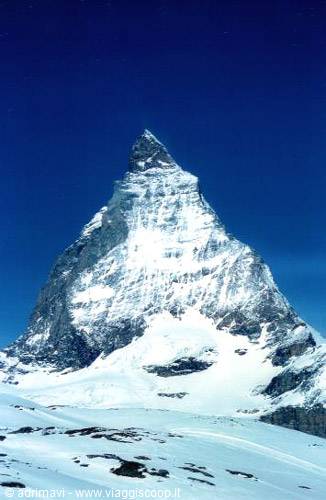
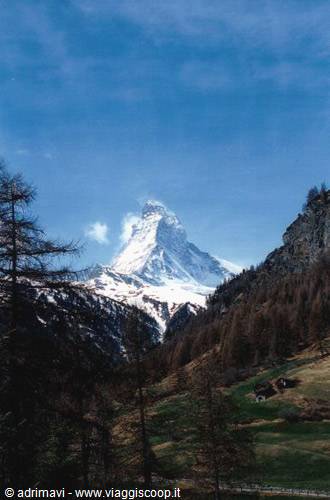
The Matterhorn, 4,478 metres high, is a unique and magnificent mountain, rising isolated to dominate the Valtournenche on one side and the Zermatt valley on the other. In the history of mountaineering the conquest of the Matterhorn represents one of the fundamental chapters. Who doesn't know the epic of this mountain that was considered impregnable? Every day the word epic is abused, yet there are adventures that defy the wear of time and remain mythical. The conquest of the Matterhorn is one of them. A challenge, bold, with oneself even before the mountain. Who has never heard of its two legendary protagonists, the Englishman Edward Whymper and the Valtournenche guide Jean Antoine Carrel? Friends and rivals in the race for the Matterhorn, both were captivated by this mountain.
Quintino Sella, the founder of the Italian Alpine Club, in a letter to a friend wrote about it: < What a beautiful mountain!! You know about beauty…but of a beauty like that of the Matterhorn you have no idea. I thought I had by now a fair knowledge of mountains, their attractions and their poetry. But climbing the Matterhorn I had to confess to myself that I knew nothing of it, so great is the difference between this most singular mass and other mountains.> A thought we fully share and feel as our own. The Matterhorn fever broke out in 1860. The race between the English, that is Whymper, and the Italians, namely J.A. Carrel, to be first on the summit, would flare up in 1865, when the race for the Matterhorn would end with Whymper's tragic victory.
After this dutiful disquisition on the history of the mountain, let us resume the account of our day, centred on paying homage to His Majesty the Matterhorn.
The day is sunny. Arrived at Plateau Rosà, the panorama opens out 360 degrees. Many beautiful mountains can be seen, from the distant Monviso to the Gran Paradiso and Mont Blanc, others are very close, but the soaring outline of the Matterhorn emerges above all of them, drawing our gaze. The Lion ridge, the Italian normal route, is easily distinguishable. The Matterhorn is truly gigantic, colossal, grand, a pyramid that grows thinner and sharper as we descend towards the Furggsattel, towards Zermatt. In these early morning hours we ski constantly with tears in our eyes, because of the biting cold. The thermometer at Plateau Rosà reads -14°, but it's a dry cold and all in all bearable. It's only from the Trockener Steg station that the Matterhorn begins to take on those features we all know, having seen them immortalised everywhere.
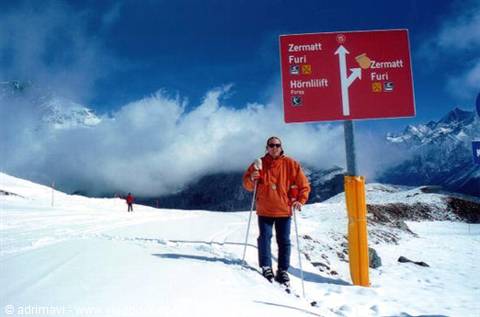
The best spot to observe the imposing mass up close is at the top of the Hörnli ski-lift; from here the Swiss normal route, the north-east ridge, is clearly visible. Often and willingly we stop at the edge of the slopes, but we don't feel weighed down at all in pulling out the camera to immortalise the peak, from every angle. The panorama is a true enchantment and not only because of the towering presence of the Matterhorn. Again from the Hörnli lift we contemplate many peaks over four thousand metres. The summits and glaciers are close enough that their profiles and outlines can be well appreciated. It's a place from which you enjoy one of the most enchanting views of the entire Alpine arc. The superlatives are not wasted in describing the incomparable semicircle produced by these 4,000-metre peaks.
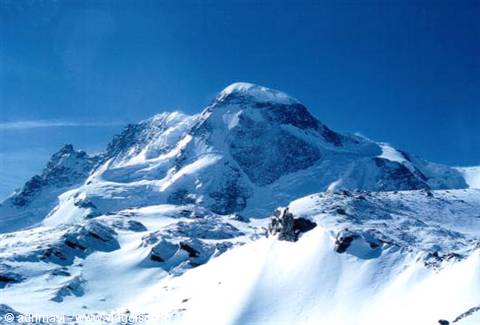
From the summits of Monte Rosa (Breithorn, Pollux, Castor, Liskamm, Ludwigshöhe, Punta Parrot, Punta Gnifetti, Punta Dufour and Punta Nordend), to those that follow the Matterhorn, namely the Dent Blanche, the Gabelhorn, the Ober Gabelhorn, the Weisshorn, down to the peaks that follow Monte Rosa (Strahlhorn, Rimpfischhorn, Allalinhorn, Alphubel, Täschhorn, Dom and Nadelhorn). Among them all, the Breithorn stands out, cloaked in tormented glaciers. As we descend towards Zermatt the atmosphere of the high Alps is joined by that of woods, meadows and huts. Now that we are lower down our descent on the slopes is accompanied by the characteristic whistles that marmots emit to signal danger. Off the piste, all around there is no snow; on the green and bright meadows numerous marmots run eagerly after waking from their winter hibernation.
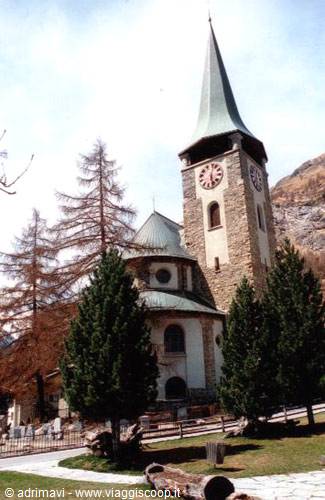
Because of the lack of snow we do the last stretch with our skis on our shoulders. In the end we reach the Klein Matterhorn station, tired now because of the heat — the temperature has risen to + 19°. At the station we leave our skis in storage to go and visit Zermatt. We take a walk to the church, where the small square that is the centre of the village is located. The first thing that strikes you about the cheerful village is the absence of cars. In fact, circulation is by special electric vehicles. The bicycles, too, are particular, as they have a curious ski rack. Skiers walk with rubber harnesses located under their ski boots. Reaching the square we quench our thirst drinking from a lovely fountain depicting marmots and rest in the nearby gardens, where there is a little area built like a chessboard, complete with pieces, rooks, bishops, queen and king, with which you can play.
Behind the church it is interesting to visit the cemetery of the mountaineers who fell attempting to climb the Matterhorn, which, mammoth, from its four thousand metres, looms over the village. From the centre of Zermatt the Matterhorn is more than ever unattainable and sublime. From the square, the streets, the gardens, the stream, the bar, you just have to look up to see it there in the sky, tall and imposing, hanging menacingly.
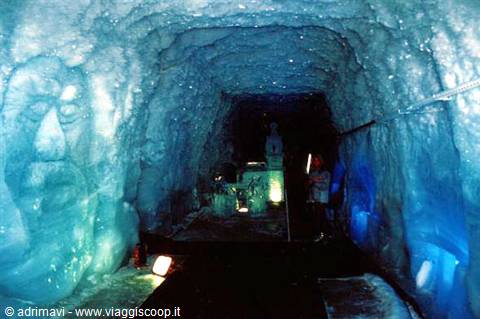
It's time to return. From Zermatt, at 1620 m, we take the Klein Matterhorn cable car that takes us to 3,820 m, precisely at the Klein Matterhorn, covering a height difference of a full 2000 m. We go up, making the imprudence of not stopping at any intermediate station, so once we arrive we feel a slight altitude sickness. - Climbing quickly to high altitudes is not healthy. - At roughly the middle of the tunnel, which leads from the cable car to the ski slopes, you can go up by lift to the summit of the Klein Matterhorn, from where you can enjoy a breathtaking panorama. Coming out of the tunnel, before putting our skis back on and descending to Plateau Rosà, we go to visit the little-publicised but very beautiful ice museum "Gletschergrotte", carved inside a crevasse. Here we appreciate the ice sculptures on a mountain theme made by skilled artists.
The day around the Matterhorn is about to end and the final plunge, this time to Cervinia, in now slushy snow, is almost torture. - With what nerve - I ask myself - do I use this term? - Once, to do a circuit like this you needed no small amount of slogging, today completely cancelled out by the cable cars. Reaching this place requires no effort, just a free day.
The journey's photographs
10 photographs · click to open them full screen




0 reader comments