Guides used: Madrid – City Book “Corriere della Sera” – vol. 8 Madrid Top 10 – Geo Mondatori – no. 16
Day 116 Sep 2006
Together with my friend Roberta, companion of other adventures, and her friends Roberto and Cristina, we set off for Madrid. The outbound flight was a tad eventful. During takeoff, while climbing, someone says a light bulb, someone says no, the fact is there was a small bang and a small explosion along the aisle, right near Roberta and Cristina's seats. People got a little alarmed, you never know, the plane might crash; but the stewardesses weren't the least bit flustered. The plane continued its climb and people calmed down. During the descent we asked ourselves several times whether the pilot had gotten his license from Cepu because it wasn't a great descent, but maybe it wasn't all his fault. Anyway when we finally had our feet, or rather the wheels on the ground, the plane fell apart.
Some people saw coming straight at their heads not only the oxygen masks but the entire piece of the plane, shelf, buttons and lights. Luckily we were already on the ground!
Once we retrieved our luggage we headed straight off in search of the bus, free, that allows you to move from one terminal to another and therefore to go and catch the metro that takes us into the city. The journey is quick, we consulted the map to understand where our hotel was and which was the nearest stop.
For those who don't know, Madrid is the capital of Spain. The history of Madrid begins more or less around 852 when the Moors built a fortress near the Manzanares river or rio, it depends a bit on your point of view. Then history of course went on but there's no point dwelling on these aspects.
In Madrid it's hot, very hot. I must say that the first impression of Madrid isn't the best. The Calle de Fuencaral, the street of our hotel, is all in turmoil, some buildings are a bit dilapidated. A group of fans passes along the street singing hymns of glory. We find the address and the building of our hostal. We're a bit doubtful. We go in and walk up the stairs. The building is under renovation, they're installing the elevator and doing quite a lot of work. We reach the floor of our hostal and ring the bell. A lady of clear South American origins comes to open for us who doesn't speak a word of English, no big deal, that means we'll practice our meager Spanish.
We must admit that given the building we weren't so convinced anymore that our choice had been a good one, sometimes when you play a bit too much at saving money you risk getting ripped off, but the interior of the apartment is very beautiful and well-kept. A long corridor leads to the rooms we booked. Our room is very nice, clean and the furnishings are decidedly new. The bathroom is also spacious. The window looks directly onto the small courtyard of the building now totally cluttered with scaffolding for the various works. Despite the ceiling fans in the room it's very hot. We freshen up a bit and here we are ready to go out and discover Madrid.
We cross the very busy Gran Via and head in the direction of a Calle de la Montenera completely under renovation. A bit chaotic to pass through. And among the passersby, the tourists and the shops, the 'ladies' stand waiting for clients. But this is nothing more than one of the many faces of Madrid today. So we reach the Plaza Puerta del Sol, all a construction site. This first impression of Madrid reminds us of Turin preparing for the Olympic event, construction sites and more construction sites. The Puerta del Sol is somewhat the heart of Madrid. It's a coming and going of people and cars, as much as can pass given that the construction sites close off a large part of the square and of the traffic. In the center of the square an equestrian statue of Charles III has been placed.
While the Casa de Correos faces onto the southern side of the square, that is the original city post office built in 1760. Later it became the seat of the interior ministry. During the Franco regime the police cells located under the building were a place of torture. In 1963, Julian Grimau, a member of the clandestine communist party was executed, and to think that he had miraculously saved himself by jumping from a window of the upper floors. Currently this building, teeming with ghosts (imagine if there weren't any with all the cruelties practiced there), is the seat of the regional government. At the entrance of the Calle del Carmen, a beautiful street of shops, stands the statue depicting the symbol of Madrid: a bear. Here too, among the coming and going of people and the subjects posing in front of it, taking a photo of just the bear is practically impossible.
From a historical point of view this place has been the theater of various important events. In 1808 the revolt against the French occupation forces began here, but the outcome wasn't, for the Spaniards, positive. In 1912 the prime minister Josè Cabalejas was assassinated and in 1931 from the balcony of the interior minister, the building that I imagine teeming with ghosts, the Second Republic was proclaimed. While, a very important event, on 16 September 2006 four illustrious Italians passed through this square: me and my three travel companions! Ah ah ah! Having left the Puerta del Sol we head towards the famous Plaza Mayor. It's a magnificent rectangular square surrounded by buildings in typically Castilian style. It's one of the most famous squares of the city. It was born as plaza de Arrabal (square of the suburbs) because it was located outside the city walls.
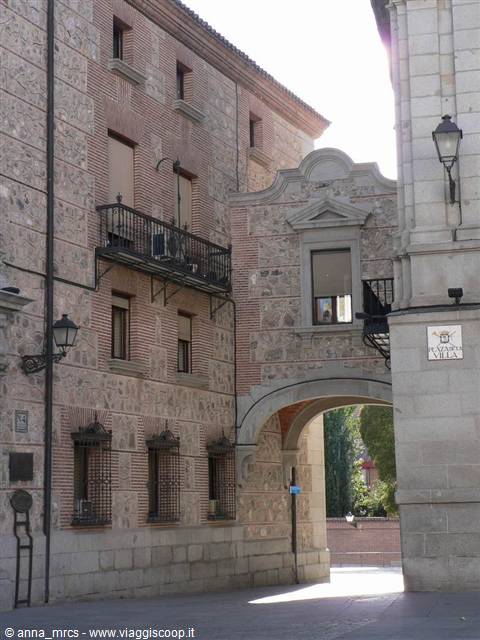
In the center of the square the equestrian statue of Philip III who was also the one who commissioned its construction which was completed in 1619. But the current design and the granite porticoes are the work of the architect Juan de Villanueva (the same one as the Prado museum) who redesigned it after the fire of 1791. In history this square boasts a very rich past. It has been the theater of markets, bullfights, executions and open-air theaters. Now it's a pleasant square in which to enjoy a bit of the charm of this city. From here we move, wandering through the streets towards the cathedral and the Royal Palace. Passing through the characteristic plaza de la Villa. Around this square stand some of the most important buildings of the city. It's said that Francis I of France was imprisoned in the Torre de Los Lujanes after the defeat in the battle of Pavia of 1525.
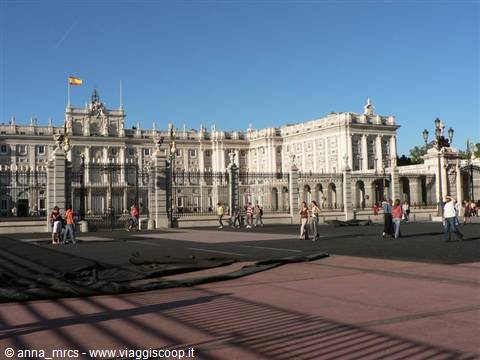
Also facing onto this square is the town hall. After a few ritual photos we move towards the cathedral. It's the time of the service so we can't, rightly, enter. A few photos in the square in front of the royal palace and then off towards the Puente de Segovia passing through the Parque de Atenas where they're setting up a kind of amusement park. The roads in the surroundings of the bridge are all being redone, construction sites to the right and left. Meanwhile dinner time has arrived, so we go looking for a little restaurant, in the surroundings of Plaza Mayor that offered good prices. We have dinner with a paella, not among the best, but with an excellent fish dish as a second course.
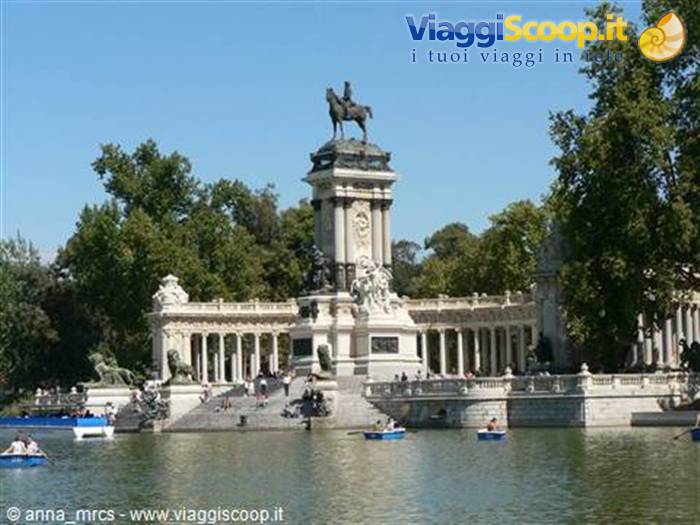
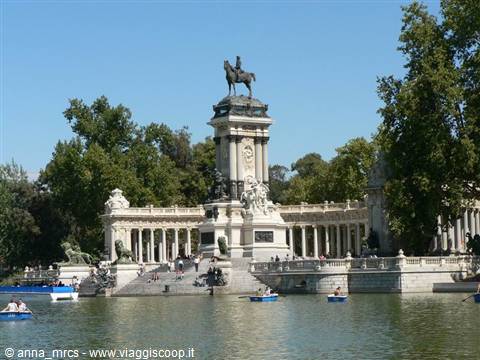
Monumento Alfonso XII - Parque del Retiro
Day 217 Sep 2006
Today is Sunday, we've drawn up a program of no small account. After a quick breakfast in one of the many places that offer this service we set off towards El Rastro, where, on Sunday mornings, the very famous flea market is set up. The origin of this market dates back to the middle ages. We walk the whole Calle de Toledo to reach the gate of the same name (de Toledo). The Puerta de Toledo represents one of the last two arches still present in Madrid. Its construction was commissioned by Joseph Bonaparte in 1813, it was in fact to commemorate the ascent to the Spanish throne of the new king after the defeat of Madrid. But this reign was brief so as soon as the construction of the arch was finished it was dedicated to Ferdinand VII. From here we slip into the streets of the El Rastro area wandering among the various stalls.
Almost by chance, wandering among the streets we arrive at the suggestive Plaza de la Paja. A square that was once the center of medieval Madrid. The goods displayed in the market range from antiques, to the usual things found in flea markets, like costume jewelry and clothing, up to real merchandise pulled out of some attic or cellar.
We then continue towards the centro de Arte Reina Sofia, a museum dedicated to 20th-century art. Inside they exhibit a beautiful collection of Picasso paintings among which the famous Guernica, and other works by other artists among whom Mirò and Dalì. On Sundays admission to the gallery, for residents of the European community (finally some advantage) is free. The building is very modern: glass, metal. The paintings displayed are particular, in the sense that understanding them and therefore appreciating them isn't simple. Among us perhaps the one who appreciates most is Cristina, we three wander through the rooms looking at these works recalling certain scribbles made by my little nephews. In front of the Guernica a large number of people. A cordon prevents people from getting too close. The Guernica is perhaps the most famous work of the 20th century.
It represents the author's protest against the civil war. The painting was commissioned in 1937 by the Spanish republican government for a Paris exhibition. The painting was then exhibited at the New York Gallery until 1981. In fact Picasso had expressly requested that the work not be exhibited in Spain as long as democracy had not been restored there.
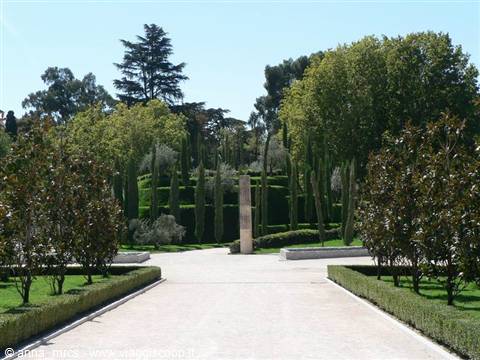
Once our visit to the museum is finished we move towards the Paseo del Prado. The Estacion de Atocha is also under renovation. Of course they decided to remake Madrid brand new right when I decided to come here? A stage of a cycling race completely blocks the Paseo del Prado. Fortunately we manage to cross and reach the Parque del Retiro. We enter from a side entrance, so to speak, the puerta de Murillo and the park seems little frequented. We find an information office and get them to give us a map of the immense park. Actually we're looking for a place to buy something for lunch. In the 1600s this immense park was for the exclusive use of the royals, it was opened to the public only in 1869. That the park was little frequented was only a sensation, once at the Estanque the sensation is exactly the opposite.
On the lake many little boats sail, the water isn't great, not very clear, but a few ducklings swim calm and blessed, happy them! At one end of the lake stands the monument to Alfonso XII. We buy something to eat and sit on the shores of the lake to enjoy a bit of rest.
We resume our walk from Calle de Alcalà, before us the Puerta de Alcalà. It's a triumphal arch created by Charles III with the intention of embellishing this area of the city. I'd say the intention succeeded. We continue to the Plaza de La Cibeles also all fenced off for the cycling race. It would be one of the most beautiful squares of Madrid but right now we're not allowed to verify it. So with the voices and colors of this race we head towards the Prado museum. The Prado museum is also free, again for EU residents, on Sundays. This museum boasts the largest collection in the world of Spanish painting. There are masterpieces by Velàzquez and Goya. Very famous is the "Maya desnuda" by Goya (c. 1800) for which he was accused of obscenity. Works by Flemish, French, German and Italian authors are also exhibited, such as Botticelli, Tintoretto and Caravaggio.
Having left the museum the paseo del Prado is clear of the barriers. The cycling race and all its organization are by now only a memory. From the Fuente de Neptuno, slightly clogged with cars, we take the Carrera de San Jeronimo to arrive again at the Puerta del Sol. The Fuente de Neptuno, it must be said, is the usual fountain with the statue of Neptune, on the usual chariot drawn by two horses. This statue was designed in 1987 and it too was part of the project to embellish this area of Madrid commissioned by Charles III.
After dinner we treat ourselves to a nice walk through the lively city center, a few shop windows and a few souvenir shops and then all to bed, tomorrow another walk like today's awaits us.
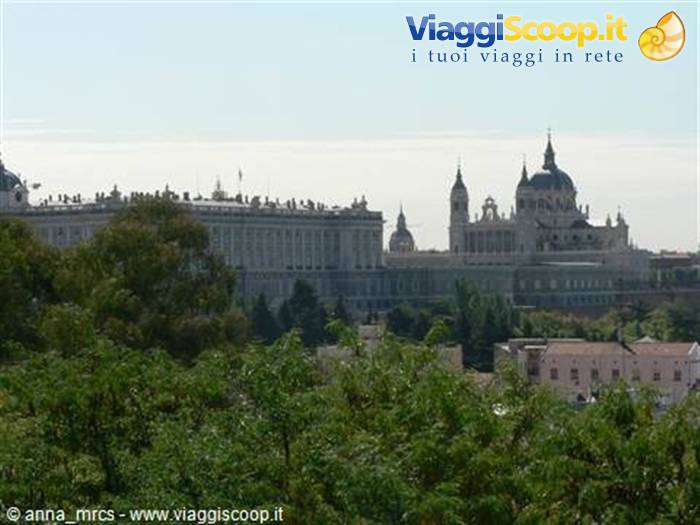
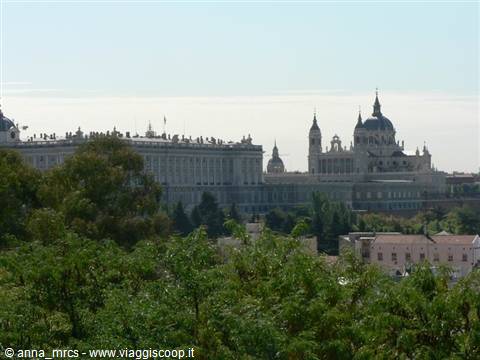
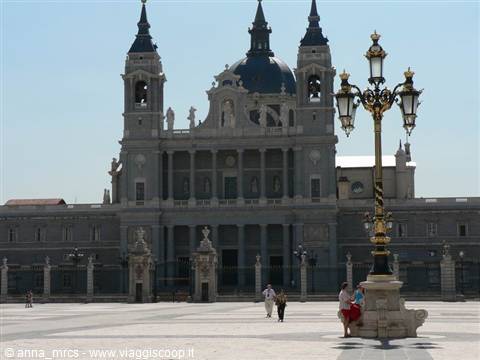
Palacio Real y Catedral De Almudena
Day 318 Sep 2006
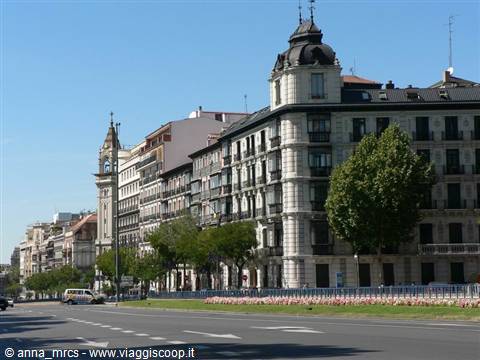
This morning the workers who start the renovation works wake us up. Cristina opens the window and finds herself facing, on the scaffolding, a worker. No no.. don't worry, nothing to do with those from the commercials, so much so that Cristina immediately closes the window! We walk along the Gran Via which with its austere well-preserved buildings, its restaurants, its cinemas, its theaters and its morning traffic retains a particular charm. The Gran Via is the main artery of Madrid. We arrive at the Plaza de Espana and continue along Calle Princesa and arrive at the arco de la Victoria. The arch was erected in 1956 to celebrate the nationalist victory during the Spanish Civil War. General Franco every time he arrived in Madrid from his home passed under it. Oh! The area is a disaster, all a construction site.
The arch can't be approached, let alone passed under! Just for a change on top of the arch there's a sculpture with a chariot drawn by two horses. To simply cross the street and go to the nearby museo de América we have to make a detour that's beyond belief. The fact is that we finally arrive and discover that the museum is closed. Weekly closing. Actually it was written in the guidebook but it had escaped us. The Museo de América houses a beautiful collection of objects linked to the Spanish colonization of the Americas, because in fact Columbus, as one would say today, got the sponsor for the trip in Spain! We also wanted to go up the faro de Moncloa but it's temporarily closed. It's not clear whether temporarily or permanently. The Faro de Moncloa is a tower 92 meters high inaugurated in 1992 that offers excellent views of the city and the Guadarrama mountains.
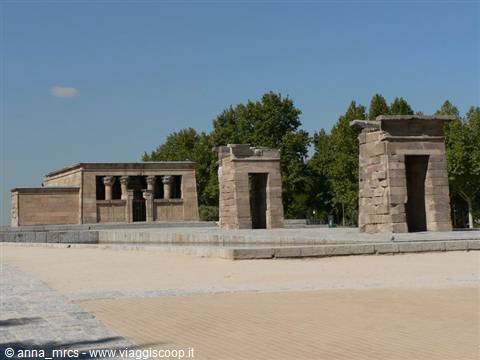
We leave this area and head for the parque del Oeste. A typical park with English gardens, we also cross a beautiful rose garden. It may also be Monday but it's worse than the desert, there's not a living soul. We arrive at the temple de Debod from which you also enjoy a beautiful view of the royal palace, of the cathedral and turning the other way of the Guadarrama mountains. The temple is closed, today is not the day. This temple is an ancient and authentic Egyptian temple from the 2nd century BC. How come it's here and not at home in Egypt? Because the Egyptian government, in 1968, donated this temple to Spain as a tribute for the work done by Spanish engineers in trying to safeguard the works of art from the floods of the Aswan dam. Just a little thought, nothing demanding! From here we move to the Plaza de Espana.
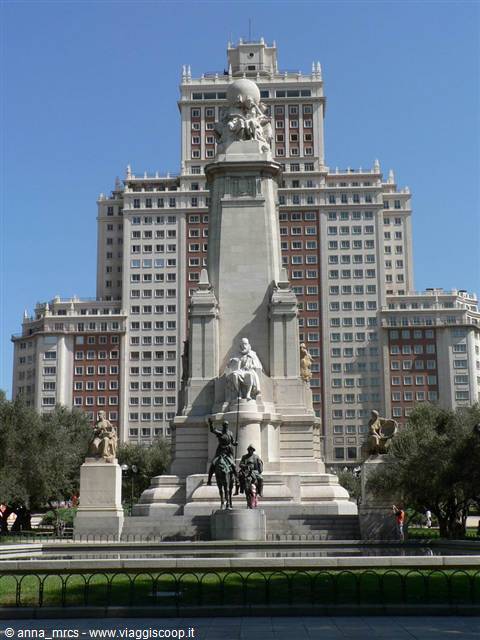
This morning we saw the upper part, towards the Gran Via, now the central one, the most beautiful with the stone obelisk dating back to 1928. In front of the obelisk the statue of Cervantes and in front of it his characters, Don Quixote, who doesn't know him! Riding Rocinante while his friend Sancho Panza follows him with his donkey. Taking a photo without living subjects is practically impossible given that the coming and going of people posing in front of the two statues is practically endless. In the background of the square you can see the Torre de Madrid, a good 33 floors.
The program continues with the visit to the Royal Palace (8 €). The royal palace, one can certainly call it grandiose, is placed on a high promontory overlooking the Riò Manzanares. It was born as a royal fortress, but following a fire that occurred in 1734, Philip V decided to transform it into a palace. Obviously the works lasted quite a while so much so that not only did Philip V not have the pleasure of seeing it finished but neither did his successor. The royal family lived in this palace until 1931. Currently they live in a more modest palace, so to speak, outside Madrid. But in this palace state ceremonies are still held. How come they didn't come to receive us? My guidebook is rather detailed in describing the rooms so we choose not to do the guided tour but to wander around on our own. The halls are very beautiful.
You visit the throne room which retains the original furnishings from the times of Charles III. No, you can't try the chair, the dining room with an impressive number of place settings. We hope they have a good dishwasher!!! Besides the halls of the palace the pharmacy and the armory are also visitable. The first recalls the pharmacies and herbalist shops of other times. The second exhibits royal weapons and armor. It can perhaps be considered the first museum of Madrid since its opening to the public dates back to when Philip I inherited the collection from his father. A tad bulky collection. Once the visit to the Royal Palace is finished we move to the nearby Catedral de la Almudena. Majestic! Its construction began in 1879 and ended in 1993. You could say the works didn't progress very quickly, but it should also be said that during the Civil War they stopped completely.
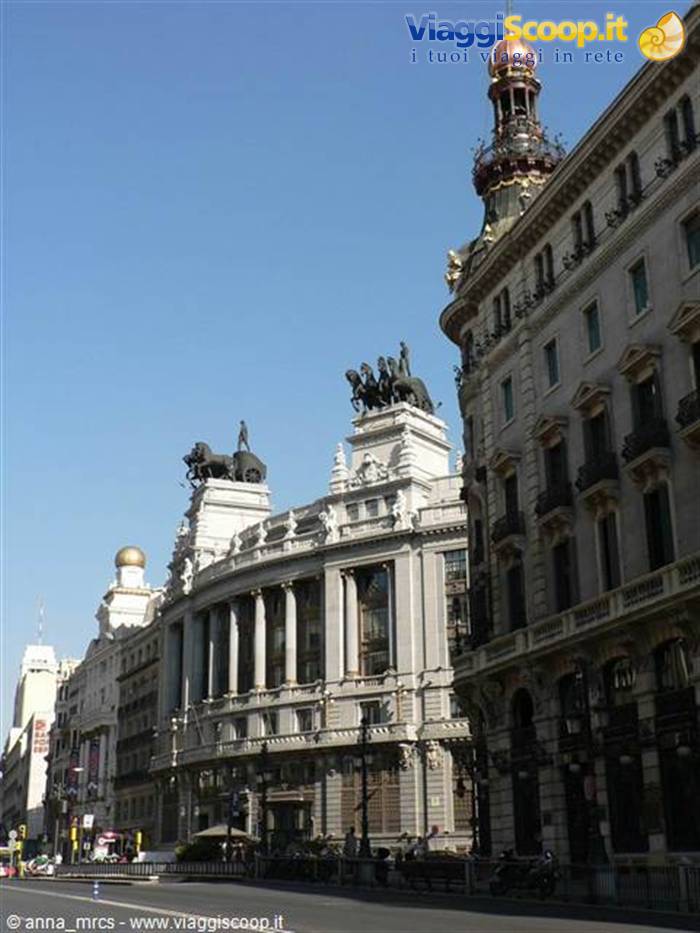
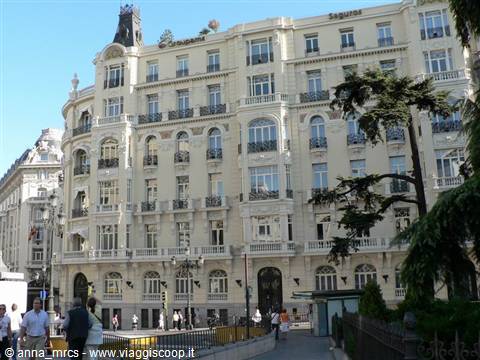
The visit to the museo de América entices us, not only because the guidebook mentions it as one of the most beautiful museums of the city but because this piece of history interests us. So we decide to slightly modify our program so that we can make a quick visit tomorrow morning. Always on foot we move towards Plaza de Colon. It's a square dedicated to Christopher Columbus, Colon in Spanish. We walk along the calle Alcalà. Heavy traffic and austere and very beautiful buildings, among which the Banco de Espana, the central bank of Spain, and the palazzo de Linares, an opulent late-nineteenth-century palace where the association that promotes Latin American culture (Casa de America) still has its seat. We can finally see Plaza de La Cibeles without the barriers and from here continue to our destination.
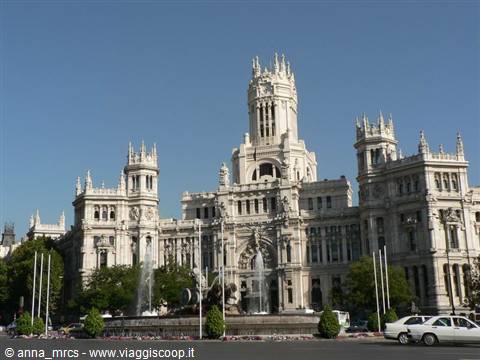
Indeed it's a beautiful square, its setting isn't bad at all and the fuente de Cibeles with the palacio de Linares in the background also makes its impression. Just to add a bit of culture the name of this fountain and therefore of the square comes from the Greco-Roman goddess of nature who is in fact represented in the center of the fountain seated on her chariot drawn by two lions. The horses were too ordinary, she preferred the kitties! On this square, designed at the end of the 1700s, four important buildings face and I dedicate a nice photo shoot to all of them. Once the photo shoot is finished we continue our walk along the Paseo Recoletos. Passing in front of the biblioteca Nacional and the museo di archeologia we arrive at the Jardines del Descubrimiento. The square and a monument placed at the edge of the garden are, as already said, dedicated to Columbus.
Actually there are two monuments to Columbus, the classic obelisk with Columbus on top and a more modern concrete thing at the bottom of the garden. We spend what remains of this afternoon relaxing on a bench in the gardens, while Roberto wanders around the garden looking for some framing for some particular photos, he's attracted by this modern monument. The garden is quiet, a few passersby and a few kids with skateboards.
Towards evening we return to the streets of the center. We have dinner in a place of a chain that offers those flat-rate formulas, where you pay a set amount and eat, buffet-style, all you want (FresCo 9.70 €). We conclude the dinner with some excellent yogurt ice cream.
Since it's the last evening Roberta wants to return to the Plaza Mayor. There are many people and much life. It must be said that Madrid in the evening comes alive with people and life. We sit on a bench and stay chatting for the rest of the evening.
Calle de Alcalá
Day 419 Sep 2006
And so the last day has arrived. We pack our suitcases and leave the hostal. Since time is short and I have a flight at 15.45 to return home, we decide to take the metro. We count in total how many tickets we need and we also buy a carnet of 10. A single ticket costs 1 €. Our first destination is the museo de América. We get on the metro to discover that a stretch of the metro is closed for works (again!!!). Of course it's the stretch that we needed. So we modify the route. We'll do a slightly longer ride but we can't help it. We get off at a stop in the University area. A coming and going of students confirms that courses have resumed. We don't know exactly which direction the museum is in because our map doesn't reach this area. So we decide to ask. Roberta and I see a distinguished gentleman and decide that he surely knows the museum.
Roberto tried with a girl, but she didn't even know which museum we were talking about.. We stop this gentleman and ask him about the museum. In perfect English he replies that he's not from Madrid and doesn't know the place. Gooood, it's always us they happen to. Finally we find someone who knows where this museum is. He's not very convinced but we trust him anyway. The museum (3 €) is very interesting. There are few people so we go around in complete tranquility. The collection is arranged on two floors. The museum was founded in 1941. There are objects of art, of common use and religious. There's also the reconstruction of a tepee and a hut from the rainforest. Once the visit to the museum is over we go back to take the metro and move to the new area of skyscrapers: Azca, defined by the guidebooks as a miniature Manhattan… ohhhhh.
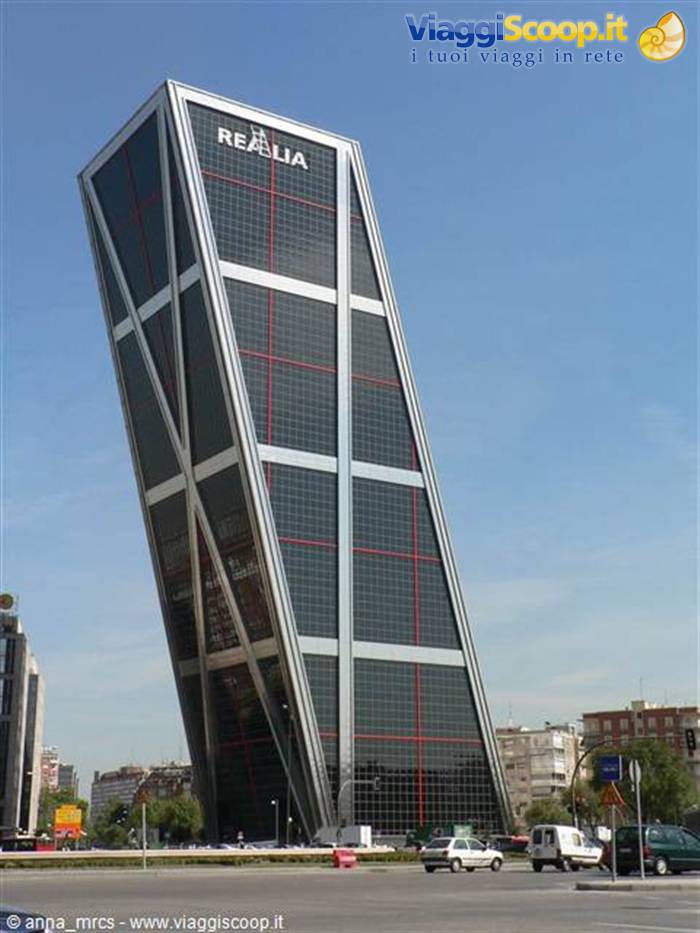
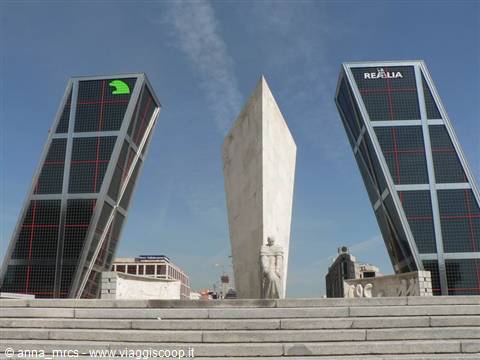
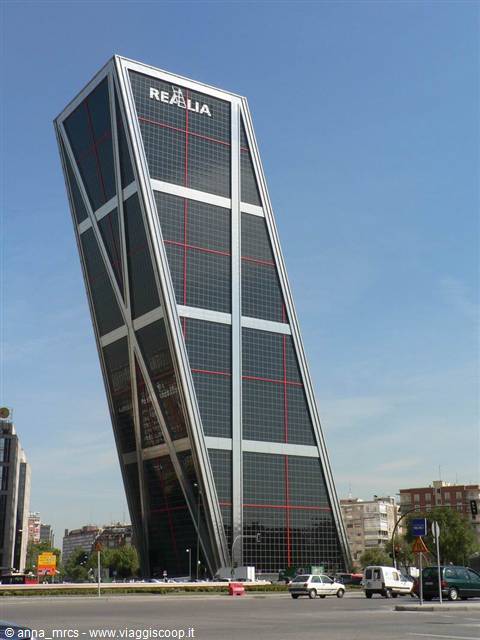
There are two reasons why we go to this area, one because we want to see these skyscrapers and two because Roberto wants to go on a pilgrimage to the Santiago Bernabeu stadium. His attachment to the stadium isn't due to the fact that it's the home ground of Real Madrid but to the famous final of the 1982 world championship. We come out of the metro in the crowded Plaza de Castilla. Above our heads one of the two twin towers of the Puerta de Europa. They're very strange, it's in fact the modern, very modern version, of a triumphal arch. They're a good 26 stories high, made of glass and metal, they were completed in 1996. Well.. they've turned 10! The guidebook reports that they survived a financial scandal. It consoles us to know that certain things don't happen only in our country! We stop to have lunch in one of the many places scattered in this area.
The coming and going is impressive, all these skyscrapers house the offices of big companies, but we also read in the guidebook that inside them there are apartments, hotels, restaurants, bars and cinemas. Meanwhile a fire in a nearby building draws the attention of many passersby. The smoke is very dense and in a short time the streets seem shrouded in fog. The bomberos (or firefighters), it's almost funny, rush over quickly. In a short time everything is under control and the air becomes breathable again. Time is starting to run short so we head along calle de la Castellana. Once in front of the Santiago Bernabeu Stadium we let Roberto immortalize this temple of football, while we little women don't even pull out the camera, men's stuff! Impressive are the nearby Towers of Europe and Picasso.
A bit out of place is the Plaza Picasso with this strange structure arranged on three levels with gardens, trees and benches among the skyscrapers! The Torre d'Europa located in Plaza de Lima was completed in 1982 and as if the floors sprouting from the ground weren't enough it also has three underground floors. The Torre di Picasso instead was completed in 1989 by the same architect who designed the Twin Towers of the World Trade Center in New York. A tad obsessed with towers is this Minoru Yamasaki. With its 46 floors it's the tallest building in Madrid. Aesthetically I prefer the Torre d'Europa, this one is all clad in aluminum, I like it less. And so we arrive at the metro stop that will take us again to the airport.
In front of the departures terminal I say goodbye to my friends, they continue on to Valencia for a few days at the sea, I have to go back to the office, not exactly the same thing... The return flight was perfect. The plane didn't fall apart and the pilot didn't study at Cepu. So I arrive in Turin right on time, while my hubby who is supposed to come pick me up got stuck on the ring road. Madrid was a nice discovery. At first I was a bit disappointed, perhaps because of the construction sites, but then its warmth, its people, its streets captured me. It's a beautiful city, a shame not to go there.




0 reader comments