The story
In April 2004 we decided (Paola and I) to go for the first time to one of the Canary Islands, the one we consider different from the others, richer in contrasts... LANZAROTE. After a smooth flight we arrived late in the evening at Lanzarote airport, where we were picked up and taken to the Barceló hotel in Costa Teguise (above Arrecife), where we booked for 550 euros a week all inclusive (although we would never be there at lunchtime). The hotel is very large and very beautiful, spacious rooms, buffet food in abundance and decent evening entertainment. The next morning we immediately took a rental car for the remaining 6 days and began our holiday discovering the beauties of the island. Lanzarote is about 60 km long and 15-20 wide, it is often beaten by winds, it is of volcanic origin, prices are definitely more affordable than ours (petrol cost 0.55 cents a litre).
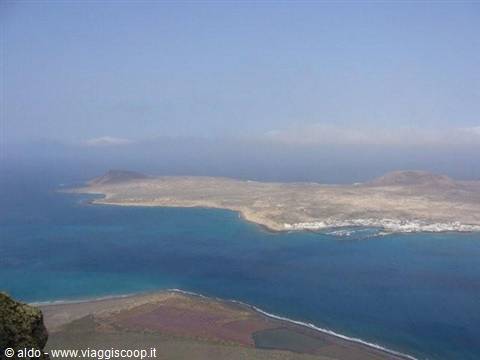
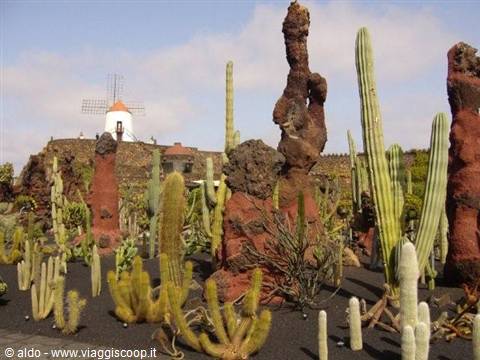
During our stay we visited at the far north of the island the "Mirador del Río", the highest point from which you get a beautiful panorama over the island of Graciosa; I recommend not entering (the cost was 5 euros) but going slightly further, 100-200 m, where you get the same view but save the money. We then went to see the "Cueva de los Verdes", where there are small white crabs and other beautiful surprises, "Jameos del Agua", built by Cesar Manrique, the great Lanzarote artist famous throughout the world, and the "Jardín de Cactus", a garden with hundreds of succulents overlooked by a gigantic iron cactus made by Manrique. We then passed through the "Haria" area, rich in palm groves and hills reaching 600-650 m in height, from where you enjoy beautiful panoramas and where you reach the beach of Famara, the most beaten by the winds, where windsurfers try their hand.
We then saw "El Golfo", a place you cannot miss as you come down from above onto a very black volcanic beach where there is a kind of protected little lake, green because of the algae and organisms inside. Close to "El Golfo", still on the coast, are "Los Hervideros", a series of black volcanic rocks that stand out against the sea and form pools and tunnels that spurt water upwards as soon as the waves break against them, and the "Salinas de Janubio", a series of salt flats made up of pools of pink, white, red and purple due to the salt present and its drying out. Inside the island are perhaps the most beautiful things to see: the "Geria" and the "Timanfaya National Park".
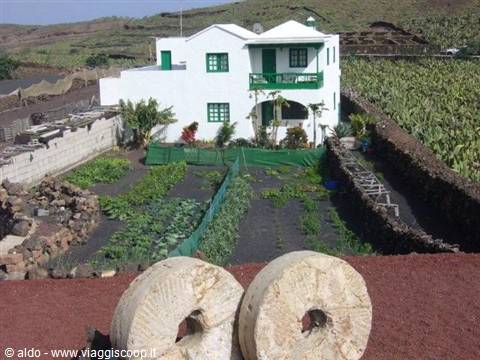
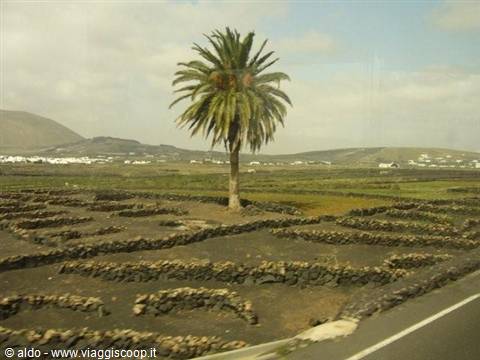
The first is a splendid area where local farmers have managed, on the hills and plains of volcanic ash, to build very special vineyards by creating pits into which the small vine is placed, so that it is protected from the winds and allows the collection of the humidity necessary for the vine itself. Here you can taste the wine in one of the many farms that produce wine and you will feel that it is steeped in the taste of ash... incredible, like the landscape! The second (Timanfaya Park) is the result of an eruption that lasted a full 6 years in the 1700s and completely upset the island. At a certain point, once inside the park, it feels like being on the moon: there is nothing at all, only lava and more lava with small mountains that are in practice the 300 volcanoes that erupted.
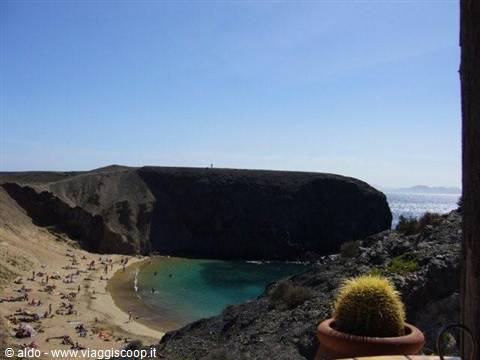
Here, before doing the tourist tour by bus in the most beautiful part of the park (Montañas del Fuego), we decided to do a short stretch on camelback, inside the park. After this pleasant experience we go to the park entrance where we take a bus to go round it.... beautiful!! We are then shown, by throwing straw into a hole a metre deep, that just below the ground it is still 400-500 degrees, which means there is still seismic activity, and then water is thrown into a hole and immediately a spurt of steam 4-5 metres high rises. As for the beaches, the most beautiful areas are Costa Teguise with its beautiful white beaches of "Las Cucharas" and the equally white beaches of "Papagayo" at Playa Blanca, from where many ferries to Fuerteventura also depart. The beaches of Quemada and the town of Puerto del Carmen are also beautiful, where you can enjoy good fish in the seafront restaurants.
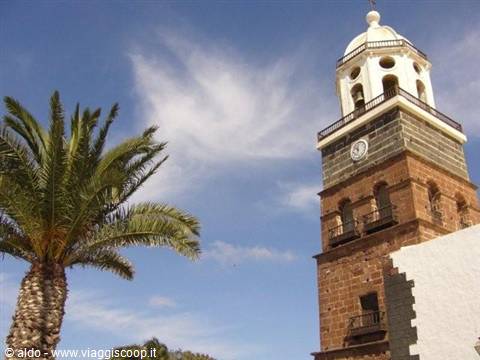
A brief mention should be made of Cesar Manrique, the true protagonist of the island, since thanks to him it was decided to build only white houses in keeping with the environment and no more than 2 storeys. There are his architectural constructions everywhere (Monumento al Campesino) and his works at the "Manrique Fundación", where there is his house, which deserves to be seen. The city of Arrecife is the capital of the island, it is the most populous and chaotic but there is nothing particular to see, while inland there are many small villages that deserve a stop during car journeys, e.g. Teguise, Tahiche, San Bartolomé. In conclusion, the island really deserves to be visited; now I hope to manage to put the photos on a CD so I can better show you what I have talked about. Greetings to all. Aldo
The journey's photographs
9 photographs · click to open them full screen


0 reader comments