The Sextant Group, creator since 1974 of motorised exploration journeys, carried out an expedition in Arctic Russia through the heart of Karelia and the Kola Peninsula.
The group, which left Italy on 6 March, reached St Petersburg via Switzerland, Austria, Germany and Finland. From there it headed north, penetrating the interior of Karelia along secondary roads and forest tracks, until it reached the White Sea and the Kola Peninsula.
The climate zone crossed was that of the taiga, contained between the boreal forest (to the south) and the tundra (to the north). This belt girdles the entire globe, from Canada to Siberia, and together with the boreal forest it forms the planet's largest green lung: far bigger than all the tropical forests put together, the Amazon included.
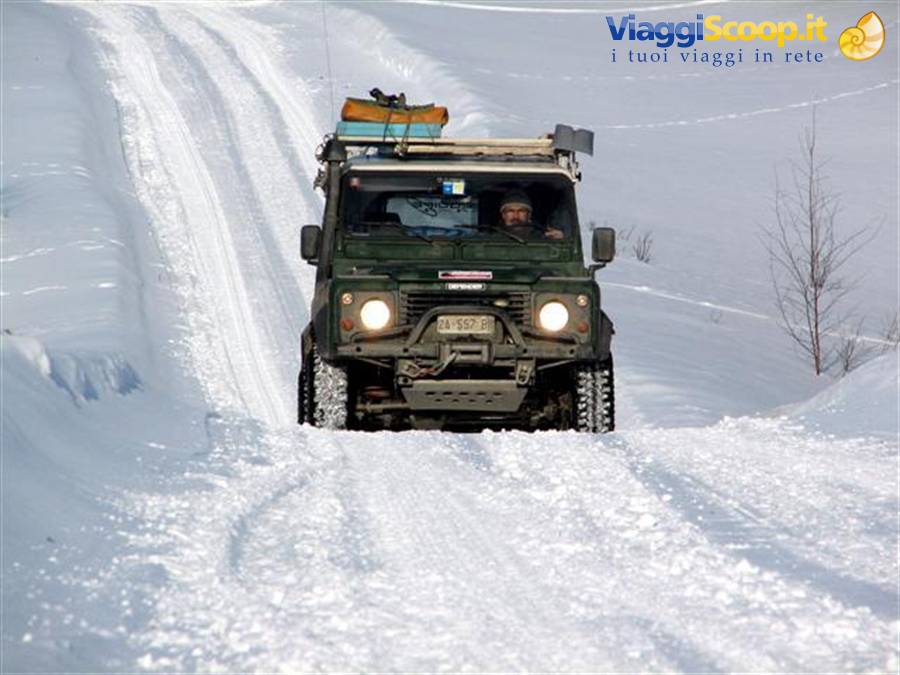
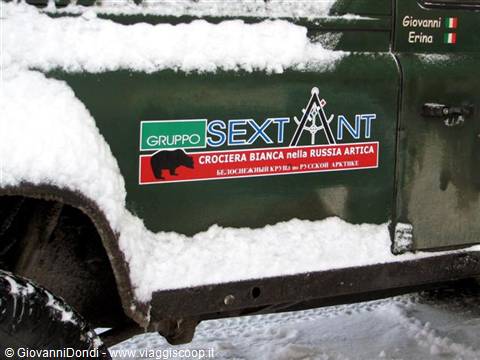
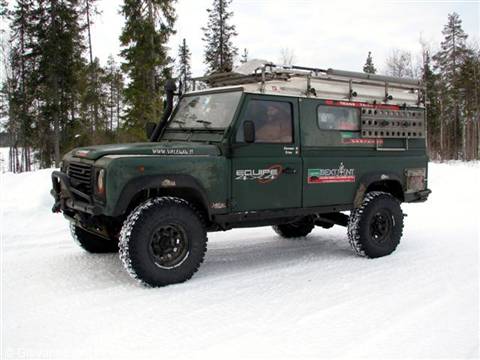
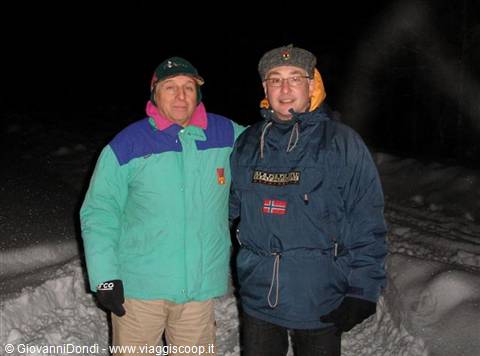
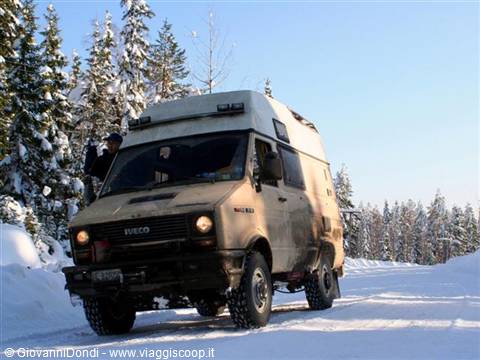
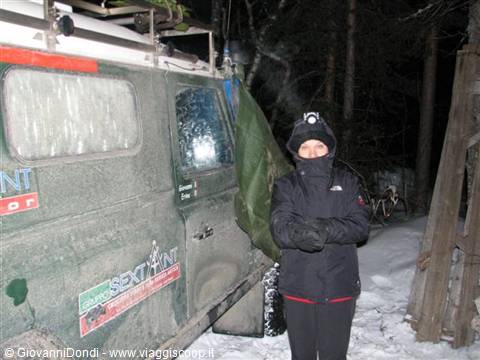
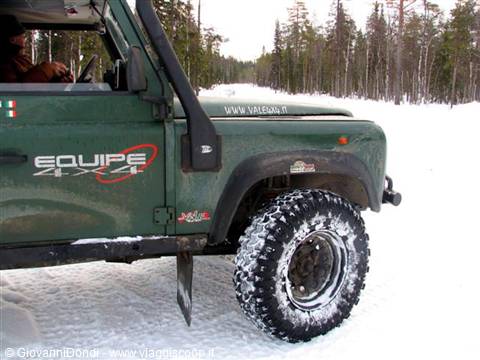
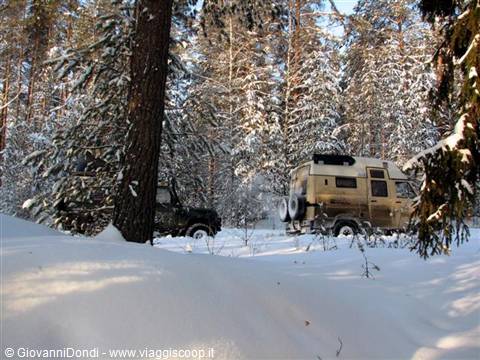
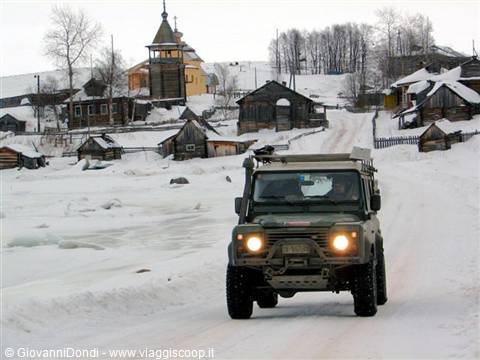
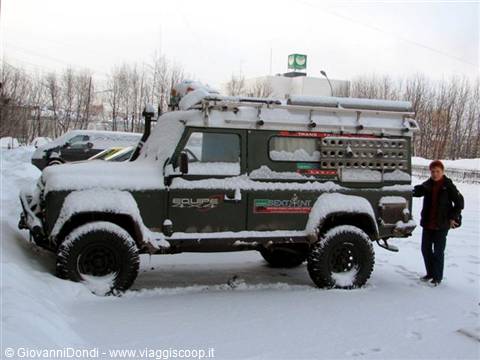
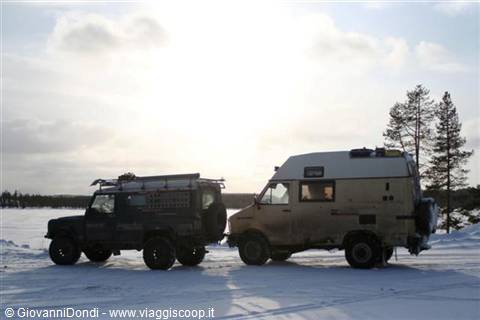
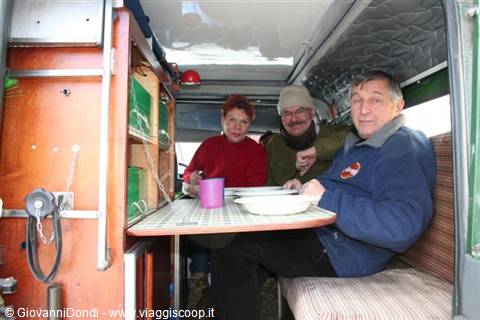
Two vehicles were used, with crews of two. Giovanni and Erina Dondi in a Defender 110HT 300Td, Mario Doria and Fabio Bresciani in a camper-converted Daily 4x4. Both vehicles were insulated, fitted with Webasto heaters and equipped for sleeping on board.
Temperatures never rose above 3 degrees below zero, often reaching –25°. Such temperatures required the use of diesel additives and additional batteries.
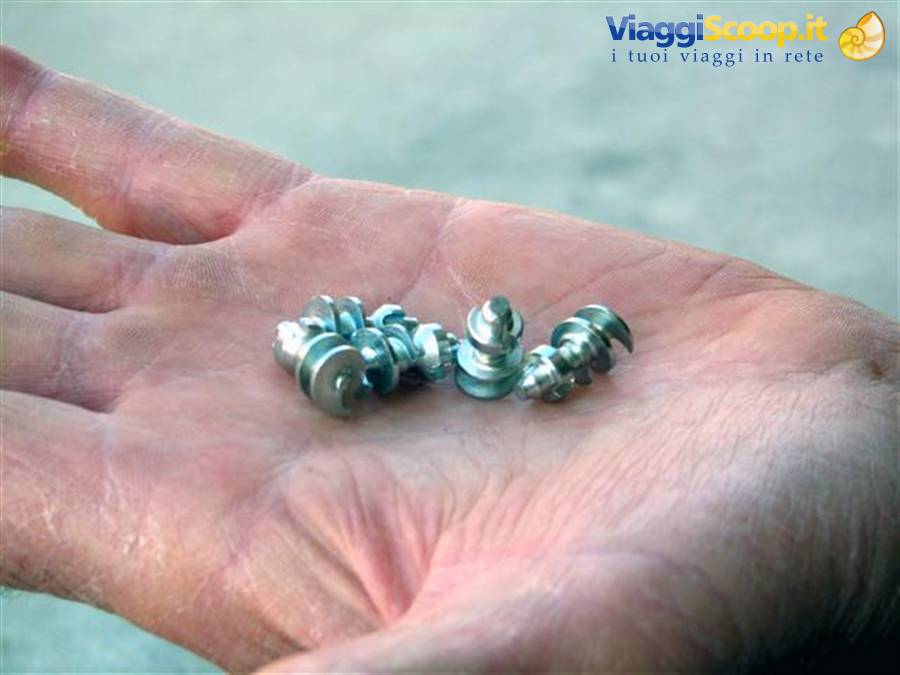
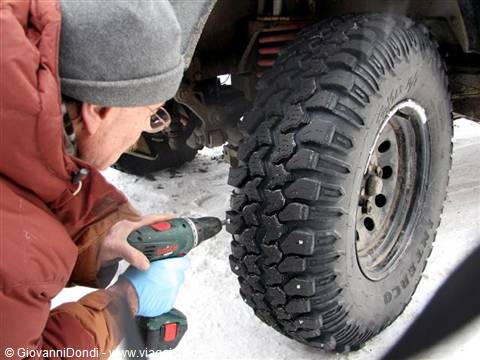
Traction on the icy ground was ensured by special Best Grip studs, which could be fitted and removed on site.
The route in Karelia ran entirely along secondary roads, with a completely snow-covered surface. The expedition reached the Kola Peninsula and followed a coastal track on the White Sea to reach the remote village of Varzuga, the last outpost of civilisation in one of the wildest areas of Russia.
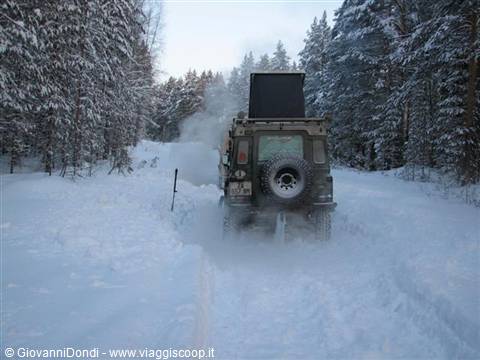
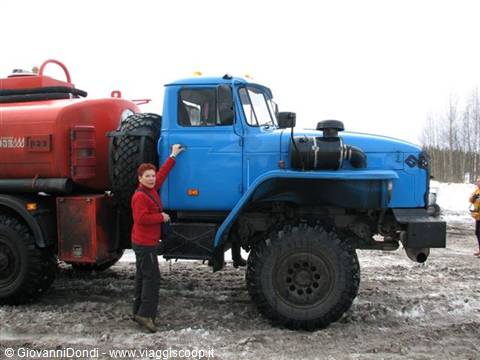
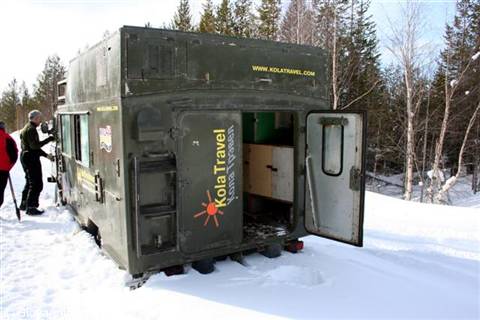
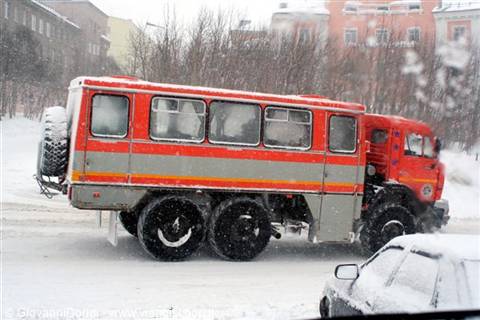
At Kirovsk the group met a Dutch operator specialising in extreme routes within the peninsula. With a mighty Russian military truck an attempt was made to carry out a raid over virgin ground, but the depth of the snow proved an insurmountable obstacle even for this extraordinary vehicle.
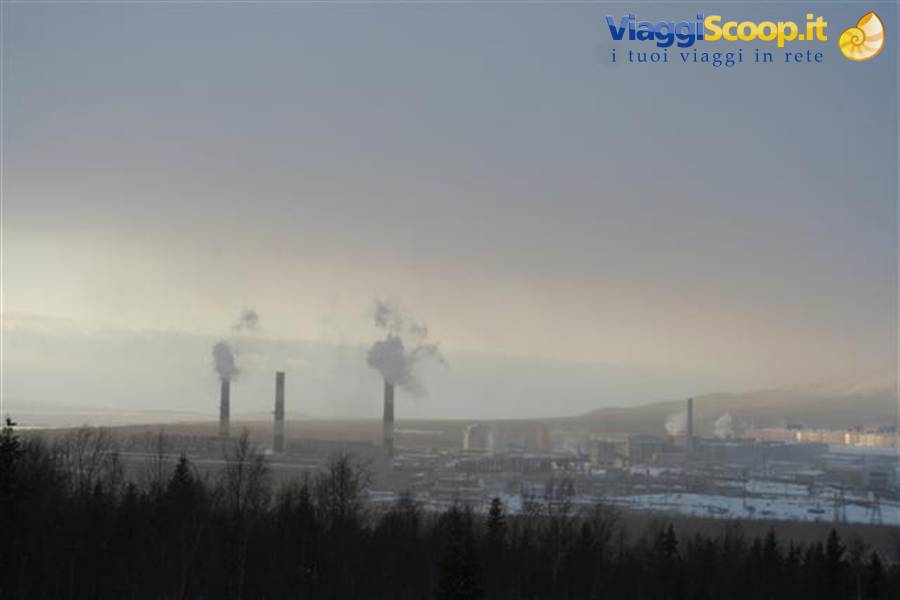
The journey was marked by the violent contrast offered by the environmental devastation of the Soviet era. Industrial cities, mines, nuclear power stations, foundries, military ports, etc. stood against a natural environment of extraordinary beauty, with untouched forests and the great tundra that is home to the surviving Sami and Komi peoples and to hunter-fishermen such as the Pomors.
The Barents Sea and the port of Murmansk, scene in 2000 of the Kursk nuclear submarine disaster, were the northernmost point reached by the expedition.
Day 110 Mar 2009
.... FROM RUSSIA WITH LOVE
... FROM RUSSIA WITH LOVE Account of the journey in Karelia and the Kola Peninsula March 2009
We have now left behind the imperial palaces of St Petersburg, its crowded avenues and the beautiful girls squeezed into jeans that revealed their curves.
The clicking of 12 cm heels that kept making us turn our heads has now been replaced by the clattering of columns of lumbering trucks kicking up sprays of frozen mud. This is the M18, the road that from St Petersburg heads north-east, skirting the great Lake Ladoga, entirely frozen, and then bends north towards Petrozavodsk.
Over the layer of packed snow covering the asphalt, a layer of sand and earth has been thrown, turning the road into a dirt track.
To get here we crossed Switzerland, Austria and Germany. From Rostock we boarded the Tallink ferry that took us to Helsinki, in Finland.
We had our first foretaste of the harshness of this year's climate right in the Finnish capital, hit by a snowstorm.
The border crossing with Russia was relatively easy (about two hours), though made uncomfortable by the icy wind that funnelled into the hangar of the crossing point, hitting the queue of people waiting at the border.
The first stretch of the M18 is in terrible condition. The road connecting St Petersburg to the far reaches of Arctic Russia is paradoxically in worse shape near the cities, perhaps because of the heavy traffic that gravitates there.
The Republic of Karelia
Heading north-east, the traffic decreases and the surface improves. According to the plan, our first stop should be near Petrozavodsk, from which a secondary road branches off leading into the interior of Karelia. After consulting the maps, however, we decide to avoid the city, making a detour 50 km earlier that will take us directly onto a forest track leading to Lake Siamozero.
There are no signs, and we ask for confirmation from a rubicund tractor driver coming the other way. "Niet polizei," he shouts at us, hitting us with a blast of vodka fumes. "Niet polizei," he repeats, as if in the absence of police any road were good. He holds a lit cigarette butt between his lips, and with all those gases coming out of his mouth it's a wonder he doesn't catch fire.
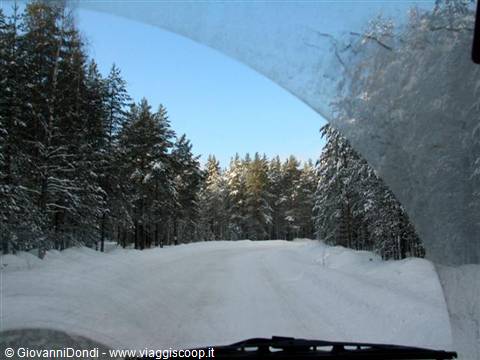
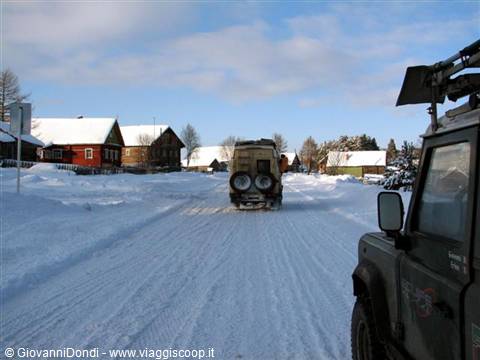
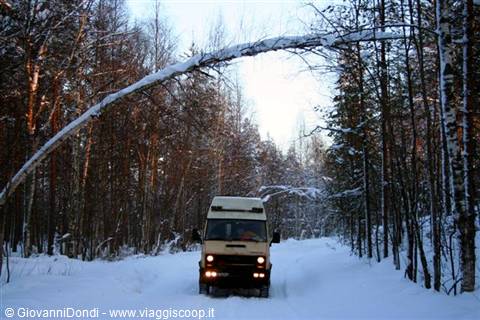
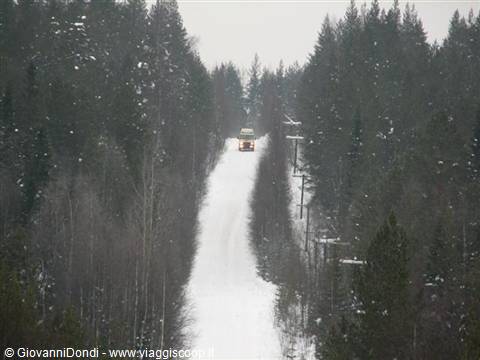
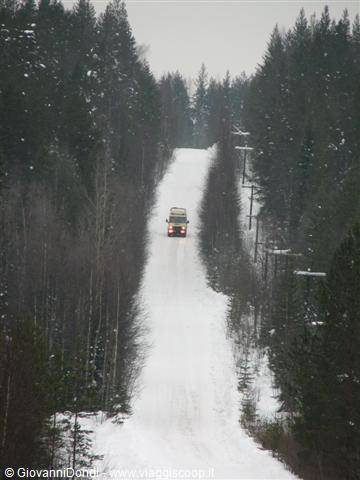
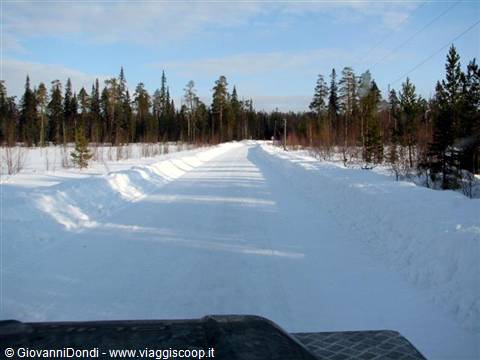
The first stretch of road, and from this point on it will always be like this, resembles a bobsleigh track, on which, given the nonexistent traffic, the off-road vehicles speed along in complete safety.
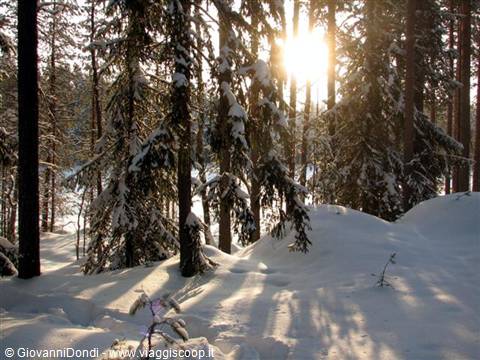
After about fifty km we turn onto the track that runs along the shore of the lake. Now the snow layer gets deeper and makes driving more demanding. The setting is idyllic: sunlight penetrates the forest, reflecting off the snow. The scene is unusual, austere but stunning. The snow on the branches of the red firs forms myriad dazzling points of light that, with the movement of the cars, seem to switch on and off like an immense Christmas decoration. The cars struggle forward with the low gears engaged until nightfall, when we locate an ideal area for the night bivouac. When the sun sets below the curtain of trees the temperature drops to -10°, heralding a freezing night.
To make our movements around camp easier we shovel the snow around the cars. It is dry and light and can be cleared with minimal effort.
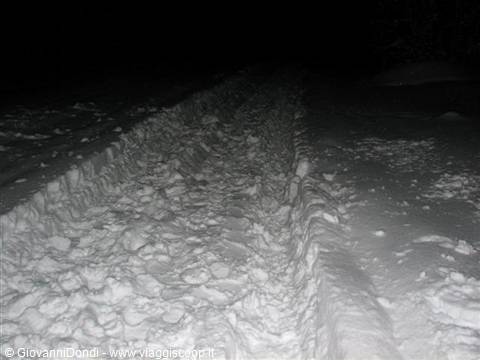
This snow is so dry that it is incompressible. It has the consistency of African fech fech, and when the wind blows it rises in sparkling swirls. On this surface the 900/16 sand tyres fitted to the Daily work marvellously. As already mentioned, this snow has the consistency of sand, and an exaggerated tread would break up the surface and make the vehicle sink. Even snow chains (which we will never fit) would be counterproductive, since there is nothing vaguely solid for them to grip.
The most important thing is "flotation", and therefore a tyre's ability to operate at minimum pressures.
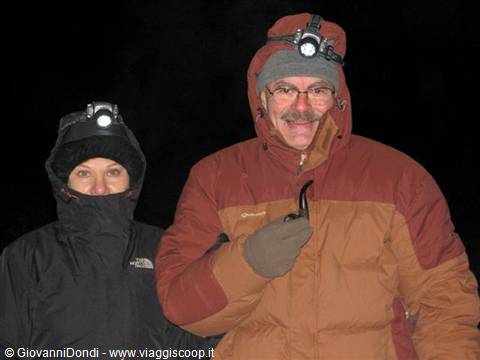
After a dinner on the Daily based on Italian spaghetti and local cold cuts, enlivened by generous swigs of Piacenza Ortrugo, we take a night-time walk. The temperature has dropped to -15°, but the dry air and suitable clothing save us from feeling the cold. The clear sky is studded with stars. The silence of the taiga is broken only by the crunching of snow under our feet and by our comments on the beauty of the setting. The short excursion carries no risk, since the most fearsome local predator, the black bear, is dozing in hibernation, and wolves and lynxes are too shy to approach the camp.
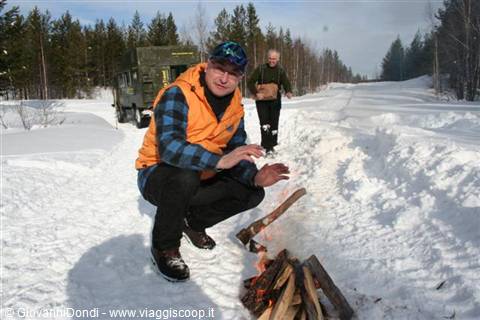
One of the greatest dangers for those camping in the taiga is not the animals, but the extreme changeability of the climate. A sudden storm can in fact dump so much snow that it blocks the vehicles. According to the Komi, halos around the sun's disc foretell snow, while other clues can be read from the smoke swirls of the campfire: if they rise vertically the weather will be cold and dry, while lazy swirls struggling upwards foretell a turn for the worse. Not being Komi, we paid no attention to these indicator signs, but since the sky is totally clear of clouds we go to sleep confident.
Tonight the outside temperature dropped to -25°, while inside the Defender, despite the insulation, it hit -8°. In fact we didn't dare keep the Webasto on for fear of draining precious energy from the two 50 Ah batteries. Even so, the soft duvet, the beanie on our heads and the arctic-climate thermal underwear gave us more than sufficient protection.
Inside the Defender everything has frozen. The water tank that feeds the little sink is a solid block (the water pump will only start working again when we get back to Italy). The water in the bottles is frozen, and so are the toothpaste, the toothbrush and anything else containing liquid. From this moment on, to have even a little water we will have to melt snow on the stove. Because of the condensation from our bodies, the seals of the pop-up roof have stuck together, locking it permanently.
On the Daily, equipped with three 100 Ah batteries, the Webasto was able to guarantee an inside temperature a few degrees above zero all night, but as far as water is concerned the situation is identical to that of the Defender.
The following morning the engines struggle to start, leaving us holding our breath for a few seconds.
Once on the move again we reach a clearing where a group of lumberjacks, with the help of a tracked bulldozer, is stacking logs. They seem annoyed by our presence: evidently they are doing something illegal, and they stop us going any further. The angriest of them tries to snatch the video camera from Fabio's hand, and Fabio hurries to show him that they haven't been filmed. It's a situation straight out of "Tranquillo Week-End di paura"; they don't raise rifles, but their chainsaws are just as threatening and dissuasive. The tension eases when we accept their request to turn back. In the end they help us manoeuvre, and at our "dasvidania" they even attempt a smile that reveals dental arches black with nicotine and full of gaps.
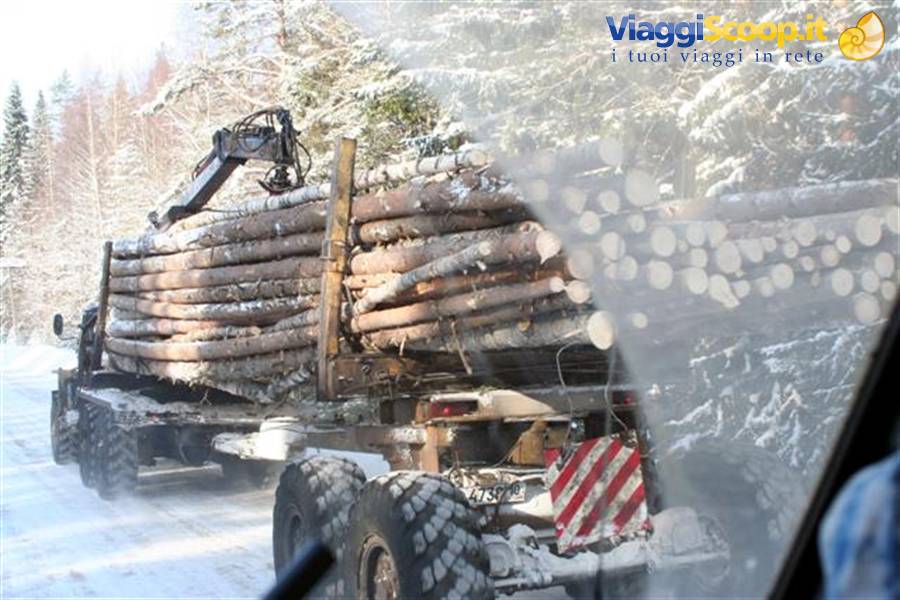
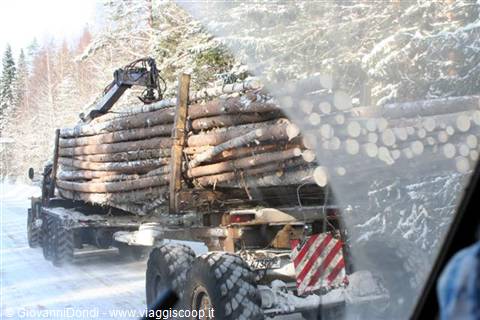
travelled by the loggers' trucks
Day 213 Mar 2009
...FROM RUSSIA WITH LOVE
In the morning we regain the road to Suojarvi. This 70 km stretch is used by powerful 6-wheel-drive trucks carrying timber. Despite being inveterate drinkers, Russian truck drivers seem to drive more correctly than many of their Western colleagues. Throughout the whole journey we never once saw a reckless manoeuvre by a truck driver.
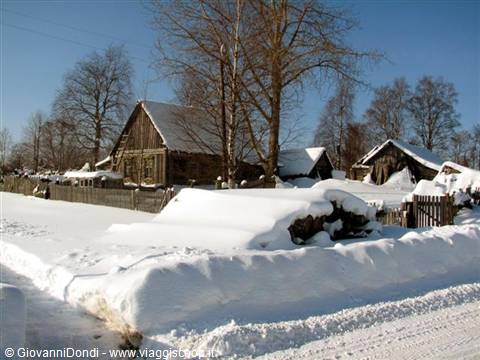
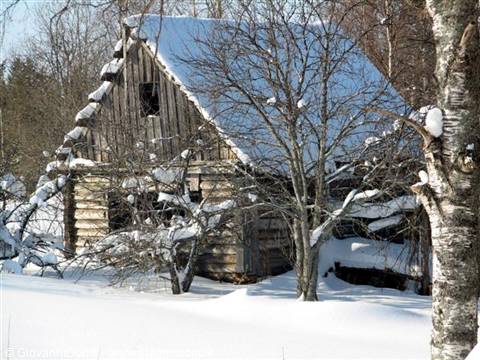
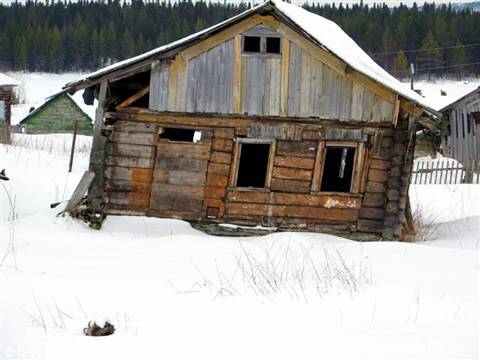
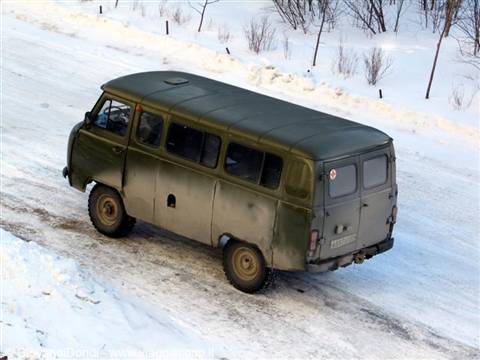
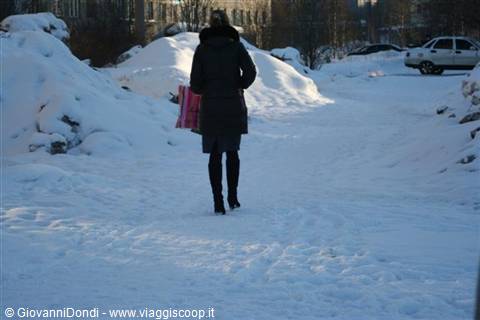
Once we reach Suojarvi we head decisively north on a secondary road with no traffic. We are once again immersed in the heart of the taiga, travelling on the usual surface of bottomless snow. Only a few lost villages break the monotony of the setting: Leppianiemi, Toivola, Lahkolamen, Kostomuksi, small clusters of dilapidated wooden houses still gripped by the long Russian winter. The houses are built with roughly hewn planks and seem never to have received a coat of paint. And this contrasts with the neat appearance of the women, who even in these places forgotten by God and by the Party wear elegant fur jackets and move with grace among huge snowdrifts. A few rusty Uaz vehicles provide the links with the civilised world. Within a radius of 1500 km there is not a single cultivated field, and every foodstuff has to be transported from the central regions of European Russia.
The only resources, apart from minerals, are timber, and most of the male inhabitants are indeed forestry workers.
This stage involves passing through the village of Porosozero and bivouacking on the shores of Lake Gimolkoe. The track leading to the lake is heavily snowed over, and once you turn onto it no manoeuvre is possible. At the sides of the track the depth of the snow is such as to prevent any U-turn, which will only be possible on the frozen surface of the lake.
The vehicles move forward with difficulty but without mishaps. The route is short and after not even half an hour we reach the shores of the lake. As expected, the ice allows us to carry out the manoeuvres needed to choose the ideal spot for the night camp.
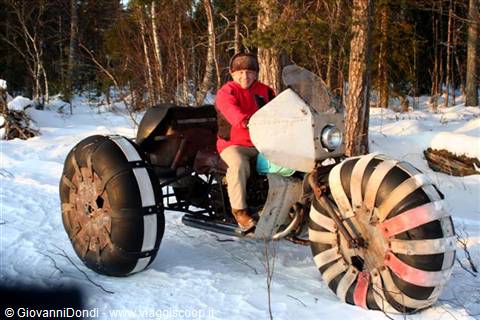
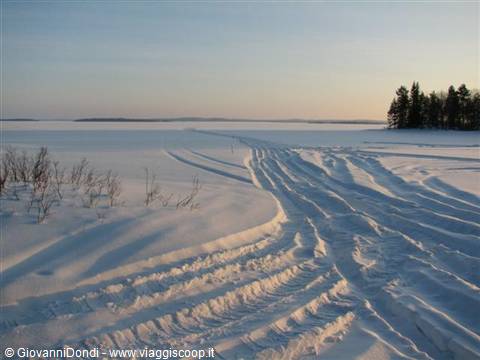
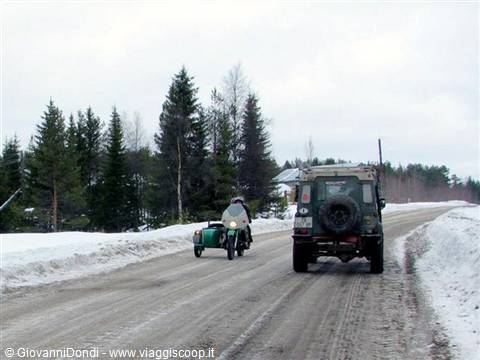
On the shore there is a strange vehicle: a three-wheeled motorcycle with tyres made from large truck inner tubes wrapped with strips of canvas running across them. The tracks left in the snow reveal an exceptional flotation capability. The vehicle, of handmade construction, is probably used by fishermen to get around on the frozen surface of the lake.
The night promises to be freezing, so we decide to stretch a tarpaulin over the front part of the Land to give some protection to the cab and the engine compartment. After dinner a night-time walk on the lake allows us to burn off the excess calories that a bottle of Tuscan red and a couple of shots of vodka have made us accumulate.
The next day, back on the road, we continue north. We spend the morning speeding along the usual bobsleigh track. What rouses us from the torpor that the monochrome setting induces in us is the whirring of the capercaillies, a kind of large black grouse that hangs around in flocks at the sides of the track. The only animals sighted, apart from a few foxes, are these grouse. No encounters, however, with moose, which are abundant in these areas, nor with other deer.
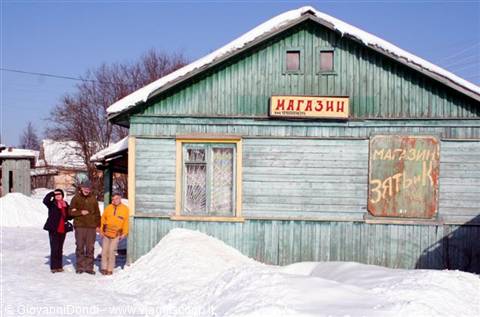
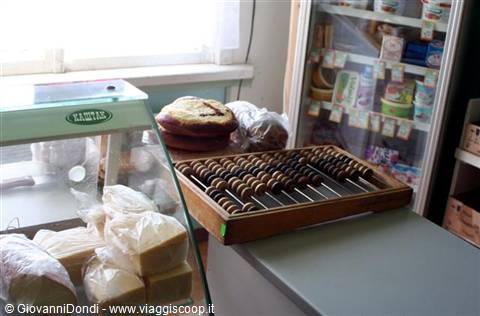
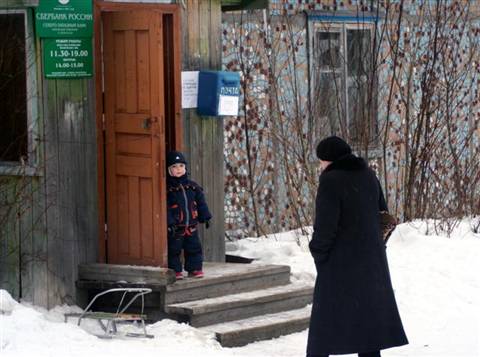
At the edges of the villages dogs roam free. Sled-dog breeds now outclassed by motor vehicles, but still held in high esteem by the local populations. Towards midday we reach the village of Peninga, where in a shack serving as a shop we buy some foodstuffs. To work out the total the shopkeeper deftly handles an abacus, a tool in use in Soviet Russia until the '80s and still operational today in the country's most remote areas.
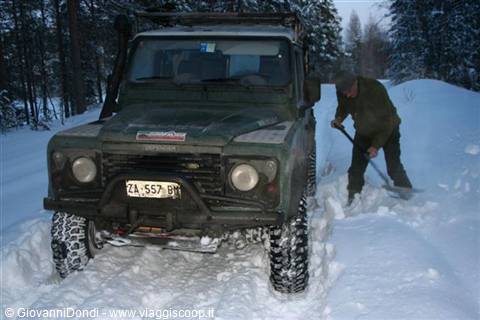
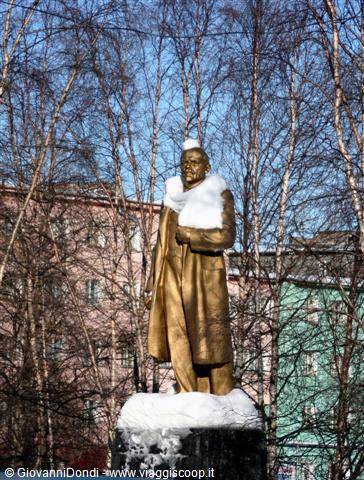
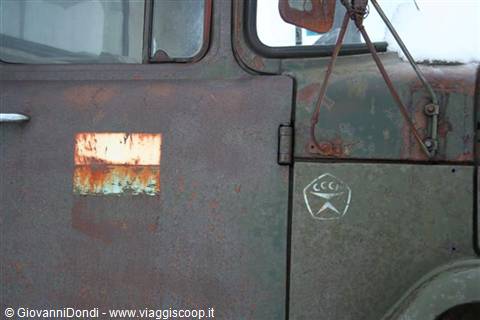
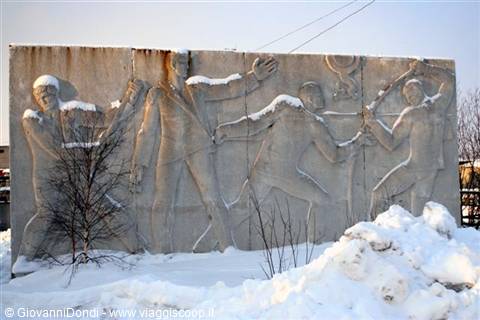
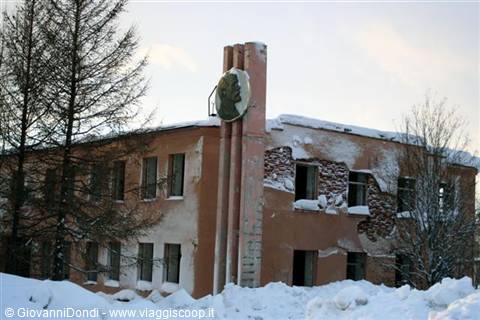
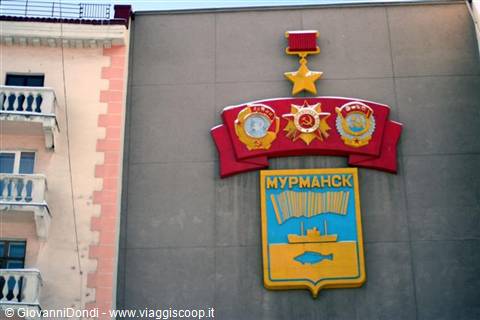
The collapse of the Soviet system did not bring drastic changes to the lifestyle of these populations, as shown by the numerous symbols of the Communist Regime still towering over many public buildings. Towards evening we reach the vicinity of the village of Ledmozero. It's late and we have to choose a spot for the night camp. We turn onto a truck road, from which branches a snowmobile track that seems ideal for spending the night. We try with the Land, but after a few metres the snow layer gives way and the vehicle sinks up to its chassis. As always when there's no grip, the diff locks prove useless and the situation can only be resolved by towing with the Daily, which has remained with its wheels on solid ground. For tonight we have to settle for a sand pit, not very romantic, but sufficiently hospitable.
Today's stage involves crossing hilly terrain with numerous hairpin bends, which leads us to make a technical stop to fit the special Best Grip studs. Thanks to a helical screw these studs can be inserted with the help of an ordinary screwdriver. The operation takes more than an hour, but it gives the vehicles stability and safety even on the steepest slopes.
This time we have the opportunity to observe the taiga from above. The immense expanse of red firs and birches stretches to the horizon. Towards the east this climatic belt crosses all 9 time zones of a country 70 times the size of Italy: a dimension we are not used to and that can disorient even the most experienced traveller.
The thread that keeps us tied to civilisation is the vehicle we travel in, and at this juncture its reliability seems to us more vital than ever. We zigzag up and down the hills heading north, passing the industrial settlement of Kostomuksha, as far as the village of Vojnisha where we turn decisively east towards Kalevala. After passing the town we follow the road to Tungozero for another 80 km and then turn onto a side track heading inland.
The track leads us to a clearing ideal for spending the night. In the morning we decide to continue on this unbeaten trail, at the limit of the vehicles' capability. We run some risk in crossing a narrow wooden bridge without railings that spans a stream. The bridge is covered by half a metre of snow, which makes it impossible to assess the condition of the planking. The vehicles struggle to hold their line. We are forced to reverse and make corrections, at the risk of a disastrous sideways slide. In the end everything turns out well and we can continue without further mishaps, heading north-east to rejoin the M18, which will take us to Kandalaksha on the White Sea.
They are helical: they are fitted and removed with a simple battery screwdriver
Day 315 Mar 2009
...FROM RUSSIA WITH LOVE
The Kola Peninsula
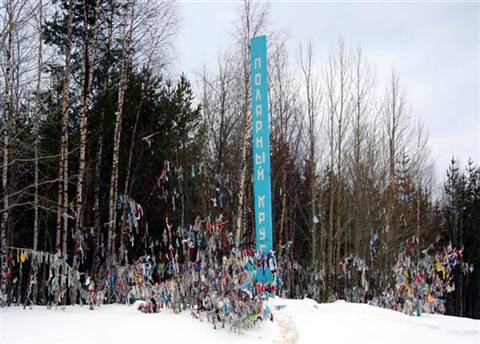
We stop at the marker indicating the Arctic Circle, surrounded by plants from which hang hundreds of strips of coloured cloth, placed there by travellers. A tradition reminiscent of that of the mountain peoples of Tibet, and which should ensure us a peaceful journey.
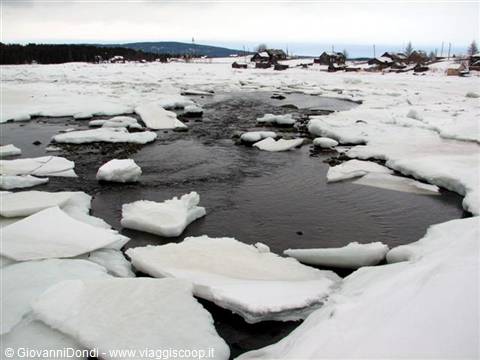
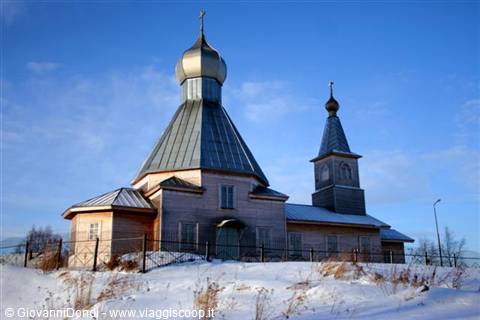
Before Kandalaksha we make a detour towards the small village of Kovda, on the White Sea. The village is perched on top of a little hill overlooking the river below, whose waters are beginning to flow between slabs of ice. The north side faces the White Sea, entirely frozen. Despite the state of the houses, many of which, for lack of foundations, lean alarmingly to one side, the village has a bucolic and reassuring appearance. It seems depopulated, but a little woman returning with her shopping bag belies the impression. At the top of the hill one of the oldest wooden churches on the Kola Peninsula is being restored. The well-planed planks clash with the colour of the boards of the bell tower, blackened by time. But Russia, as we know, is a land full of contrasts.
It seems that in summer the village fills with life, but during the winter season the resident inhabitants number no more than 30 souls.
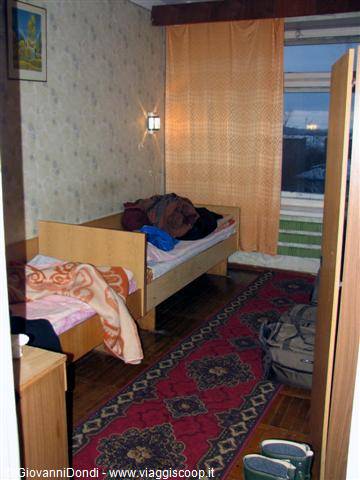
Once in Kandalaksha we finally book a room in a hotel in perfect Soviet style. They give us what by Russian standards would be the best. It has a roughly patched-up shower and toilet, but it's clean and heated, and that's enough for us.
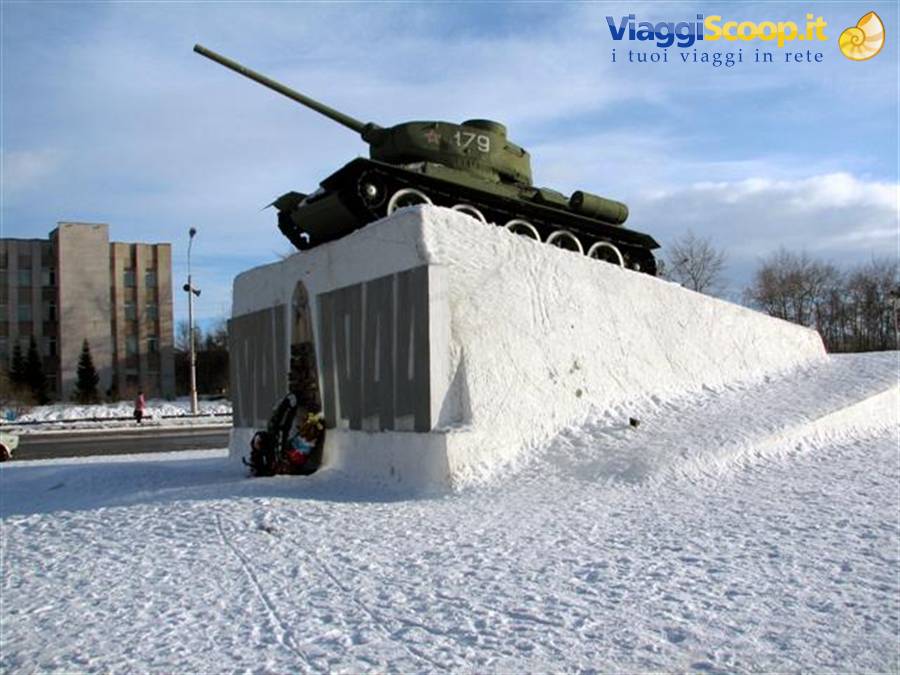
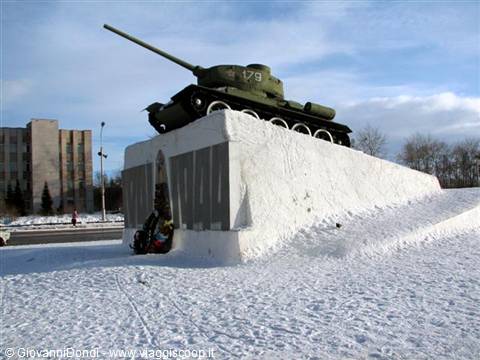
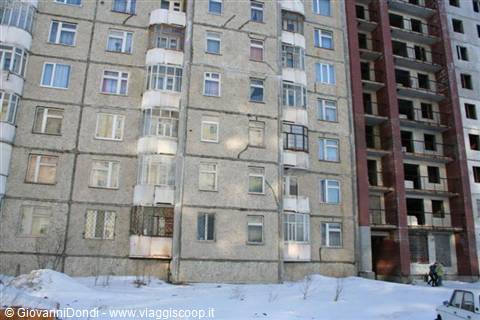
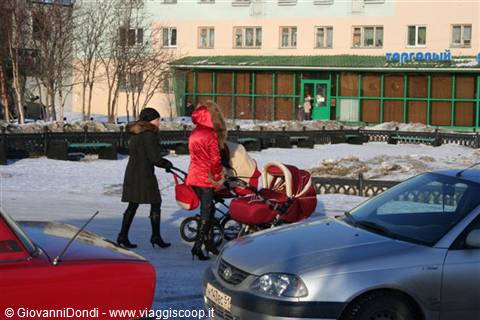
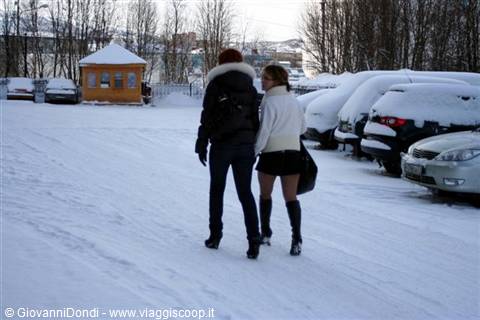
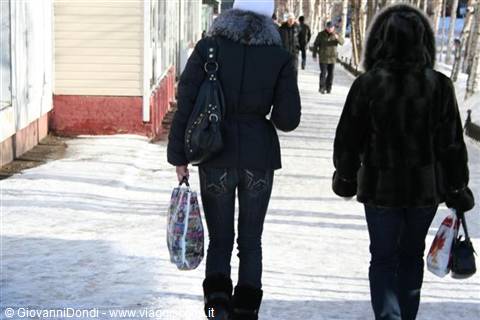
The city too is built according to Soviet architecture: large public housing blocks in an evident state of neglect frame the main square, in the centre of which, on a large concrete base, a T34 tank recalls the glories of the great Red Army. It seems there are no shops, but in reality they are hidden without signs or windows inside the courtyards. In the city, the usual beautiful women. Russia is a country of tall, slim models, but well-fleshed, capable of firing the fantasies of the males of the expedition: those temporarily single, of course!
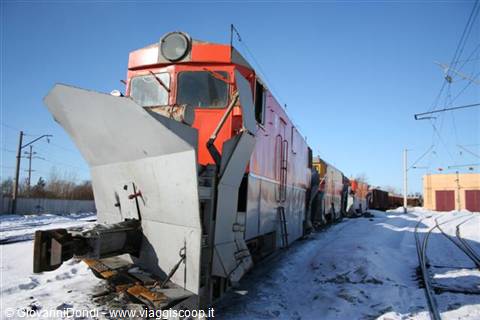
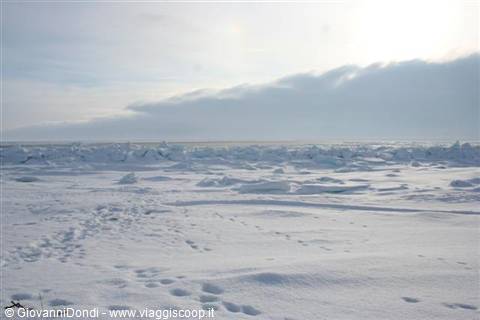
Leaving Kandalaksha we turn onto the coastal road that leads first to Umba, a city closed for military reasons, and then continues to the remote village of Varzuga. The route is not very demanding. The road has been cleared by snowploughs and is passable even by conventional vehicles. The ice of the White Sea, because of the pressure, has risen near the coast, giving us the impression that the backwash wave has frozen in an instant.
Varzuga is one of the oldest villages on the peninsula, inhabited by the Pomors, a settled population dedicated to fishing. The new part includes a road, a school and some recently built houses, while the old part stands on the opposite side of the river, accessible only by boat.
The next day we retrace the coastal road in reverse, returning to Kandalaksha. The city has by now become our base for refuelling and food supplies.
A tank dominates the main square of Kandalaksha
Day 418 Mar 2009
...FROM RUSSIA WITH LOVE
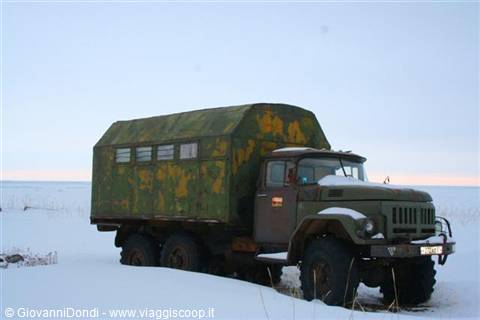
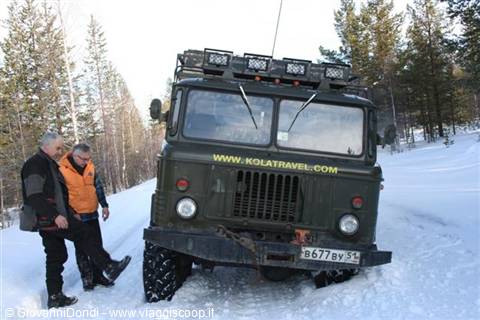
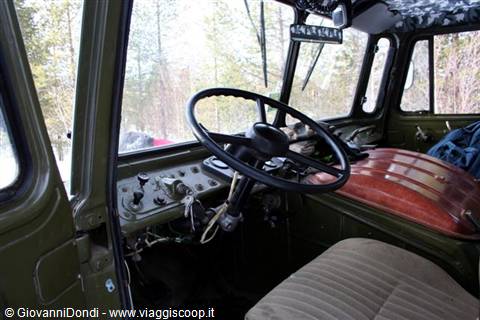
In the afternoon we take the M18 again to meet Frank, a Dutch operator who organises summer and winter excursions by truck, snowmobile and off-road vehicle. He informs us that the track he intended to take is probably impassable and advises us to try only with the Gaz truck, a compact vehicle equipped with enormous wheels, a powerful 8V petrol engine (entirely copied from the Range Rover engine) and a mechanical winch. We follow his advice and set off on board the legendary Gaz. It's immediately clear that the snow is too deep even for this powerful vehicle. The truck struggles forward, labours, sinks, then moves forward again and sinks again, until it becomes permanently stuck. Everyone out. Shovel and winch get the vehicle back to the surface, but after a few metres the whole thing repeats.
We advance in fits and starts for a few km until it becomes clear that the further inland you go, the more the depth of the snow increases. We therefore decide to turn back, picking up on the way back a beat-up Uaz van that stripped a differential while trying to follow the truck's tracks. In total we managed to penetrate 8 km inland, and according to Frank, given these snow conditions, that is already a record.
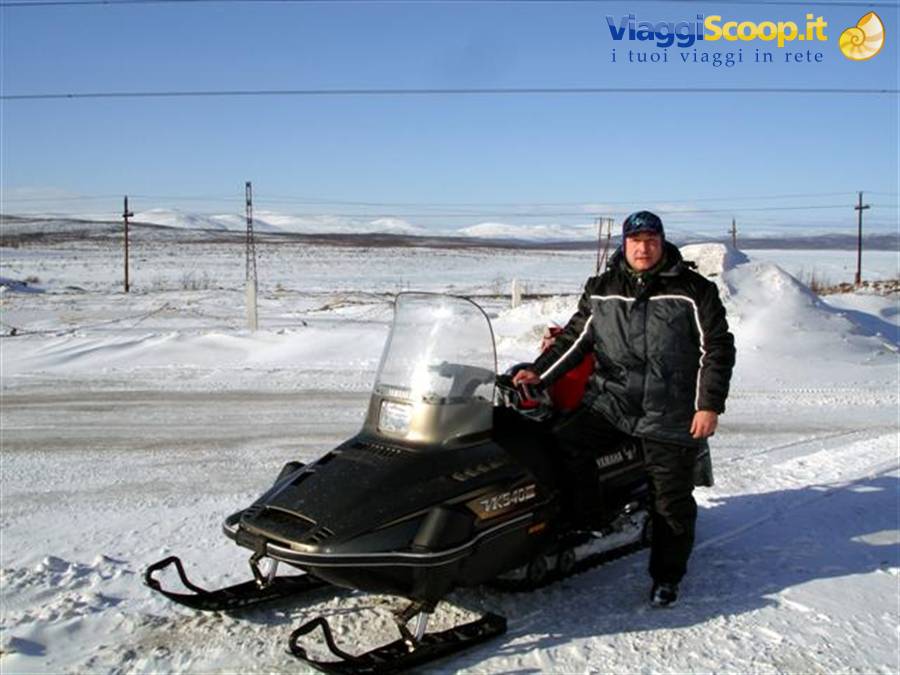
To compensate us for the truck flop, Frank proposes a day by snowmobile across Lake Mocheozero and the area north of Monchegorsk. Mario and Fabio accept enthusiastically and experience the different driving conditions on the frozen expanses of the lakes and on the hills.
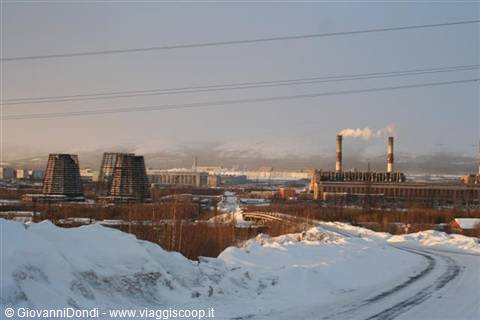
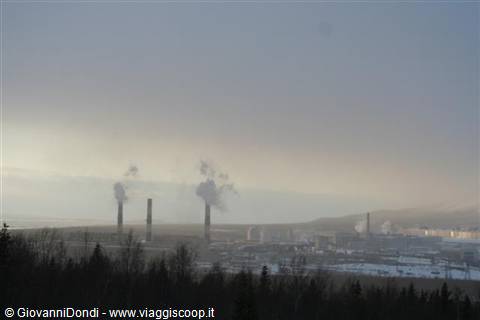
After completing the adventure within the adventure, our centaurs return to Monchegorsk. Just time for a scalding coffee and a cordial goodbye to Frank, and we're back on the main road, passing through the city of Apatity, which owes its name precisely to apatite: a valuable phosphate extracted in the mines of Kirovsk and refined here. Apatity has been the scene of one of Russia's most immense devastations. Not even the prospect of the beautiful Khibiny Mountains in the background can soften the images of the impressive industrial complex. The apocalyptic scenario of Apatity makes us appreciate the town of Kirovsk, located close to the Khibiny Mountains. Although it too was born as a mining town, its industrial suburb is 7 km from the built-up area. Today the town is a flourishing winter sports centre with ski slopes, free-style and cross-country.
Its facilities are used for the training of the Russian National Team. In summer it is the starting base for all trekking routes.
A nice snowmobile excursion
Day 520 Mar 2009
...FROM RUSSIA WITH LOVE
Once again we deviate from the M18 to visit Lovozero, the most important Sami centre in all of Russia. The town has a depressing appearance, with the usual dilapidated public housing blocks and a cultural centre shaped like a teepee that in the general context comes across as pathetic. Of the Sami of the collective imagination, nomadic reindeer herders, there is not even a shadow. The forced sedentarisation imposed by the Soviet system has denatured these populations, who now suffer from major problems of unemployment and alcoholism. But this too is Russia. Its ugliness is part of the general context and one must accept it. In recent years there have been some attempts to revive Sami culture. At the moment only one community has resumed reindeer herding, and in summer it is possible to observe a few herds in the grazing areas.
Back on the M18 we continue our journey north, heading towards the last eyesore on the Barents Sea: Murmansk, the largest city in the world north of the Arctic Circle. Beyond the city, on the fjord itself, is the port of Severomorsk, which hosts the nuclear fleet and is off-limits to foreigners. Murmansk is laid out on three levels: the industrial part and the port are obviously at sea level.
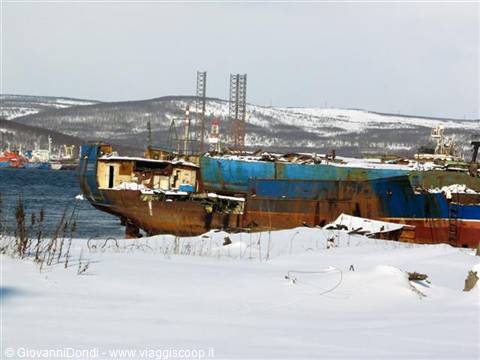
The port is, like all the ports in the world, a forest of steel cranes. The fjord is dotted with rusty hulks of ships being dismantled. Off this fjord in August 2000 took place the tragedy of the Kursk, a nuclear submarine and pride of the Russian navy. News of the tragedy was released after a full 18 days, and even today its causes are shrouded in mystery. The code of silence of the military circles meant that even Gorbachev, who still enjoyed great standing among the political class, was unable to shed light on what happened. The official version attributes the cause of the tragedy to the accidental explosion of a torpedo.
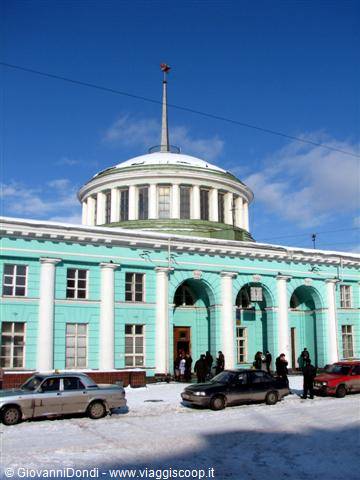
The city centre is in an intermediate position, and the surrounding heights are crowned by the outlying apartment blocks. After seeing Apatity, Murmansk seems pleasant to us: wide avenues, buildings with freshly repainted facades, well-stocked shops, and the ever-present beautiful women who as always sashay elegantly on stiletto heels, heedless of the gusts of snow hitting them. We stay at the Polarnie Zori (Polar Dawn) hotel, of Western standard. This time adventure has stepped aside and we enjoy maximum comfort.
After leaving the city we head south-west on the P11 road, which will take us to the Raja Jooseppi border post. The 250 km of road are heavily snowed over and the last stretch is particularly dilapidated. At the Russian border post there is still a Cold War atmosphere: wire fences, iron gates, spike strips and turrets with soldiers armed with AK47s. At the passport check something doesn't add up and we are detained for almost two hours. We are alone at customs, and despite the rigid bureaucracy requiring thorough checks of documents, we are treated courteously and given seats in a heated lounge. When the situation is resolved it is already evening, and having reached the Finnish border post we are stopped again, and this time much more brusquely.
They have detected traces of radioactivity on our vehicles, a souvenir of the Kola Peninsula, and they guide us under an arch equipped with Geiger detectors. Fortunately the values are not high and they finally allow us into Finland. It is night, and at the first lay-by we stop for dinner.
Chimneys and waste as far as the eye can see
Day 623 Mar 2009
...FROM RUSSIA WITH LOVE
The return through Finland
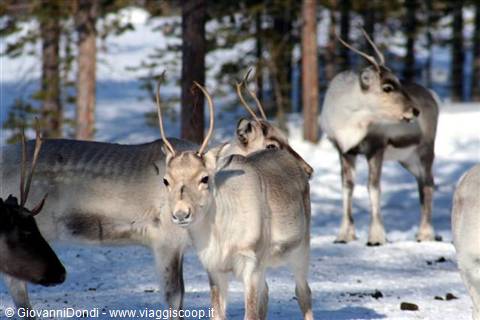
The next day we reach Ivalo and begin our descent south. Since the desire for adventure still animates all the members of the expedition, we decide to deviate from the E75 to make a crossing that should take us onto a parallel road. The track, about seventy km long, has not yet been opened, and we manage to cover only about ten km of it, with a few interventions to get the vehicles unstuck. But it was worth it. The setting is of extraordinary beauty; the immaculate snow is violated only by the hooves of reindeer that flee among the trees at our arrival. We stop for a frugal bite. Back on the E75 we descend further south to turn onto another track that makes a large loop inland and then returns to the road.
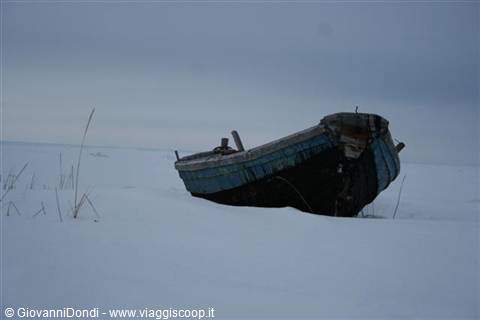
It's the last adventure before the big transfer home. It's a snowmobile route, but trodden enough to be passable for us too. We proceed in first low gear until dark, when, near Lake Seiupajarvi, we reach a clearing that allows us to set up camp. On the frozen lake, some boats buried in snow and a few apparently uninhabited little houses. But the barking of a dog in the night tells us we are not the only frequenters of the place.
This is the last bivouac in the forest. We are still above the Arctic Circle. But from tomorrow the road separating us from Helsinki and the ferry to Germany will be considered pure transfer. The night is freezing and moonless. The absolute darkness and the crisp air bring the vault of the sky, studded with myriads of stars, closer.
We go outside to toast the success of the journey and to Great Mother Russia, which has allowed us to live an extraordinary adventure, disproving all the gloomy forecasts that were circulating on the Internet.
This is our second experience in the Arctic, and if it's true that there's no two without three……..
We are ready for the next winter adventure in Great Mother Russia























2 reader comments
che spettacolo..
che spettacolo..