Where: Romania - Baia Mare, Surdesti, Plopis, Harnicesti, Budesti, Sapanta, Sighetu Marmatiei, Barsana, Calinesti, Ieud, Rozavlea, Viseu de Sus, Moldovita, Sucevita, Humor, Voronet, Rasca, Agapia, Piatra Neamt, Bicaz Gorge, Lacu Rosu, Lazarea, Odorheiu Secuiesc, Targu Mures, Sighisoara, Viscri, Brasov, Bran, Rasnov, Sinaia, Busteni, Bucharest, Horezu, Curtea de Arges, Transfagarasan, Sibiu, Alba Iulia, Hunedoara. When: from 2 to 20 August 2008 How: by car Budget:
Day 12 Aug 2008
Brescia-Budapest
Departure at 05:30, wake-up at 05:00. The first traffic report announces 13 km of queue at the Mestre barrier, we divert toward Austria. At Villach, we encounter many motorcycles, perhaps a rally, we finally get back on the highway passing through Graz and just past Klagenfurt we run into a downpour complete with hail. Many cars stop at the side of the road, we pass a broken tree fallen in the middle of the roadway and continue slowly. Good and bad weather alternate. Today is the day of the Austro-German exodus, the rest area is packed and the queue at the gas station is a serpentine of more than 100 meters. Everything smooth until Vienna, but shortly after taking the highway for Hungary we run into two hours of queue at the border due to the heavy volume of traffic, many cars of emigrants returning to their native country with Hungarian and Romanian plates are unbelievably loaded.
After more than two hours we discover that the queue is due to the need to purchase the "vignette" for the Hungarian highway; in fact at the border only two gates are open which do not carry out checks but shortly after everyone stops to refuel and purchase the vignette, reducing the lanes of travel from three to one. The Hungarian police positioned after 300 meters try in vain to make the traffic flow more easily. Rain again, some slowdowns, we too manage to buy the "vignette" after a few km. We arrive in Budapest at 21:20 exhausted and take refuge in a hostel: a university dormitory turned into a hostel for the summer (Hostel Universitas). It is run by students who carry out the tasks of the usual reception with the result that the formalities take twice as long.
We are close to the Danube and on the way there we noticed many venues with music, but after 16 hours in the car I throw myself into bed.
Agapia Monastery
Day 23 Aug 2008
Baia Mare
Around 08:30: we check out and point the car in the direction of Romania. We have to cross Budapest, and a couple of closed bridges and some new roads complicate life when leaving the city. Today the Formula 1 GP will take place and the traffic is heavy up to the exits for the Hungaroring circuit. We continue, the Hungarian landscape is varied, hills and plains alternate and driving is a pleasure. The highway suddenly ends, finishing in a small town overwhelmed by traffic, the road up to the border with Romania is now particularly rough. At the border we are checked only by the Hungarian customs officers, who check identity documents and more meticulously those of the car. The Romanian border is deserted, it almost seems abandoned; continuing on, the road is narrow and even more rough. Suddenly a level crossing, without warning signs.
The road improves, we encounter the first village (Valea lui Mihai), it looks like a construction site, dilapidated houses, asphalt road half-finished with potholes that look like craters, it is not a good impact. Carts loaded with hay pulled by horses occupy the road. Dozens of sellers, old and young, stationed along the road just outside the village sell watermelons, melons, potatoes and some mushrooms. One encounters many carts transporting mainly hay, but also scrap iron. The roads are mostly rough, the old Romanian cars are slow while the rare new ones speed along disrespecting the limits outside built-up areas, everyone however never exceeds 50 km/h in the villages. Along the road we notice on many utility poles some stork nests and shortly after we also encounter them, the storks.
We cross the city of Satu Mare, ugly, gray, "concrete-filled" the road is even worse than before, a succession of dips and craters. We cross other small villages, we find an ATM and finally we touch the local currency. We hear religious music coming from a loudspeaker not far away, we go into the courtyard and, next to a small police station, there is surprisingly a small wooden church still under construction from which the music comes. We then arrive in Baia Mare, the capital of the Maramures region, important since antiquity for its wealth of minerals, and we stay at Pensiunea Marioara (pensiunea_marioara(at)yahoo.com), located in the city center. It is Sunday, the shops are closed, only Kaufland (a chain of department stores) and the bars are open.
We visit the tower, symbol of the city, the only surviving part of the ancient Cathedral of Saint Stephen, the church opposite which however is not that great, we stroll through the main square. We haven't touched food since last night and it is 4 in the afternoon so we go to Kaufland. How nice, we fill the bags with just 8 euros. Opposite Kaufland there is a church still under construction, we enter walking over wooden walkways. The interior is decorated with paintings in very bright colors, in strong contrast with the austere exterior appearance. Not far away, a church built entirely of reinforced concrete and with a bizarre architecture stands in contrast to this more recent one. We return to the guesthouse, a bit of relaxation, we plan the following day and have dinner with herring and cheese.
Agapia Monastery
Day 34 Aug 2008
Hearty breakfast cooked by Mrs. Maria, salami, cheese, tomatoes, bread and weak coffee. Leaving Baia Mare we run into the usual watermelon vendors. Surdesti, the first wooden church we visit, built in 1721 dedicated to the Archangels Michael and Gabriel, is the tallest of all, 72 mt. You get there along a narrow road and once parked, immediately a woman around sixty comes out of her house and, armed with a key, opens the church for us. Inside it seems smaller than it actually is, the small windows don't let much light in and this creates an intimate atmosphere. We leave a small offering for the woman who however refuses and points us to the box where we should deposit the donation. We continue the visit outside, around the church there is a messy cemetery with half-overturned graves.
Some peasants are scything the grass in the nearby field, they start a conversation, but since they only speak Romanian it's rather difficult. I can only understand that they were interested in knowing how much a motor mower costs in Italy, but having no idea I can't answer and they anyway tell me "a lot!" and laugh, perhaps meaning that it's better to scythe by hand than to spend so much money. Bah! We go back to the car and a girl around 10 years old who probably saw us drive past from her house is waiting for us, she sells handmade necklaces and minerals, we decline and say goodbye. Ploplis, shortly after the village of Surdesti. Plopis is a small village with dirt roads and the church built in 1796, also dedicated to the Holy Archangels, stands at the top of a small hill.
It will turn out to be internally the most beautiful of all those we will visit and it's already open, there are faithful praying and it's normally used for all services. We pass through Baia Sprie, famous for the countless carved wooden gates typical of Maramures. They are a sort of status symbol, the bigger and more elaborate it is, the more important and wealthy the family living in that house will be. Harnicesti, the church dedicated to the Nativity of the Virgin and built in the 17th century is reached via a path behind the elementary school, which also has a large wooden gate. Unfortunately we can't visit it inside, it's closed. Budesti, the church built in 1643 is under restoration and it's not possible to visit it entirely, we take a stroll through the small village along the unpaved road.
We then continue along the road, we pass through the villages of Sarbi and Calinesti, the bucolic landscape we cross is beautiful. Sapinta, much more touristy than all the destinations touched so far. We visit the monastery under construction that should become the largest and tallest wooden church. We enter the construction site without anyone stopping us. We move to the "merry cemetery", many sellers of handicrafts line the entrance of the cemetery. The graves in the cemetery bear a sort of allegorical / satirical vignette about the life of the deceased, this tradition began with a local artist, in 1935, Ioan Stan Patras and given the positive feedback received from his fellow villagers it survives today thanks to an artisan who has taken up the legacy of the promoter. It's a shame not to be able to understand what is written on each tombstone.
One of the most famous reads: "Tuica is a clean poison / that brings tears and laughter / It brought them to me too / Death has put me under its feet. / Those who love good tuica / Like me will suffer / Because I loved tuica / With it in my hand I died. (Here lies Dumitru Holdis, lived 45 years, died of forced death in 1958)". Vadu Izei, the guesthouse is just outside the center. We meet many horse-drawn carts along the road. The guesthouse "Casa Muntean" is very nice and cozy (recommended! Casamuntean(at)yahoo.com), we relax, I drink a beer under the pergola. We have dinner with a French couple and a Polish family, we eat a decidedly tasty "Chorba" with meatballs and then chicken and Tuica. We take a stroll through the small village, there is a shop that sells everything and also serves as a tavern.
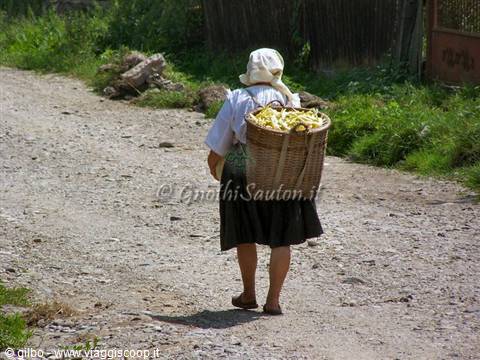
We meet a family of peasants returning from work in the fields, their faces are worn out from work, in front the mother beside the son who holds the reins of the horse pulling the cart loaded with hay and behind the father with two other children.
Agapia Monastery
Day 45 Aug 2008
Sighetu Marmatiei, an important city in the north of Maramures near the border with Ukraine. We visit the center, the churches of various denominations, the small one in the main square is beautiful, Maramures Museum (admission 4 lei, ~1.20 €) recommended to understand daily life today and in the past in this fascinating region. In the 1960s Sighet hosted a prison where political opponents of Communism were imprisoned, the former prison now houses the "Memorial of the Victims of Communism", very interesting (admission 6 lei, ~2 €). Overall Sighet can't be said to be a beautiful city, it's messy and anything but fascinating, but the Maramures Museum and Memorial are certainly worth a visit. Calinesti, built in 1630, the wooden church is reached after about 1 km of dirt road, it definitely deserves a visit, it's very well preserved and has maintained its original appearance over time.
The custodian asks us for 5 lei to open the door, it's little, but it's a lot compared to the usual rates. Along the road we see a small wooden church, but we struggle to find the entrance, you have to go through the yard of a private house to reach it via a series of little stairs. It's closing, but a young guide opens it for us anyway. Vadu Ieuz, the church stands on a small hill near a new church, also surrounded by poorly maintained graves. Rozavlea, the church is located along the main road, built in 1720 it is now under restoration both inside and out; we make a quick visit. Outside, local girls try to sell us necklaces, but we politely decline the offer. Ieud, the church stands on a small hill (admission 2 lei, ~0.60 €), built in the mid-17th century, it preserves inside the famous images of hell, this one is also reached via a dirt road.
They are restoring the apse which can still be visited. Along the road elderly ladies sell fabrics and other handicrafts. Barsana, just outside the village stands the "manastirea Bârsana", a Convent for Orthodox Nuns, very well kept with a recent wooden church still being furnished, a small museum of religious icons and other buildings that echo the architecture of the wooden churches. The beautiful garden is lush and industrious Nuns take care of it with the help of some little girls probably guests of the structure. Continuing towards Viseu de sus we cross a beautiful hilly landscape, perhaps the most beautiful we have seen so far, we stop more than once to fully enjoy the view and take some photos. We see the damage from the flood a few weeks ago that had jeopardized our visit to Maramures, many of the river banks have been knocked down and the riverbed is full of debris.
We arrive at Viseu de sus, our guesthouse, "Pension Danuta", is the most "ancient" and the last on the road that runs alongside the flooded river and the train station, flanked by many others born with the tourism of the little "Mocanita" train. The excavators are still working to secure the banks and the road we are traveling on is new because the previous one was destroyed by the flood, the fields and courtyards of the houses are still full of mud. The guesthouse is close to the tracks where until recently the "Mocanita" passed. The "Mocanita" was a narrow-gauge train that went into the valley alongside the river and carried workers from the city to the woods. It was an important center for timber that came down from the north near the border with Ukraine and served the whole region, with many furniture factories in the village.
Today the little train was more than anything a tourist attraction. We have dinner at the Cazare in the living room with chicken and appetizers that will be served again for breakfast too. We take a walk along the railway after dinner and see other damage from the flood, the small bridges over the streams where the railway passes have been seriously damaged, the tracks are bent, in some stretches torn up. We meet a man who is still shoveling the earth dragged into his garden, with whom we exchange a few words, again in Romanian, still frightened by what happened but happy that his house was still standing.
Budesti, returning from the fields
Day 56 Aug 2008
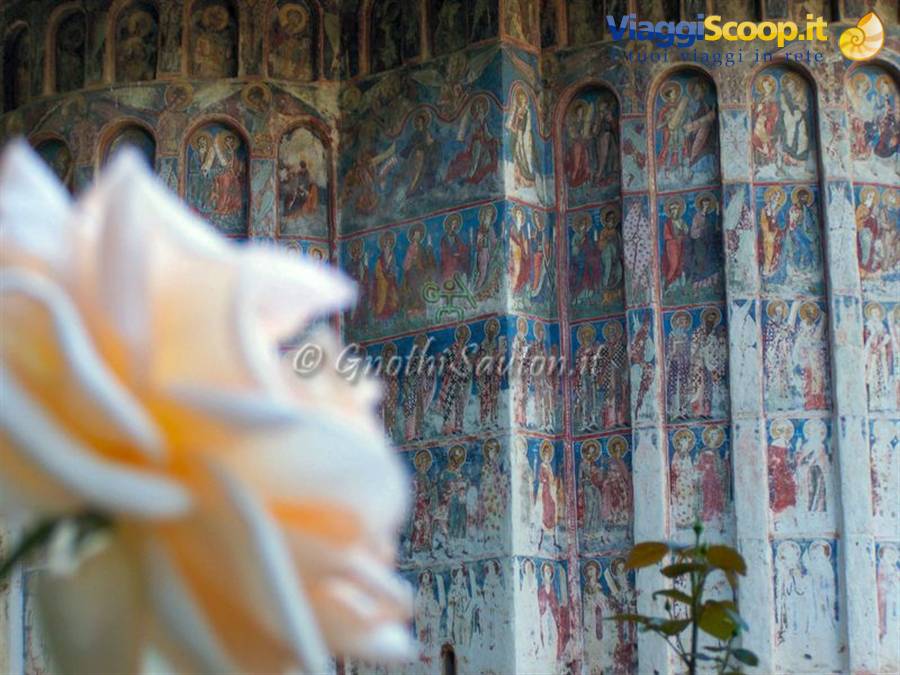
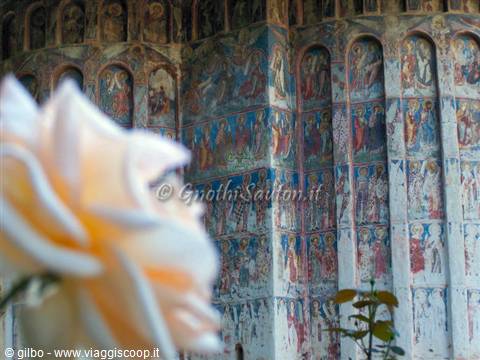
Breakfast, mountain pass between Maramures and Bucovina, scenically interesting. Moldovita Monastery built in 1532 by Petru Rares to defend against Ottoman invasions (admission 3 lei, ~1 €), characteristic of the Bucovina region, the Monasteries were fortified, enclosed by high defensive walls to protect them from enemy attacks. In the center the stone church with the characteristic frescoes on the exterior and interior walls that were used to instruct, in an era when illiteracy was widespread, the inhabitants of the area. We meet the first Italians, or rather a tour of noisy Italian campers. We have lunch along the road to Sucevita for only about 8.5 eur for two with a single dish, dessert and drinks. I taste for the first time one of the dishes that we will then find throughout Romania, although made in different ways, the Tochitura.
Definitely very good! Sucevita Monastery (admission 3 lei, ~1 €), outside there are some rides and a food stand, it's full of Romanians, but we don't understand what celebration they are holding. The monastery stands near the Sucevita river, its construction dates back to 1585, it is defended by high walls and at the corners stand tall defensive towers. The road from Sucevita to Humor runs straight through the predominantly flat landscape. Humor Monastery (admission 3 lei, ~1 €) built in 1530 on the ruins of a previous building by Voivode Petru Rares, it is dedicated to the Dormition of the Virgin Mary. Many street vendors outside sell textiles, various household items and the classic hand-painted eggs, which we buy. We also visit the imposing defensive watchtower.
We stay at the guesthouse, or rather Cazare, Gheorghita (Gheorghita Maria, gheorghita-delia(at)yahoo.com) run by the frantic Mrs. Maria, kind and a bit crazy. The relaxation area with a view of the adjacent fields is unique, created in the back of the house with a well in the center, where we have dinner in the company of the other guests, a French family and an elderly Romanian couple. I drink Tuica before the meal as usual in Romania and wine which is however awful, the amber-colored white is drinkable, but the red is a fruity and sweetish novello. Soup with bread meatballs and a main course with meat sausages, potatoes and legumes. We spend the evening chatting in Italo-Franco-Romanian. Around 10 pm Mrs.
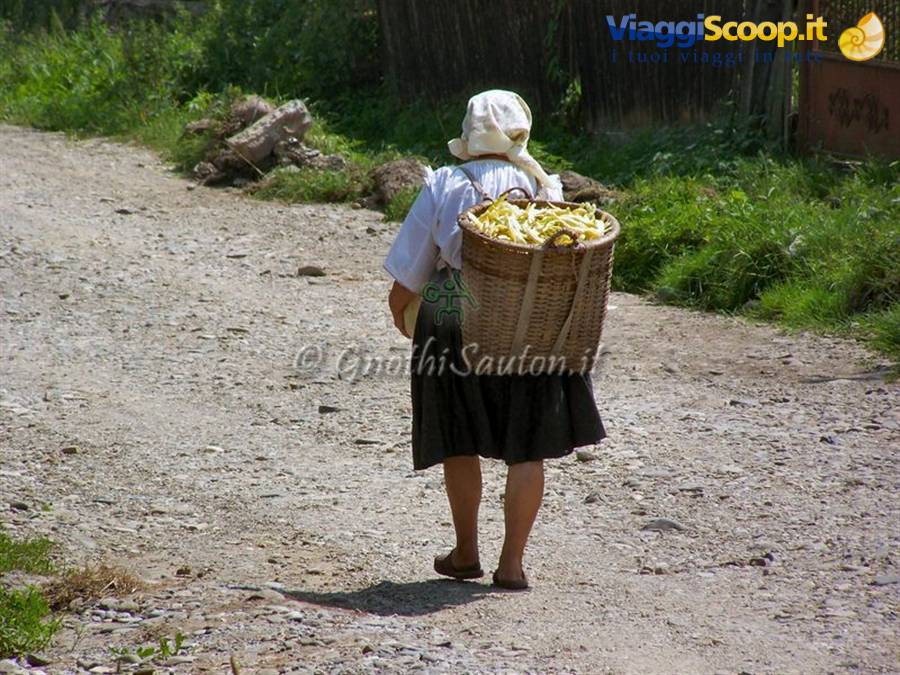
Maria's mother arrives back from work in the fields, she doesn't need it economically, but every day in the morning she wakes up early and goes to the fields, "as long as your arms work well your mind works well too", this is her motto, which I confirm, she must be between 75/80 years old and carries them very well.
Budesti, returning from the fields
Day 67 Aug 2008
Breakfast on the veranda with the usual appetizer with the addition of homemade jams and honey, decent coffee. Bucovina presents itself better than Maramures, big roads under construction, fewer carts, fewer vendors along the roads, the few sell berries. The houses are almost all made of masonry and few are wooden. In the fields you see cows grazing alone, without herders. Voronet, the parking lot is full of vendors. The Monastery was erected in 1488 by Stephen the Great to commemorate the victory of the battle of Vaslui where he saw 40,000 Moldavians prevail against 120,000 Ottoman soldiers. The Last Judgment frescoed on the outside is very well preserved, a guide with a group of Spaniards explains in depth the allegorical meanings of the work and given the affinity of the language with Italian I take advantage of it. It deserves a visit (admission 3 lei, ~1 €).
Rasca, built in 1542, it is now run by Orthodox Monks, it's not a very touristy destination, enchantingly quiet, Gregorian chants in the background in the garden. We meet two little girls drawing water from the well which they use to water the beautiful flowers in the garden. The church in the center is dedicated to Saint Nicholas. Naemt, very religious, the largest male monastery in Romania, construction began around 1370 at the behest of Stefan cel Mare, it is now under restoration. The atmosphere is gloomy, there are many faithful present. We also visit a small museum of icons, illuminated books and about the origins of printing located in a wing of the complex.
We meet a cycle tourist loaded like a donkey whom we had already met twice in the past few days in Maramures and then in Bucovina, congratulations! We also visit the souvenir shop opposite the monastery entrance located in a beautiful building, they also produce vin santo which I don't buy though. Agapia, built by Voivode Vasile Lupu around 1645, the convent run by nuns who live in small houses with beautiful flower gardens located outside the complex (admission 5 lei, ~1.5 €). It's all flowers, here too it's very religious and a pilgrimage destination, there are many faithful present. We also visit the small museum of sacred art. On the way out we buy some jam produced by the nuns.
Having been forced to skip the excursion with the little "Mocanita" train we are one day ahead of schedule, we look for a guesthouse along the road and after viewing a very characteristic and colorful wooden one we prefer the one located at the beginning of the main road with a swimming pool and tennis court. We have dinner with vegetable omelette, chicken, potatoes and Mamalita dessert (100 lei plus 30 lei for dinner, ~40 eur in total for two adults).
Budesti, returning from the fields
Day 78 Aug 2008
Piatra Neamt, a very lively and busy city, we park in a paid spot, struggling a bit to find coins for the parking meter. At the "kangaroo" supermarket we buy breakfast: two awful croissants and yogurt which we eat in the central park. Visit to the old part of the city, beautiful, there is a church that seems to be used as a warehouse, messy and gloomy but still crowded with faithful. Visit to the art gallery, there is an interesting female artist whose name I didn't write down though. The ethnographic museum consists of only four rooms (admission 3 lei, ~1 €), there is the reconstruction of a typical peasant house, tools, clothes, etc. In the center of the square the bell tower, the tower of Stefan cel Mare. Piatra Neamt gives the idea of being a productive and wealthy city, we see the first large electronics store.
On a glass building under construction a large display broadcasts various advertisements, a small Piccadilly circus. For tourists there is also a panoramic cable car that goes from the city center up a little higher to the largest park in the city, but it doesn't seem very interesting. Leaving the center we stop to quickly visit a beautiful recent church with striking exterior colors. Bicaz, the village is decidedly ugly, until the 1950s the economy was based almost exclusively on forestry activities and then the construction of a large cement plant changed its appearance. Cement plants tower at every corner, we stop only to stock up. We continue towards the renowned "Gorges" encountering other cement plants, the road runs alongside a small river, suddenly it narrows and the first stalls appear. We stop, the gorges are a little further ahead and we continue on foot.
The narrow road, the presence of many tourists and the stalls everywhere create a nice traffic jam. The "Cheile Bicazului" were created over time by the flow of the Bicaz river and are impressive for their height and peculiarity. The road that crosses them connects the region of Moldavia with Transylvania. The stretch of road that follows is the most scenic, a succession of hairpin bends among the rocks and spurs of the mountain.
Lacul Rosu, a few km after the Bicaz gorges you arrive at "Lacul Rosu". There are many cars and coaches parked along the sides of the road since the parking lots are all full. We have lunch in the park facing the lake and entertain ourselves watching from afar a madman who alone in the middle of the parking lot is producing a monologue that probably only he understands until a policeman reprimands him and then meekly he sits down at a table in the bar continuing his introspective speeches in a low voice. Legend of "Lacu Rosu", it tells that once in Lazarea lived a very beautiful girl named Estera. One day she said she would go to the party in Gheorgheni. Here she met a handsome and strong man who could have fought against a bear. They fell in love immediately, the young man immediately asked her to become his bride, but the wedding didn't happen because he had to leave for the war.
Estera waited for him. In the evening when she went to the spring to fetch water she cried so intensely that even the mountains were impressed. One Sunday afternoon she was seen by a thief, he kidnapped her and quickly took her to the Suhardul Mic, the mountain with a hundred faces where he lived. He promised her gold and silver in exchange for her love, but she wanted nothing but her true and only beloved. The thief lost patience and forced her to marry him. She desperately asked the mountains for help and the rocks responded with lightning and thunder, a heavy rain began that swept away everything and everyone, the mountain collapsed. Under the rocks Estera and the thief died, after which the waters withdrew and only the Lacu remained, Rosu like the blood of the deceased Estera.
We take a boat ride on the lake, at most 10 meters deep, calm and we have the chance to get close to the half-submerged trunks and then we take a walk along the lakeside. As we leave a stall sells the Kürtoskalács which we already knew from our trip to the Czech Republic, we don't let them get away. We continue the journey, we cross beautiful mountain landscapes, we come across a festival complete with tents. We overnight in Gheorgheni, Pension Teke, nice, full of flowers, the kitchen window faces the corridor of the rooms, the scent that comes in is an irresistible temptation, we have dinner at the guesthouse. As usual I overdo it, "peasant's chorba" (vegetables and boiled meat), tochitura this time served without mamaliga (polenta). The food is good but a bit heavy.
Budesti, returning from the fields
Day 89 Aug 2008
Lazarea Castle, 6 km from the guesthouse, built in 1450, it is not well preserved despite the recent restoration work, the hall of the main building with large wooden tables is beautiful, two musicians play ancient sonatas on the violin. We also visit a small gallery where works by very young budding Romanian artists are exhibited. Odorheiu Secuiesc, the road is awful, the road surface is covered with at least 5/6 layers of asphalt of different application; we meet quite a few motorcyclists, I don't envy them at all. 97% of the citizens of Odorheiu Secuiesc are of Hungarian origin, the only thing in my opinion that deserves a visit is the main square. A little further on in the old citadel a folk festival is taking place (admission 6 lei, ~2 €), there are artisans selling their products, from ceramics to traditional clothing. We have lunch at the festival with a mediocre Ghiros.
We resume the journey, heading to Targu Mures. The road is good and busy and we meet the usual Roma selling blackberries, blueberries and hazelnuts. Targu Mures, at first glance it seems a wealthy city, judging also by the number of car dealerships we encounter. The population once almost entirely Hungarian is now 50% present. It's Saturday, the streets are very busy, we nevertheless easily reach the main square near the hostel which proves impossible to find (the street number doesn't exist) which we reach only by calling and asking for directions. It's on a side street off the square "behind the church with the green roof", this was the indication (Ms Hostel, tel +40 751246861).
The reception is closed, we are welcomed by some Hungarian guys who seem a bit drunk, the one who says he works in England shows off a kindergarten-level English, bah?! We visit the central square with the beautiful Habsburg-style balconies and the churches, the jarring note being the multitude of casinos with blinding neon lights. We then visit the surroundings and the citadel, very beautiful on the outside, but not equally so on the inside, only a couple of views are worth the visit. We have dinner at "Leo" in the square, grilled specialties, here too we overdo it and two huge platters of meat arrive, good, reasonable price by Romanian standards.
Humor Monastery
Day 910 Aug 2008
Visit to the church bordering our hostel, the sky is overcast and it's cold. The church is closed and the faithful wait outside. The Orthodox church at the end of the square is very beautiful, they are celebrating a baptism, we watch from afar, the church is rich in paintings and the dim light makes the atmosphere intimate and pleasant. We visit the "Palace of Culture", the auditorium rooms in early 1900s style with a huge organ, the hall of mirrors with beautiful stained glass, the history museum, an interesting art gallery. The rooms, the staircases, the entrance and the exterior of the building are beautiful, not the bathrooms.
We leave Targu Mures heading to Sighisoara in the rain, we pass through a village renowned for being the souvenir village and indeed all the houses facing the main street have set up in their gardens or better yet with improvised wooden stalls shops that sell local souvenirs, even though there are really very few genuine handicraft products for sale. Sighisoara, the guesthouse is located opposite the train station (Vila Franka, vilafranka(at)gmail.com), we arrive around 1 pm. The city has Saxon origins, when in the 12th century some Hungarian colonists invited by the King settled in this area. We go to the center on foot, we come across a small cemetery of Russian fallen from the Second World War. We cross the wooden pedestrian bridge to then climb up to the citadel which immediately presents itself as very touristy with souvenir stalls everywhere.
We take a tour, we climb to the top using the covered wooden staircase. Church and view of the walls, they are celebrating a wedding and the bride is very young. We return to the center using the same staircase, at the end a small alley on the right leads us to a splendid café close to the inner wall with a beautiful vine pergola, splendid for relaxing, despite the proximity to the tourist area it distracts from the chaos. Only flaw: they only speak Romanian, we order a piwo (beer) and a gelato. The museums close at 4:30 pm today, we postpone the visit to tomorrow. Walks through the citadel and along the walls, a monument dedicated to Vlad who was born here, remembered with a bust placed next to the church where at 6 pm we attend a concert by the conservatory students who accompany two musicians playing viola and violin, plus a soprano.
Admission costs 2 lei, the church is bare and slowly fills with people. It ends at 7 pm, we return to the guesthouse. We do the shopping at the little shop opposite the station, all around it's full of Roma, a young mother accompanied by her children, sitting on the steps of the shop calmly lets one of her children roll on the ground in desperation. We have dinner in the room with Prague ham, cheese with onion and dark Silva beer, excellent. Outside the guesthouse the reception guy shows off his Dacia extolling its engine, it's for sale at 2000 €. On TV there's Discovery channel in the original language with Romanian subtitles.
Humor Monastery
Day 1011 Aug 2008
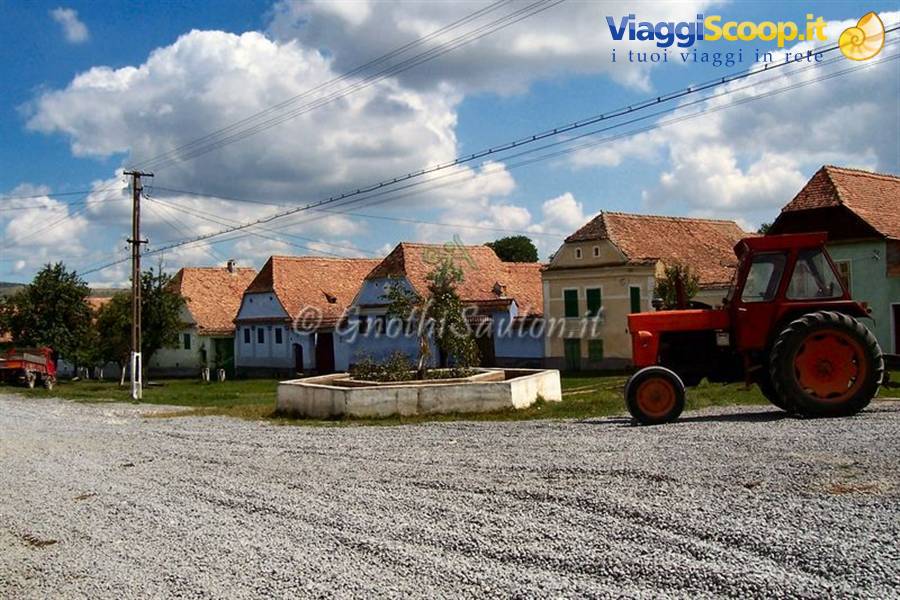
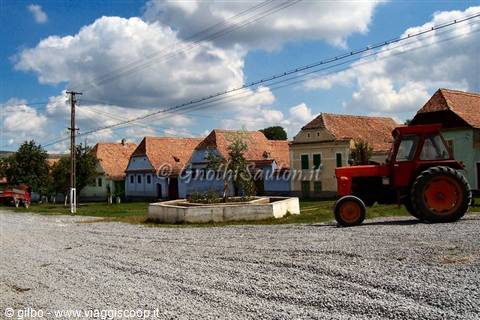
Sighisoara, visit to the history museum in the tower. There is a room dedicated to astronomy, Hermann Oberth, a native of Sighisoara, was an important aerospace engineer at NASA at the dawn of this new frontier. From the top of the tower you enjoy a beautiful panorama of the city. The weapons museum contains a painting of Napoleon (but did he ever make it this far?). Torture museum set up in the foundations of the tower where the prisons were, it's nothing more than a small cell. Leaving touristy Sighisoara behind, we head towards Viscri on a beautiful road that we then have to leave for a secondary one asphalted only halfway and then totally unpaved. We meet only one cart along the 5/6 km to reach the village. Viscri The village develops along an unpaved main street where there is the watering trough for the livestock.
We ask some children playing in the street where the Biserica is and they point us to a road that we will later discover to be the alternative: from cobbled ground to path, we park and continue on foot. The custodian is an elderly Saxon woman who, speaking German, explains that the organ has been recently restored and that a German-language mass is held there twice a month (admission 1 ron, ~0.30 €). We climb up the tower/bell tower via narrow passages accompanied by unsettling creaks; the panorama is worth the effort though. We visit the church's defensive wall, the small agricultural museum and the lard tower where the lard of all the families of the village was kept, the room was opened once a week and each person cut the amount needed for the coming week. Returning to the car the path is blocked by a cart unloading bricks, we wait patiently.
The road that leads back to the main road for Brasov is still unpaved, we stop at a restaurant for lunch. Decent chicken and beef skewers and the usual low price. We eat while watching the negotiation taking place at the table next to ours between an old gypsy woman and a middle-aged couple, a negotiation about some jewels. Harman near Brasov, Saxon church built around 1240, but it's closed, we take a quick tour of the defensive wall. The chimneys of the nearby houses almost all have a stork's nest. Brasòv, very busy, with wide roads and too many lanes for my taste. We reach the hostel crossing the historic center. The "Rolling Stones" hostel is a big house with three double rooms and two bunk rooms that serve as dormitories. It's certainly not quiet, but it's worth it for the family atmosphere that develops. We go to the center for a stroll.
Strada sforii, the narrowest narrow street in Europe, between 111 and 135 cm wide and 80 meters long, citadel, square, central boulevard. We return to the hostel, after eating decently in the square, tonight we have the Suite with Jacuzzi which of course I try.
Humor Monastery
Day 1112 Aug 2008
Wake up early, breakfast with jam, sliced bread and instant coffee. Bran, Dracula's castle is the "tourist destination" of Romania, too bad that for the visit you are required to follow a route (admission 12 lei, ~4 €). It was built in the 12th century by the Teutonic Knights and inspired Stoker for the description of Dracula's castle, although it never belonged to Vlad Tepes. At the foot of the castle an inevitable tourist speculation with a multitude of stalls and a boy dressed as Dracula with a very sorrowful face. The reconstruction of the small rural village is interesting. Rasnov, citadel perched on the top of the mountain dominating the valley, also built by the Teutonic Knights in 1215. The parking lot is near the main road and then you walk up for about 15 minutes (admission 8 lei, ~2.4 €).
The citadel is very nice, the first part is well preserved, which cannot be said of the opposite area. We have lunch at a restaurant not far from the parking lot, good considering the all-wood setting, the food and the price. Afternoon in Brasov, we visit the small Church facing the main square, citadel, cable car up the mountain dominating the city from which you enjoy a beautiful panorama. "Biserica Neagra", the Black Church so called after the fire that in 1689 ruined and darkened it. We attend an organ concert (admission 5 lei, ~1.5 €), impressive 18th-century organ with over 4000 pipes. Walk along the shopping street, we have dinner with pizza, that is Romanian pizza, which has little to do with Italian pizza, triple the ingredients.
Humor Monastery
Day 1213 Aug 2008
Sinaia We move from Brasov to Sinaia, we visit the Pelisor castle, room with very original wooden inlays, while climbing some notices indicate the danger of bears being present. The visit takes place only accompanied by a guide, quickly and only for a minimal part of the castle. We go down to Sinaia, more markets along the way. We see the monastery from the outside. We try to have lunch at the Green House, very nice inside, the service is more than poor and after three quarters of an hour and useless and vain attempts to order we leave. We have lunch at the Pralova restaurant, decent. Relaxing afternoon, we stay at the "Green Eden" guesthouse (~16 € with breakfast per person, 3 stars in Busteni, a very busy mountain resort, we have quite a hard time finding it, it has no address, it's new and nobody knows it.
When calling, the lady only speaks Romanian and hangs up on me, luckily a Romanian lady who worked in Italy and knows our language helps us. We had passed close by on the first search, what a fool. The guesthouse is new and also cozy, nice view of the village below, we take a walk, it's culture week, the show is only in Romanian though. Dinner with cheese bought at the market for 1 eur and grapes, we have dinner on the guesthouse porch watching the sunset.
Local products of Horezu
Day 1314 Aug 2008
Snagov, misreading the guide we ended up here, but it's not worth it. The only thing that seems interesting is the real tomb of Dracula in the church on the island in the middle of the lake. The signs are non-existent and we don't come across anyone we can ask, I buy some Tuica from a woman along the road and we head towards Bucharest. The arch of triumph is under restoration. The hostel is beautiful for how little we pay, too bad about the mosquitoes ( near the 5th district of Porta Romana. Visit to the Italian church, art museum in the old royal residence, princess's church (Biserica Doamnei), Cismigiu park and beer at a bar looking for some coolness. Tour of the old part of the center, national military circle, Victory Avenue, a covered gallery with many bars and public venues. We visit the beautiful Stavropoleos church and the nearby old brewery with extraordinary interiors.
Dinner near piata tricol? Mediocre carbonara. We return to the hostel, the caretaker speaks Italian and in exchanging a few words he says how young Romanians go abroad to work and after 10 years they return and have money to buy a house, car, motorcycle etc..
Local products of Horezu
Day 1415 Aug 2008
The city is very busy, the night was hot and humid. Many people are dressed up and carry small bouquets of little flowers, probably for the day's observance. We take the metro from Piata Romana to Piata Uniti, we walk to the Palace of the People along Union Boulevard which strongly recalls the Parisian Champs-Élysées. It's hot, having reached the palace you have to go around it to reach the entrance for visitors, we arrive at 10:10, the next available visit is at 12, we adapt and wait. We would like to visit the modern art museum which is in the same palace, but the entrance is on the opposite side, we try to go around it but after half an hour we are only halfway, this building is decidedly immense. Returned ruefully to the entrance we wait, we are checked by the metal detector, they keep my trusty Victorinox. Galactic palace, rooms upon rooms.
There's no air conditioning, they feared chemical attacks via the conditioned ventilation. On the way out we run into the French family we met a few days ago, what a coincidence. On 22, 23 and 24 August there will be a motor racing event in which the Formula 1 racing teams will participate, the traffic is turned upside down. We move by metro to the north of the city, we have lunch with pasta and bakery products taken from a bakery. We visit the Muzeul Taranului Român: a very interesting peasant museum, there is also a house reconstructed inside. Metro to the Avilator stop. Muzeul National al Satului Dimitrie Gusti, it's the open-air village museum, beautiful (typical houses from the various regions of Romania transported here in 1938, also a wooden church from Maramures. Today too it's very hot, we return to the hostel.
Local products of Horezu
Day 1516 Aug 2008
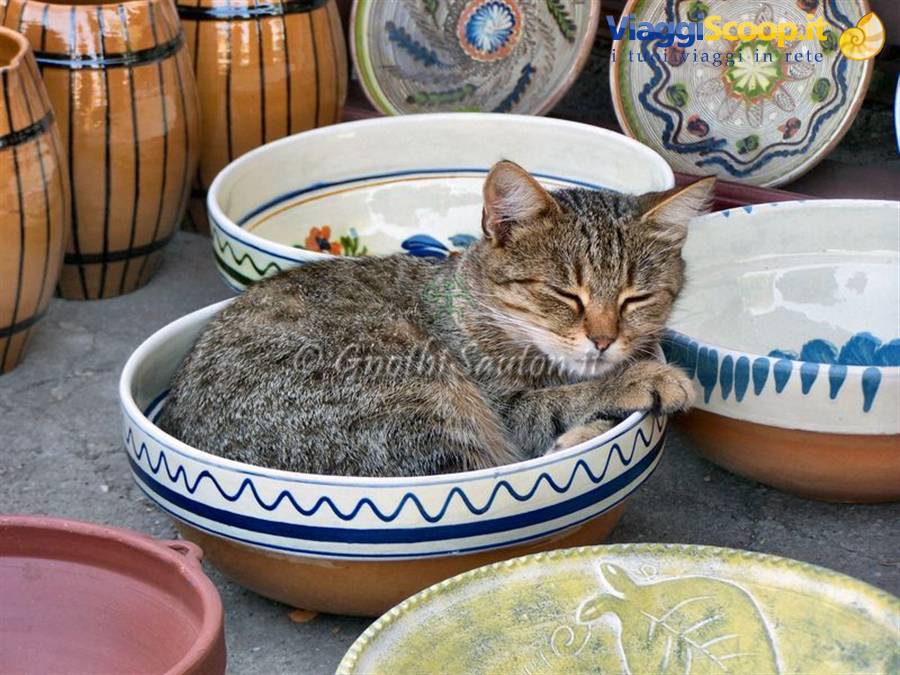
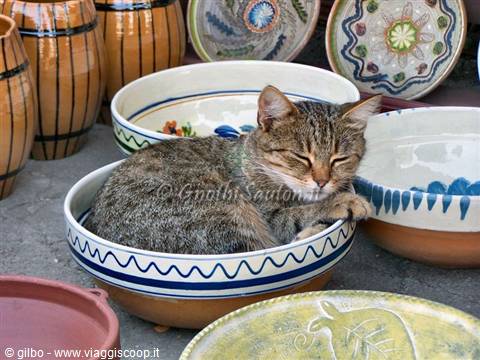
Bucharest, Horezu We leave scorching Bucharest taking the highway, we stop at a service area after about twenty minutes where many truck drivers are having breakfast with "chorba" (soup) and beer. Horezu, renowned for its artisanal production of ceramic objects, we too buy some vases from the interesting little markets along the main road just before the town. Lunch based on tochitura, not great this time, certainly not up to the wait. We visit the Monastery, the exterior seems quite austere, while inside it reveals itself to be much more fascinating. In the parking lot a middle-aged lady, noticing the Italian license plate, attempts a sentence in Italian, we get to know her and discover that when she was young she had been engaged to a man from Turin and that she had learned a bit of Italian.
She is originally from Maramures, now she is retired (77 eur/month) and to supplement her income she runs a small souvenir stall. We head towards Curtea de Arges along a beautiful hilly road passing through small villages. It's Saturday, we are a day ahead of schedule and the B&B where we had our reservation for Sunday has no room today, we have trouble (after an hour of wandering around) finding a free room in a small bar/restaurant/hotel on the main street of the town. We then discover that all the rooms are occupied because Saturday is a wedding day and many relatives come from out of province. In our hotel a wedding is being celebrated and we witness the typical dances in which all the participants take part, from the youngest to the oldest. We have dinner at the hotel restaurant, it's a beautiful evening with a full moon.
There's a concert at the sports field, there's no lighting on the road, the security service is reduced to a traffic warden who stops cars to let pedestrians cross the street. There are many spectators, first a group of young girls sing and dance (a sort of Romanian Spice Girls), then a Romanian Folk-Rock group with good sounds, but with lyrics obviously incomprehensible to us.
Local products of Horezu
Day 1617 Aug 2008
Abundant breakfast at the hotel, breaded cheese and sausage. We visit the Monastery, a pilgrimage destination, it's very crowded also because it's Sunday. Legend "The legend tells of Manole, master builder, who had been entrusted with the task of building the church. Although he was one of the best of his time, what was erected by day collapsed at night. One night, Manole dreamed that to make the construction solid and put an end to the work it was necessary to sacrifice and wall up inside the first woman, wife or sister, who the next day would bring lunch first to her husband or brother. Manole told of the dream and everyone accepted the idea, convinced that a work of such great value and importance also required a great sacrifice. The following day there was frenzy in anticipation of the first woman and at a certain point Manole from afar recognized his pregnant wife.
Manole's wife was the only one that day to bring lunch to her loved one because the others had made sure to warn their wife or sister. So she was walled up inside the building and the next day the church was still standing. Negru Voda, happy with the beauty of the monastery, decided that no other such beautiful building should ever be built and ordered the workers to remove the scaffolding while Manole (the mind behind the project) was still on the roof. Manole did not give up and tried to save himself by building wings from leftover wood. Like Icarus, the wings did not work, he fell a short distance away and died. The legend concludes by saying that, moved by the gesture and sorrowful, the earth made a thread of water spring forth, a tear, and since then at the spot where poor Manole fell there is a fountain.".
We stroll among the stalls, it's a beautiful sunny day and the fresh mountain air blows down into the valley. We now tackle the Transfagarasan, going back up the Arges valley, we pass through Poienari, where on its summit stands the castle lived in longest by Vlad Tepes. After a short while the road begins to climb along a series of hairpin turns and we reach Lake Vidraru, with the dam 165 meters high built for the region's energy needs. The Transfagarasan is the renowned road that connects Transylvania with Wallachia. It was built between 1970 and 1974 by the Romanian military on the orders of the then dictator Ceausescu to create a north-south link through the Carpathian mountains. The road is very busy up to the dam, then smoother. The dam Along the roadside there are many Romanians busy with barbecues and grills.
There are also many tents of people who had already set up the day before. The road that runs alongside the basin created by the dam is winding but very beautiful scenically, we stop often to better admire nature. We also stop at a fountain where ice-cold, delicious water gushes out. Once at the top you have to go through a tunnel more than 800 m long that takes us to the other side of the mountain, arriving at Balea Lac. The weather is the opposite of what we left behind just two minutes ago, there's fog (clouds considering we're at 2000 m altitude), visibility is poor and it's a bit chilly. Stalls sell various handicrafts and typical foods. The cars of the numerous visitors are parked everywhere along the sides of the road and with difficulty and a bit of luck we find a parking spot.
All this chaos creates a strong slowdown in the lane opposite to ours causing a queue that we will later encounter of at least 3 km. We take a quick tour of the lake and then continue the descent on the other side, less fascinating. We make only one stop to admire the waterfalls. Sibiu, the "Pensione Fortuna" is about 4 km from the center (~22 € with breakfast per person, We have dinner in one of the central pedestrian squares of the city, finding it hard to find a place where one can eat Romanian cuisine, it's a "European" city just like Brasov and the "Italian" pizzerias have taken over from the typical places. The city, compared to others, is very lively even though the sun set long ago.
Viscri, the village centre
Day 1718 Aug 2008
Sibiu We visit the Cathedral, we climb the tower that overlooks the city from which we enjoy the panorama. We haven't had breakfast yet and we take advantage of a bakery with still-warm pastries. Continuing towards the center, we visit the church that overlooks the largest square and then we take a stroll along the pedestrian shopping street. In the afternoon we do a bit of shopping in a nearby shopping center. In the late afternoon we reach Ighiu, a small village not far from Alba Julia where the most unusual accommodation of the holiday awaits us. The owners have turned the old country house into a charming B&B, hostel, farm stay, I wouldn't know exactly how to define it, with a pool (pond) complete with inflatable boat, gardens with water features, a room for meetings, a cellar for wine tasting (this is a renowned area, in my opinion terrible though).
The rooms are nicely furnished with Ikea furniture. The staff, all family, are very kind and give us a tour of the hotel and offer us wine; they are very proud of their business. Relaxing under the patio that overlooks the pool we meet a Romanian who works as a cook in Bucharest and knows a bit of Italian. He explains to us why many of his fellow citizens emigrate and why he prefers to stay in his native land, the difficult relationship between Romanians and Roma, how Romania has changed for better and worse after Ceausescu. We have dinner in this "amusement park", there, this is perhaps the right definition, good food and great atmosphere, also because in the village besides a couple of bulk wine sellers there are no other businesses.
Viscri, the village centre
Day 1819 Aug 2008
Alba Julia We have breakfast in a pastry shop at the foot of the citadel, we visit the summit, the church with the tombs of the Hungarian rulers is interesting, the fort with the possibility of a visit and the monastery now being restored. Hunedoara, the Hunyad castle well preserved in the city of the steelworks, the city has a more spectral appearance than one would assume the Corvino castle to have. Luciano helps us find parking, a Romanian in his sixties who, speaking decent Italian, asks us for the addresses of bookshops in my city because he has a passion for Italian books, go figure?. We visit the well-preserved but bare castle (entrance 6 lei, ~2 €). Interesting is the legend of the well and the two prisoners: "The legend tells that it was dug by two Turkish prisoners who were promised their freedom if they found water in the stone.
After fifteen years of digging the unfortunate men found a spring but were not rewarded by their jailers, who instead placed next to the well a plaque engraved in Arabic: You have the water but you have no soul." Arad, we arrive in the late afternoon, we have a bit of trouble finding the "Hostel Fortress" (fortress_aradyahoo.com). At the reception, which is in the boiler room, a Romanian to whom foreign languages are unknown welcomes us and, understanding nothing of what is written on our reservation, makes us also pay the deposit we had given (2 €). We are the only ones sleeping in this establishment, which isn't old but is kept badly. We have dinner taking advantage of the kitchen with cheese and salami that we bought at Billa.
Speaking in RomanianLatinItalian he asks me for information about the car and to be careful of Romanian police officers who take advantage of seeing foreign cars and plates by stopping you and insinuating problems in order to be greased so they can let you go without trouble. Which never happened, despite having read of many cases that occurred in previous years, in fact we weren't even checked at the border crossing.
Viscri, the village centre
Day 1920 Aug 2008
We wake up early, Budapest, Maribor, Ljubljana, Italy, home.

0 reader comments