The story
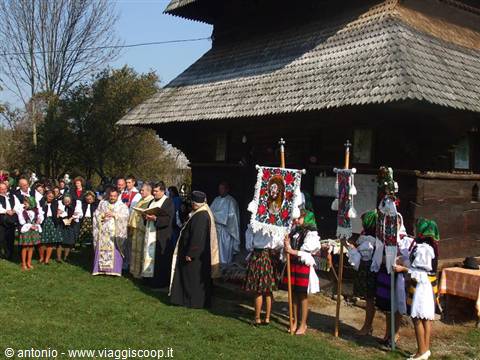
There is a place in Europe where people still travel in characteristic carriages overloaded with hay and children, where the churches are made of wood and have tall pointed bell towers, where the houses are preceded by large carved portals. There is a place inhabited by a people considered the most hospitable in the Old Continent, where people open their homes to you and the traveller is welcome. Maramures, in other words how to take a leap back in time and still stay in Europe, because here ancient traditions are preserved, life is paced by religious feast days and ancient working techniques are still used.
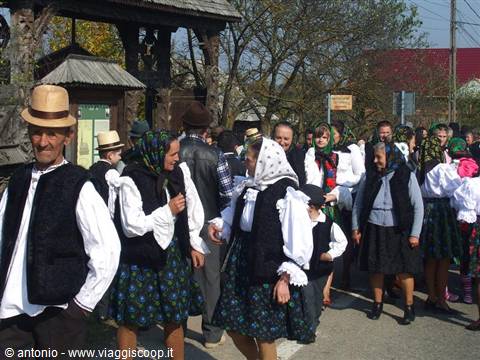
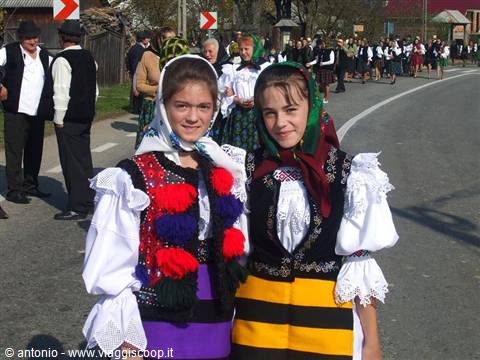
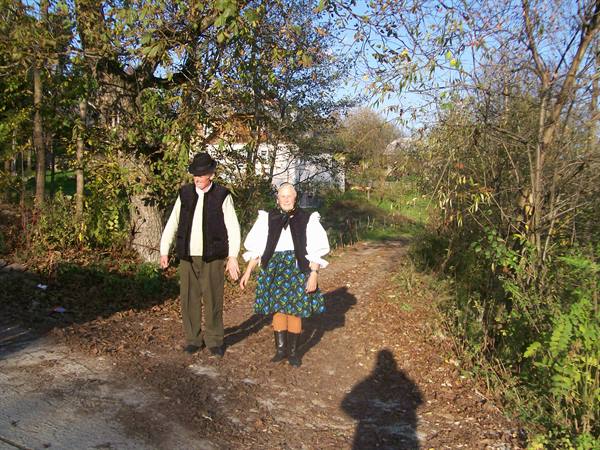
Arriving here on a Sunday is a spectacle, because around the village church or along the single road that crosses it you'll see men, women and children in their traditional dress: gaudy costumes rich in rhinestones and coloured pom-poms, flowery skirts for the girls, showy belts and characteristic straw hats for the boys. These costumes are not a folkloric touch for the benefit of tourists but the everyday life of this people who, squeezed between the Gutai Mountains and the border with Ukraine marked by the Tisa, have managed to preserve this ethnographic island that has no equal in Europe. But you must hurry to visit Maramures because times are changing: more and more, carts are being replaced by cars, ox-drawn ploughs by second-hand tractors, the characteristic wooden houses are being plastered and beside the traditional churches anonymous concrete places of worship are rising.
Two valleys cross this region, that of the Iza river and that of the Mara river, both dotted with little villages that will amaze you. The further you go from the main road, the more intact villages you'll find. I have been to Maramures very many times, a place I am proudly enthusiastic about. In the broad sense, Maramures is a province of Romania that also includes the part south of the Gutai Mountains, where among other things the capital Baia Mare is found — a large city with a small historic centre — and the rural area around Tirgu Lapus. But the true, historic Maramures is on the other side. Coming down from the mountains you meet Mara, Desesti, Sat Sugatag, Giulesti, Berbesti, Feresti. Small detours lead to Cornesti, Calinesti, Budesti, to the spa of Ocna Sugatag where the pool water is so salty that you float, and to the mining village turned winter-sports resort of Cavnic.
At Vadu Izei there is the fork for the other valley, that of the Iza, where along the road you pass Birsana, which has a fine wooden monastery on a hill, Strimtura, Rozalea and Dragomiresti. The only real city of historic Maramures is the anonymous Sighetu Marmatiei, with a few churches and the former prison used by Ceausescu's Securitate for political dissidents. The city is lapped by the Tisa river, which divides it from the Ukrainian Slatina, connected by a bridge reopened recently after years of hermetic closure. From Sighetu Marmatiei the road east leads to the Rodnei Mountains as far as Viseu and Borsa, passing through villages inhabited by Romanians or Ukrainians. Going west you run for a long time alongside the course of the Tisa, passing through Sapinta, a place that boasts a wooden church with a very tall bell tower but above all the famous Merry Cemetery.
Here a local peasant, Ion Patras, carved the wooden grave markers with ironic epitaphs that recount in poetic satire the life of the deceased. After all, around these parts the relationship with death is much more serene: in all the villages of Maramures the Luminatia is celebrated, the day dedicated to the departed, when all the families gather in the cemetery to eat at the grave in communion with the deceased. Another important moment in the life of this people is the wedding; if you happen to see one it will be an unforgettable experience — don't hesitate to invite yourselves, you'll be welcome guests. The celebration often takes place at the Casa del Popolo, where people eat and dance for hours showing off the finest costumes of their folk trousseau.
They dance to the notes of unwritten, often improvised music, accompanied by the beat of feet, the men's whistles and the snapping of fingers. A fascinating land to visit before it's too late.
The journey's photographs
6 photographs · click to open them full screen


0 reader comments