MAMALIGA AND MITITEI. Our trip to Romania was organised in just one week. We had already been there 10 years ago and we wanted to see the change; besides, my sister-in-law Mina had never been. She will be our travel companion. Our children, this time, have to stay at home, because of school commitments!
Day 122 Sep 2006
Szilvásvárad - Debrecen - Marghita
At 10:30, after serving breakfast to our agriturismo guests, we set off from Szilvásvárad (Hungary) heading for Romania. After one kilometre we immediately turn back because I have left all the maps, the itinerary and the Routard Guide at home!! It's the first time we've travelled with the Routard; let's hope it doesn't let us down. We bought it in French, since that was the most up-to-date edition. At 12:00 we still haven't covered even 100 km... our friend Claudia (an Italian who works in Romania and whom we're going to visit this evening) will have to explain how she manages to cover the Eger-Marghita stretch in two and a half hours! Marghita is our first stop in Romania, a small town located near the Hungarian border, between Oradea and Satu Mare. At 2:00 pm (3:00 pm Romanian time) we cross the small border post at Letavértes.
We are starving because, from Debrecen onwards, we haven't found even a small trattoria, which is very strange for Hungary. So we stop at the first place where it says "Restaurant", or at least that's what's written. We eat Snitzel with Pireu (schnitzel with mashed potatoes)! Then in the afternoon (quite late) we arrive in Marghita, a rather anonymous little town. But, wouldn't you know it... tonight is the village festival. In the evening some Italian friends of Claudia's invite us to their home for dinner, so we eat Italian-style, to be precise Veneto-style! After dinner we go to the village festival where there's music, rides, stalls and kiosks with various Romanian specialities to taste. We browse among the food stalls...
not because we're still hungry but out of an atavistic passion for the culture of victualling! So we get to know the 'mici' (or 'mititei'), little sausage-shaped meatballs that are grilled. Besides those there are also the 'Kanuz' (a kind of luganega), the 'frigarui' (skewers) and the 'gratau' (mixed grill). We taste... Then we go for a little ride on the rides and finally go to bed. The people seem quite poor to us, without great means... and yet we're in a small town where there are several foreign factories and therefore no shortage of work. They are also rather badly dressed. The difference compared with Hungary is abysmal, even after 10 years.
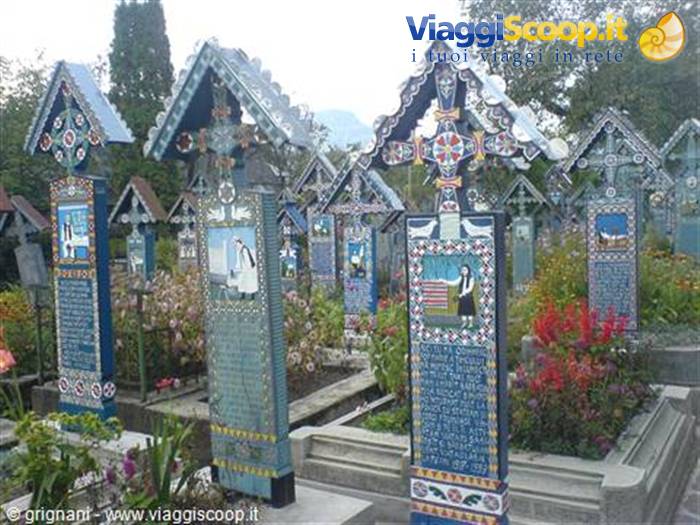
SAPINTA - The Merry Cemetery
Day 223 Sep 2006
Marghita - Satu Mare - Sighetu Mare - Breb
After a night in the freezing cold (the double duvet was enough for one and a quarter people...), we have breakfast and go to Claudia's to pick up Mina, who slept there, and begin our journey! Giampaolo and I, on the other hand, slept in a guesthouse that, though quite nice, we consider was very expensive; in fact the price they asked, 42 euros, seemed to us an exaggeration... especially compared with Hungarian prices. At 8:00 we set off towards Satu Mare. We're almost out of petrol, so we look for petrol stations... which are scarce!!! Uh oh uh oh uh oh... But near a border town we find a petrol station and fill up! Wow... it costs almost a euro here too! After an hour we're stuck in a queue along a main road because of an accident.... People are discussing what to do...
but in fact on the map there are no alternatives, even supposing we turn back! After half an hour they inform us that we can detour onto a country road, unpaved but passable. An Austrian woman gets angry with her husband, telling him if he's crazy to think of going with the BMW convertible through the countryside.... and uses all the respectable German idioms. Laughter! In the end we decide to try it too. First stretch ok. The second stretch begins to become a real country track, complete with weeds and shrubs in the middle of the road that brush menacingly against the bodywork of our poor car! After half an hour everything comes to a halt... And yes..., because they've channelled the cars coming from the opposite direction onto this narrow track too, so there's great chaos! At most one car can pass on the road; by turns you have to try to move onto the fields...
We get stuck straight away.... Fortunately everyone is willing to push us. After a while we spot an enormous articulated lorry coming from the opposite direction.. Oh mamma... and now what? No fear, the ground is firm and you go across the grassy field! Fortunately we were among the first to set off and we manage to finish our Rally within half an hour! However, I believe that afterwards the total gridlock was inevitable! Towards midday we begin to climb up the Maramures valley, on the borders with Ukraine. A valley populated by a people rich in strong historical traditions, evidence of folklore and customs rooted in time, a people who live off substantial agriculture and woodworking, but also mining.
A strong, tenacious people, who have known how to coexist with different cultures (Hungarian, Jewish, Ukrainian) without losing their own identity, not even under the various dominations (Austro-Hungarian, Russian...). Having passed the town of Negresti, heading towards Satu Mare, we cross a village where beautiful villas, some luxurious, follow one another along the road and leave little space for the poor old houses, which seem almost to have disappeared. Stunning roofs, colonnades, glass windows, wrought-iron gates. It is the village of Certeza. Has Romania changed so much in 10 years? We will later be told that most of the inhabitants of this place, after the fall of the communist regime, went to work abroad (especially in Italy and France); they sent a lot of money to the family members who remained in the country and with it they rebuilt their houses....
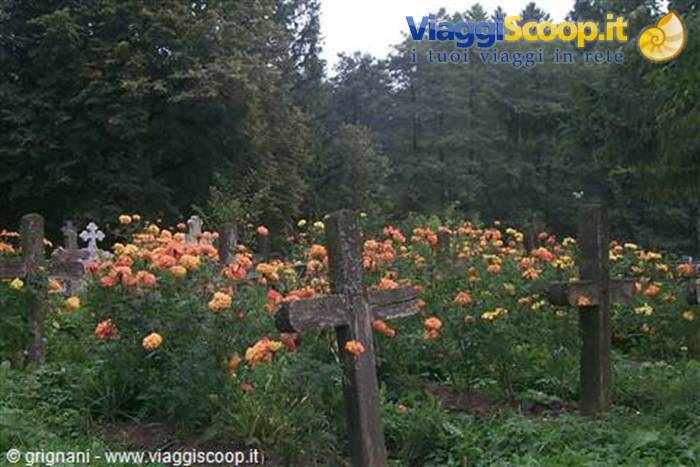
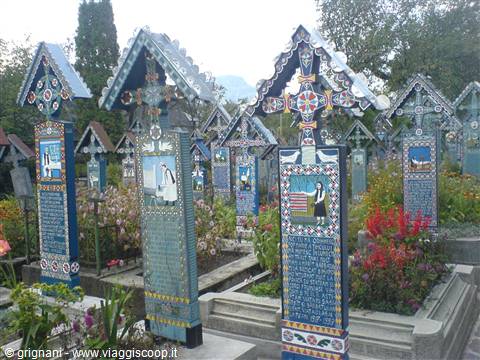
Well, certainly villas like these you see few of even in Italy. The road continues to climb and the landscape becomes more and more beautiful. Terraced cultivated fields and hundreds of very tall haystacks. At 1:00 pm we stop in Sapinta to see the Merry Cemetery! Here too everything has changed compared with ten years ago. The graves have been partly restored and at the entrance there is a row of bars, buffets and craft and souvenir shops. The Merry Cemetery is a real cemetery, still in use, but with the special feature of having caricatures of the deceased drawn on the tombstones with verse descriptions of the activities they carried out in life. The base colour is a deep blue, while the naive-style paintings are in bright colours. At 2:00 pm we arrive in Sighetu Mare. This town too has changed a great deal.
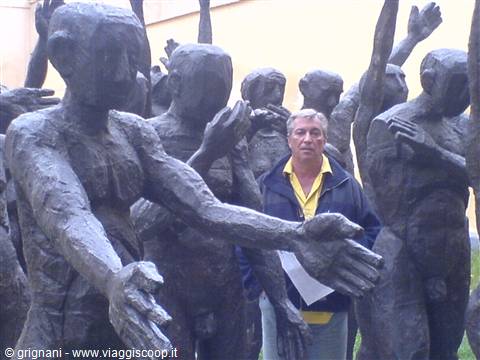
We stop for lunch at the restaurant Casa Lurca de Calinesti! The restaurant is very nice and we eat well too. The cost is ridiculously low. The only problem we have is with the grappa, because at the end of lunch we order a grappino and.......... they bring us a decilitre each!!! We then go to visit the Museum of the Memorial. This memorial to the victims of communism and the resistance was inaugurated in 1994. It is housed in the old prisons of the Austro-Hungarian empire which, unfortunately from 1945 onwards, were used as a concentration camp, where writers, artists, intellectuals, politicians were locked up — practically all those whom the communist regime thought might oppose the regime. Even Catholic priests and bishops. More than a quarter of them perished in their cells from malnutrition and cold. Inside the cells small themed exhibitions are set up.
The themes vary: deportation to East Germany, labour camps, the deposition of King Mihalyi, etc. Very striking is the "Space of prayer and recollection" dedicated to the more than 8000 prisoners who died in Romanian prisons, designed in a style that combines the ancient with the modern, as well as different religious faiths. After visiting the Museum we head towards the small village of Breb, where we have booked at an agriturismo. The countryside landscape along the road is stupendous, a true mosaic of fields dotted here and there with countless haystacks. We come across many carts drawn not only by horses, but even by oxen. Few cars. Buses or coaches, even fewer. Don't they have public services? At 6:00 pm we arrive in Breb, at Maria and Petru's, who welcome us very warmly. Their two little daughters (7 and 12 years old) bustle about a great deal. The older one even speaks good French.
It's with her that I spoke on the phone yesterday. A French couple is also staying with them: backpacks on their shoulders! Incredible.... They explain to us that the means of transport are scarce (we had noticed) but they have got around partly by train, partly on foot and partly by hitchhiking. To come here, though, we discover that they have rented a car. The French couple sleep in an open-air bungalow (who knows how cold it must be....) because the rooms were already occupied by us {ED: good thing we booked}. While Petru offers us a welcome grappa (Horinca), Maria milks the cows and the daughters set the table. The dinner is excellent, including Maria's apple cakes. After dinner we chat a bit with them while the two little girls clear the table (our children should learn from them!). Petru speaks a little Italian too. He has projects that he is gradually carrying out.
He has also bought a small minibus, with which he takes around small groups of tourists that the local agencies procure for him. He is also renovating an old wooden house, where he will create more rooms for tourists. We wish him success because they really are a lovely family. Towards eleven we go to bed. In bed we find warm, soft Maramures blankets... we certainly won't be cold!
SIGHETU MARE - The Memorial
Day 324 Sep 2006
Breb - Budesti - Borsa - Cimpolung - Varna
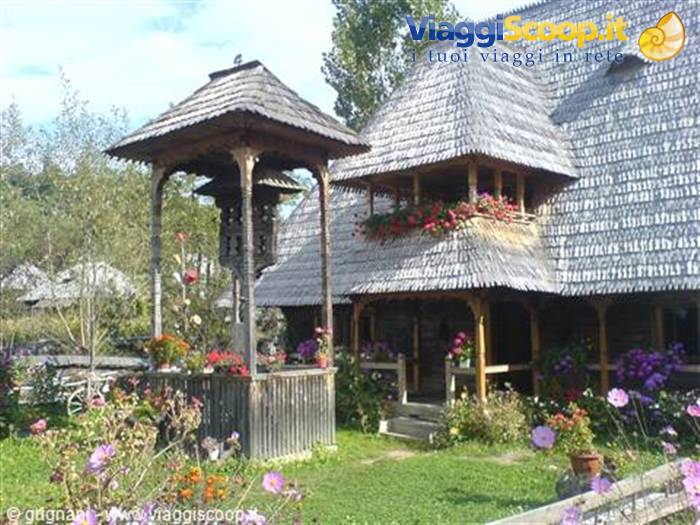
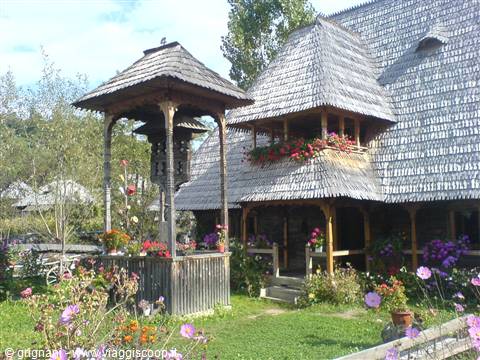
After a good breakfast accompanied by fresh milk just milked, at 8:30 we set off! Petru also gives us a little bottle of Horinca... which, however, will not make it home because it will be consumed during the journey! The first stop is Budesti, where we visit at least from the outside – since it's Sunday and it's closed – the Budesti Iosani Church of 1643. We then continue to the village of Sirbi, famous for having preserved most of its ancient wooden houses. We visit a small 17th-century church with an adjoining cemetery. A lady invites us into her home to show us some embroidery, which I would gladly have bought too if she hadn't asked the exorbitant price of 100 euros per piece! Then we take a stroll around the village to admire the historic wooden dwellings, with their tall fences, also wooden, and with gardens full of flowers.
In the courtyards, apart from the typical well, the "pot tree" is omnipresent.... that is, a little tree on whose branches the various pots and pans are put to drain. In Sirbi today everyone is in costume! It's Sunday and they are going to Mass. The young girls have very colourful, very pretty costumes; the women, on the other hand, fall into two categories, those with long black skirts and those with very colourful long skirts. We have no way of discovering the reason. The men wear very distinctive hats and a waistcoat over rich shirts. We give a lift to a lady with crutches... the only one not in costume because she is a Jehovah's Witness... and we set off again from Sirbi. We pass back through Budesti and head for Botiza. Botiza is a village famous for its crafts, but we don't see even one craft shop! Everything is closed because it's Sunday and on Sunday EVERYONE goes to Mass.
In Botiza we manage to see the interiors of the first ancient wooden church, which fortunately is open. In the main square, many people in costume in front of the imposing Orthodox Church listen to the Mass. In this area the churches are certainly the most important and grandiose buildings. We set off again towards midday and decide to skip the stop at Leud, both because the French couple told us last night that it's nothing exceptional, and because we assume that this village too is very similar to this one and that today everything is closed there as well. Crossing the various villages scattered along the route, we discover another local tradition. Most of the ancient wooden houses (we had noticed this at Sirbi too) have benches carved into the fence, usually beside the entrance gate.
They are a real meeting place, where family and friends returning from Mass sit and chat with one another. Some even have a canopy {in case of rain?}. At 1:30 pm we arrive in Borsa, a small town on the border between Maramures and Bucovina. We have lunch at the restaurant Perla. They even have porcini mushrooms!!! Delicious. We spend quite a lot though, almost double yesterday's. After withdrawing some money from the local cash machine (using gloves because it even gave a shock!), we take the mountain road towards Bucovina. At 4:00 pm we reach the Prislop pass. It is at 1400 Mt. and it's quite cold. Here they sell mushrooms. But at 7 euros a kilo they seem a bit expensive to us, given that in Hungary they get them for 3-4 euros. In any case we couldn't cook them either, so.... We drink a coffee and set off again. Having passed Cimpolung we arrive in Varna.
It's already 6:45 pm because the road was practically one long construction site and it took us much longer than expected. We are a stone's throw from Moldavia, where tomorrow we will do the tour of the Monasteries. We look for a private guesthouse recommended by the Routard but it is deserted. There aren't even any neighbours.... Then two girls pass by who tell us they'll phone for us. There's the village festival and everyone is in the square! Let's go!!! Another festival. After a while the owner arrives, friendly, but tells us he has no rooms. He assures us, however, that he will find us accommodation with someone else. Indeed, after a couple of phone calls, he takes us to a nice private house where we wait for the owners to arrive (they too are at the village festival).
The house is very elegant and well kept; the lady even prepares us a good dinner which we eat in her living room, around a very nicely laid table. What is missing here, though, is the friendly welcome that Maria and Petru gave us last night. After dinner we drink a horinca on the terrace (tonight it isn't cold) and then, amid the mooing and ringing of cowbells that surround us, we decide to go to sleep because we are too tired, even though going to see the village festival was quite tempting...
MARAMURES - Sirbi
Day 425 Sep 2006
Varna - Moldovita - Sucevita - Dragomirna
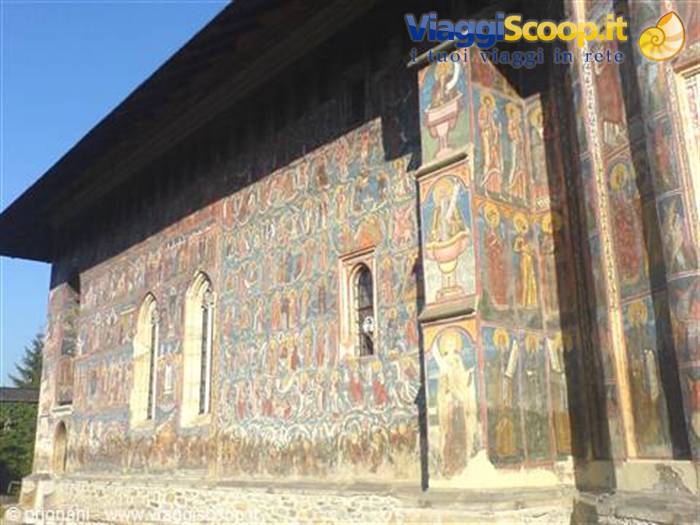
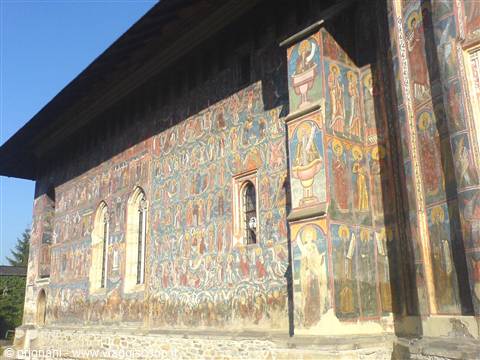
At 6:30 Mina and I are already on the terrace smoking a cigarette and having a grappino too... why not? After breakfast we set off. The weather is splendid. We have a slightly flat tyre but on the road the police tell us that the first tyre repairer is 30 km away! And if someone's tyre were completely flat?? Oh well. The first Monastery we visit is the Monastery of Moldovita. Surrounded by imposing outer walls, the Monastery, run by Nuns, was built in 1532-1537. We visit it first on our own since the nun (Maica) Tatiana, recommended by the Routard as a guide, cannot be found. The Routard moreover, unlike the Lonely Planet, doesn't give much information about monuments and museums. We do meet Tatiana later, though; she is with a small group of French people, so we join them, and thus we attend a detailed and very lively explanation.
We have a chance to understand the meaning of both the interior and exterior frescoes. The themes of the frescoes arise from an association between religion, history, philosophy and tradition. So there is Jesus with the traditional shirt of Bucovina. There is the tree of life, outlined against a blue sky, and along the branches the religious figures are depicted, and at the base also the sovereigns and philosophers. Inside, divided into two halls, the twelve months of the year are represented by the days corresponding to the Martyrs. The iconostasis is richly decorated and truly very beautiful. We leave our offering and set off again. The landscape flows by amid dense woods and fields cultivated with hay. The second stop of the day is at the Monastery of Sucevita. Very similar to the first but with better-preserved frescoes, especially those on the northern outer wall.
Very interesting is the fresco illustrating the various stages of the creation of the world; the first scenes are painted on a very white background to indicate the purity of the genesis. Later, however, after Adam and Eve's sin, the scenes take on an ever darker background, until it becomes black. Also very interesting is the fresco depicting the staircase of the Virtues, for access to Paradise. After death everyone must climb this staircase but only those who have not committed sins in life manage to reach the top. The others fall. We meet the French from the other evening. They are shattered because they spent the whole night on a train. I don't envy them.
We are backpacking travellers but in these parts of Romania I really wouldn't recommend it to anyone, unless you have a lot of time available! Once the visit to the Monastery of Sucevita, also run by Nuns, is over, we head towards Dragomirna. We get some directions wrong, so we end up on a private road of a National Park which, through a splendid route through the woods, leads us to the forecourt of Dragomirna. We save the visit to the Monastery for the afternoon, though. First we have to look for a place to sleep tonight and a restaurant to have lunch. Since there is a bar on the forecourt, we ask for information to find the Burac family, recommended by the Routard. The girl at the bar answers me in perfect French, telling me that she met Mrs Burac this morning and she told her she has no rooms, but she can recommend someone else.
This doesn't convince me, so I tell her that I've already booked. {ED: I wouldn't want them to be trying to divert customers elsewhere... the Routard guide says that even the monks do it!!!} So she explains the way and, after no small difficulties, we find the place. Mrs Burac welcomes me kindly. She has rooms available and she will also prepare dinner for us! There you go! I had guessed right...! That one wanted to divert us to someone else and maybe she was even taking a commission! We drop off our luggage and go to Suceava to look for a place to have lunch. Suceava is a big city, with nothing interesting to see. We would have liked to avoid it too but it seems it was the only alternative for eating. We also waste a lot of time. Anyway, we find a good restaurant, Villa Alice. The lady who runs it is on her own and runs herself ragged between bar, restaurant and kitchen.
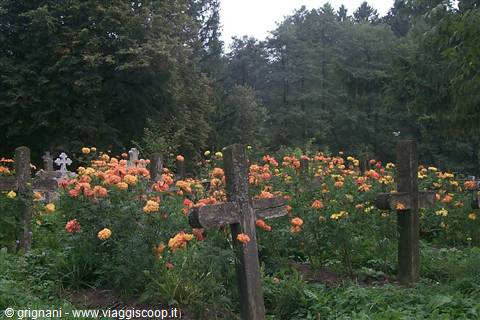
She doesn't speak any foreign language but we manage to understand each other. After lunch we go to visit the Monastery of Dragomirna. Also run by Nuns (but are the Monks here in the minority?), this monastery fascinates us. It is completely different from the first two. A splendid garden, no frescoes but many decorations and inlays on stone. Inside there are also two nuns singing. There is also the courtyard with all the laundry hung out. We take a couple of photos of the nuns' knickers hung out to dry, just like that... for a souvenir, then we head for the exit. We venture out following some directions to a phantom Church of Saints Peter and Paul but find only countryside, woods and roads in terrible condition. Meanwhile our Seat is getting a workout! At 5:30 pm we return to the family hosting us and.... SURPRISE! We're welcomed by the girl from this morning's bar.
She's the daughter! Incredible, I can hardly believe it... would she try to compete with her mum? Or did she want to avoid working too hard??? The mystery will remain unsolved. This place isn't up to much. The rooms are even nice but there are no common rooms, or a patio in the garden to sit in, there's no kind of welcome, no glass of wine to welcome us... nothing. On the other hand, who do we meet? But of course, the usual French people! So at least at dinner we'll have company. We go out for a short stroll around the village. I throw out the idea of going for an aperitif and Mina laughs!! Where do you think there'd be a bar in the middle of the countryside?! But Giampaolo insists there is one; he saw it this morning..... Bets are placed.
Meanwhile we cross an immense grassy open space in the centre of the village, where cows, geese, sheep, rams and even horses gather, as well as children playing. It is the central common threshing yard for the whole village. An ancient Bucovina tradition. On the other side of the open space there's the bar, as Giampaolo stated.... Let's say that more than a bar it's a little kiosk with iron tables outside, but for a beer it's perfectly fine. We also try to communicate with the locals but it's hard work. Some things we understand, for others it's a total blank. We go back for dinner. We eat quite well, apart from the dessert. The French are starving because between the train, the non-existent public transport, the lack of places to eat, etc., they explain to us that they haven't eaten since midday yesterday (I envy them less and less...).
Then today they also had a blazing row with a taxi driver, with whom they almost came to blows! We chat until eleven, obviously among ourselves, because there's no sign of the owners. They limited themselves to bringing us the food. We all agree that so far the most welcoming and warm place has been Maria and Petru's agriturismo.
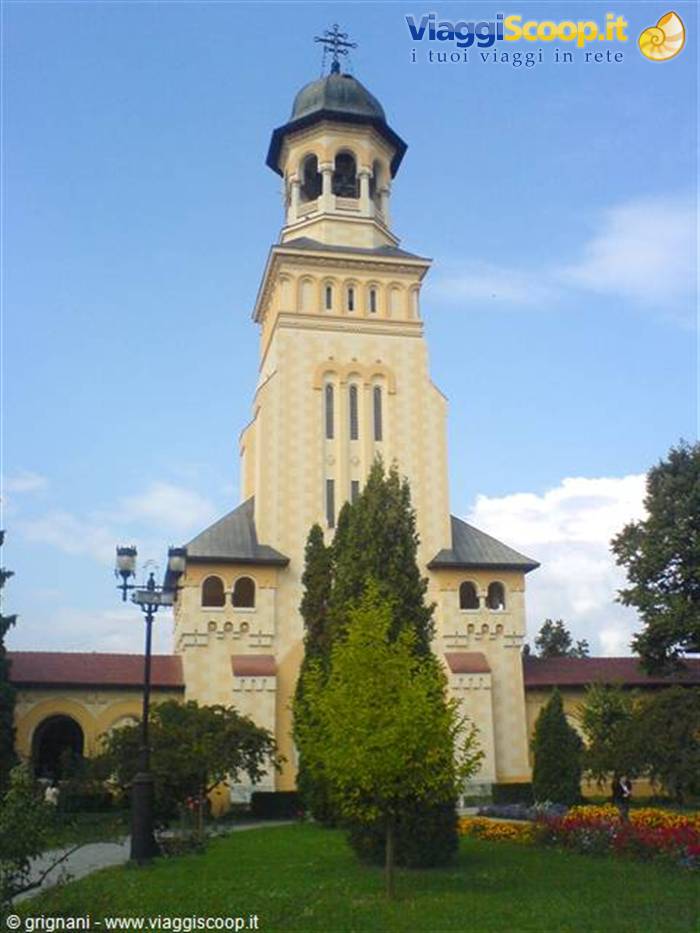
ALBA IULIA - monastery
Day 526 Sep 2006
Dragomirna - Bicaz - Gheorgheni
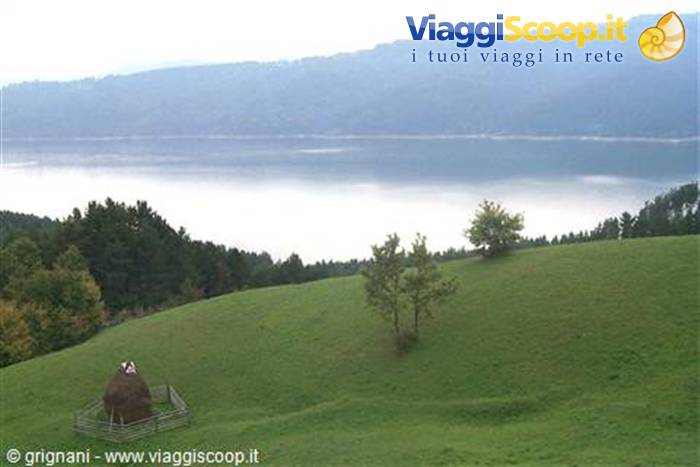
At seven we're already having breakfast. The breakfast is very abundant! This morning I did a bit of accounting and discovered that so far the average spend per person has been 32 euros a day, including petrol, cigarettes and museums. Not bad! Today the Bicaz Gorges await us. So we set off towards Transylvania! On the way we make a stop at the Neamt Monastery, so that we finally see a monastery run by Monks. The Monastery has a structure slightly similar to that of Dragomirna but with an iconostasis inside that is truly splendid. We buy a bottle of wine made by the monks for our collection and then set off on our way again. The weather is getting worse. At 11:00 we're already on the shore of Lake Izvorul, towards the Bicaz gorges. The view is beautiful! We stop to have a drink in a guesthouse run by a German, with a splendid view over the lake.
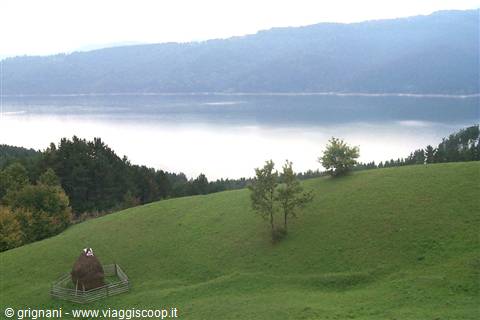
The lunch stop, on the other hand, is at the port of Bicaz. There is a campsite hotel with a restaurant floating on the lake! We eat quite well and spend only 11 euros between the three of us! We still haven't managed to taste all the specialities of Romanian cuisine listed in the Routard. Anyway, today I had grilled trout! In this area the change compared with 10 years ago is really noticeable. Guesthouses and restaurants have sprung up like mushrooms and the roads are kept very well. After lunch we join the scenic gorge road. The Bicaz gorges are fantastic. The road runs through a rocky canyon and skirts a lively stream. There are points where the walls Are so narrow that they hold back the sun's rays. We stop to buy a few souvenirs at the stalls set up in the lay-bys of the road, then we make a stop at the lake of petrified trees.
We take a nice walk around the shores of the lake and take a few photographs. Then I eat a roasted corn on the cob! I hadn't eaten one since I was a child. Towards evening we arrive in Lazarea, a village near Gheorgheni where we have booked two rooms for tonight. The Papp family, who host us, consists of mamma Emma and her daughter Sarolta (Carlotta) and is of Hungarian stock. Here we find again the warmth of Hungarian hospitality and, knowing the language, we are also able to converse. They offer us something to drink and tell us that in this village only people of Hungarian origin live. Only the policemen are Romanian. The language spoken is still Hungarian. The schools are also in Hungarian. It's incredible. Since 1918, the year in which the territories of Transylvania were taken from Hungary, this people has managed to preserve the language and traditions of the Magyar ethnic group.
We are in the Szekely area. The area with the greatest concentration of Hungarian traditions in Romania. The area of houses with immense carved wooden gates. The area where the csarda is still danced. The area where the churches are still mostly Catholic. They have also preserved good traditions in the kitchen: in fact the dinner is excellent, based on stuffed cabbage with various side dishes. Exquisite dessert, excellent plum brandy (palinka) and good wine! In fact, I'd say the first good wine drunk in private homes in Romania! After dinner we talk with Emma; she tells us that her husband passed away a few years ago and that the only livelihood they currently have is tourism. Emma also has a 22-year-old son who studies in Cluj Napolca. It's not easy to get by, she explains. And we believe her. The opportunities for young people are few.
Salaries are around 100 euros a month, even for graduates. {ED: It's incredible… I wonder how they manage to live given that costs are the same as Hungarian ones but in Hungary salaries are at least 4 times higher, not to mention new graduates who even reach 1000 euros a month}. Many young people, as soon as they graduate, go to work abroad, Emma explains to us. She shows us the guest book! It's full of so many memories. Some guests still remember her after years with Christmas greetings. We must write something too! It's obligatory, but we put it off until tomorrow morning because we're a bit tired.
Moldovita monastery
Day 627 Sep 2006
Gheorgheni - Brasov - Bran
At 7:30 we're already having breakfast and I finally taste the Zazusca… a little sauce of peppers and aubergines typical of Transylvania. No wonder I couldn't find it on restaurant menus — they eat it for breakfast! At 8:00 we're already on the road. Heading for Brasov. We cross the whole Szekely region and catch sight of a few houses with the famous carved wooden gates. In truth, very few. On the road to Brasov there is nothing particularly interesting to see apart from a nice little mountain holiday village, Baile Tusnac, which isn't even mentioned by the Routard. The weather isn't the best. At midday we arrive in Brasov where we visit the historic centre. We take a long walk through the streets of the centre and visit the Black Church, so called because after a fire the walls remained entirely blackened! The interior of the Black Church is imposing.
There is a collection of marvellous Anatolian carpets and the pews, highly decorated, recall the Bavarian style {ED: like old beer halls!}. The architecture of Brasov in fact has German influences since it is part of the Saxon cities. After visiting the Church, we have lunch at the restaurant Cerbul Carpatia in the main square and there we pay an stratospheric bill… (at least for Romania) spending more than triple compared with the restaurant in Sighetu Mare where we had eaten very well! Never mind. After lunch we go into the Schei districts. These are the ancient medieval quarters with narrow lanes and alleys full of history. Brasov is almost entirely under renovation. When the works are finished, mostly sponsored by the European Union, it will be a very beautiful city. We quickly reach the car because it starts raining again.
We head for Pojana Brasov, a nice holiday town located on the mountain above the city of Brasov. Poiana Brasov is the most important Romanian ski resort, very elegant and well cared for. We stop to have something hot in a chalet-style bar and then continue to Bran, especially since it's pouring with rain. In Bran there is Dracula's castle, whose visit was scheduled for tomorrow morning, but since it's early and it's raining, we decide to visit it right away! The castle is very unusual and truly very well restored. Built at the beginning of the 1300s by Saxon merchants, its purpose was to defend the passage between Transylvania and Wallachia.
Prince Vlad Tepes, who inspired the novel Dracula, lived here for some periods, although the locals maintain that the prince was in reality a very good person, a hero of the resistance against the Turks and with little in common with the Dracula of the novel! At the beginning of the 1900s the castle belonged to Queen Maria, from whose period furniture and porcelain of excellent workmanship remain. Other furniture dates back to the 1300s! The castle is a labyrinth of halls, small rooms and staircases. There is even a secret passage, many terraces and balconies. At the end of the visit, a Romanian girl, who works as a guide at the castle, offers to sell us gloves and thick wool socks, typical of Transylvania. Since we were looking for exactly something like that, we buy a few things. She is so happy that she doesn't stop kissing me and hugging me! And all for a few euros.
At the castle exit we also buy some local grappa and sheep's cheese which will "perfume" the car for the next few days! It's still raining. We go to look for accommodation for the night, again relying on the Routard. We reach Villa Laura, a nice house with an immense garden, a pity it can't be used given the weather…. The rooms here even have a private bathroom and the lady will prepare dinner for us. Mamaliga with Brinza (polenta with sheep's cheese) baked in the oven! Excellent. Tonight we go to bed early.
BICAZ - The Lake
Day 728 Sep 2006
Bran - Sighisoara - Sibiu
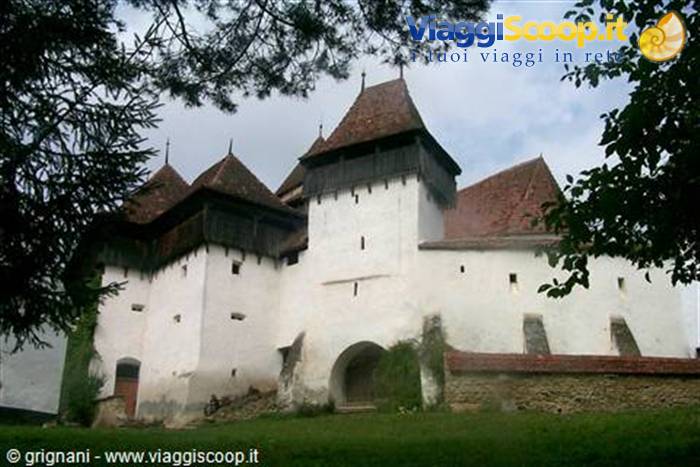
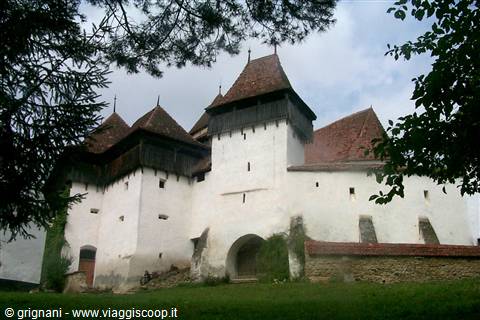
At six in the morning I'm already awake! Outside it's pouring with rain and pitch dark. So I try to stay in bed a little longer. But then I give up and go onto the terrace to read something (freezing cooold…). After a breakfast of zazusca and brinza we set off! Today we have a lot of road to cover. We have to cross the whole area of the Saxon villages, continue to Sighisoara and finish at Sibiu! Will our heroes make it? At 10:00 we arrive in Soars, a disappointment!! We then continue to Viscri, which should be the best-preserved medieval Saxon village. Let's hope so, because so far not even the roads have been preserved. We proceed at 30 kilometres an hour at most! The potholes, better described as craters, that open up on the roads are indescribable! Giampaolo proceeds in slalom!
DRAGOMIRNA - the cemetery
Day 829 Sep 2006
Sibiu - Alba Julia - Cluj Napolca - Turda
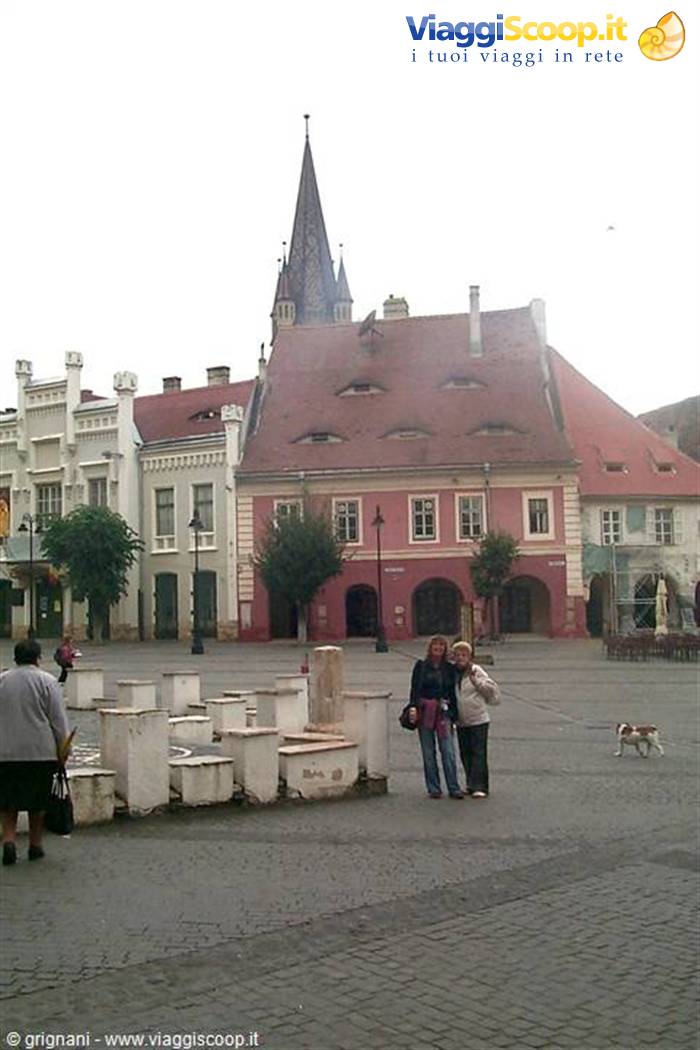
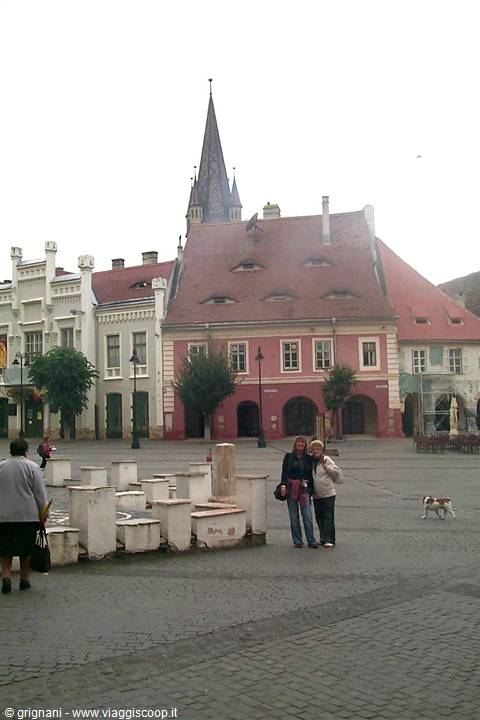
Today a big event! We have breakfast at 8:00!! The hotel buffet is extremely rich. Then we go out to visit the city and take some photographs since yesterday evening we arrived in the dark. The three squares of Sibiu: Mare, Mica and Huet are each more beautiful than the last. The evangelical church, the imposing bastions and the splendid Saxon-architecture houses create a wonderful atmosphere. We witness a horrifying scene that, precisely because it happened in the city elected European capital of culture, leaves us speechless… In the middle of the square two poorly dressed guys arrive with a stick in their hands—at first we don't understand what it is. Then we realize they're dogcatchers but the leash is a wire and the dog they catch and drag away howls desperately. The common thought is: how can one talk about the European Union?? We return to the hotel, pay the bill and leave.
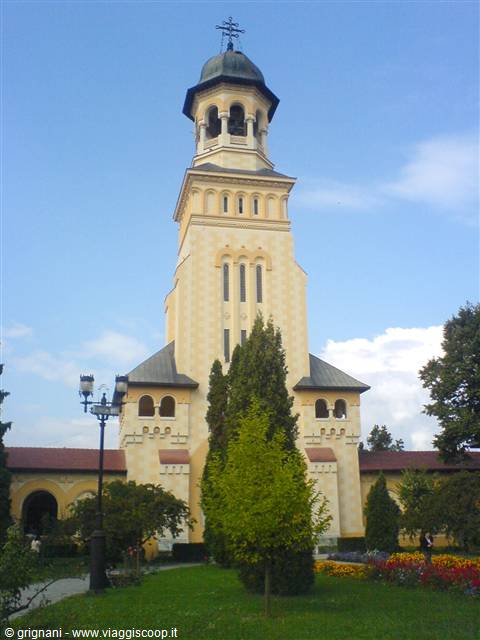
Heading to Alba Julia. Alba Julia is famous for the citadel and the fortress, which until two years ago was a military base, but now has been opened to the public and can be visited. Entering the city everything appears very clean and tidy. Alba Julia's citadel is also a construction site! A good part of it, including the monastery, is already restored, and very well too. In the fortress they're preparing a costume show. There are groups of people dressed as soldiers and as peasants from the 1600s. They have also set up a field kitchen where they're cooking a gulyas… no wait, someone corrects me right away! It's not a gulyas, it's a Romanian soup!! Let's not forget that it is precisely in Alba Julia that thousands of Romanians gathered to proclaim the independence of Transylvania from Hungary.
We also photographed the marble plaque affixed to the facade of a beautiful building in the citadel. In the fortress we visit a couple of interior rooms (the only two open to the public) and then take a tour outside. We leave again crossing the new part of Alba Julia. In ten years they have made a lot of progress, even though the difference with Europe is still abysmal. Especially in services. Public transport, for example, must be almost nonexistent. This is testified to by the mass of people hitchhiking on the outskirts of the city. We thought it was a problem of the rural areas but instead we realize it's a fundamental shortcoming. {ED.: The Romanian government must not have much respect for the needs of the people, starting with public transport but unfortunately extending even to hospital facilities, orphanages and homes for the elderly.
Several reports by Amnesty International have pointed the finger at the problem of mental institutions or prisons, not to mention cases of human trafficking. The government doesn't even bother that much about putting a stop to child prostitution and we noticed this personally last year during a stop in Timisoara}. On the road to Cluj, since lunchtime has passed a while ago and our stomachs are growling… I have Giampaolo stop in front of the only small restaurant we spot after kilometers. The restaurant doesn't have a nice facade but inside it's nice instead, full of Romanian families, and we eat well too! We are in Turda. At exactly 16:00 we enter Cluj Napoca and at 17:00 we leave… Quick visit? No… we simply drove around for an hour without finding either a parking spot or a guesthouse that had free rooms.
Since Cluj is anyway a big city without even a pedestrian area where you can take a walk in the evening, and since the Ethnographic Museum of Transylvania is already closed, we decide it's not worth staying for the night. So we continue. At 18:00 we're already in the Aries Valley, which was on the schedule for tomorrow. We stop to sleep in a little inn near the Turda Gorge that is quite nice. The Ciprian. For dinner we order so many things that we manage to eat only half. Except Mina, who is hungry tonight and also eats Giampaolo's Mamaliga.
VISCRI - Saxon Fortress
Day 930 Sep 2006
Turda - Albac - Chiscau
At 8:00 we're already in the car. We decide to go back a few kilometres to visit the Turda Gorge, a small canyon. But, after 6-7 kilometres back and forth, we can't find the turn-off (they should learn to put up signs for tourist sites!!) so we decide to carry on, since we've already seen the Bicaz Gorge, which is undoubtedly more spectacular. We cross the Aries Valley, a valley that runs parallel to the south of the Cluj Napoca-Oradea line. It's the native valley of the Moti people, farmers and wood artisans, although so far we haven't seen any craftwork. But cows, goats, buffaloes — there are thousands of them. For now the road runs alongside the Aries stream and is surrounded by greenery. How strange that the hotel didn't have milk with all these cows!!! The carts here are mainly pulled by oxen. We begin to make out the Apuseni mountain range.
We stop in front of a small bar, it also says pizzeria… but everyone makes pizza here so we don't think it's an Italian place, especially lost in a valley cut off from the world. Instead, there's a real Italian here! He's been living here for 16 years! While we drink a coffee we chat about this and that. What interests us most is consolidating the idea we've formed about Romania's economic situation. And unfortunately our intuition is true. Romanians earn around 100 euros a month. Costs are extremely high, as we had noticed, even almost higher than Hungarian ones! Then there are very rich Romanians. It's the middle class that doesn't exist. We continue along the Aries Valley. The road starts to climb and the landscape is very beautiful. It reminds us a bit of the Trentino Alps. Mountain pastures, alpine farms and lots of cows.
Then we begin to come across guesthouses, restaurants, farm stays, hotels. They explain to us that in summer many tourists come, especially Hungarians. Indeed in this area there are many things to see: canyons, caves, underground glaciers, gorges, waterfalls. However, it's an area where you should stay several days and do some hikes, since all these tourist sites are quite far from the main routes and to see them you have to walk several kilometres. {ED: Or have a good 4x4!!!} The underground glacier, for example, is 18 km from the main road, along a dirt road that they advise us not to travel with our car because it's in terrible condition. We stop for lunch at the top of the pass before descending to Stei.
We eat well, especially some oven-baked peppers that are divine! Then we arrive at Chiscau! Chiscau is the village where the Bear Caves are, ancient caves that we manage to visit by joining the last group of visitors. In Chiscau there's also the farm stay where we're sleeping tonight. Before going there, though, we visit a nice ethnographic museum set up by a private family that has a passion for collecting old things. The museum is full of objects related to agriculture, but also to everyday life: pots, rugs, pottery and even clothes. There's also an attic where a typical dwelling has been reconstructed. There's no entrance fee, they only ask for a donation to maintain the Museum, a donation we gladly leave, of course. At 18:45 we go to take possession of our rooms, just in time to witness the procession of a village wedding. How lovely, there are even musicians and flag-bearers.
People are dancing! The owners of the farm stay show us their garden, the vegetable patch at the back, where they also grow aromatic herbs: rosemary, sage, basil! In summer they also organise barbecues for guests. The place is simple but the hospitality is warm. In summer it must be very beautiful. There are large spaces and plenty of greenery. We taste the honey they produce. Can we buy some? No! It's only the first year they've made it. He also lets us taste his wine. Not bad at all. Dinner is even delicious, with some exceptional stuffed peppers. We go to bed early because tomorrow we have to make it all the way home.
SIBIU
Day 101 Oct 2006
Chiscau - Oradea - Szilvásvárad
We set off early but after a few minutes we stop in the next village because hundreds of cows are occupying the road. The spectacle is interesting all the same. It must be the departure for the mountain pasture! A woman in a typical long skirt, shawl and headscarf is probably gathering the cows of the various owners to take them to pasture. As she passes, the cows come out of the various courtyards and join the group!! At the same time, the women also come out of the gates of their respective houses and hand the woman fruit, sandwiches, various foodstuffs. So, as the procession advances, the herd grows and, consequently, so does the bag of provisions!! Others, meanwhile, are on their doorsteps with sticks in hand to dissuade the cows from eating their little flowers!!! After 20 minutes they finally take another road.
And we say goodbye to the Romanian countryside! We pass through Oradea and re-enter Hungary. 10 days, 2400 kilometres, 1150 euros for three.

0 reader comments