As always, online. We used a promotion on lastminute.it: zero agency fees for flight+hotel purchases. So we paid 460 euros all inclusive for a package we built ourselves. Namely: TAP direct flight Rome – Lisbon (departing 31 December, returning 5 January) and 5 nights at the Holiday Inn in Lisbon. Not bad, I would say, considering the season too. The only false note was the 5-euro fee Lastminute charged for sending the electronic ticket!! Incredible but true, there is always some rich rip-off lurking somewhere. I obviously complained, but nothing—they pretend not to notice!!
Hotel
Excellent. The room was on the top floor (10). It was a real apartment, complete with a minibar (paid) and a kettle for tea or coffee (free). Plus a TV and adjustable heating. All very nice. Breakfast was not included but honestly it really was not a problem. The hotel was about 500 metres from the Alameda stop, on the green metro line. Unfortunately all downhill!! So on the way back, plenty of uphill trekking!! There were no other alternatives (tram or bus) running near the hotel, so that was truly the only option. With 5 stops you were in the centre, taking 10-15 minutes at most.
Transport
Very efficient, like in all European capitals—except Rome, of course! There are 4 metro lines, trams and buses running frequently between 5.30 am and 2.00 am to all the most important areas of Lisbon. We bought a 5-day pass for all transport and paid (if I remember correctly) 16 euros. It covers the whole metro, trams (of any kind except the "tourist" ones), buses and funiculars. You pay another 0.50 euros because the pass comes with the famous "/ Colinas", a rechargeable magnetic card. If you keep it and return to Lisbon, simply show the card and top it up with tickets or a new pass. A point of merit: it is impossible to dodge paying on public transport! There is a barrier at both the entrance and exit of the metro that only opens when your card or ticket passes through. On the bus the driver also acts as inspector, so it is truly impossible not to pay.
Some local kids act clever on the trams that climb the hills, standing on the outer step. If I were you I would not do it… the jolts are such that you would end up on the ground after two bends! For the record, a single ticket for one ride costs 0.75 euros (of course we caught the price rise, since until 31 December it was 0.70!!!)
The city and its neighbourhoods
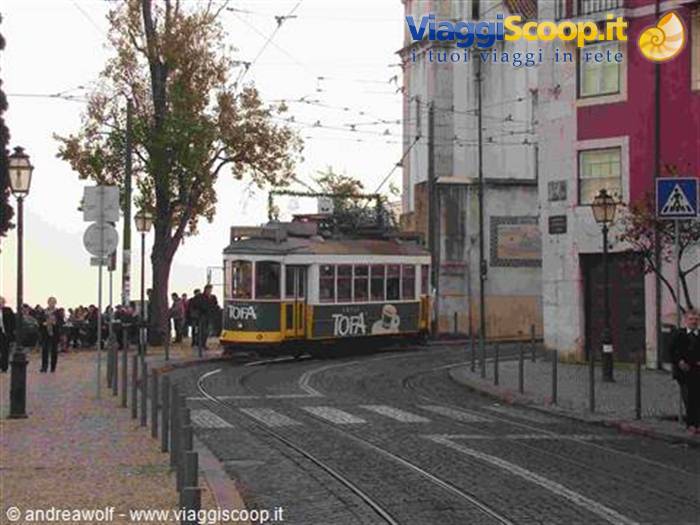
Lisbon is not really a city, I would say more of a small town. It is very small and easily visited in 2, 3 days at most. The most interesting areas are: Baixa (the central district that reaches up to Praca do Commercio, the largest square in the city); the Castelo de S. Jorge area with the Alfama and Graca districts; and then the notorious Bairro Alto (upper district). Once you have covered these places the rest is just to broaden your knowledge, but the city visit is practically over. Getting around is quite tiring without the help of public transport: Lisbon is all ups and downs, and especially the Castle and Bairro Alto areas are really hard to reach on foot. You cannot leave (as most guidebooks advertise) without having tried a ride on tram 28. It cuts the city in two and makes a beautiful tour of all the districts mentioned.
One tip: catch it at the terminus, otherwise you will do the whole tour standing, tossed about like in a washing machine! You can catch it at the terminus near the Martim Moniz metro stop.
Taxis
They are a valid alternative for getting around. You find them everywhere (all Mercedes at least ten years old) and they are very cheap (at least compared to Rome). A ride from the airport cost us less than 7 euros, with the luggage supplement included! If you use them to get around the city, you will not spend more than 5 euros. You read a lot about taxi drivers' bad faith and "inflated" prices for tourists. We did not have this problem, but it is always better to check, once you get in, that the driver turns on the meter. If he does not, ask him to and everything will be sorted. Outside Lisbon things change: many taxis do not even have a meter in the car, so it is always worth agreeing the fare before setting off.
Airport
It is quite close to the city, about ten kilometres. If you arrive in the evening (like us, we landed around 21.45) you will have no alternative to get into the city but a taxi. There is a bus service called "Shuttle", but its last run is at 21.00. Besides, the Shuttle costs 3 euros per person, and once you do the maths a taxi is better! There are also city bus lines that take you from the airport to the various areas of the city. You certainly save money, but you are forced to travel with your luggage on you and with dozens of furious people who may be coming home from work… There is also a voucher service for taxis: at the airport you can buy a taxi ride at a "fixed" price, regardless of the destination. If I am not mistaken it costs 15 euros per taxi, and once you do the maths it is NOT worth it at all.
In any case, to remove any doubt, when we arrived at the airport this service was also "closed"…. Final tip: do not buy anything at the airport! The prices are really high (some things cost more than triple what they do in the city), even higher than the shop inside the Holiday Inn where we were staying. So either you remember your gifts beforehand or… forget it!
Nasty encounters
The people are quite calm, though very reserved. Hardly anyone speaks English, so talking becomes difficult. But the language, even though it is light years from Spanish, is understandable if spoken slowly, and many words are similar. So it is easier to speak and make yourself understood in Italian rather than in English. If you want to make a good impression, bring a small Portuguese phrasebook and you are all set. We wandered at different hours of the day and night, in all the neighbourhoods. There are areas best avoided even during the day, like the one between Rossio station and Praca de Figueira. There are lots of drunk or marginalised people who will ask you for money, more or less insistently. We found the Bairro Alto area calm, though quite dark and full of alleys that are not exactly reassuring in the small hours.
The Baixa area, on the other hand, is the one that left me most puzzled: it is a maze of commercial streets with trend-setting shops, very busy and well lit. Despite this, on several occasions young men approached me trying to sell me every kind of drug, quite insistently too.
Shops and "Portuguese nightlife"
We arrived on the evening of the 31st and until the 2nd practically all the shops and most of the restaurants were closed for the holiday. Compared to Spain, they have not the slightest business sense, considering there were thousands of tourists on the streets of Lisbon ready to squander their money on senseless purchases. Instead, nothing. Nightlife too, also much praised in the guides, is practically concentrated in the Bairro Alto area. But even here very few places were open, and for that reason they were practically impossible to get into.
Day 131 Dec 2006
31 December
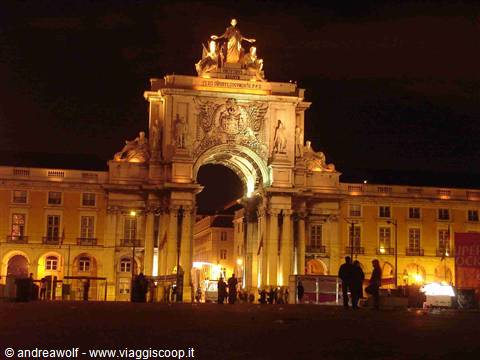
We arrived at the hotel practically right before midnight. It must have been 22:30 and we asked the young woman at reception where we could celebrate the New Year. Whether there was a party in the square or something like that. She pointed us to 3 possibilities: fireworks at Cais do Sodré, a party at Praca do Comercio or in the new Expo district. We asked her for a suggestion, also given her young age, and she had no doubts: Praca do Comercio. We ran to the metro and got off at Baixo – Chiado along with a crowd of tourists and locals. Everyone heading to the square which, despite being large, was packed with people. What struck us most was the Christmas tree they had set up in the square: the tallest in Europe (about 80 metres), obviously fake but brilliantly illuminated (you could clearly see it even from the plane as we were landing). There was also a big stage with commercial music.
We carved out a bit of breathing space for ourselves so as not to be stunned by the crowd. It was a quarter of an hour to the fateful midnight, so we didn't have to wait long. At the appointed hour the fireworks began, along with many champagne corks popping (but nobody dares light a firework, not even a sparkler or a Roman candle!). The fireworks last about half an hour and at the end loud applause from the thousands of people in the square. And then? A general stampede towards the metro, which had its last run scheduled for 01:00!!! So we too headed for the station and the square emptied in a few minutes.
Even in the streets of Baixa the situation was one of almost unreal silence, and only the crowd in the metro carriages reminded us that it was New Year's Eve! For the record, we didn't manage to eat anything, but not for lack of will but because there was nothing open! Not even a kiosk, not even a small bar, NOTHING! Truly incredible!!
1 January
If on the 31st we didn't manage to eat anything, on the first day of 2007 it was just as difficult to do so. Restaurants of any kind and price were all closed and those open could be counted on the fingers of one hand. We ended up in the Baixa area at Rua de Correeiros 132 in a place also listed by the Lonely Planet. It's called Adega Regional da Beira. A real tourist trap where we ate badly and spent 30 euros for 2. They boast numerous typical dishes but they're cooked really badly. The prices are also competitive but padded with a series of hidden costs (see the "starters" chapter) that make the bill rise beyond any reasonable level. For the record, we had the infamous pork with clams and a dreadful vinho verde (young wine). The food upset our stomachs so much that in the evening we ate a truly miserable sandwich before going to bed.
Food
Almost all places sell bacalhau, the Portuguese national dish. There are many types of restaurants, all very dirty and with few seats. So take that into account with the time you go. The really local ones don't have a menu in any language other than Portuguese, so come prepared with a small guidebook. Almost no one, especially outside the tourist circuits, accepts credit cards, so bring cash. As for prices, I have to say they're very low compared to Rome. A fish dish with a side costs between 6 and 9 euros, as does a meat one. You go higher if you want something very special or expensive like lobster (between 70 and 100 euros a kilo), Atlantic crab (20-25 euros a kilo) and other delicacies.
For example, in many places they sell plates of raw seafood for two people: they're enormous and there's truly everything, but the price is obviously proportional since it costs about 70 euros to buy one. Always consider the house wine, which costs between 3 and 7-8 euros and in many cases is served in a bottle! Wine is the real surprise: it costs little and in many cases is very good. Beer isn't drunk at the table but especially in bars outside of meals. A small one costs 1.5 euros and a classic pint at most 2.5 euros. I drank several during the hottest moments of the day. Starters Here's the rip-off organised by Portugal's national restaurateurs' association. In whatever place you go to eat, you'll find your table invaded by little starters that the prompt waiter will bring to your table in about 4 seconds flat.
Obviously they cost money, and quite a lot compared to the cost of the individual courses. You can easily reach 10 euros each, I'm warning you in advance!! But the funny thing (or frustrating, depending on your point of view) is that the more you send back these nice little morsels, the more will arrive, or if you tell the waiter you don't want starters you'll find, as if by magic, the bill with a series of strange entries from cover charge to bread etc. In other words: you'll pay something regardless, there's no way around it even if you don't eat any of what they bring you.
Also because this is the second technique used: they bring you 200 little dishes, you say you don't want them and the waiter with an innocent "Heidi"-like air tells you that if you don't eat them you don't pay, adding an "obviously"!! IT'S AS FALSE AS JUDAS!! Anyway, the bread, butter and some other nice useless thing will be slipped into your bill!!! It's torture, a genuine disgrace. But the battle is endless and in the end, exhausted, you'll pay!!
Climate
Ideal for a winter trip. In the evening never below 10 degrees and during the day often above 16! The only annoyance is the fog which, especially in the Baixa area and around the 25 April bridge, rages for several hours of the day. It's a thick fog that prevents you from fully admiring the splendid landscapes of the areas around Lisbon. In the 5 days it never rained but the night-time humidity is such that in the morning it always seems as though there's been a downpour during the night…everything is wet and soaked with water.
Day trips – Cascais
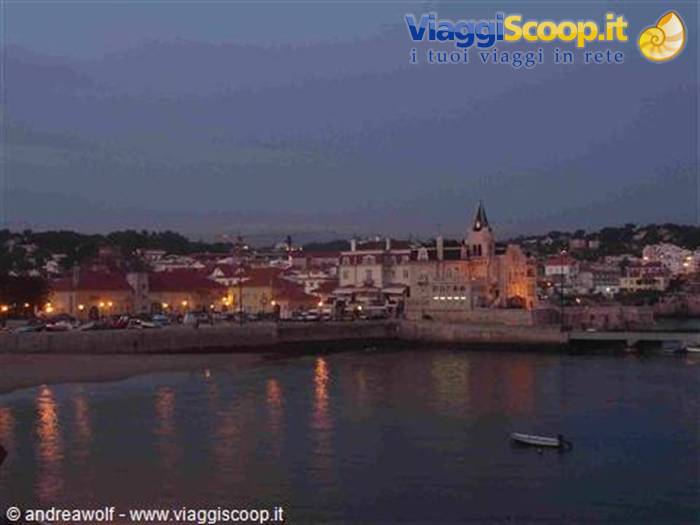
There's the possibility of taking several trips outside Lisbon, that is, a few minutes by tram or bus, to discover the true beauties of Portugal and escape the chaos of central Lisbon. The first I recommend is Cascais; it's about half an hour by train from Cais do Sodré station. A one-way ticket costs 1.60 euros and the trains run frequently (about every 20 minutes and until 2 in the morning). The train also stops at Estoril for anyone wanting to pop into the Casino. Cascais is a small seaside town, which apparently is very crowded in the summer months. The centre is very nice, with lots of shops and a beautiful pedestrian area and a very pretty little harbour. There's a large covered fish market but it's only open in the morning (from 6 onwards) and a nice walk towards the Citadel, the ancient residence of the King, today a military barracks that unfortunately can't be visited.
There are also beautiful gardens, where peacocks and many birds and animals of every kind run wild (including some beautiful rabbits). The park is obviously full of children and mothers. There are lots of places to eat, perhaps in winter very oversized even in terms of supply compared to the people present. There's also a large, very modern shopping centre full of young people busy with modern shopping. The beaches aren't very big and don't seem to be up to much, but if you want to take a trip to admire the town and have a beer by the harbour, in my opinion it's worth it.
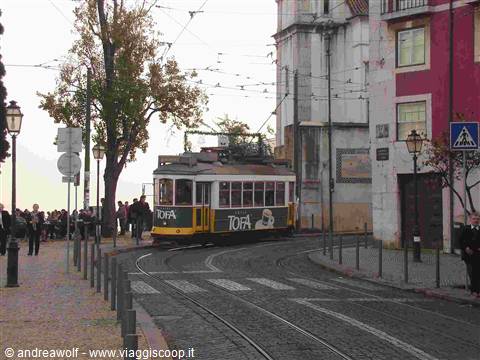
Tram 28 in the alleys of Lisbon (Praca do Sol)
Day 21 Jan 2007
Day trips – Belem
This is a historic area of Lisbon. Vasco da Gama set off from this place for his voyage of discovery to the Indies. There's a fantastic cathedral (Mistero dos Jeronimos) built right on the spot where De Gama and his officers passed in prayer the last night before sailing on the long voyage. For this reason King Dom Manuel I ordered the construction of the cathedral upon their return and called the area Belem, Portuguese Jerusalem. Also beautiful is the lookout tower right in front of the cathedral (Torre de Belem), enjoyable even from outside without having to go in. To go to Belem I recommend tram no. 15, which leaves from Praca de Figueira and stops right at the cathedral. Near the tram stop (Rua de Belem 84) you'll find a bar-café called Pastéis de Belém.
It was founded in 1837 and the eponymous little pastries are famous (which you'll find anyway in all the bars and all the pastry shops in Lisbon and I think in Portugal), Pastéis de Belém. They're little pastries filled with cream with cinnamon and sugar. The room of this place is decorated (like very many historic Portuguese buildings) with blue majolica tiles.
Day trips – Expo 98
Here it's not really a trip outside Lisbon but in my view the Expo must be visited. You get there on the red line of the metro; the stop is Oriente. It's an area with very beautiful architectural style, with lots of greenery and on the bank of the mouth of the Tagus river. There's a huge shopping centre called Vasco de Gama (strange!). If you cross the shopping centre at the back, about 30 metres away, you'll find a small wooden building to buy tickets and get info about the Expo. For 16 euros you can buy a voucher that lets you do the complete tour, that is: visit the Oceanario (it's an aquarium with a tank of 5 million litres of water), take a ride on the cable car (a sort of gondola lift that crosses the whole Expo. It's over 1 km long and about twenty metres high.
You can admire from above the whole Expo and also the Vasco de Gama bridge, a good 17 km long!!! which crosses the mouth of the Tagus), visit the Pavillhao do Conhecimento (Pavilion of Knowledge, where you can personally try numerous scientific experiments, do a test with the people you're travelling with to find out whether women or men are more intelligent!) and finally take a ride on the little train that goes around the park once an hour. If you have children you can't avoid it; if you're only adults then decide for yourselves. We had a great time and spent half a day relaxing in the open air.
Day trips – Cristo Rei
From any point in Lisbon you can't fail to see the Cristo Rei, the statue depicting Christ commissioned by the wives of the Portuguese in 1959 as a thank-you for the fact that the country and, therefore, their husbands, had been spared from the Second World War. It's a mini version of the Christ the Redeemer in Rio de Janeiro in Brazil. Anyway, the statue including its base is over 130 metres tall and stands right above the 25 April bridge. To reach the monument you have to go to Cais do Sodré and take the ferry that crosses the Tagus. The ticket costs 0.74 euros and the crossings are very frequent (even every 15 minutes at peak times and until 2 in the morning) and last at most 10 minutes. Take the line that goes to Cacilhas. Once you get off in this small harbour you have to go to the bus square on your left and find line 101.
It climbs up through the Peasino and then towards Cristo Rei, the terminus of the route (you can't go wrong). The ticket costs 1.02 euros one way and you buy it directly from the driver. We, as usual, walked half the way thanks to the directions of a "nice" Portuguese woman who pointed us the way on foot to reach the monument…exhausted after an hour of walking uphill we had covered more or less 1/3 of the way…when fortunately the bus came by and we jumped on it! The view you enjoy from the height is beautiful: the marvellous 25 April bridge passes right beneath you and in front of you the whole view of Lisbon. It's a trip not to be missed. If you want you can take a lift up to the top of Cristo Rei. It costs 3.5 euros but in our opinion it's not worth it considering that the base is already high relative to the view you have in front of you.
Behind the monument there's a square with a small souvenir shop and a bar. For those who want it, Cacilhas in the harbour part offers numerous little fish restaurants at lower prices than in Lisbon.
Day trips – Costa Caparica
It's a beautiful beach over 8 km long that faces the Atlantic Ocean. It's a wonderful place to spend a day, especially for surf lovers or just for a wonderful walk along the beach. Getting there isn't easy. You always have to take the ferry to Cacilhas and then take bus no. 135, which will take you to Costa Caparica (final stop). The ticket, one way, costs 2.5 euros. It takes about 30-40 minutes depending on traffic. If you can, don't get off at the terminus but at the previous stop, since it's much closer to the sea than the last one. The little village is nice (but less characteristic than Cascais) and full of shops and small places to eat. For football fans I recommend a visit to a small shop called "Futbol Shop" which is right in the pedestrian area.
In my opinion a visit is necessary just to see the commemorative scarves of Miccoli and Rui Costa or those with the teasing between Benfica and Porto. Once you reach the sea the spectacle is breathtaking. Despite the good weather and the absence of wind there were long waves about 3-4 metres high with lots of young people armed with boards and cold-proof wetsuits having fun riding them. From the beach a little train sets off that covers all 8 km of beach, stopping every so often near refreshment points or small beach establishments. Unfortunately this train doesn't run in winter. We ate in a big outdoor bar enjoying the spectacle and the sun. Just one thing: be careful to check the times for the return trip because from 3 pm onwards the bus passes once an hour to go back to Cacilhas.
Restaurants to mention In particular I'd like to mention two places where we ate and had a good experience. The first is Velho Macero at Rua da Maddalena 117 (in the area between Baixa and the Castelo). They cook few dishes but very good ones with generous portions. Over two different evenings we had the salmon, the bacalhau, the grilled octopus and the monkfish. All truly very good with a good house wine. We spent 25-26 euros for two, also eating the infamous starters and having fruit too. Two observations: the place is small and the owner's service truly impeccable, with the menu also in Italian. The second: if you order fruit it will be served to you peeled and prepared by the diligent owner, but be prepared to see it served by the unit…that is, if you order the pineapple you'll get the whole pineapple peeled!!
View of the town of Cascais
Day 32 Jan 2007
The second restaurant is Quebra Mar and it's on Avenida da Libertade, opposite the Hard Rock Café. To get there take the metro and get off at Restauradores and walk a little way towards Praca Marques de Pombal. It's a very crowded place but with phenomenal fish. Many locals are present in the restaurant (a good sign!) and you won't be able to resist trying the house specialities, which are lobster and crab. We had the big crab (1.3 kg in weight!) which is served to you with two hammers to break the claws! Then two potato soups and a seafood rice with lobster. All with a nice bottle of white wine and two coffees: 63 euros for two! PS Including 3.6 euros of starters never consumed, obviously!
Chestnut sellers
In the squares of Lisbon but also in small towns outside, every so often you'll see huge columns of white smoke rising into the sky. Don't worry, nothing's catching fire…they're the roast chestnut sellers! Who cook the chestnuts with a small brazier. Towards the end of the cooking they throw handfuls of coarse sea salt into the pan (the reason for the dense white smoke) so that the chestnut takes on a snowy white colour and peels better. A bag of chestnuts (about 12 pieces) costs two euros. Try them!
Trying Port
One tip: if you want to try Port, the famous Portuguese wine, you can't fail to go to Solar do Vinho do Porto at Rua de Sao Pedro de Alcantara 45. You can taste over 200 types of Port, from red to white, from 40-year-aged to freshly distilled, comfortably seated on armchairs and sofas in a truly relaxing and pleasant atmosphere. The prices are accessible to everyone: from 1 euro up to 35 euros a glass (all clearly indicated) and if you want you can also buy bottles of Port up to 200 euros. The waiters will be happy to give you advice and recommendations. You can also taste small pastries and have soft drinks for those who don't drink wine. To buy Port, if you don't have particular requirements, go to supermarkets, otherwise there are dozens of wine shops scattered everywhere. But be careful because Port is expensive and a good bottle will cost you 20-30 euros.
There are also bottles that cost as much as 2,000 euros!!! But they're kept under lock and key!!
Conclusions
Lisbon undoubtedly deserves a visit but it's not a city that leaves its mark, at least it didn't on us. We've travelled all over Europe and I personally was missing the Portuguese capital. It's not very fascinating, it's not clean and the people are, let's say, "strange". It takes a few days to appreciate it, to get into the slow rhythms of the Portuguese and their "let's take it easy" mentality (anything takes time!) But if, like us, you decide to take a few trips outside the centre, then Portugal comes out in a big way…people radically change their attitude and the landscape changes rapidly, showing the beauties of this fascinating land that bewitches the visitor with its colours and flavours.




0 reader comments