Telling of a trip made in 1999 is no simple matter. Memories often fade, but in this case time has only dimmed part of the memory. The most beautiful part, the most moving, still lives inside us. And for this reason I decided to share it with you. It is a particular journey, with the final destination the Lofoten Islands, in Norway.
It is 8 August when we set off on a Swissair flight (yes indeed, it was still called that...) from Rome bound for Oslo with a stopover in Zurich. We arrive in the late afternoon and head to the station to buy a ticket for Bodø. Instead of buying a ticket they suggest we buy a Scanrail Pass. It is a rail ticket that allows you to travel freely on the Norwegian railways for 4 days out of 10. The price (if I remember correctly) is around 220,000 lire (yes indeed...). Get it into your head that the Scandinavian countries have exorbitant costs for transport and not only. For a supplement we also take a couchette and towards 11 p.m. we set off with a stop at Trondheim, where we arrive the following morning around 7.00 a.m.
I had been to Norway several times and the weather had always been dreadful...but this time I see the sun! The temperature is pleasant and, having left our backpacks at the station's left luggage, we head for the little town. Nothing special, pleasant and nice to wander through the streets of the centre. It is not tiny (by Norwegian standards) it is a proper city. It is famous for the local football team, Rosenborg, which a few years earlier drew 2-2 at home with Real Madrid. In various places in the city you will find celebratory photos and posters of the event, as well as a shop entirely dedicated to Rosenborg. We pick up some material at the local tourist office and in the evening we take the train again bound for Bodø. In the middle of the night we are woken by the train conductor announcing the crossing of the Arctic Circle.
It is 2 at night and although it is August there is still a great deal of light, enough to get off the train and take a few steps...in fact the train stops to allow the ritual photos for the passengers. Excited by the event (especially my girlfriend, who had never been so far north) we can no longer sleep and start planning the next day, that of the transfer to the Lofoten Islands. We arrive in Bodø early in the morning and the temperature is rather brisk (about 10°C). The weather is still rather fine, so we leave weapons and baggage and head for the city centre. If Trondheim is a small town, Bodø is a real little fishing village. There is a large port and the railway. Nothing more. Note well: the Norwegian railways stop at Bodø. To go further (towards Narvik and North Cape) you can only use coaches. We go to the port and buy the ferry tickets.
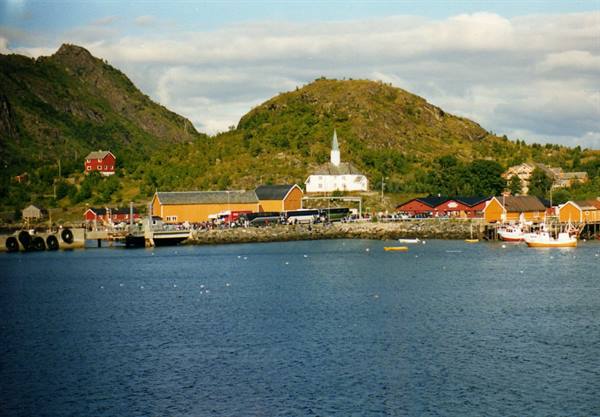
The Lofoten, among other things, are connected to the rest of Norway by a ferry service that leaves from Bodø to arrive at Moskenes. The Lofoten are made up of several islands connected to one another by bridges and tunnels. Austvågøy, Gimsøy, Vestvågøy, Flakstadøy, Moskenesøy, Værøy and Røst are the islands that make up the archipelago and Moskenes is the main port, located on the island of Moskenesøy. The crossing is calm, the sea rough but not too much. There is a very stiff wind and, as we approach the coasts of the Lofoten, small fishing boats begin to appear. They immediately remind us that the local economy rests on fish and particularly on cod. We arrive at Moskenes and head for the village of Å, where the (only) road of the Lofoten ends, the E10, and where the archipelago ends.
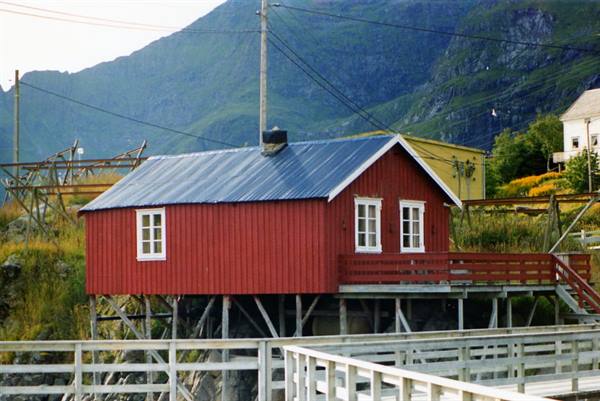
In this village we have booked a rorbu (a typical Norwegian fishermen's house) where we will stay for 9 days! Well, I confess, we opted for a total-relax holiday, far from traffic and smog. Alone with nature, contemplating the beauty of the landscape and meditating. That year had been very heavy in terms of stress and so the holiday in the Lofoten was chosen precisely to "unplug". We booked the rorbu on the internet with Å-HAMNA RORBUER. 9 days for a rorbu cost us 600,000 lire. Inside the rorbu there is every comfort: bathroom, equipped kitchen, beds with sheets and duvet, independent heating. The rorbu are rented to tourists in the summer season while in winter they are used by local fishermen. Cod fishing is in fact typically a winter activity, while spring and summer are dedicated to the drying phase of the product on special racks.
The air (or rather the wind) of the North Sea, the temperature and the salt do the rest...producing an exquisite stockfish that is exported in wooden packs all over the world and especially to Italy, the Vicenza area (the leading importer of Lofoten cod). In the Cod Museum in the Lofoten there is an Italian flag and many photos testifying to this "twinning". Moreover the guide speaks Italian precisely because of the commercial relations it maintains daily with our country.
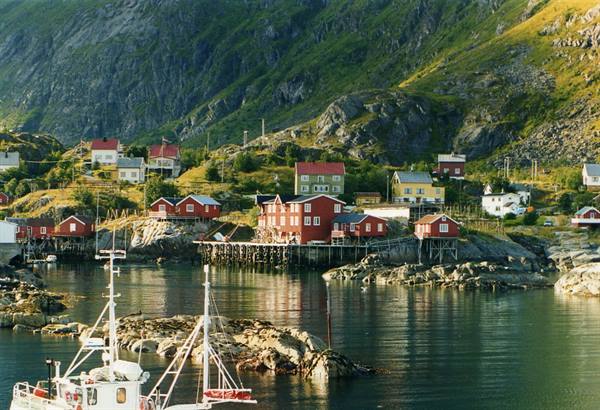
Let's resume the account because to get to Å from Moskenes there are about 5-6 km...and we would not want to walk them with our backpacks. The bus runs at rigid times that do not coincide with the ferry (Norwegian efficiency here is a little leaky) and so we take a shared taxi with other young people who are also heading for Å. Our destination appears just as we dreamed: it is a village of red wooden stilt houses, silent (you can only hear the gulls) and almost uninhabited. We go to the Å-HAMNA RORBUER and are welcomed by a friendly host who is amazed that we have decided to spend our holidays in the Lofoten coming from..Rome! Perhaps because he lives there, he dreams of our city! Whoever has bread has no teeth! We take possession of our rorbu and take a walk, taking advantage of the presence of a small supermarket to buy creature comforts.
A confession is in order: at the time we were university students and so with little money in our pockets: so in our backpacks we had brought from Rome non-perishable foodstuffs that we thought might cost a lot in Norway. And with hindsight I must tell you we did very well...life is very expensive!!!
We made friends with a lady from the local Tourist Office who came from Paris and had married a Norwegian from the Lofoten! She told us about the harsh and very long winter that was spent at home with the neighbours telling each other fairy tales and stories, entertaining the children! Something that struck us deeply and made us reflect on the very kind of life we lead every day, frantic, hysterical and not at all enjoyable. We have lost deep, important values: friendship and closeness with people.
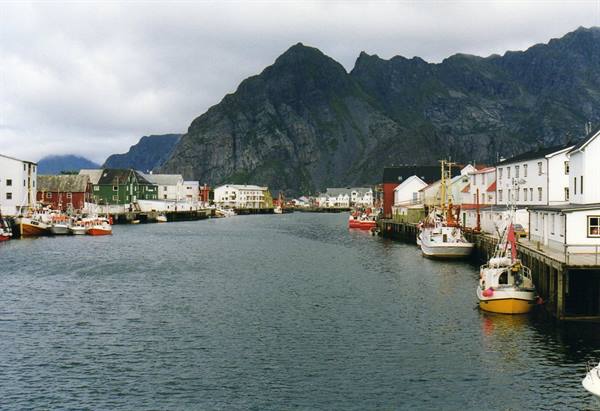
In the following days we take long walks towards Moskenes, Sørvågen and Reine. We move on foot (clocking up several kilometres) and sometimes getting by with the coaches and their impossible timetables! A word about Reine. A small fishing harbour often captured in postcards and photographs, a symbol of the Lofoten Islands. It takes your breath away with its raw, almost primitive beauty. You could spend hours admiring the enchanting arrangement of the houses and the boats moored in the inlet. A splendid encounter between nature and human activity. For a couple of days we even allow ourselves the luxury of a car. Not that we miss the car, but as I said, getting around the island is not simple, the connections are hard to reconcile.
Day 19 Aug 1999
Tour Lofoten
We take a bus from Å to Leknes on the island of Vestvågøy. It takes several hours of winding roads along the E10 but it is the only town where they rent cars.Of course you should phone to check availability and the price! For around 200,000 lire we rent a Nissan Micra for 3 days.When we arrive at Leknes at the bus station, the lady from Hertz comes to pick us up and takes us to the rental office. We sign the necessary paperwork and she leaves us the car.
The immediate memory is about the price of petrol: 2,400 lire! Today in Italy we are close to (if not above) that price but at the time I assure you the gap was impressive, considering Norway is also a producer country (Statoil is one of the largest Norwegian producers and distributors). The roads are narrow and the limits strict. So you will take a long time to make short journeys.We tour the various islands far and wide and notice small inlets with a turquoise sea to make the Maldives envious...if it weren't for the water temperature that discourages everyone from taking a refreshing swim! Ramberg on the island of Flakstadøy deserves a mention. It overlooks the Atlantic Ocean and is battered by the wind and the seagulls. But the beaches and the sea are enchanting.
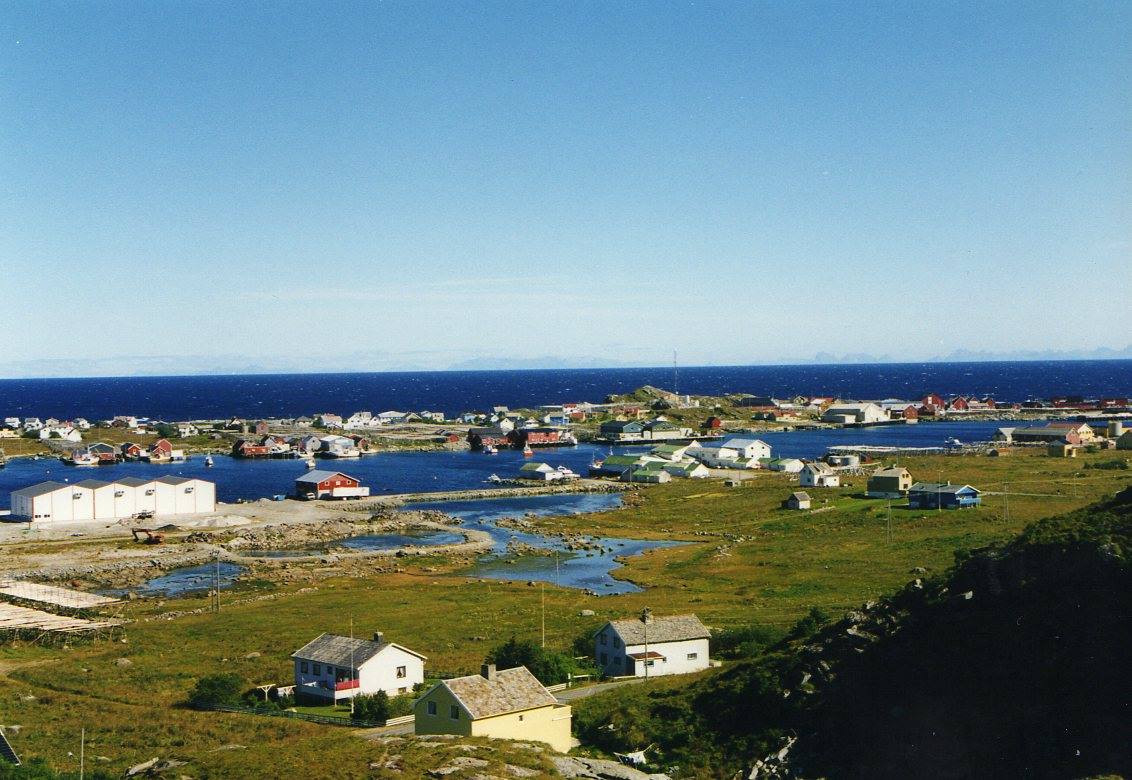
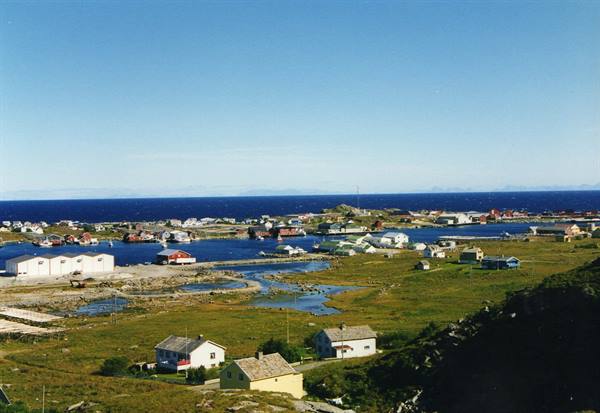
We also dedicate a day to visiting the island of Værøy, reachable by ferry from Moskenes and crossing the terrible Moskenesstraumen currents. They are said to be the strongest sea currents in the world and judging by the whirlpools you see from the ferry it really seems that this is not an exaggeration. Edgar Allan Poe and Jules Verne were inspired in their tales precisely by these currents. Værøy is a small island, where the wind blows very hard throughout the year.It is famous for its Puffins, these nice birds with the colourful beak. Unfortunately they are not present during the month of August except for a few specimens. If the Lofoten are primitive islands, Værøy is a primordial island where time seems never to have passed. You find a lot of fishermen's houses and a small centre. Life is very slow and everything is marked by fishing and by...the wind!
This is the brief account of our relaxing holiday in the Lofoten Islands. After two days of travelling we returned to Rome. We leave Norway with many memories, with the feeling of having lost something and of not being able to find it easily again.With a bit of envy and a bit of recklessness we somewhat envy the French lady who will stay on the island to spend another winter telling stories to her children.
Fishing village with colorful houses and boats along the Nordic coast
Ciao! Bella la vostra descrizione del viaggio, soprattutto la parte in cui riflettete su quanto sia frenetica la nostra vita a Roma...condivido e scapperò alle lofoten quest'estate per questo motivo. Vorrei chiedervi se avete dei suggerimenti particolari, luoghi che considerate imperdibili quando si visitano le lofoten. Noi alloggeremo ad A, ed ho intenzione di visitare il villaggio, Reine, vinstad con la sua bunesstranda, poi ci sposteremo a svolvaer e lì a parte Henningsvaer, sono a corto di idee. Avete fatto escursioni in montagna? Qualunque consiglio sarà prezioso! Grazie Luana


1 reader comments
Ciao! Bella la vostra descrizione del viaggio, soprattutto la parte in cui riflettete su quanto sia frenetica la nostra vita a Roma...condivido e scapperò alle lofoten quest'estate per questo motivo. Vorrei chiedervi se avete dei suggerimenti particolari, luoghi che considerate imperdibili quando si visitano le lofoten. Noi alloggeremo ad A, ed ho intenzione di visitare il villaggio, Reine, vinstad con la sua bunesstranda, poi ci sposteremo a svolvaer e lì a parte Henningsvaer, sono a corto di idee. Avete fatto escursioni in montagna? Qualunque consiglio sarà prezioso! Grazie Luana