The city itinerary
Chisinau, the capital, is its exact geographic center, where all the main traffic routes converge; the city rises along the course of the Bi'c River and has a population of over 752,000 inhabitants distributed across its 5 urban districts over an area of 120 square kilometers. Considered one of the greenest cities in Europe, Chisinau offers architectural beauties and monuments of rare artistic value, erected mainly during the Tsarist era with the contribution of virtuoso Italian masters and later also in the Soviet period. A visit to the city of Chisinau has as its indispensable starting point the majestic statue of Stefan cel Mare, located at the entrance to the park of the same name. This place represents the heart of the city center as well as the main usual meeting point for the inhabitants of Chisinau.
Until 1991 the statue of Lenin occupied the base on which today rests the statue of Prince and Saint Stefan cel Mare, also known as the hero of the struggle for liberation from the Ottoman invader. The park of the same name, which extends behind the monument, is undoubtedly the most beautiful and best preserved in the city. Inside it there is a beautiful fountain (closed during winter) and several statues of Romanian and Russian writers and poets. Leaving the park along the avenue of statues, we cross Bulevard Stefan cel Mare and reach the Soviet-era Opera and Ballet Theater. The square in front has recently been rebuilt and equipped with two illuminated dancing fountains that offer a very evocative image in the evening.
From this place we can admire the imposing Presidential Palace, also known to the capital's inhabitants as the "glass palace." Returning to Bulevard Stefan cel Mare and passing the statue of the same name, we look out onto the Square of the Great National Assemblies (Piata Marii Adunari Nationale), where until the early 1990s military parades and speeches by the communist leaders of the U.S.S.R. were held. On this enormous square stands the gigantic Palace of the Moldovan Government (formerly the seat of the communist party of the Moldavian S.S.R.), and on the opposite side the Triumphal Arch, built in 1840 by the architect I. Zauschevici in commemoration of the victory of the Tsarist troops over the Turkish invader.
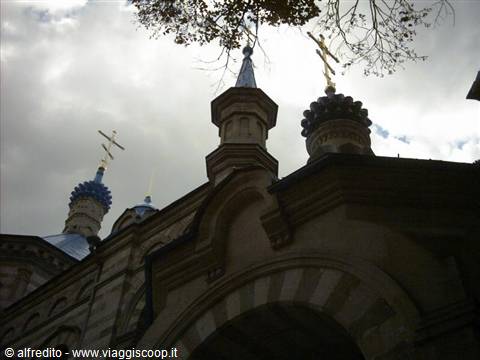
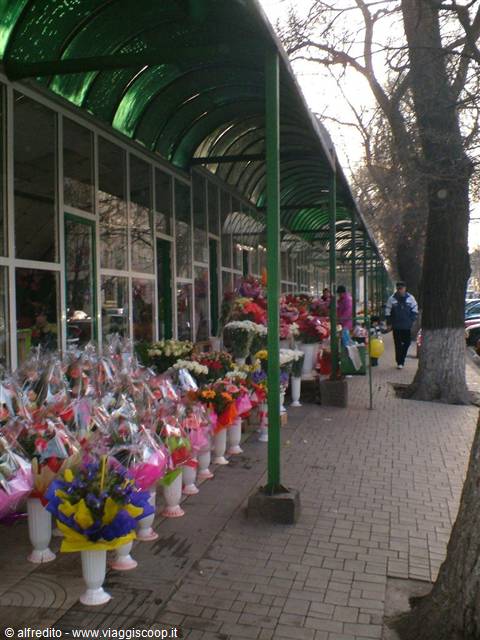
Behind the Arch rises the Russian-classical-style structure of the Orthodox Cathedral of the Nativity of Our Lord, composed of a central body and a tower with a separate bell tower; originally the work of the architect Abraam Melnicov, who designed it and completed it in 1836. The entire work was destroyed several times in various armed conflicts; therefore the currently existing structure is the result of the reconstruction completed on August 25, 1996, at the wish of the former Moldovan president Mircea Snegur. The cathedral is surrounded by another flowered park where, on weekends and during the main state and religious holidays, a colorful little market of local handicrafts is set up. On the side of the park parallel to Strada Banulescu-Bodoni is the main open-air flower market, open 24 hours a day, where the stalls follow one another for a length of over 200 meters.
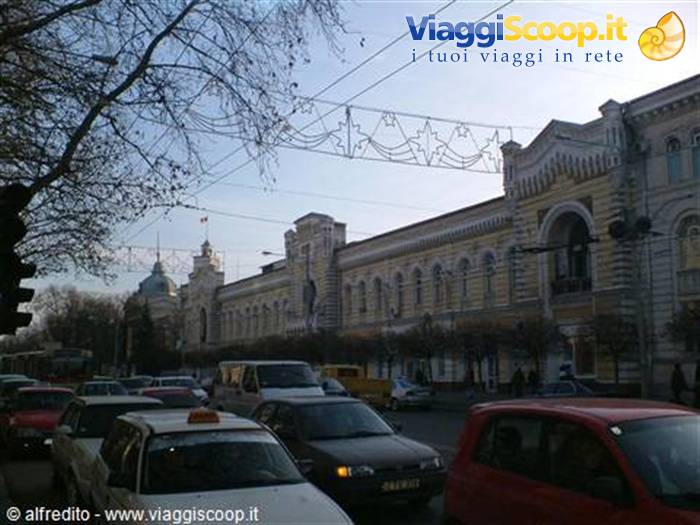
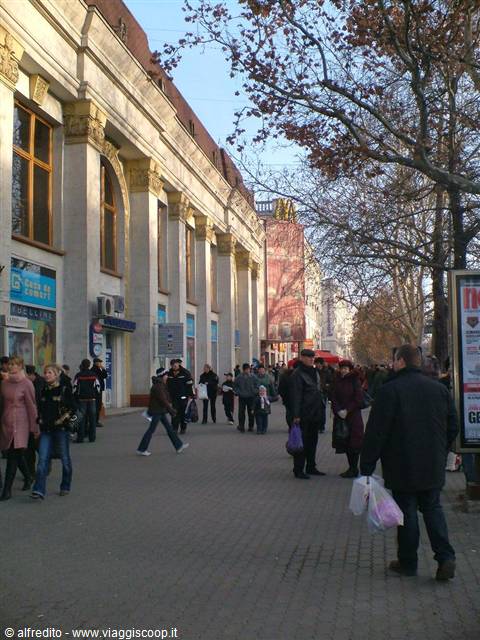
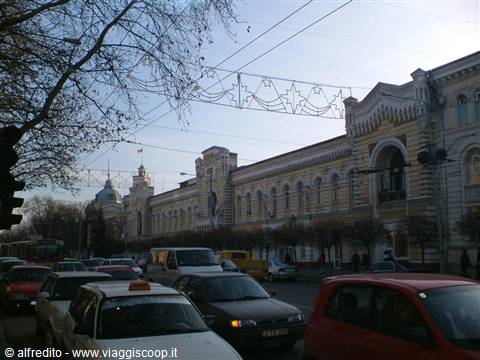
Crossing the park again diagonally, we return to Bulevard Stefan cel Mare, which from here extends eastward for another 3 kilometers. The first building worthy of mention is undoubtedly the City Hall (Primaria Chisinaului), built in 1902 by the architects M. Elladi and A. Bernardazzi. The building was realized in Venetian Gothic style and features a tower with a clock at its peak. Facing the city hall is the circular-plan building of the Central Post Office. Continuing the walk along the Boulevard, we find the Organ Hall (Sala cu Orga), built in the 1920s and miraculously spared from the bombings of World War II. A building in classical/romantic style, the Hall boasts an organ made up of 3,000 pipes with exceptional resonance.
Beside the Hall, in a tiny but charming park, stands the "Vernisaj," that is, the most beautiful art and craft market in the whole city; this is undoubtedly the best place to buy your souvenirs and mementos of the city. On the other side of the "Vernisaj" rise the imposing columns of the "Mihai Eminescu National Theater." Continuing along the Boulevard to the modern "Moldtelecom" building, we can turn left onto Strada Armeana, or a little further down onto Strada Bulgara, and access the multicolored Central Farmers' Market, the former kolkhoz market of the city. Leaving the Market and returning to the Boulevard, after another 100 meters we reach the UNIC department store, which was built in the Soviet era and still today represents the largest commercial space in all of Moldova.
After crossing the large intersection formed by the meeting of the Boulevard and Strada Izmail using a convenient underpass, enlivened by an infinity of small kiosks and street vendors, only a few meters remain to the end of the very long Corso. Already from this point we can glimpse the tall column of the Monument to the Fighters and Liberators, which is located right at the intersection between Bulevard Stefan cel Mare and C. Negruzzi on Independence Square (formerly Liberty Square). This monument was erected in 1969 as a tribute to the Red Army, which in 1944 liberated Moldova from Nazi-Fascist occupation. At the sides of the square are the National and Chisinau hotels. The latter, built in 1960, deserves special mention for its architectural structure and for the "Crama" restaurant furnished like a traditional Moldovan wine cellar.
From here begins Bulevard Negruzzi, which we follow completely to the roundabout for about 500 meters; on this elegant avenue are the offices of the main airline companies and travel agencies. Arriving at the roundabout we can admire, on the left, the equestrian Monument erected in memory of Grigore Kotovski; a Soviet military leader and Moldovan communist activist, he rebelled twice against Tsarist rule. Behind the monument is the Hotel Cosmos. Passing the roundabout, we enter Bulevard Yuri Gagarin, which leads us to the Railway Station, built in 1948 and recently renovated.

1 reader comments
Per entrare nella Repubblica Moldova dal 1 gennaio 2007 non è più necessario il visto per un soggiorno fino a 90 giorni.