The story
The village of Rudi, located in the northern Moldovan district of Soroca, is about 200 kilometres from the capital Chisinau. It is considered one of the most fascinating localities in the whole country. The village, formed by ancient fortifications and an old church, is situated among deep valleys with countless rocks of mysterious shapes, enigmatic caves, prehistoric remains and a wonderful waterfall. In the surroundings of this village, one can visit countless mysterious places such as, for example, “The valley of the wolves”, a very deep area that is difficult to reach with several steep slopes. Some time ago and, to a much lesser extent, still today, a large pack of wolves lived in this place.
On the highest part of the slopes there are rocks with very particular shapes, which, on days of strong wind, emit pleasant melodic sounds, so much so that they are called the “Harps of the Wind”. Not far from the village of Rudi there are the “Three Crosses”, a wooded hill whose name recalls three stone crosses installed previously. Since the steep slopes made the hill practically inaccessible, the local people built a fortress for protection whose entrance was guarded by an imposing system of bastions about three metres high, whose traces still exist today. According to some archaeologists, the first inhabitants of the fortress settled there from the 6th century before Christ. The ruins of the Fortress are very imposing, particularly striking for the complexity of the fortification system.
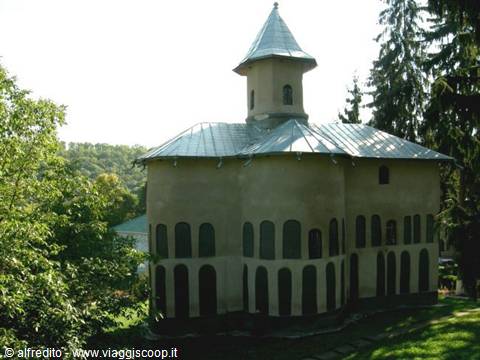
The ring-shaped fortress is called by the people “the plate of the Turk„, located in the valley of the Nistru, it was built at the edge of a hill, at the entrance to the village of Rudi. This fortress in fact defended the area for countless centuries. “The cave of the Deceased”. Beneath the cemetery of Rudi extends a cavern with several galleries that have a total length of one kilometre. The cavern has six rooms in total and its composition is mainly limestone rock. The climate inside the cavern varies from 10°C during the winter to 15°C in summer. During the rains, the walls become wet and drops fall from the ceiling. In the cavern there are some families of invertebrates, including spiders and scorpions. “The Monastery of Rudi”. Not far from the village of Rudi is the monastery of the same name, which was erected in 1777.
Near this Monastery one can find a spring of water with miraculous properties. The church dedicated to the Holy Trinity was built according to the traditions of medieval Moldovan architecture. The dimensions of the church are rather imposing; the external decoration consists of two lines that soften the monotony of the church walls. On the floor of the church one can see the inscription Sfinta Treime (Holy Trinity) and an engraving made by anonymous craftsmen: “This temple was built during the days of the glorious prince Grigorie Alexandrovici Ghica Voda. Year 1777.” The locality of Rudi is finally known because in its surroundings passes the Struve Geodetic Arc, a site classified by UNESCO as a world heritage site
The journey's photographs
5 photographs · click to open them full screen



0 reader comments